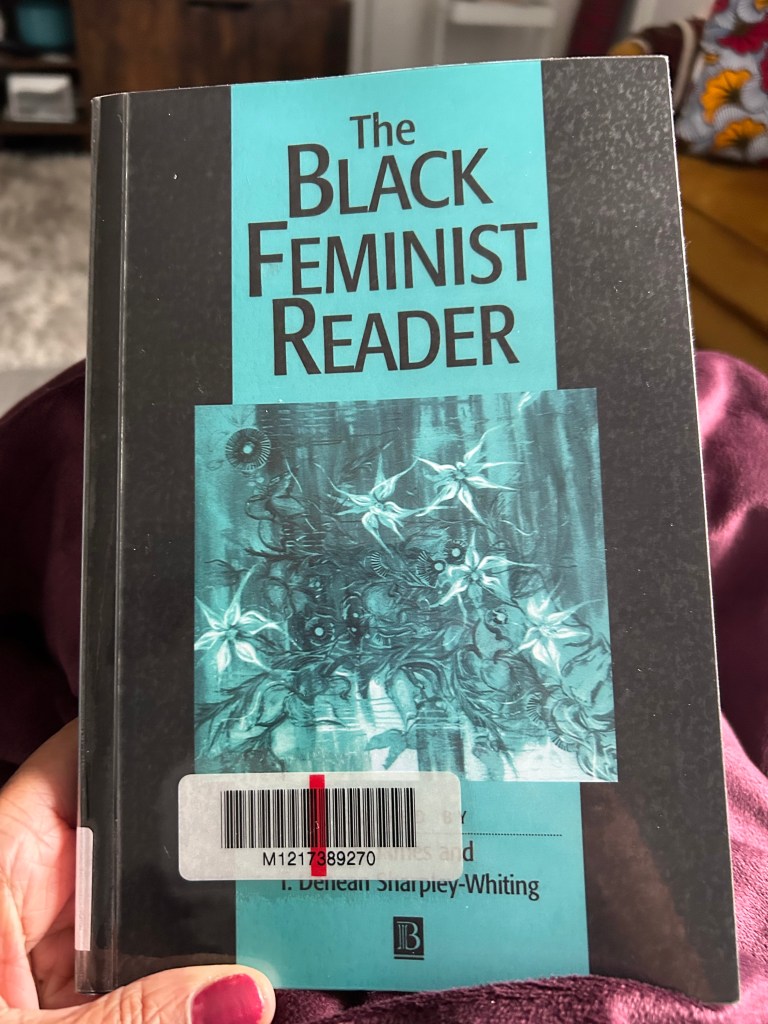
I’ve got time on my hands to read. A reading week as we used to say at Uni. Why? Well that’s another story, I’ll tell you at another time, maybe.
For now, I’m getting my teeth into something that will make me feel better, or feel as if I’m getting somewhere with my self-study/permaculture diploma design/ ways of being.
I’m reading The Black Feminist Reader edited by Joy James and T. Denean Sharpley-Whiting. And I’m heartened to read in the first essay in the collection by Barbara Christian, ‘The Race for Theory’, that along with her Black sisters, Christian has not rushed to create abstract theories around how to read Black women writers/ Black women’s literature. The argument goes that there are countless Black women around the world, women colour around the world, and one single set of ideas cannot be applied to such diversity.
As Christian goes on to argue, “There is, therefore, a caution we feel about pronouncing black feminist theory that might be seen as a decisive statement about third world women. This is not to say we are not theorizing. Certainly our literature is an indication of the ways in which our theorizing, of necessity, is based on our multiplicity of experiences.” ( p.20)
Instead of being seduced into the academy, being at the centre, desiring/ claiming what might seem like power within the hierarchy of old traditional departments of knowledge, where the Black female experience is subordinate to others, ” We can pursue ourselves as subjects”. ( p.21)
This is music to my ears as I have always found it difficult to pin down what is Black Feminist Theory. What does it entail? What are the tools of engagement? What methods should be employed to reading Black women writers?
But that’s where I’ve been going wrong, thinking about theory. As for me theory was legitimisation. Writing dies if it’s not being talking about, theorised. But now I understand that :
- Theory has been their way, their terms, their approaches ( p. 16)
- Theory has been more about how clever the theorist is than about the writing or writer
- Theory is prescriptive and it ought to have something to do with practice (p.13)
- Theory is about those masters who have long gone and not about the here and now.
And as Christian states, and I totally agree, “But what I write and how I write is done in order to save my own life. And for me I mean that literally. For me literature is a way of knowing that I am not hallucinating, that whatever I feel/ know is.”(p. 21)
So I’m following Christian in my pursuit of what Black Feminism(s) is by having no fixed method of enquiry or even results. My method relates to what I read and the historical context of the writers I read and “to the many critical activities in which I am engaged, which may or not involve writing.” ( p.22)
So there is no set method within Black Feminist Theory and is influenced by practice, no prerequisite of a new theory as every work suggests a new approach, forcing me to think differently.
“As risky as that might seem, it is, I believe, what intelligent means – a tuned sensitivity to that which is alive and therefore cannot be known until it is known.”( p. 22)
 Living Wild Studios