Capitalism Fatigue

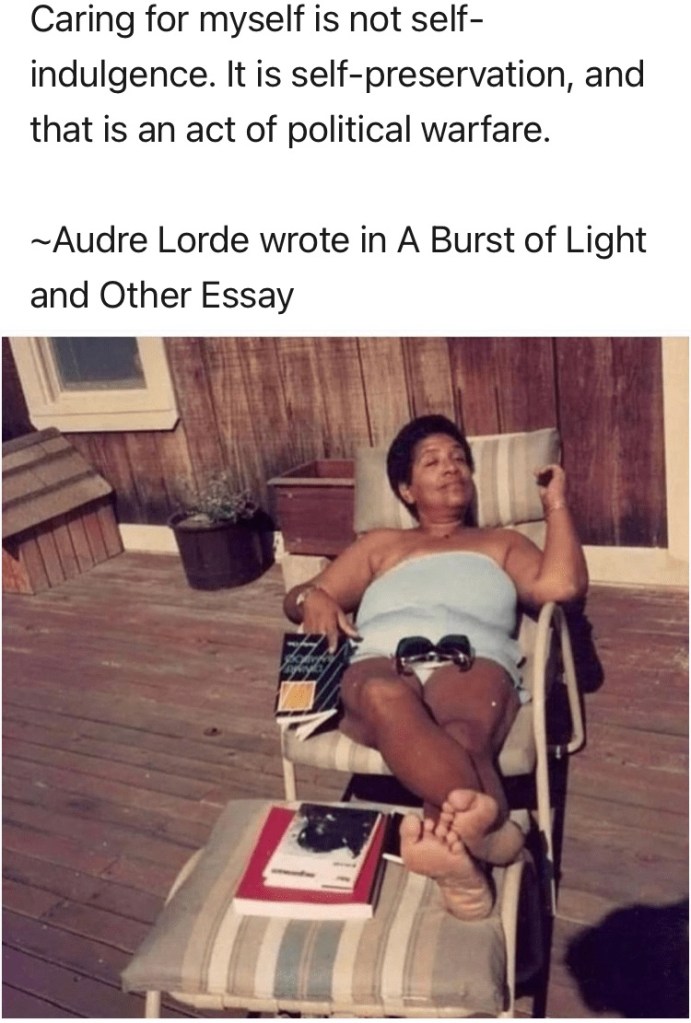
No amount of pampering can cure or stop that slow soul death I experienced being part of the system. Being a secondary English teachers within capitalism.

I was indoctrinated early to believe my worth was equal to how hard I worked. Even with a young son, I world get up early drop him off at nursery early to get into school extra early and be unpaid. I would work the full school day and stay late and be unpaid. And not complain. To then pick up my son late and spend very little time with him before bed and then I would work late into the night, marking and creating schemes of work and again all unpaid. And then repeat it all again for days, weeks, months and years.

“This is a Eurocentric, deeply white supremacist way of thinking and it is straight and ableist. It does not consider someone’s mental, physical, and emotional capabilities. … It does not consider offering space to dream, create, or simply partake in a longer lunch or even a nap.” Jennifer Mullan, Decolonizing Therapy.

I would do extra work, take on extra responsibilities, make sure I was seen being the ‘good’ teacher and look how good I am at handling pressure because I believed this is how I could prove that I was enough, I was good enough.

And there wasn’t just those internal pressures but there was also that external pressure that would flatter and coax and demand and make me feel that I wasn’t doing enough or that I was needed even more and only I could solve this problem or issue or be the one to stay late and sort it out.

I couldn’t rest and I shouldn’t rest and if I was feeling burnt out it was my fault. I should learn to manage my time better, eat better, do less and take care of myself. But how can you do that within a system which doesn’t allow it? That just keeps on rolling and takes you along with it through desire or force? I couldn’t afford to work less, to drop responsibilities as I needed the money to keep the roof over our heads, food on the table and clothes on our backs. Earning just enough to live from one pay check to the next. I felt trapped. I was trapped. Until I broke.

I got sick. Took time off. And stepped away. Self-care wasn’t the cure for burnout but it helped for a time as it gave me the time and space and clarity to realise that I wasn’t the problem. My burnout and breakdown wasn’t my fault. The problem was deeper than me. The root of the problem was the school, the education system, the businesses, the organisations, the media, the policies, the rules and expectations that kept me working to exhaustion, stressing about not doing enough, tired and struggling and giving more of my time and energy and heart to strangers than my own son.

“You cannot self-care or self-love your way out of systematic oppression.” Jennifer Mullan, Decolonizing Therapy.

I agree, however, I would argue that leaning more into self-care with slowing down and rest and learning to love myself through my reconnection with nature, did and continues to do so, provide the space and time and energy to question my conditioning, to agitate the ways things have always been done within capitalism, colonialism and patriarchy, to recognise the dehumanising, extractive and exploitative systems that are fixing to kill us and attempt to do something to stop it.

I continue on this path of decolonisation by starting with myself.

MICRO AGGRESSIONS

This is a series of poems that can be read in full here.

Abdul Ali

#9

On the day of your interview a full itinerary is prepared. Jokingly, you wonder

 if you should have requested potty breaks. Never has your day been this structured. 

About six or seven hours of back-to-back meetings. During lunch you meet the only 

Black faculty member in English, who is leaving. You don’t think anything 

of it except that the coincidence is more than ironic. You try to make small talk. 

You want to gauge if there is any coded language from the “sista”  

that says Get OutDo not succumb to this Sunken Place. Instead, 

you get an unexpected quiz during lunch from the Black faculty member. 

“How will you as a Black man teach these privileged kids

how to read Black literature as universal?” Before you can respond, she cuts you off

It’s a blessing

Day 3 of GloPoWriMo and I promise the last one from Lucile Clifton ( for now!).

And this poem, I just love the tone, the softness which for me mirrors the moving of the boats out with the tide into the deep waters.

The smooth cruise of wood on water is a the sight to behold. But there is love here and a turning away from fear and a floating off into the future with hope.

This is not about boats this is a blessing, a wish on how to live our lives. And I totally buy into it with an open heart.

To keep that innocence, to keep that hope within our hearts against the odds, against our day to day struggles is a gift. Is a blessing.

my kissmaking hand

I’m sticking with Lucille Clifton today for day 2 of GloPoWriMo because I don’t think I read enough of her. I don’t think anyone can read enough of Lucille Clifton.

I came to her writing late and I’m not going to beat myself up to catch up. I’m going to savour every poem I read of Clifton’s as I don’t believe her poetry, her words should be rushed.

Clifton’s words have the ability to live in the bones of a person and that’s where I want them to lodge and not let go.

So today I share ‘cutting greens’ because of this poem’s ‘kissmaking’ – nature and humans as one.