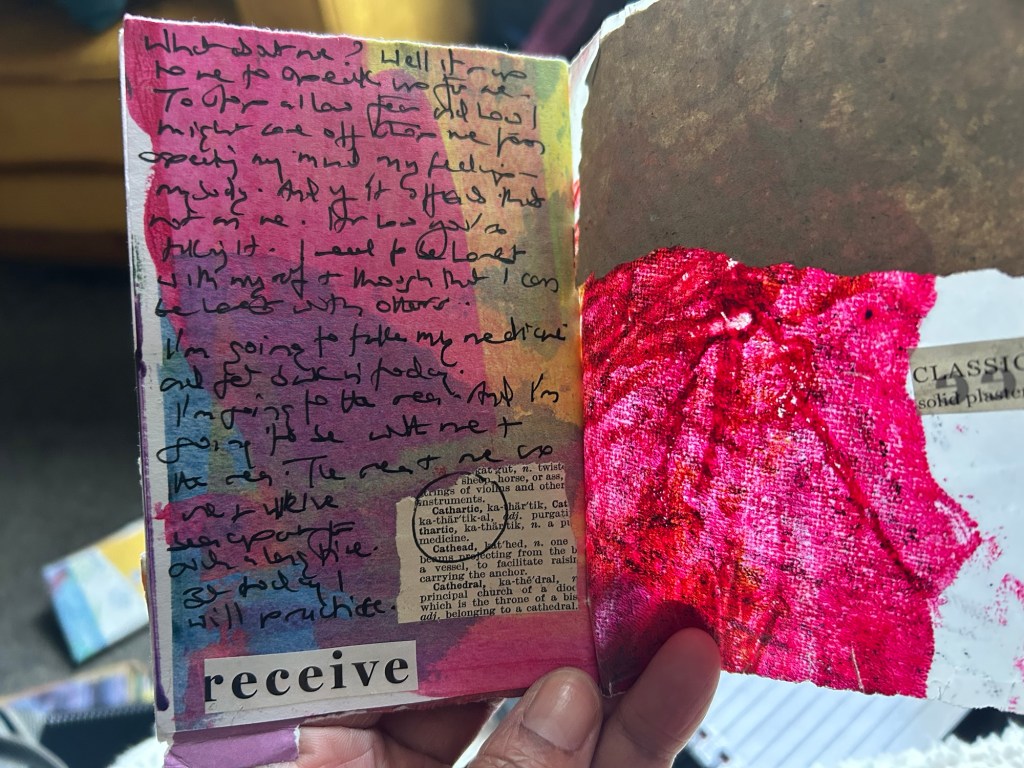
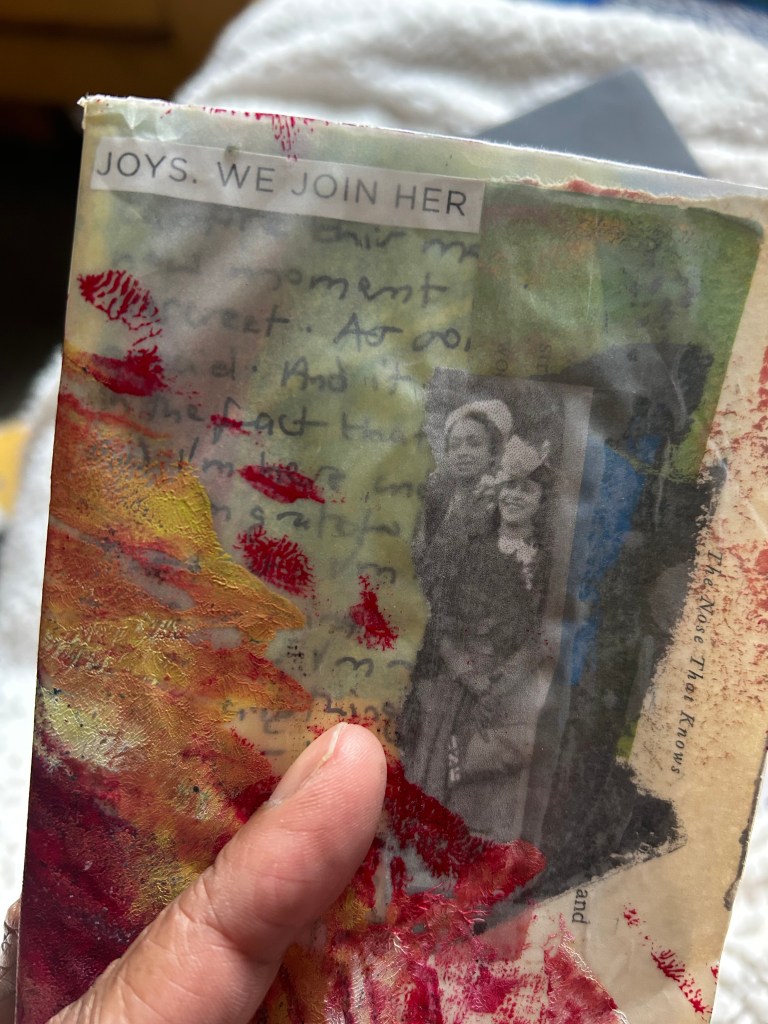
I’ve been coming later and later to my creative sketchbook practice this month.
It’s day 123. 123 days since I started this practice of play within my creative sketchbook. Daily.
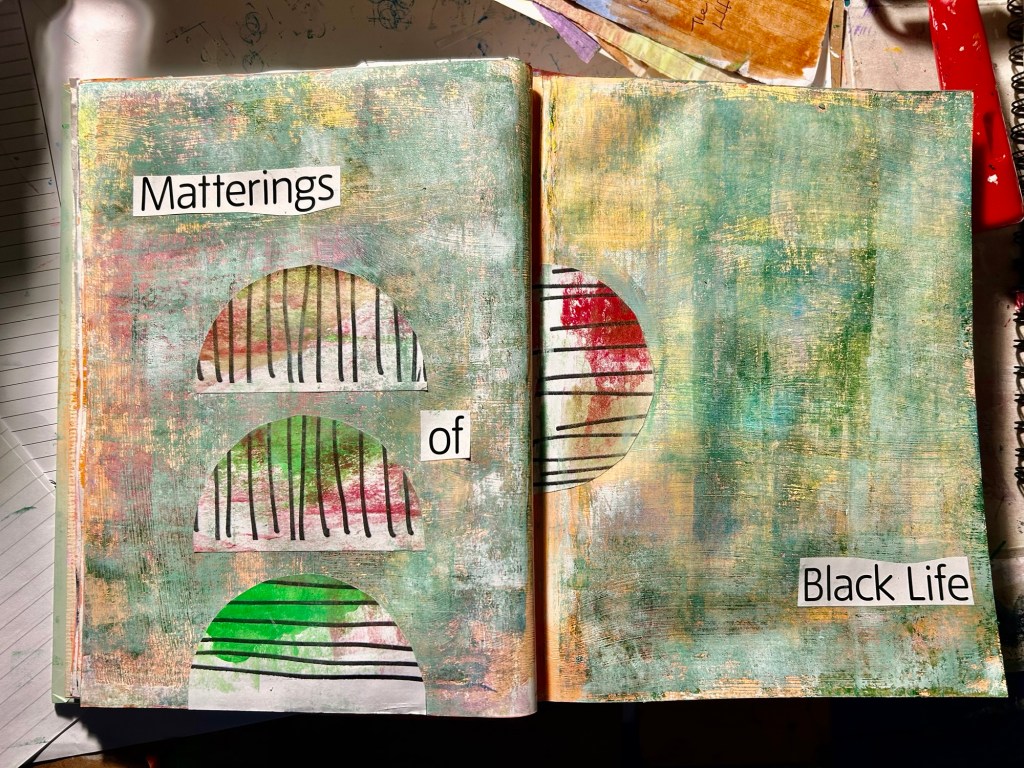
This piece tonight is significant because it chimes with my word of the year/ focus of the year being AFROSURREAL.
The right now. Capturing the now.
AFROSURREAL has been bubbling below the surface all year so far. I’m thinking it’s about time to share my musings and thinkings here in a mini series of posts.
Everything is overlapping and I’m fixing to gain some clarity knowing fine well that the practice of writing it out will only throw up more questions than answers.
The Matterings of (ordinary) Black Life is the practice. The push back against the colonial, historical categorisation of black people as subhuman. As stereotype as no life beyond the construct.
Right now. Black life. Black aliveness.
I’m living a/my reality which isn’t acknowledged or if is then it’s challenged/ denied/ erased.
It’s important to storytell, mythmake, historicise and archive within these liminal spaces. Centre the margins where these matterings happen.
Through the reconstruction and recalibration, healing and reparative processes challenge the exclusions and colonial impulses to conquer, control and exploit.
Expect to read more around AFROSURREAL and the overlaps with my other obsessions as through my research and readings and writings, I attempt to come to some understanding of myself and my creativity, moving backward and forwards between the now and beyond.
Describe one positive change you have made in your life.
It’s a luxury I know. It’s probably frowned upon. It’s probably not seen as productive within white supremacy culture. It’s probably classed as dangerous. I know it’s where the best insights happen.
In the morning. In my bed. In a book (non-fiction at that).
As I mentioned yesterday, I’ve taken to my bed. Well really, I don’t leave my bed, in the morning, until I’ve had a thorough lazy read. A slow imaginative wandering through my current squeeze of a book.
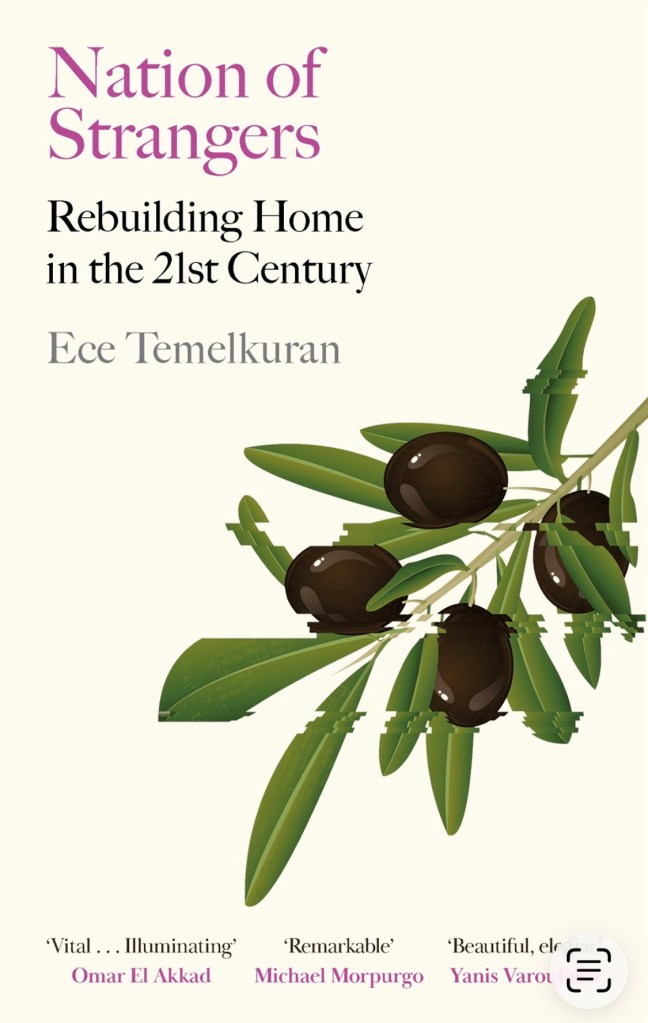
A Nation of Strangers by Ece Temelkuran, an exiled Turkish author who is unhomed but can see how we’re all becoming unhomed , one way or another, due to the rise of fascism.
Climate refugees, political dissenters, people seeking asylum from persecution, may be where our minds go when we think of the homeless. And yet, within these times of far right practices, war and genocide, the silent majority may still be in their homes but feel no longer at home.
Home is no longer what we knew it to be. Home is no longer safe and stable. Home is terror and fear. Home becomes strange. We become strangers and unhomed.
Some of us have never felt at home even when we have made our homes here in the UK as the message has always been we’re not welcome here. We do not belong here. Even if born here.
We search for a language to talk, to share our feelings and experiences of being a stranger within our own lands. It’s a practice.
I continue to practice reclaiming my mornings. Reclaiming the slow rise, reclaiming the time and space to read at leisure. Finding some refuge, some peace within a cocoon of sheets and pillows. Warm and cosy and safe for now.
“When Brian asks me about the word exile as we sit in front of the audience, the words come out of me as if a film ribbon were spooling off its reel. ‘Let me list why this exile thing is no longer plausible and, in fact, already a stale joke. One: Exile is not as sexy as it has been, despite what some still want to assume. I know Westerners still like to think of Europe as the safe haven for the oppressed intellectuals of the Global South, but that is giving too much credit to Europa when thousands are pushed back into the sea to die. Putting the spotlight on “the exile” to divert from “the refugee” operates as a crisis management tool, if not a branding strategy for Europe’s self-image. The Europeans’ need to believe that the continent is still a civilised haven is as critical as the refugees’ need for safety. Two: Exile is a title of nobility that generates undeserved attention. The undocumented refugees, the precarious majority of the unhomed, don’t even get a chance to relay their name so it can be put on their tombstone, whereas an exile is asked too often. Alas, many of us accept the invitation to go on and on about ourselves. We are the boring windbag aristocrats of the greater society of the unhomed. Three: The title exile gives you only two chances in life – you are either kept hostage by your personal melodrama or enslaved by the constant urge to reject your tragedy. Life cannot be diminished into such an unending test of dignity, and it certainly cannot be confined to the limits of the self. Four: If one accepts the title exile, one can never arrive home. But the fifth and the most important reason is …’ For a split second, I catch a glimpse of the listening faces. They are mostly activists, people who are already at work to build a new world, a new home. And it is hard to put your finger on it, but when you know, you know – they are with me, we are in sync. Also, now that ‘the most important’ has already escaped my mouth, I am at that delicious moment of no return. I gear up. “Yes, the most important reason is that you are no different than me. Do you, I mean, let’s be honest here, do you really think you are more at home than me? Of course not. Otherwise, why would you, as beautiful human beings of the earth, be trying to change the world and talk about building communities all the time? Why would you imagine shelters from, rather than movements against the new fascism building around the globe? Don’t you think there is already a sense of defeat there? Aren’t you already admitting that the world is not your home anymore but a hideous jungle from which you need to seek shelter? Yes, we are many in our discontent, but still, we cannot make enough of a majority; we cannot shape the political reality into a new home. We are not powerful enough to make this world our home again, not yet. From where I sit, you are no less homeless than me. Or, if you like the word better, we are all exiles already. Misfits, outcasts, the displaced and the disowned. We are the strangers of the world”
With the light returning and it still being the Easter break, I’ve been waking up early without anywhere to rush to, anything urgent to do.
So I laze in bed reading. Body resting, mind and heart racing. I’m not reading what used to be my usual fodder; romance or crime fiction. I can no longer stomach the charade they are, have always been. They are all part of the system of mind numbing compliance and distraction. If not sending the message that you’re nothing of worth unless you are attached to someone else or just glorifying violence towards and death of women, usually.
So I’m taking my time to rise each morning, as I stay in bed reading about refusal, about how to get free.
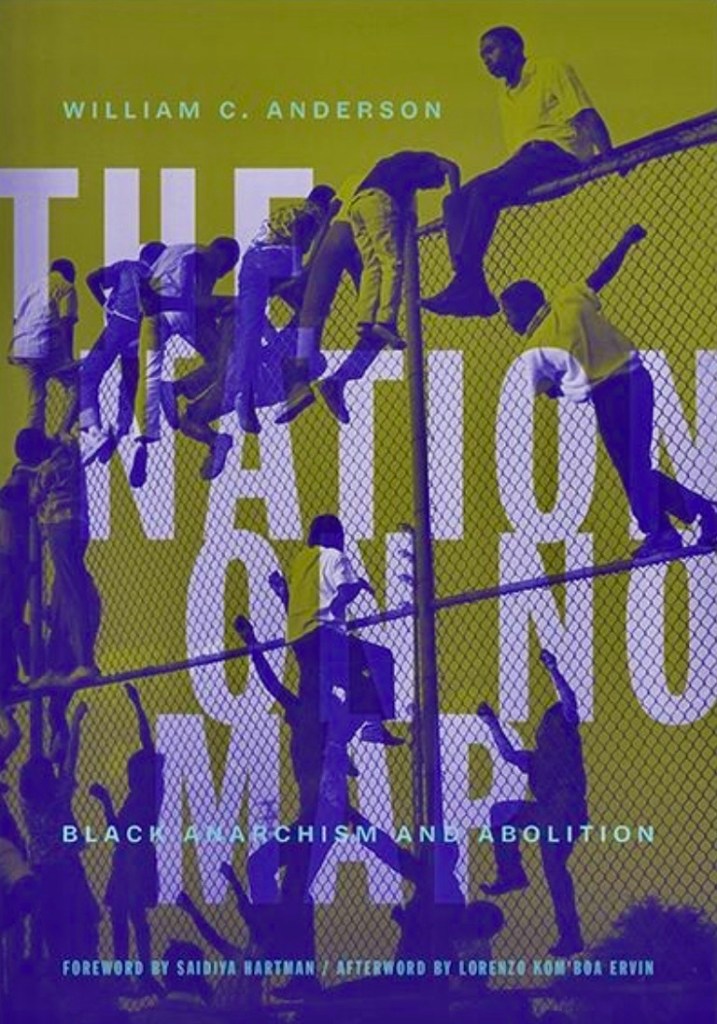
Just finished The Nation On No Map by William C Anderson about Black Anarchism and Abolition. A quick yet profound read which makes a lot of sense to me and provides further tools for my arsenal.
“From the nonevent of emancipation to the afterlife of slavery, Black America has been required to consistently think outside of the state because the state has consistently been our oppressor.” Statelessness, as Anderson explains, “is more than a lack of citizenship: it renders you nonexistent, a shadow. So why not embrace the darkness we’re in, the darkness we are, and organize through it and with it?”
William C. Anderson
Why continue to buy into the state, into government and their rules and laws when black people have never been recognised as citizens, or human? Echoes of Fugitive Feminism here too.
What might be possible when our freedom dreams are not tethered to old forms?
I applied to Arts Council England for a Developing Your Creative Practice grant mid 2025. It was unsuccessful.
Undeterred, I resubmitted it under the project grant scheme. I was notified of being successful just before Christmas 2025.
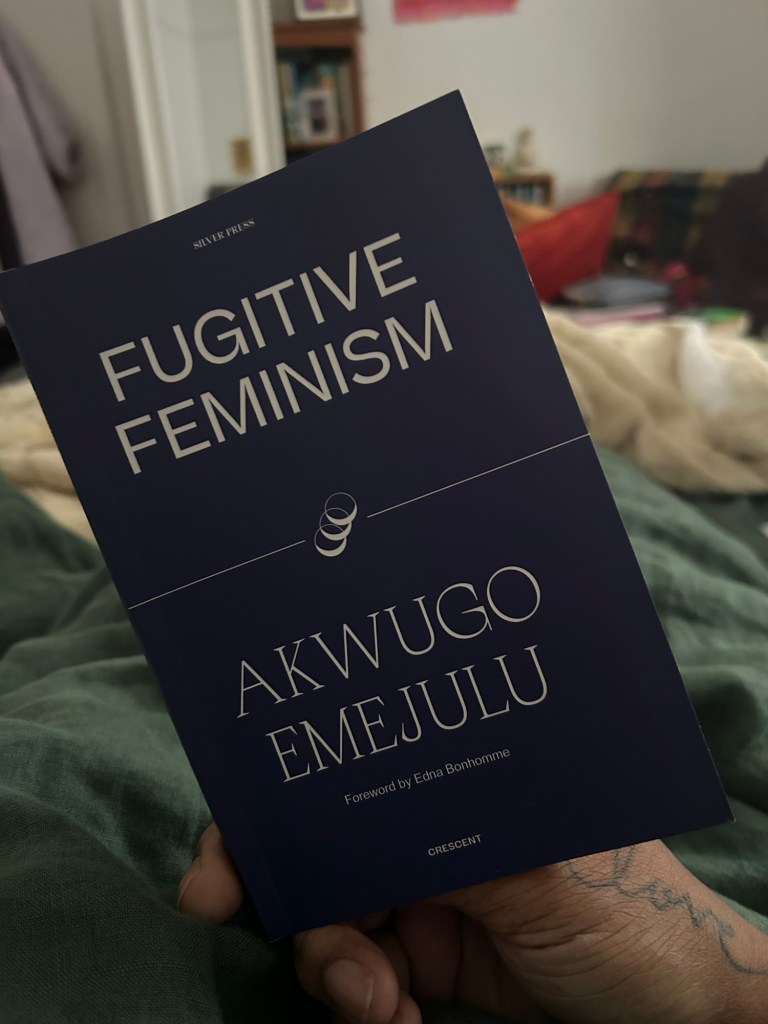
Practicing Creative Fugitivity is its name, and it involves researching fugitive practice. It also involves reading in community Fugitive Feminism by Akwugo Emejulu.
A study circle of women of the global majority.
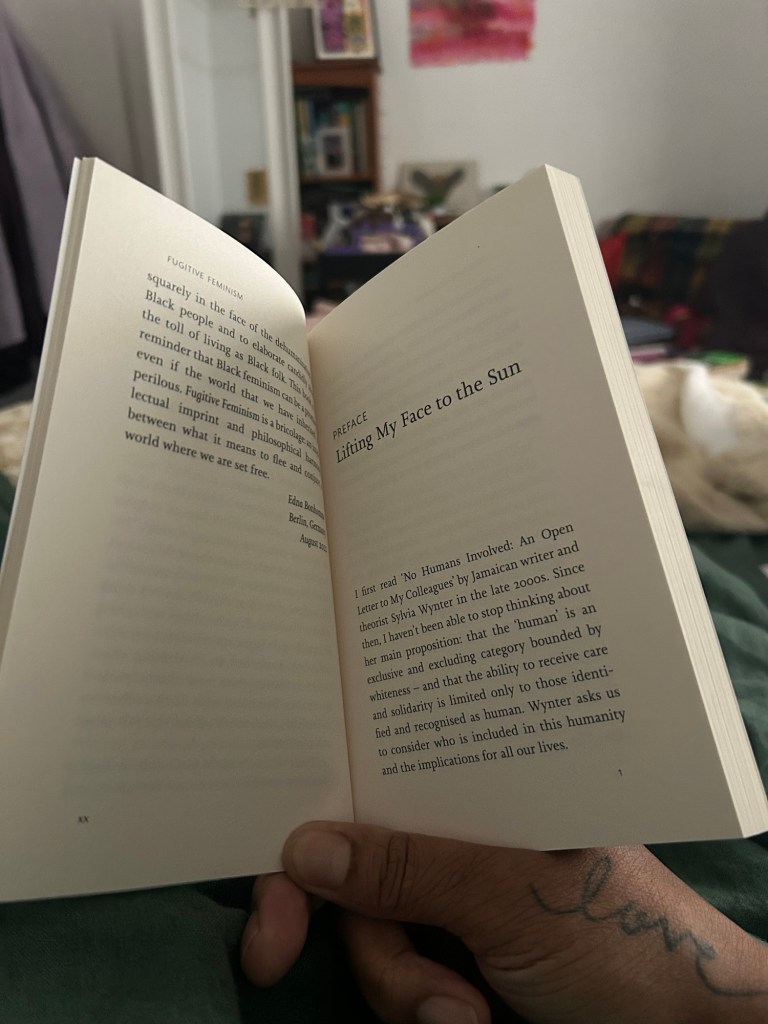
When did you first learn that you were a non-human?
The question that opens the first chapter of the text Fugitive Feminism.
A question that hits me in my gut with its open, blatant honesty and curiosity.
A question which niggles at a truth that I’ve not wanted to face up to as it would mean that I’ve spent a lifetime trying to demonstrate, prove, live up to an unattainable category of being human.
Human as a category was never created to include someone like me within it.
Human = Whiteness
Human v Non-Human
You can’t have the light without the dark.
All constructs to create hierarchies. A hierarchy where white, EuroAmerican, able bodied, middle class, cis-gendered, college educated and suburban men reign supreme. Superior.
Conceptual Other. No Humans Involved. The Lack of the Human.
Black women. Outside. Out Outside.
Our exclusion determines the borders/ boundaries of the human.
But consider this …
If Black women were free, it would mean that everyone else would have to be free since our freedom would necessitate the destruction of all systems of oppression.
Combahee River Collective
Where the excitement lies for me and others, is once we realise that Black women cannot be human, then with the support of this book in community, let’s consider what if ‘human’ cannot and should not be reclaimed?
Speculate. Speculation. Speculative.
How might we divest from the human?
That the non-human Other actually decentres the human. Move beyond human to something otherwise.
Something else.
Becoming ( something else).
Thinking of how to be/ how to live beyond the binary of human v non-human could produce the means of improving our community/society/our planet.
Centring the human ( v non-human/ othering all else) has got us into the shit we’re facing now in terms of ecological disaster.
Finding a way to decentre the human, divest from what this concept / construction means and how it operates has to be the way forward.
Fugitive Feminism is the doorway into another way of being. A portal into an alternative world built upon the Black Feminist politics of liberation.
The path ahead is not clear or defined. It’s slippery and ambiguous. It’s experiential and experimental. Yet full of possibilities. Caring not harmful possibilities.
Speculative. Suggestive. Spacious.
And it starts and continues with the act of refusal. Refusal of the way things are right now.
Refusal of being defined by others to fit into their definition of humanity ( whiteness).
Refusal of being extracted and exploited for the benefits of a few.
Refusal of being non-human.
Refusal of being outside of humanity.
Refusal of the whole concept of human/whiteness/ fascist.
Refusal of these limitations when i, we, i and i can be something else beyond humans.
Hello again. It’s April first. And I’m back. And after taking March off from posting here, I’m come to realise that I need this space, this digital, open notebook. This open notebook acts as a catch all space as well as a release of the pressure valve. Knowing I can come here and share anything, let off steam, muse, not even make sense or have the answers is something I’ve been taking for granted. Time away has given me a rest but also a renewed perspective and appreciation for this space, this blog, this notebook, this website. I can hang out here and be completely myself. Spaces and places like this are few and far between.
What makes this space cool also is you. You come here and read all about it. You’re part of the process. And I appreciate your eyes and hearts. Thank you for sticking with me. Thank you for being here. I’ll be honest with you though, from the get go, I didn’t get very far with the archives of this space. I’ve hardly touched the practice as I’ve been pulled elsewhere. But I’ll let you know what I’ve been up to by ad by. For now, I’m just marking my spot, putting down a marker that I have returned and with great joy.
I’ve got so many images to share with you as well as notes about my adventures and reading and thinking and dreaming. But all in good time. I don’t want to overload the senses straight away. Let’s just ease ourselves back into position. Take a look around and see if anything needs changing. I’ll be back daily during this month.
I’ve always loved April for creativity. Both my kids are April babies. The womb, my gut is the seat of your creativity, so let’s see what comes forth this April as I dive back into poetry reading and writing. I’m feeling the urge to write and I’ve got time on the horizon. I’m excited to see what occurs.
I got out earlier than expected from my gig today. So I used the time to get to the library and pick up a book I’d spied
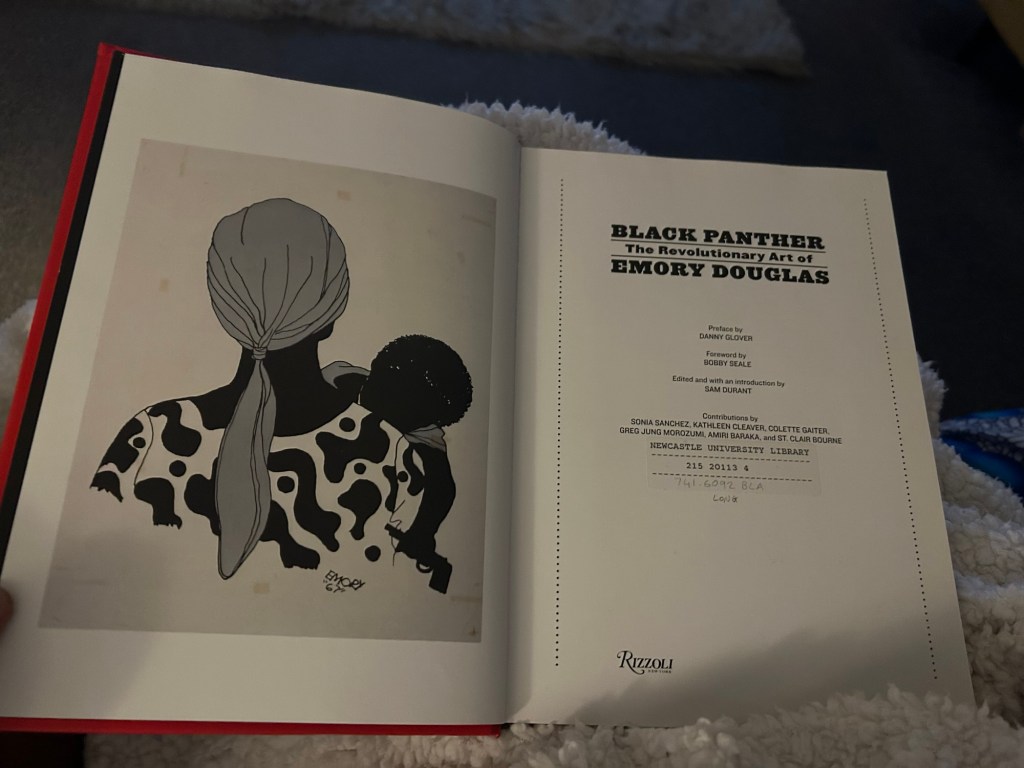
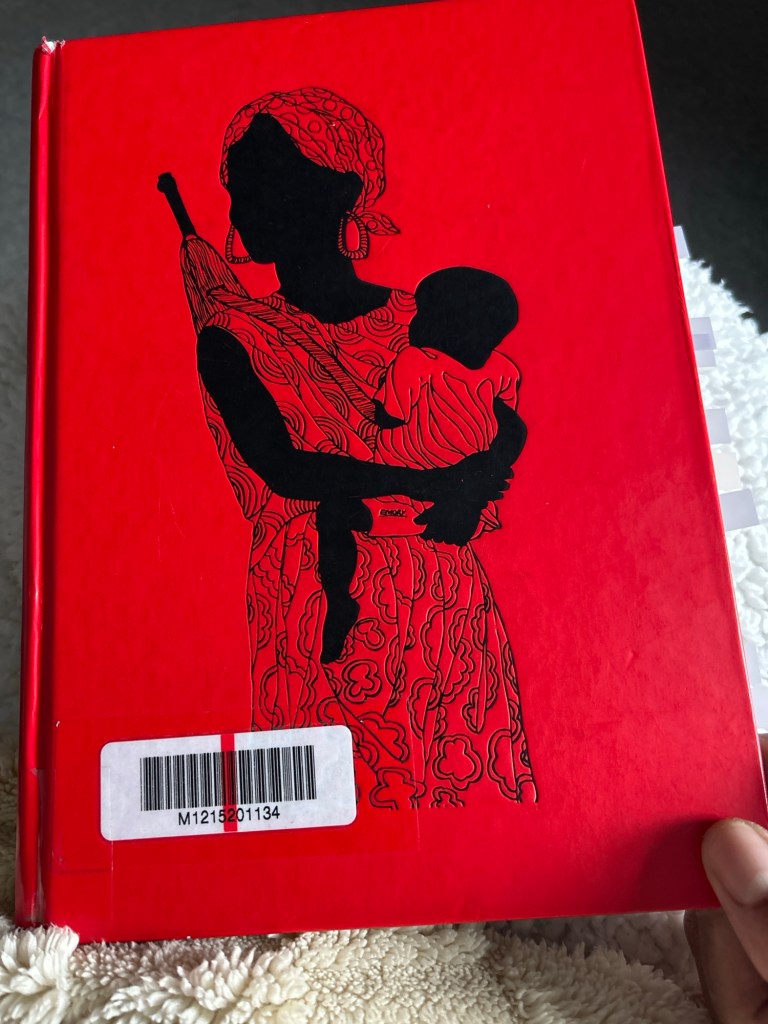
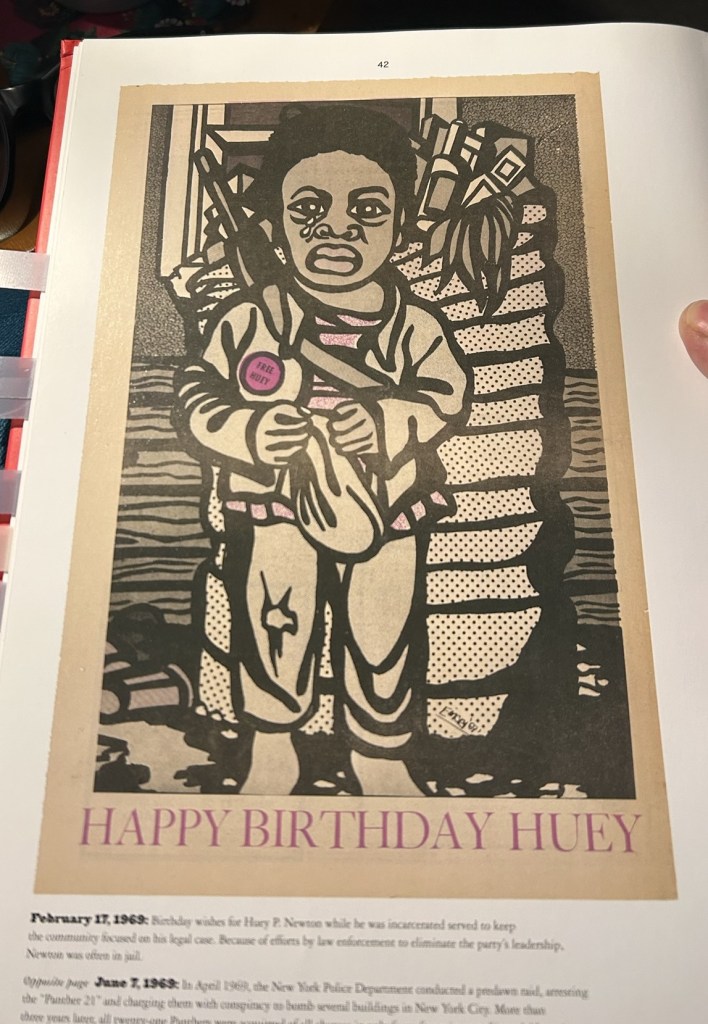
Black Panther: The Revolutionary Art of Emory Douglas.
I’ve seen the posters created by Emory Douglas as part of exhibitions such as in the Soul of the Nation: Art in the Age of Black Power (2017), but never before have I seen his extensive artwork all together.
This monograph edited and introduced by Sam Durant is a gem.
Along with my exploration of Paul Amos Kennedy Jr. last year (and continuing into this year too) and this dive into the artworks of Douglas gets me thinking that I might be feeling the need to create some social justice/ black power artworks myself.
Who knows. My interest has been caught and this book is feeding me with inspiration to the max.