I applied to Arts Council England for a Developing Your Creative Practice grant mid 2025. It was unsuccessful.
Undeterred, I resubmitted it under the project grant scheme. I was notified of being successful just before Christmas 2025.
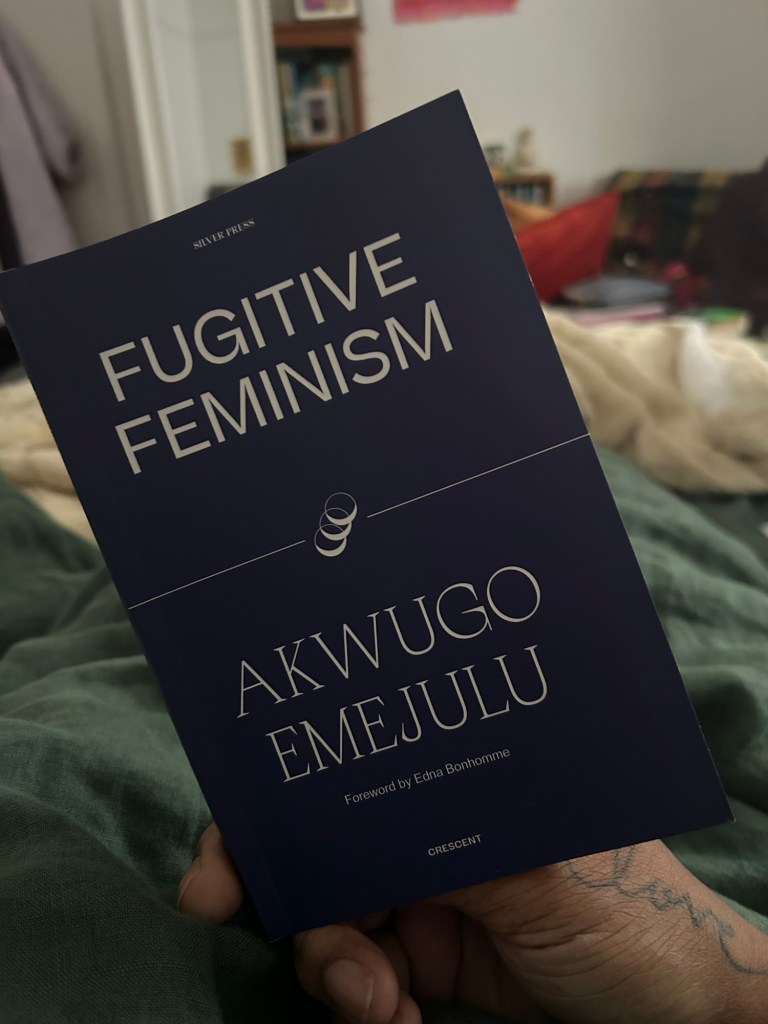
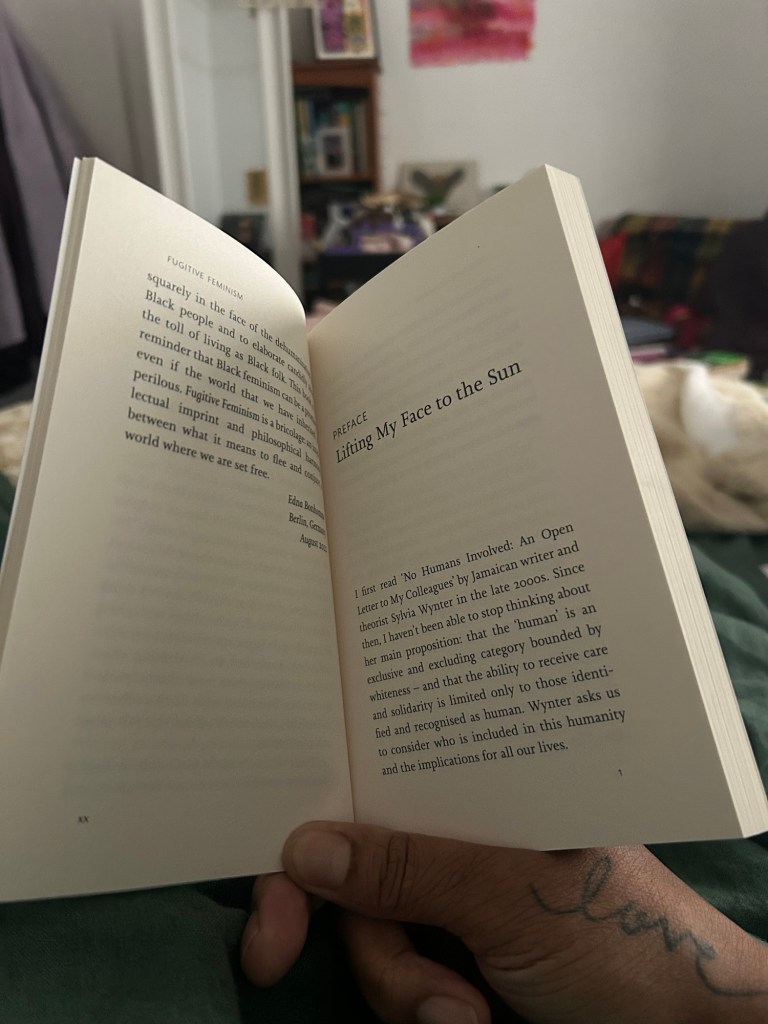
Practicing Creative Fugitivity is its name, and it involves researching fugitive practice. It also involves reading in community Fugitive Feminism by Akwugo Emejulu.
A study circle of women of the global majority.
When did you first learn that you were a non-human?
The question that opens the first chapter of the text Fugitive Feminism.
A question that hits me in my gut with its open, blatant honesty and curiosity.
A question which niggles at a truth that I’ve not wanted to face up to as it would mean that I’ve spent a lifetime trying to demonstrate, prove, live up to an unattainable category of being human.
Human as a category was never created to include someone like me within it.
Human = Whiteness
Human v Non-Human
You can’t have the light without the dark.
All constructs to create hierarchies. A hierarchy where white, EuroAmerican, able bodied, middle class, cis-gendered, college educated and suburban men reign supreme. Superior.
Conceptual Other. No Humans Involved. The Lack of the Human.
Black women. Outside. Out Outside.
Our exclusion determines the borders/ boundaries of the human.
But consider this …
If Black women were free, it would mean that everyone else would have to be free since our freedom would necessitate the destruction of all systems of oppression.
Combahee River Collective
Where the excitement lies for me and others, is once we realise that Black women cannot be human, then with the support of this book in community, let’s consider what if ‘human’ cannot and should not be reclaimed?
Speculate. Speculation. Speculative.
How might we divest from the human?
That the non-human Other actually decentres the human. Move beyond human to something otherwise.
Something else.
Becoming ( something else).
Thinking of how to be/ how to live beyond the binary of human v non-human could produce the means of improving our community/society/our planet.
Centring the human ( v non-human/ othering all else) has got us into the shit we’re facing now in terms of ecological disaster.
Finding a way to decentre the human, divest from what this concept / construction means and how it operates has to be the way forward.
Fugitive Feminism is the doorway into another way of being. A portal into an alternative world built upon the Black Feminist politics of liberation.
The path ahead is not clear or defined. It’s slippery and ambiguous. It’s experiential and experimental. Yet full of possibilities. Caring not harmful possibilities.
Speculative. Suggestive. Spacious.
And it starts and continues with the act of refusal. Refusal of the way things are right now.
Refusal of being defined by others to fit into their definition of humanity ( whiteness).
Refusal of being extracted and exploited for the benefits of a few.
Refusal of being non-human.
Refusal of being outside of humanity.
Refusal of the whole concept of human/whiteness/ fascist.
Refusal of these limitations when i, we, i and i can be something else beyond humans.
the zine that documents the zines I want to create moving forward into 2026
I’ve just been over on my Patreon page sharing about the first zine of the year. Do you want to know what I shared about it?
Okay, I’ll tell yo here too!
A few years ago, I gave myself the challenge of creating a zine a month. Check back using the ‘zine’ tags and no doubt you’ll find them, still there ready to download and peruse.
This year, I vaguely set myself this challenge again, to create a zine a month and share it here. I think. As I’m still in the process of committing. But last night, at a Zinester Sanctuary that I’m creating witha fellow fugitive, I had the time to create my first zine of the year. See the video above.
I looked back at one of my zines from my first challenge, this was a zine about the zines I wanted to create. I looked back to see if this list of zines with illustrations were still zines I wanted to create.
After this reflection, I then set forth to create the zine that hopefully is the blueprint for 2026 creations.
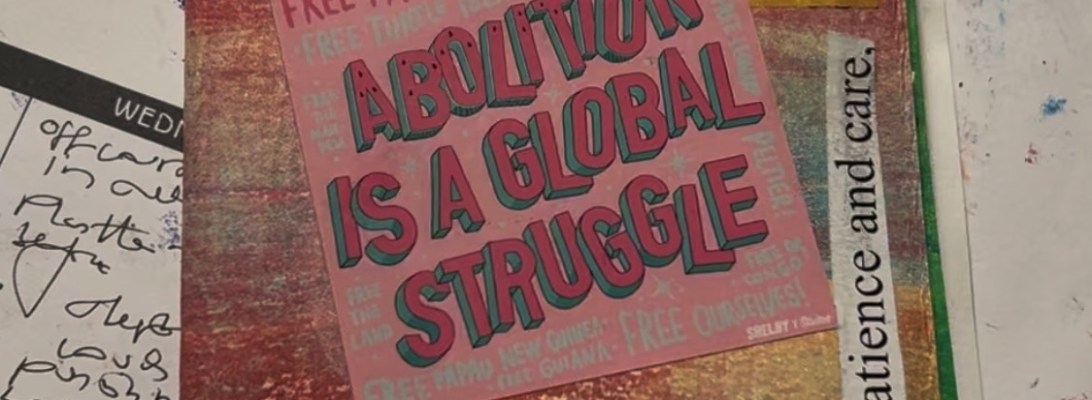
In the video what you are seeing is the front cover stating that ‘Abolition is a Global Struggle’ with FREE PALESTINE but also the caveat that this has to be completed ‘with patience and care’.
The next page with a wheel of a VW Campervan and the text ‘ like a bird flying into’, is a nod towards my love of nature and how she will always appear in my zine creating, some way or another.
The next double spread with an image of two little girls standing on the beach, myself and my estranged sister and the text reads, ‘me in all my fucked up glory’. This signifies the task of creating perzines, using the format to explore my life stories.
On the green page with a roughly drawn book in black pencil refers to my desire to dive deep into my black studies, studying blackness as fugitivity, fugitive spaces. ‘You will find comfort in blackness’ the text reads to accompany this intention.
The next page is a quote from Octavia E Butler, from Parable of the Sower which states, ‘All that you touch you change, all that you change, changes you. The only lasting truth is change.’ This was a small print I received from a printmaker friend called Theresa Easton.
The second double spread, because I hadn’t finished yet with my intentions (so who says you can’t add in another page?) is a recognition of my word of the year which is AFROSURREAL. I’ll be exploring what this means further throughout the year here and on my website.
This is partnered with a splash of purple/ mauve as the text reads, ‘ in mauve there is a quiet power.’ This is a reminder for myself to use my zines to share my poetry. My voice is my power. This was how I started making small zines, booklets before my first collection of poetry, Family Album was published. Because I was reading at all these gigs and people would come up afterwards and say where can I buy your work and I had no where to point them to. So I got creative and created these little zines , one dedicated to the poems I’d written about my daddy and one other dedicated to my mummy, and sold them for £1 each. I’d forgotten about them until I just wrote about them here now. Don’ you just love the creative process?
And then moving towards the end of this first zine of 2026, which apparently has been announced as the year of the zine – 2026, we’ll see what happens there as zines could become if not already commercialised and co-opted and become unrecognisable from their origins ( which I’ll be exploring and sharing further about here), there is a polaroid photo of myself smiling. This was taken last year at a Outdoor Citizen gathering, and these were taken to put on the wall with details about ourselves so we could be putting names to face,s be recognised within the crowds. This image is here with the title ‘fugitive sista’ as a reminder of who I {BE} but also who I {BE}coming through my continuing thoughts and praxis around fugitivity.
The final page with the outline of a goddess in black pencil and spiral within her gut/ womb and the text, ‘ Today I will praise. I will praise The Black Woman.’ Today ,tomorrow and always, I will praise the Black Woman. I support this praise with my continuing reading and practicing of Black Feminist thought and praxis. This is my foundation always.
The back cover ends with another sticker and this time it states, ‘ From the river to the sea, Palestine will be free.’ Again reminding myself that I do this work, explore my creativity and share whatever comes up within a constantly changing context of struggles, struggles for liberation, peace, justice, self-determination and love.
2026, the year of the zines. Let’s make it the year of the zines that give voice to the struggles near and far , struggles for liberation, peace, justice, self-determination and love.
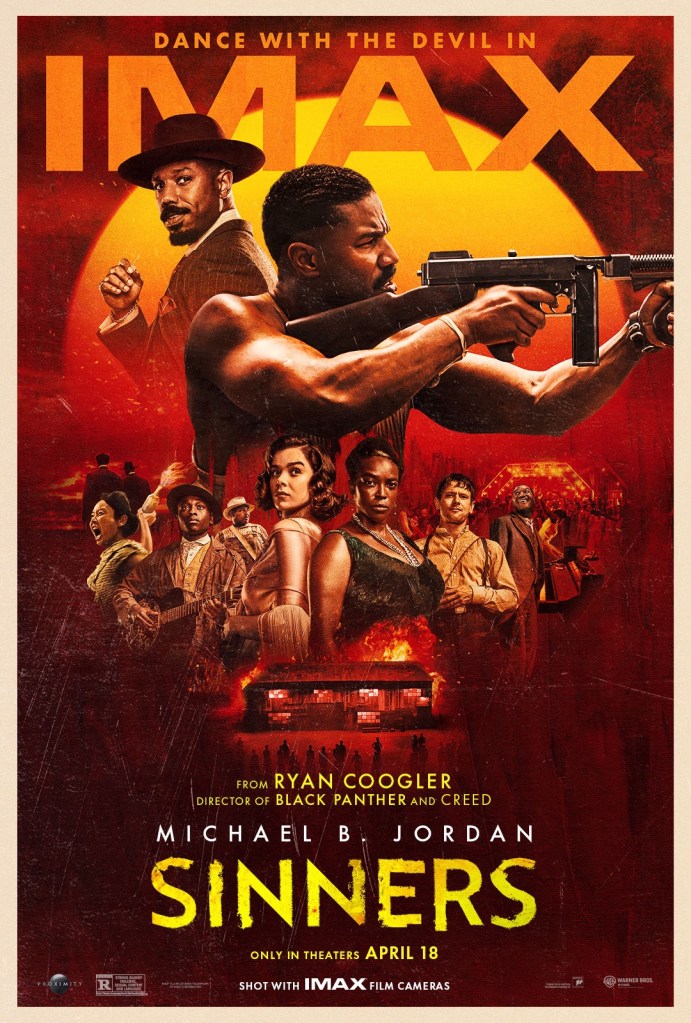
With it being awards season and all, I felt called to watch Sinners again. This might have been my fifth or sixth time. I’m sorry, I’ve lost count. It still hasn’t lost its magic. The film just keeps on giving for me. To me.
This time, I’m struck by how many times freedom is mentioned. How to get free? How to be free? How to protect that freedom?
I think Sinners explores the price of freedom. The price of being free. There’s always a cost for attempting to live life on your own terms.
From the beginning, we might be introduced to sharecroppers, working for the white men, still on plantations. But this will be a self-sustaining community. More than bodies for working on the farms, the land they do not own. But they have each other. Each character is developed at the beginning of the film. The viewer is allowed to get to know them and see them in their element. They be vibrant and they be fixing to be free. Free from the restrictions of white supremacy culture, capitalism, patriarchy the whole shebang. And this isn’t without pain but also joy and laugher and love.
Sinners is what happens when a community, when people are living their own lives and are infiltrated by others, who want what they have. Outside threats come to ruin the day. Vampires come and covet what this community has. Sammie. Sammie has a gift, the gift of music that connects him with all ages. Griot.
Delta Slim’s says, “With this here ritual, we heal our people. And we be free.” This is the power of music and how a community can tell their stories through music. And outside forces, in this case vampires, who hear, see, realise this power, are threatened by it as well as want it. Want to control it take it away from this black community who are gain strength and sustainance through it all. And be free.
Sammie’s gift, the music, the very culture needs to be/ has to be protected from these outside threats at all costs. As culture, its very existence is threatened from being sucked dry by the devils coming tonight.
So as a people, as black people, we do whatever we can do to tell our own stories, protect and preserve our music, our culture as through this we heal. And we be free.
If you’ve been watching the news this week, you’ve seen that it’s been dominated by what is happening in America. Or the actions America has taken elsewhere in the world. Flexing their muscles, going in for the strike.
In my opinion, what is happening, right now, is that white people can see the power of the state being used against people who look just like them.
This is where AfroSurrealism takes on significance – because the reality of blackness is the power of the state is always and, repeated for centuries and generations, been used against black people. Being black is a surreal experience. THEN. RIGHT NOW. ALWAYS.
The abuse of power has been turned up to the max so that no one is safe. But some people can’t see this yet. Maybe even deny it, spin a false narrative around it.
There’s a quote somewhere that I remember which goes something along the lines as, they’ll come for me in the evening, but then they’ll come for you in the morning.
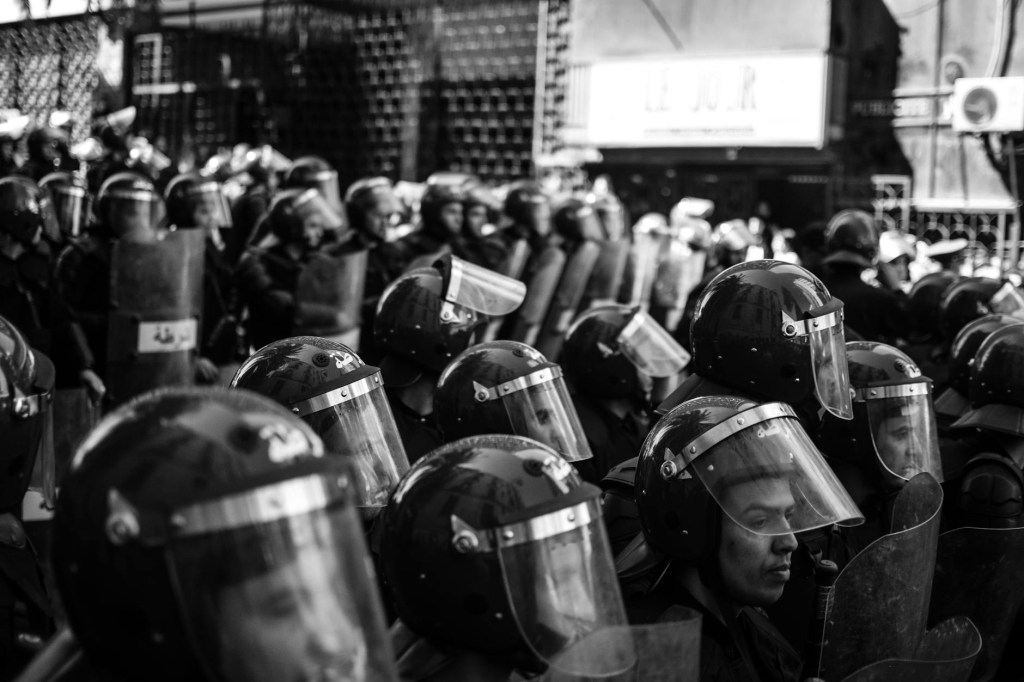
Fascism had raised its head once again. But did it ever go away for black and brown bodies? Did it not just change its mask, switched up its playbook?
There’s protests across American cities against the unlawful killing of a white woman/ mother by an ICE agent. These protesters scream out, “say her name.”
The thing is this – no disrespect or condoning of this violence or unlawful killing as it is an abuse of power and murder. I am outraged but …
I am also outraged because #SayHerName was an awareness campaign started by Kimberle Crenshaw to bring attention to the unlawful killings of black women by law enforcement that were going unreported/ not getting the same level of outrage and attention as when black men and boys are killed by law enforcement, in comparison. And this doesn’t even start into the ‘white woman syndrome.’
#SayHerName was needed to highlight and remember and get justice (?) for black women who have been killed in custody, or when calling 911 for help, or when sleeping in their beds, or for just breathing while black.
#SayHerName is needed for these unlawful killings of black women not for the white woman killed in Minneapolis on Wednesday because everybody knows her name and everybody is saying her name.
What happened in Minneapolis was wrong and the Trump administration is lying about it and blaming the victim. This is an abuse of power and is being played out, as the images of the bloodied seat and the bullet hole in the windshield, as a threat.
You get in the way of us, protest our regime then this is what happens to you, is the message. They rule with fear, threats and intimidation. The ICE agent is immune from prosecution because he was just doing his job. His job for the state. Above the law. Lawlessness is the state. This is the only way to get the mass of population behind a fascist society. Fear, threats and intimidation.
Check the historical playbook.
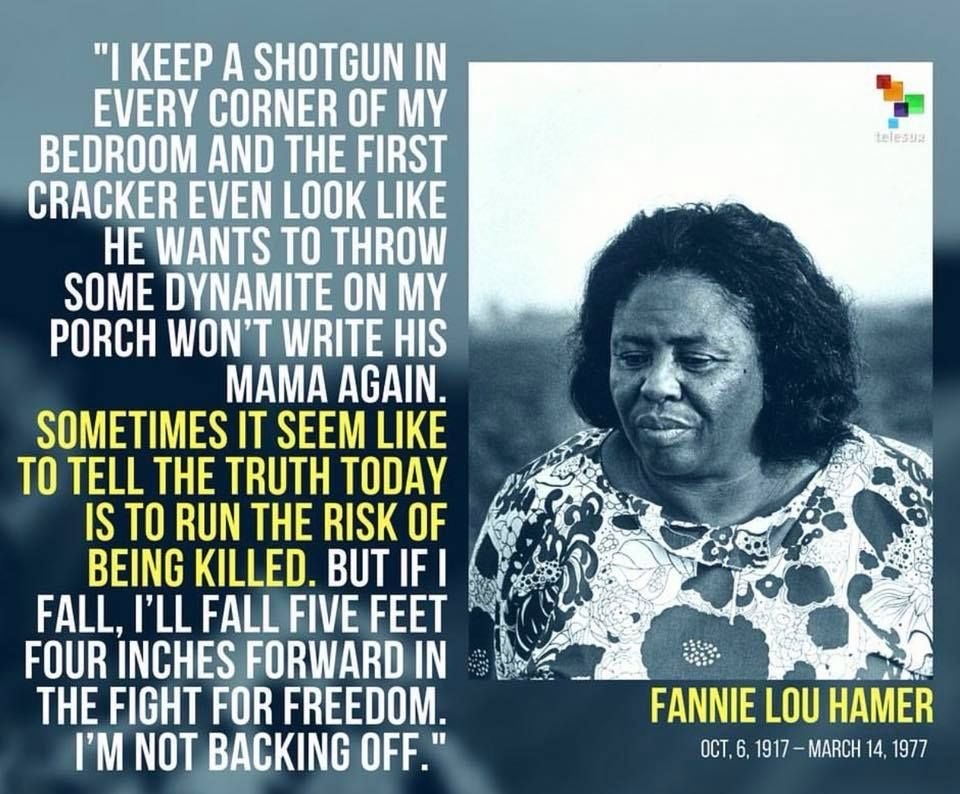
The reality though, the truth that has to be stated otherwise I’d be silenced through fear and intimidation, is that #SayHerNane centred black women, centred blackness. But using it here in this instance for the murder of a white woman, this is just another thing that is whitewashed and co-opted by white people.
I’m thinking this and berating myself for thinking this. Condemning myself for seeing this play out in reality. I had to go online and check myself. Check that I’m not being unreasonable, or hateful or wrong. But I’m not alone in seeing this reality.
This truth.
( And do you also notice how much and often I’m couching my opinion in diplomatic ways, highlighting my intentions not to cause harm. Obviously needed as far too often people choose to see only part of the argument. Take issue with what isn’t the real issue as a means of not listening and not addressing the real issue! Kill the messenger and all that!)
I also have to ask ( myself, anybody else) if the woman who was killed by ICE was black or brown would there be such media attention, protests, calls for justice? Would her unlawful killing/ murder be used as a touchstone, as a moment that changes American history moving forward? Or would that be another case of #SayHerName?
I say this not to distract from the horrendous crime that has been committed by the state against a white woman. I say this because it’s all part of the same system that has been operating for centuries and it is just now, in this moment, that more people, white people are seeing that this shit is killing them too. It has been all along but just slower than black people (Fred Moten).
These are strange times (white) people are arguing. Democracy is being eroded. Violence is no longer buried and concealed. Violence is (now) at their (white) doors.
AfroSurreal. This has always been the reality of blackness. The violence. The absurdity of it all. No rhyme or reason except profits and power.
Now white people are waking up to seeing on their feeds people who look like them being murdered by the state. Unlawfully murdered by the state for demanding justice and fairness.
It’s awful that some (white) people are just starting to experience the dangers of oppression right now.
This is nothing new for / to black people. And saying this isn’t to wish ill will on anyone else or to take glee or satisfaction in violence inflicted on anybody.
This is one of my favourite images from my extensive collection.
I know exactly when and where it was taken. Westfjords Residency, Iceland, Feb/March 2017.
This was my go to breakfast. Coffee, cornflakes and Skyr, Icelandic protein enriched yogurt. I love the colours, the composition. The items included. But most of all, I love the memories and feelings just looking at this image evokes.
It takes me back to that time of wonder and discovery during my second time to Iceland. A residency I gifted to myself, writing the application while teaching temporally; frustrated, longing to get out and create.
I stayed for two weeks in the shadows of the mountains, knee deep in snow most days until the thaw came with some greening of the landscape.
I didn’t know what the fuck I was doing there back then. I just knew in my body that I needed to get away, gain inspiration from the landscape and {BE}.
I might not have completed much when I was out there, but I know when I returned the experience shifted my creativity and how I saw myself as a creative.
I saw glimmers of the Northern Lights during this retreat. Pale creamy wisps and trails in a dark navy sky. It was magical and a mystery.
This makes me think about my art-making practice and how most of the time I’m working in the dark, moving out of my comfort zone into the unknown, looking and listening hoping to catch a glimpses of magic and mystery in the process.
What’s created on the page, like this photography, is an archive, a record which when looked upon brings to the surface all the memories and feelings of the process, the experience once again experienced to the full with wonder and a smile.
If you’ve been around here for a few years then you’ll know that I choose a word each year to act as a guiding source for the year ahead.
I hold this word lightly as a beacon to support my movement through the year as I navigate through society, this world, with the ebb and flow of commitments, responsibilities, projects and inspirations.
Last year, fugitivity took hold of me and kept me refusing those things that have already been refused of me throughout the year.
Fugitivity and visual journaling went hand in hand in 2025 to the point that I was able to create a loophole of retreat, a space of freedom and play for most of 2025. No doubt fugitivity is changing my life and remains in my rucksack as I traverse into 2026. The year of the horse ( more on that later).
So what is my word of 2026?
Usually I have something chosen at the back end of Oct moving into November. It just comes to me, lands and takes up root as something that just feels right. And something I want to carry for a year or more and explore.
That didn’t happen this year.
I had the feeling of being ‘unapologetic’ to the max but that felt, as a word, so dated. I feel it has been co-opted by mainstream and capitalist culture that to hear it now feel so twee for me. It’s original radical power being neutered.
Then we had radicale ( with an ‘e’) meaning to get to the basic root of something. Its natural origin. It’s fundamental and essential, changing from the roots. As well as radical being judged as unconventional, pushing things to the limits.
But again this word didn’t sit well within my gut. I wasn’t feeling it.
For me my word of the year has to be embrewed with feelings as well as be able to stand the test of time, the year and beyond, as well as act as talisman, inspiration and haven. Words of the past has included voice, water, shakti, open, listen, love etc.
I have a tall ask for my word of the year but none of my words of the year so far has let me down. I suppose it’s a difficult act to follow after fugitivity as this practice has changed my life in so many ways.
But choose a word of the year I will because after so long in this practice, I would feel naked walking into 2026 without some word(s) at my back as support and/both motivator.
I’m making the commitment here now to go with – AfroSurreal – as my words of 2026.
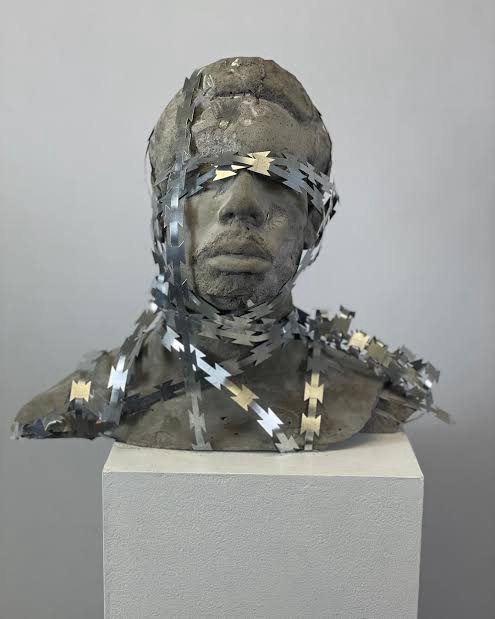
Of course AfroSurreal is much more than a word it’s a whole artist and literary movement which blends the weird and absurd with the reality of blackness. That the reality of blackness, being black today is surreal.
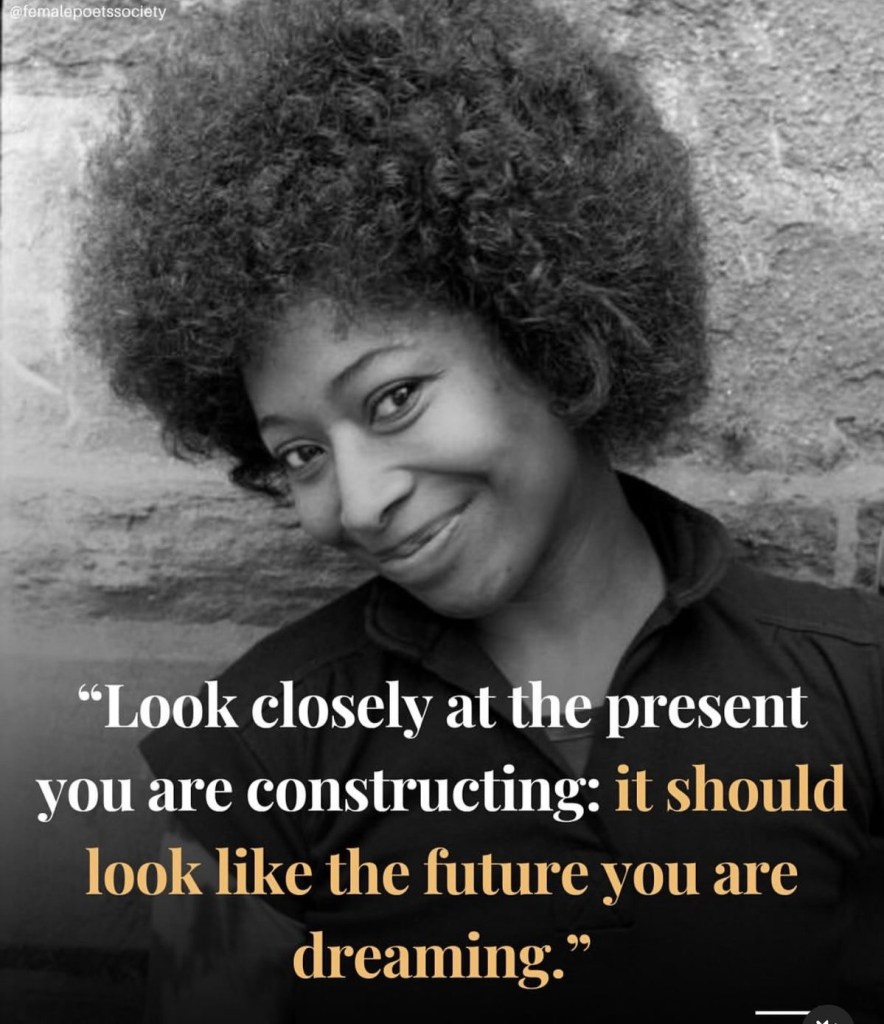
AfroSurreal is also a way of {BEING} that roots me further into the RIGHT NOW. Creating the future that has to happen right now.
I’ll be exploring more and sharing about AfroSurreal over the next couple of days to get my basis understanding and direction down. And then look out for more posts about how I’m moving and shaking with AfroSurreal(ism) for the coming year.
I’m excited to see where this word will take me. A good sign if any that I’m chosen the right word ( movement) for 2026.
i’ve been spending the last week or so really diving deep into what my word for 2026 will be.
2025 was all about fugitivity, dreaming and conjuring. And this will continue into 2026. But i need some direction. Something that will encompass my purpose with room enough to expand and explore.
i learnt a few lessons in 2025 in adopting a persona/ a mask in order to protect myself / to create some safe space for myself so ‘ i may not see myself as others see me.’ Invisible Man, Ralph Ellison
i’m fixing to create ( or is it continuing to create?) new narratives around blackness in order to expunge the past dominant narratives we’ve been fed around blackness up until NOW.
i think i’ve found my word for 2026 – AFROSURREAL.


 Living Wild Studios