I’ll tell you the truth, I heard about Keith Porter Jr. 1 day ago.
Keith Porter Jr., a 43 year old father of two girls. He loves fishing and spending time with his family. Laughing.
Keith fundraised for battered women’s shelters, supported street artists, advocated for health services. With real family and friends, real daughters and a real presence in his community, Keith Porter Jr. is no longer with us.
Rest in Power Keith.
On New Year’s Eve, in Northridge, Los Angeles, Keith was seeing in the new year with family and friends in his neighbourhood. Tradition was to fire a gun into the air in celebration.
An off duty ICE agent, heard the shots, and inserted himself into the situation. A situation he shouldn’t have been in as an ICE agent is supposedly trained in compliance, transportation, custody paperwork. Immigration.
ICE is not designed or trained in community engagement responses. community law enforcement.
It is argued that after a short verbal exchange, the ICE agent shot and killed Keith.
Official reports from federal agencies say the ICE agent was responding to an ‘active shooter situation’. The department of homeland security says Porter fired at the agent before he was killed (in cold blood).
Watch how they change the narrative. Remember Keith Porter Jr. the man laughing with his family, caring and empathetic will become the monster who deserves to be dead.
Family and community advocates dispute this claim, stating that there is no independent released video evidence showing Keith Porter Jr. posed an imminent threat or fired at the agent.
Rather than lethal force, this off duty ICE agent should have done his citizen’s duty and called local Police as this was not an immigration issue. This was not his jurisdiction, his authority.
Keith Porter Jr. became an imminent threat only when this ICE agent turned up.
ICE has no community engagement training. They might have authority but not in the community, they don’t have the judgement and empathy to be on the streets. But obviously this ICE agent, off duty, thought otherwise.
Nearly two weeks ago Keith Porter Jr. was shot and killed. And people, the average person, even those online are just starting to find out about this murder. Only after Renee Good’s cold bloodied murder.
There is selective outrage in America. As I wrote last week, I have no issue with the response to Renee Good – that’s how we should be respond in this situation.
But
#SayHisName
Keith Porter Jr.
His family had been struggling to get his story, his unlawful killing into the current media cycle. This just compounds what I’ve been saying about the lack of visibility in mainstream media of black people being unlawfully killed by law enforcement.
Be honest have you heard of Keith Porter Jr? But you’ve heard of Renee Good?
There are arguments we can put in place here . You might not have heard his name, Keith Porter Jr. because he was killed by an off duty ICE agent not on duty with a large crowd there. Might be because there’s little video evidence circulating around. But the main reason is because Keith Porter Jr. was a black man.
This is part of the reason for not using #SayHerName for Renee Good.
No one’s even heard of Keith Porter Jr. No national attention for his murder but within 24 hours everybody knew Renee Good’s name.
This is the very reason #SayHerName was created for the invisible black women and black men who are causalities of the state, of state terror.
And it’s only now that white people are waking up to this terror when black people have been enduring if for centuries. This is why I argue to consider the language used and to give credit and recognition for where it originated, why it was created in the first place.
And yet the same stories are being used to justify the unlawful killings of Renee Good and Keith Porter Jr. They were both pointing weapons at ICE agents, posed a threat and had to be eliminated.
I say
2 different people
2 different cities
but the same structural problem.
Later down the line this might get read as the one bad apple or one bad moment. But this is clearly a system which once hidden no longer neededs to remain hidden.
A system that is built without limits or accountability.
De facto special powers bestowed by the Trump administration on ICE that seem to supersede police powers. ICE is now inserting itself into everyday life and every day neighbourhoods. And as we are witnessing this very presence is killing people. Killing more and more people who weren’t even their targets.
But that no longer seems to matter.
As I’ve said before and I’ll say again, I don’t have an issue with the response to Renee Good – that’s how we should be responding in a situation like this. I just argue that the others, and there’s a long list that is growing of people who have been killed by ICE during this administration, deserve the same energy that is surrounding the murder of Renee Good.
As last time I checked, these are not animals, criminals or just talking points but human beings. Real human beings with grieving families. And this is something that gets forgotten in the media.
We need to continue to have these conversations and we need to keep fighting, on the small and large scale, against fascism near and far.
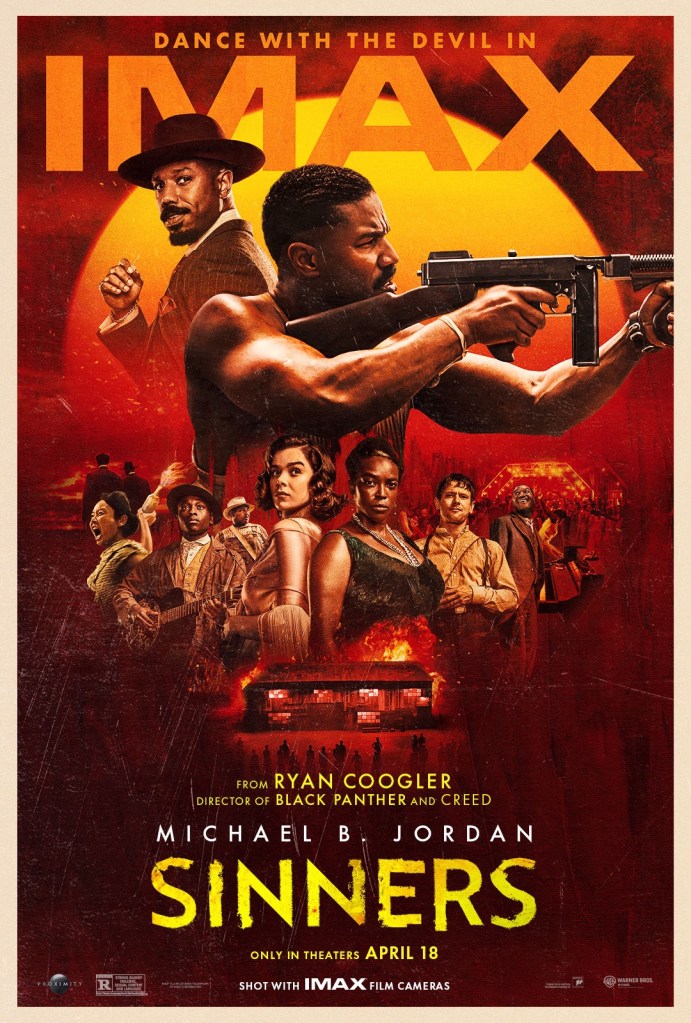
With it being awards season and all, I felt called to watch Sinners again. This might have been my fifth or sixth time. I’m sorry, I’ve lost count. It still hasn’t lost its magic. The film just keeps on giving for me. To me.
This time, I’m struck by how many times freedom is mentioned. How to get free? How to be free? How to protect that freedom?
I think Sinners explores the price of freedom. The price of being free. There’s always a cost for attempting to live life on your own terms.
From the beginning, we might be introduced to sharecroppers, working for the white men, still on plantations. But this will be a self-sustaining community. More than bodies for working on the farms, the land they do not own. But they have each other. Each character is developed at the beginning of the film. The viewer is allowed to get to know them and see them in their element. They be vibrant and they be fixing to be free. Free from the restrictions of white supremacy culture, capitalism, patriarchy the whole shebang. And this isn’t without pain but also joy and laugher and love.
Sinners is what happens when a community, when people are living their own lives and are infiltrated by others, who want what they have. Outside threats come to ruin the day. Vampires come and covet what this community has. Sammie. Sammie has a gift, the gift of music that connects him with all ages. Griot.
Delta Slim’s says, “With this here ritual, we heal our people. And we be free.” This is the power of music and how a community can tell their stories through music. And outside forces, in this case vampires, who hear, see, realise this power, are threatened by it as well as want it. Want to control it take it away from this black community who are gain strength and sustainance through it all. And be free.
Sammie’s gift, the music, the very culture needs to be/ has to be protected from these outside threats at all costs. As culture, its very existence is threatened from being sucked dry by the devils coming tonight.
So as a people, as black people, we do whatever we can do to tell our own stories, protect and preserve our music, our culture as through this we heal. And we be free.
One time when I came home crying after being called nasty names at school, he told me to fight back. If I couldn’t use my fists and feet to fight back, he said, to then pick up a brick and use that to fight back instead.
“On the afternoon of May 16, 2020, about a week before George Floyd was killed by the police, twenty-one-year-old Tye Anders was accused by the Midland, Texas, police of running a stop sign. He pulled over in front of his ninety-year-old grandmother’s house.”
Excerpt From We Refuse Kellie Carter Jackson
There’s Anders pleading for his life. There’s many policemen with guns drawn pointed at him and there’s bystanders filming it all. One woman who’s filming this is also pleading for the police to not shot Anders saying he’s scared. Hasn’t there been enough killing of unarmed black people, killed just because of the colour of their skin?
Still no guns are lowered and Anders is on the ground clearly empty handed but the situation is just escalating as the police continue to train their guns on his body.
Anders’ ninety-years-old grandmother steps out of her house praying. With cane in hand she walks towards her grandson even though guns are trained in her direction.
There was still panic still bystanders screaming for the police to put their guns up. Some do but still one cop is walking towards Anders with his gun raised. Trying to move and push her out of the way, his grandmother doesn’t believe that her grandson won’t still be shot so she falls onto her grandson, protecting his body with her own body. Not longer after this with the police and crowd pushing and pulsating around her , she loses consciousness.
Anders is arrested for fleeing the police. His grandmother is taken to hospital.
Reading this story this morning made me cry. Not because of the police brutality or the disregard for human life, black life. But because of what the grandmother in the story did. She’s ninety-years-old, frail and only has her prays and body, but used both in protection, in an act of love.
“Her collapse was not a coincidence. Protection is powerful, beautiful, and sacrificial because protection is love. But she should not have needed to put her body between the police and her grandson to protect him.”
Excerpt From We Refuse Kellie Carter Jackson.
Protection. She should not have needed to, but she did put her body between the police and grandson to protect him. This act of courage broke my heart this morning. Had me weeping. Maybe it was the last straw that pushed me over the edge into the breakdown. Maybe it was my imagination seeing this playing out.
Maybe I’m just sick and tired of living in a world where white violence is justified and black violence is really self-defence but is never judged that way.
I’ve always been a supporter of care work but even more so now. As care work, along with rest are forms of protection. Through the way I {BE} with myself and others, and the work that I do for self and others, I’m tending daily to the mental, emotional, and physical needs and health of black people, so we are better equipped to survive and thrive within a hostile, brutal, grinning world.
This piece originally was published over on Medium with Binderful. I’m drawing this piece into the Living Wild Studios archives. Because I can!
Image credit — Donovan Valdivia
“How difficult is it for one body to feel the injustice wheeled at another? Are the tensions, the recognition, the disappointments, and the failures that exploded in the riots too foreign?”
Claudia Rankin
In August 2014, there’s a summer of “hands up, don’t shoot” protests, in Ferguson, Missouri, in response to the unlawful shooting of Michael Brown Jr.. In November, Darren Wilson, the white Ferguson police officer responsible for Brown’s murder isn’t indicted. In December, filled with rage and helplessness, I organise the first ‘Black Lives Matter’ protest in the North of England; a political poetry reading at our city centre library. Together artists and writers, cram into a hot room on the top floor of a building made of glass, and pour out our rage and pain through our writings. Black people’s words. Our ancestors’ words.
I’m criticised by one Black woman, in particular, because I invite white poets to read. They could only read the words of Black people as this event is centring our lives. Black lives. A white people’s presence is not what this Black woman wants. She wants a safe Black only space. I respect and understand her views. We all want a safe space for Black people. But I feel we can achieve so much more when we work together, Black and white, to solve our society’s problems. I know where she’s coming from though; a place of pain and suffering and hatred. As Black people, for so long, we have endured so much hate and violence from the hands of white people. For far too long, we have been excluded from a share in the economic wealth our ancestors paid for with their lives to create. We’re sick and tired of being excluded from the abundantly spread societal table which our ancestors give the skins off their backs to forge. And this hurts.
In March 2017, there’s a ‘Stand Up to Racism’ demonstration in London, Miss Ella, my seven year old daughter, and I dance behind the sound system truck, towards Trafalgar Square. Crowds behind metal barricades line our route, with the Metropolitan Police shepherding us along. We shout, ‘Refugees are welcome here.’ Miss Ella, dressed as her superhero, Black Widow, looks as if she’s just stepped out of a Black Panther’s meeting. With her long brown hair blowing in the wind and her peachy fist punching the air, she’s learning long before I did how to use her voice to bring about change. She carries her homemade banner stating, ‘Black Lives Matter,’ high with pride and courage. Along the way, a white woman with screwed up face screams at us to shut up and go back home to where we come from. Disallowing our protests, devaluing our presence here.
I recognise where she’s coming from; a place of her ignorance and pain and hatred. As white working class, for so long, she’s been fed the lies that Black people and immigrants come over here and take their homes and jobs. For so long, the poverty they’re experiencing is down to these Black illegal criminal and not a capitalist system rigged in favour of a few priviledged people. We’re just as sick and tired of this too. And we know it hurts.
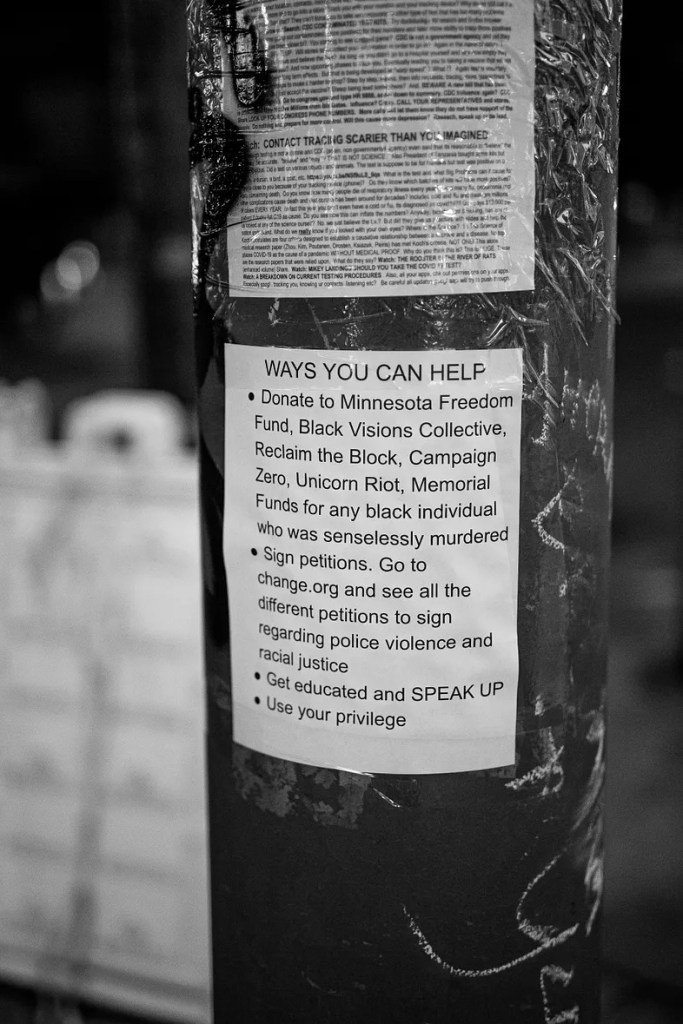
In May 2020, there’s ‘Black Lives Matter’, protests around the world. In response to the recent killings of George Floyd, Tony McDade, Ahmaud Arbery, and Breonna Taylor, to name just a few, the streets are talking through fire and smoke. Thousands take to the streets, Black and white, to demand justice for all our Black brothers and sisters who have been and continue to be murdered by state sanctioned violence.
I’ve grateful for their voices and bodies. This time, I protest through my words and art. As the Covid-19 pandemic still poses a real threat here in my part of the world. I’m a Black, fat woman carrying yet another target on my back. While protesting, the odds of getting molested and arrested, and not surviving the experience is higher for me than any white person. Just as the odds are greater for me of dying from the Coronavirus than a white person.
Black, Asian, and ethnic minorities in the Western world are dying at a disproportionately higher rate and number than white people during this pandemic. Many explanations for this reality have been voiced with the blame thrown at the feet of Black people. That it is our unhealthy bodies and behaviours which are spreading this disease, conveniently not addressing the inherent racism and systematic inequalities that have operated for over 400 years that has brought about this dis-ease, making our weathered bodies more susceptible to this virus.
‘We rather die on our feet than keep livin’ on our knees,’ taken from the James Brown song, ‘I’m black and I’m proud’, I feel this as we see thousands of Black people (and white people) take to the streets, even though there’s a greater risk to their lives than ever before. But I recognise where’s they’re coming from. We’ve had enough. We’ve endured enough. We’re not prepared to accept Black lives being devalued anymore.
In the dream, he comes back to me, whole and young.
He was always young in my eyes. When I used to ask him at each birthday how old he was, Daddy would answer, 45.
He was always 45 in all the years I knew him. All the years I was living, he was dying.
In the replaying of images, I play it differently.
I keep my distance until he asks for me to bring his slippers or newspaper. I offer them with bowed head. I don’t throw them at him as I used to. Escaping his rage, escaping the beats.
I keep my distance, but I want to be close to him. To hold him. To feel his love for me. Then and now, still needed after so many years gone.
To serve, he brought me up, to serve. Instead of getting the vacuum clearer out, he had us on the floor picking up the bits of fluff and crumbs. To hear his pride at a job well done was enough.
When I enter the chapel of rest, it’s like I’m floating on air, light as the flowing curtains concealing a prize. I see him now, as then …
he‘a surrounded by gold satin, his mahogany black skin shines, relaxed and unlined, sea-black lips wave-curled and still.
He looks younger than 45. Even though the plaque on the coffin lid reads 1920 -1981 – he was 61. And the time he was dying. I was living.



 Living Wild Studios