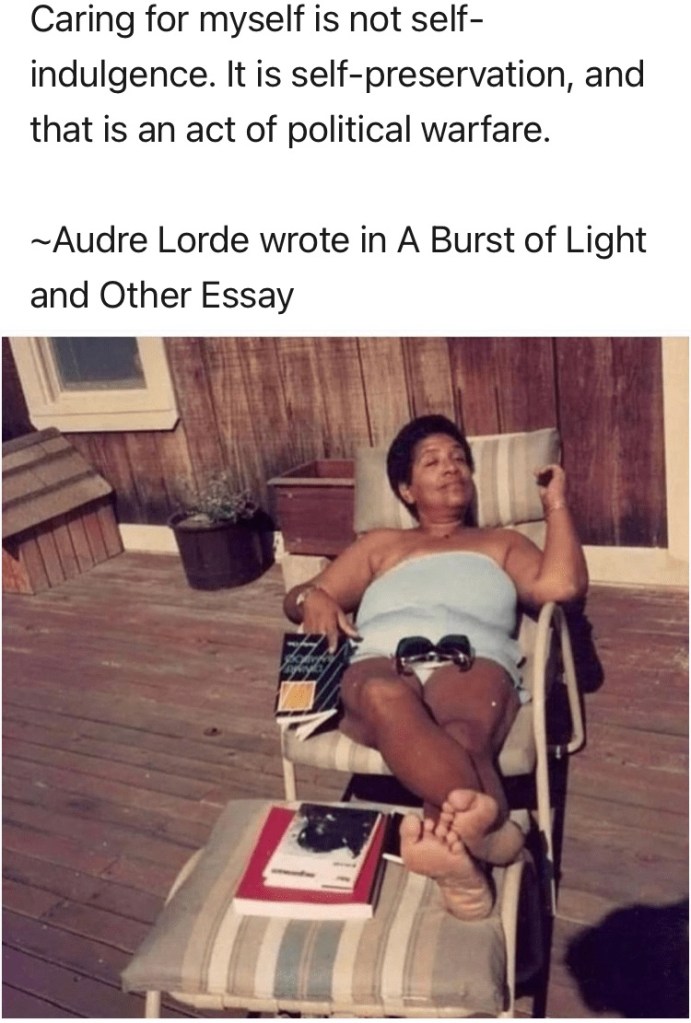
What’s one small improvement you can make in your life?
I’ve been noticing how my work/ being has been reactive. There’s been a sense of scarcity and time urgency that’s been guiding my thoughts and actions. There’s been a hopelessness. Because some incidents are out of my control but which have impacted me. There’s been feelings of not being appreciated, feeling a lack of trust and working without purpose, moving away from my core values and moral compass.
I might have been using food or drink to numb my way through the shit. Through the ‘work’, not allowing myself to feel and be present. Really present to all the feels.
Do you feel me?
I know I need to take a step back and really look at the life I’ve been living. This is the only life I have and cannot be relived. I have a deep desire to change the system. To abolish the system and live otherwise.
And yet in order to change the system, I have to change my life, how I live my life. The way / how I live has to reflect the way/ how I want the world to be.
What does this mean in reality?
How I am just as much as what I do within the system will have an effect on system change. I have to be living my life with intention and purpose. Making sure I’m living my values, that I’m not compromising my integrity. That each decision I make is coming from that place of love and trust and hope.
That I’m not shutting down but open to togetherness but also trusting my gut that when I say ‘no’ it’s not from a place of malice but from a place of capacity and boundaries.
I’m learning, I’m sharing and I’m growing. Alone and in collaboration.
And I’m feeling and shifting into the practice and recognition that this is coming from a place of love and care rather than exhaustion and pain.
Small steps. Small acts. Small makes up the large. Small scales up to large.
I’ve got to be practicing the world I want to see now in my own life. Daily. Practice.
Love not hate.
Cooperation not competition.
Conversation rather than condemnation.
More care less harm.
More listening less violence.
The turn towards Mother Nature rather than against her.
A recognition in the value and worth of every human being regardless of race, class, gender, religion, ethnicity, age, sexuality, body type and body and mind abilities.
This is why my favourite pattern within nature, apart from the wave, is the spiral. Again and again, experience shows me how we may feel that we are going around in circles doing the same things, making the same mistakes and never learning or moving forward.
But I beg to differ. I believe life’s journey is a spiral. Each year we go around, and it may feel as if we’re not moving. We’re not making any progress or making our mark. But I see it as coming back around over similar track but we have changed. Through the movement of time and experiences and knowledges, we’ve changed since the last time we were in this spot. It’s not the same spot. Things have shifted. and so we’ve changed. We’re not right back at the same point but moved further into the spiral. Not in a hierarchal way, , ascending or even descending, but more of a going deeper, more connected and centred movement of the journey.
Each rotation in the cycle, in the spiral throws up more learning and more insight that if we’re paying attention we can use on our life’s journey with more consciousness, connection and joy.
I share this because I’ve just recognised how I’ve moved through the spiral this year to come to further understandings and wisdom.
This time last year, preparing for anti-racism facilitation, I was reading What White People Can Do Next by Emma Dabiri.
It was from reading this slim volume of wisdom that I fell into ‘solidarity’ is needed within the anti-racism movement. In fact I started using a anti-racism is anti-capitalism. Solidarity between oppressed and marginalised groups in society is the way forward.
I went on a journey from here, maybe a spiralling into despair, as I searched for a group or organisation to be a member of, in solidarity across different sections of society. I was looking into the communist party, unions, anti-racism organisations, trying to find a place where I could belong and be in solidarity with others.
In my search, I found racism and sexism, individuals and groups still perpetuating the racial capitalist system. Still working with hierarchies and the unconscious bias that they were better than me, than they knew more than me therefore should control me.
I become demoralised and retreated. I put away my radical thoughts and ideas, convincing myself that it was better to be alone and true to my ideals than compromise and waste my time explaining or highlighting blind spots to so-called comrades.
And then these part few days, solidarity has raised its head again but through a different door. Through the door of abolitionism.
Ours is a fight against powerful systems of violence and terror.
In recognising the interconnectedness of systems of state violence, abolition can be the basis of a new solidarity: one that acknowledges specific experiences of violence in particular communities, whilst building a unified, internationalist resistance.
Abolition doesn’t understand the concept of solidarity as an airy-fairy call for different oppressed groups to ‘just get along’. Solidarity is a vital strategic response to the prevalence and ubiquity of state violence.
Abolition Revolution by Aviah Sarah Day and Shanice Octavia McBean
As we have witnessed in the recent council elections, with the surge in the popularity of Reform. This isn’t because this party has set out a manifesto of policies that will solve the issues of poverty, unemployment, economic crisis, the state of the NHS, the policing in our schools and stop crime such as rapes and murders. No this party, it just playing out the age out trick of creating the ‘enemies within’. The ‘enemies within’ can carry all the responsibility for what’s wrong within British society today. The immigrants, the refugees, the gangs, the nasty women, the people with darker skin who are innately hardwired for crime. The general public, usually predominately working class white people, can blame others, other oppressed and marginalised people for all the woes of society. Smokescreens and mirrors, instead of people coming together, across class, race, gender, sexuality, religious lines, in solidarity and challenging racial capitalism and state control and violence which are geared towards keeping the majority of people in poverty at each other’s throats instead. While a few, usually white cis-gendered men, retain wealth, control and power.
I say Reform, but the present ‘Labour’ government operates the same way. They’re all apparatus of the State working to keep power and control through violence and terror in the hands of the few.
So for them the problem is not the historic experience of racism and the legacies of slavery and colonialism: it’s Black ‘gangsters’ on our streets. It’s not disinvestment from and neglect of working class communities: it’s Syrian migrants in our hospitals. It’s not military and imperial domination of vast swathes of the world: it’s Muslim extremists in our schools. Constructed ‘enemies within’ like these provide a constant justification for the use and expansion of state violence in order to maintain control; they tie people’s lived experience of the world to divisive narratives that weaken the collective consciousness of ordinary people. – Abolition Revolution by Aviah Sarah Day and Shanice Octavia McBean
I see the value of solidarity now, in building power in the direction of marginalised groups because it weakens the State’s power and control which is based on divisive narratives that weaken the collective consciousness of everyday people. The marginalised and oppressed.
Now maybe if I had this knowledge, last year, cycling and spiralling looking for my tribe, I might have stuck it out a little longer. Allowed our differences and bias to take a back seat because I believed we were working together across solidarity lines. Maybe.
This year though, with another trip around the sun under my belt, and another spiral deeper into my learning, I believe my solidarity within these groups would have still faltered as within and outside of these groups because they are not spurred on from the foundations upwards and onward with an abolitionist revolutionary thought and praxis.
I see now that these groups are looking toward reform rather than abolition. They are satisfied with tinkering with the edges. Gaining small concessions rather than a total overhaul. It’s like asking for and being satisfied with a more comfortable prison cell as a demonstration of change in how the State handles inmates instead of defunding/ abolishing the prison industrial complex all together.
I see that now as I continue to spiral towards consciousness, again and again. Onwards.
I’m been expanding my reading of late. I’ve just become a member of the Abolitionist Futures Reading Group which is focusing on abolition, obviously.
Reading in community, sharing ideas and thoughts which are probably considered radical, revolutionary to the majority is so refreshing and affirming.
It makes me feel less alone in my way of thinking and {BEING}. It gives me hope that there are alternatives to the current system and that together we can get there.
Abolition, might be associated recently with prisons, or defunding the police, and closing detention centres.
But abolition is much more than this. Started with the aim of abolishing Transatlantic Slavery, abolition of prisons has been there since the inception of prisons themselves. Abolition is revolutionary because in order to decarcerate the Prison Industrial Complex not only does the whole of society have to change, be overhauled not reformed as that just wouldn’t work, but we also, the people have to change.
The world has to change at the same time as the people within this world change. We have to move away from the indoctrinated belief that prisons and the police, state terror more like, are the only means of deterring crime and criminals. Which jus isn’t the case.
We have to stop focusing on the individual ‘evildoers’ who deserve the harshest punishments for whatever crimes they committed, to taking an honest look at our societies and cultures that have forced people to commit such crimes ( or in a lot of cases no crimes being committed but still punished with prison sentences.)
I’m talking about poverty, economics, drug abuse, race, class, sexuality, isolation, migration etc.
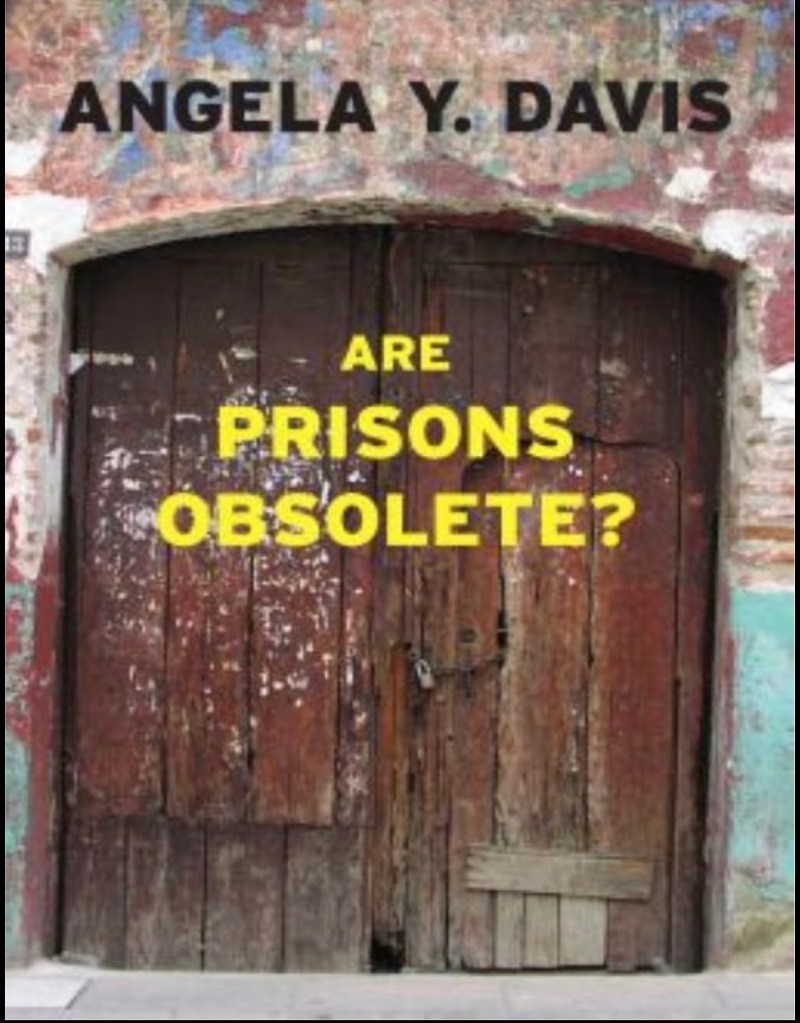
To reiterate, rather than try to imagine one single alternative to the existing system of incarceration, we might envision an array of alternatives that will require radical transformations of many aspects of our society.
Alternatives that fail to address racism, male dominance, homophobia, class bias, and other structures of domination will not, in the final analysis, lead to decarceration and will not advance the goal of abolition. – Angela Y. Davis
Me reading, thinking and becoming anti-prisons, anti-establishment, becoming an abolitionist is just the next step on this journey of fugitivity, via black anarchism. And I’m so pleased and relieved that I don’t have to walk this path alone. I have a community around me as support.
Woman got herself dry socket. Exposed bone and nerves after a tooth extraction happens when the blood clot for Porte took doesn’t form properly or get dislodged.
It’s painful and can lead to infection. Guess I’m one of the lucky ones. As mine is infected.
I thought the pain and bad taste and breath were part of the healing process. No pain no gain right?! Seems this level of pain and the foulness is a sign of dry socket and infection. Go figure.
Thank goodness for saltwater washes, walking and self-care. Looking out for myself has become a priority in a world that just doesn’t care.
I’m been talking here about finding my tribe. About my search for comrades in solidarity. I’ve remained pine in the process, for real. From one particular source I asked for further reading, as something was niggling me. Id expressed my concerns in terms of using the oppressors language as well as, well I felt as, the lack of warmth, kindness, care and love. And then through the further reading it all became clear. This was my response.
I believe that there needs to be unity to fight all oppressions. You can’t fight racism without fighting against capitalism.
But I realise through this further reading where my concerns lie. It’s not in the socialist/Marxist movement as a whole but it’s with the people who make up the movement.
I’m not sure if the people of the movement have/ or continue to take the time to work on their own racism. There seems to be a given that because the movement is against all oppressions that it means those who are part of the movement can’t be racist or sexist because they say they are against all forms of oppression. Saying it is one thing. Practising it is another.
In practice there is still the use of the oppressors language as I’ve mentioned before. Using ‘non-white’ or ‘minorities’ is offence as they still centre whiteness which is used for division and oppression.
The articles mention the BPP alienating white people because of their support for Black Nationalism and Separatism, and their language used around Black Power. You even mentioned yourself that we can’t fight capitalism through language and its use. Modifying language is not going to bring about material change you say.
And yet it is language the party is using to rally the masses, to bring people together. Language is the tool of persuasion no? Language is the tool of education.
But if that language continues to use the language of the oppressor and is offensive to certain groups of people, they are accused of being confused, ill informed and falling into the identity politics trap again.
However, from my experience, through reading the literature of the party, I feel that the language used reflects a party line where the people behind that line are not continuing to work on their own racism/ biases while focusing their efforts on society’s ills, outside of themselves.
I do not feed into white supremacy culture with the characteristics of either/or. I believe in and/both. That means for me, there has to be the work on the individual’s internalised racism and sexism at the same time as working against oppressions within society. Working on our own blind spots and prejudices can only benefit the movement as a whole. Where this fails to take place is where the oppressors divide and rule become fixed without our recognition of it.
To say that ‘non-white’ is every day language, quote, ‘commonly understood by ordinary people as respectful ways to refer to some people who are oppressed’, as a black person being referred to as ‘non-white’ is offensive to me and I’m not really bothered if other black people are okay with it. I might be falling into an identity police trap but one my identity is not built on my relation to whiteness that is racism. Two, if someone says they find it offensive and that is not recognised or is questioned and explained away as being the norm is denying that person’s experience which is racist. Three, to bring this up then to have it dismissed as being defensive and accusing someone of being a bigot/ racist and dismissed as a distraction from the cause is another example of an individual failing to check themselves and work on themselves to combat their racism/ discrimination tendencies.
I work on myself daily to check my prejudices or biases or judgments and blind spots. I only wish more people would also as I do believe the world would be a better place because of it. Movements and societies are groupings made up of individuals. Working on the individual at the same time as the collective can only strengthen that connection and keep moving it forward in an effective way, I believe.
If we think about what is happen in the USA today, and the ICE raids within every community. The Latino community is coming out and asking where are the black people why are they not out here on the streets with them protesting? Why are they sitting this fight out etc.? Black people are tired, esp. black women. Black people told everyone to vote for Kamala Harris and they didn’t listen. They voted for Trump. And now he is doing all that he said he would do.
Now people are asking for black people once again to put their bodies on the line. And yeah this is a prime example of the ruling class dividing and ruling. Pitting one group against another. But what is true there and what is true here, black people only make up a small percentage of the population. In the states 12% here 4% with other ethnicities. And yet it is expected for us to save the world. ( Aside here we might be termed ‘minorities’ within these countries but we are the global majority. I don’t use ‘minorities’ because it is used as language of control. Black Feminism or Third World Feminism has always been global in its remit).
It is expected for black people to put aside those differences which on a daily effect our life chances. Our lives in terms of life and death. And this is not feeding into a victim hierarchy and who’s suffering is more than someone else’s. It’s a reality. Black people, black women do not just suffer violence and brutality from the state but do so from person to person in their every day and yet black feminism still criticises and attempts to bring material change for all through fighting all oppressions including capitalism and yet if they ‘fail’ to bring about material change it is because of ill-fighting or confusion in their ideology but no mention of doing this within a racist/ sexist society that does not see Black women as anything except mules of the world. Not either/or but and/both.
As black women we continue to not be seen as human. Read Fugitive Feminism by Akuwgo Emejulu to understand this, which is anti-capitalist, anti-imperialist and anti-colonialist. It’s arguing for a rejection of the whole system. A refusal of what has already been refused to us. Other ways of being are possible.
Marx himself saw the future of capitalism as self-destruction and a social mode of production being the outcome. Fugitive Feminism is being/working now with the other possibilities. It’s about creating an outside while still on the inside. Creating spaces of liberation and joy on our own terms. It’s not waiting until then for it to be now. It’s collective and speculative and might be fostered by black women but can be utilised for all, all oppressions including capitalism and the class struggle. It is probably dismissed though because it comes from the mouths, minds and hearts of black women.
Thanks for all these readings. They have helped in clarifying where I stand. In solidarity but at the same time in my own fullness and power which I lend to any movement which recognises this and works with me to bring about dismantling all oppressions for all people.
The reply I got, was thanks, I’ll reflect on it, and wish you luck on finding your people.
I’m sharing it here as I don’t want my realisation to do to waste. The words I shared to go to waste, as I’m still open for the conversation, still open to standing together.
This piece was written back in 2020 and published on Medium. I’ve brought it over here to be part of my writing archive. I also feel that the case needed restating frequently. Did I say daily?
We queue with our shopping basket. This is the norm now. But we don’t complain. It keeps everyone safe. We’re at the front of the queue, for a change. My daughter and I. We’ve only come to the one shop. I let her ride her bike into town. She needs the exercise as she’d be happy in front of her screen all day. I probably would too, as at least she’s inside safe, connecting with her friends, and I get a moment to myself.
Front of the queue, but we hold back as the woman in front of us has just gone into the shop. There’s someone coming out at the same time. The store security guard is standing in the mix too. We allow a gap to form between us; the woman and the entrance and our bodies. Coming across from an adjacent shop, a man and woman stride. Stride into the front of the queue, ready to walk into the shop. I raise my voice just above my normal speaking voice to say to them, There’s a queue. We’re waiting to go into the shop too.
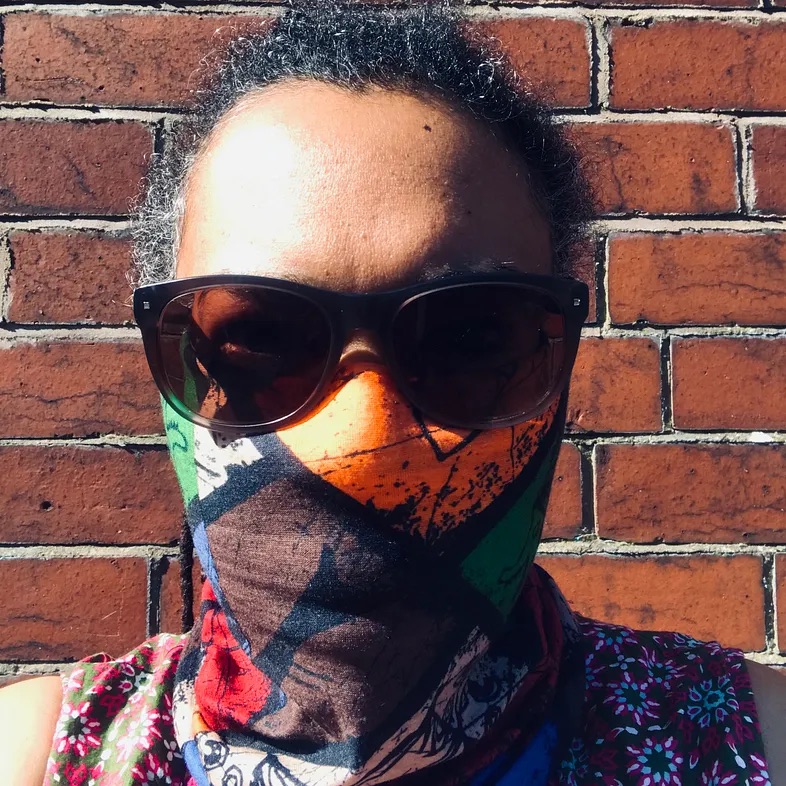
I think I’m smiling but how can they know? How can anyone tell if you’re smiling when you’re wearing face protection? By your eyes. I think by the eyes, you can tell if someone is smiling. It’s a warm, sunny day. I’m wearing sunglasses. Maybe they can’t see my eyes. They can only use my voice as means of communication.
Sorry, they say. We thought the queue was going the other way. They walk to join the queue behind us. I say, in a tone of voice which I think says I understand, No, the lady in front of us has just gone in and we’re waiting back here to giving everyone some space.
In the time it takes for the couple to walk and wait behind us, at the recommended 2 metres, the woman of the couple has already started saying in a loud enough voice for us to hear, Some people are just getting angry about the situation now, and there’s s no need for it. We walk into the shop.
Note: The angry Black woman stereotype portrays a black woman as sassy, ill-mannered, and ill-tempered by nature.
Walking back home, Ella walking with her bike, I approach what happened outside the shop, asking Ella if she heard what the woman said about people getting angry.
She was referring to me. I explained. She saw me as an angry Black woman. Do you think I was angry because you’ve seen me angry?
My daughter knows me. She knows I wasn’t angry and says so.
When you live in a society where you’re powerless, perceived as worthless and inferior, those who have power, believing themselves to be superior, spend their time telling others how they handle the situation isn’t right. They tell you that how you speak or act or response isn’t appropriate. You are wrong. They gaslight you, forcing you to doubt yourself; your actions and capabilities. You are at fault, always. You are wrong. You are silenced.
Back home, I talk to my husband, who’s a white man. I think if he’d been with us, the woman behind us, wouldn’t have uttered the angry line. He disagrees. She sounds like a woman who would have gotten annoyed if anyone had checked her behaviour, he said.
He has the right to think and say that. And maybe he’s right. Who knows? But to accept this explanation, I’d have to disallow what I feel about the situation. I’d have to make allowances once again for someone else’s behaviour, reaction and treatment of me. I’ve spent a lifetime of making allowances for other people’s treatment of me. How can I be sure that when they treat me unfairly, or discriminate against me that this isn’t how they treat everyone else? I don’t know. All I have is the way they make me feel. My lived experience as a Black woman.
All I know is that when I’m walking down the street and someone is coming towards me, it’s me who walks into the road to maintain social distancing. It’s me who walks into the gutter to keep us both safe. Would they do the same? I don’t know. I can’t take the risk to wait and find out either.
I’ve been socialised, fed the stereotype of the angry Black woman for so long, I police myself. I play my part. I don’t raise my voice. I don’t protest or question. It’s part of my make-up to check myself so I appear in society as passive and non-confrontational and unseen.
End / beginning of another week. Depending on if you see Sunday as the end of the week or the beginning of the next.
For me it’s and/both. Sundays are usually change over day at our house as Ella goes between my home and her dad’s. Sometimes we do things on a Sunday or sometimes we don’t.
We just take it easy.
But usually on a Sunday I reflect on the week gone and plan for the week ahead. It’s a ritual of getting my head in the game. Not the outside societal, capitalist game. No, my own game. The Sheree Mack Game, which runs counter to the White Supremacy Culture game of go go go produce produce produce and strive for perfection at the same time as avoiding conflict and being grateful for the crumbs from their table. Yeah counter to that game as I refuse to be part of this system, where my labour is being bought and sold to support the actors, that are white people.
I’ve been hibernating for months now and I’m still tired. Go figure. Maybe my exhaustion is more than a year in a dumb ass job but runs much deeper. A generational exhaustion that I just can’t shift which has to be recognised but will take a lifetime to ease.
Ease. Yes that would be welcome.
There are moments when I grasp these ease and feel it spread across my back, untightening bunched up muscles. Making my spine fluid rather than ridged. These times I can feel my heart and soul float and I’m relaxed into whatever I’m being. But these are just moments. The aim is to extend these moments into longer moments, into days and months.
I’m working on being so but it is a practice. So when I say Sundays are reflecting/ planning days. I don’t mean around a to-do-list of jobs that need to be completed in order to bring in the tainted coin. I mean, where did I experience ease this week and where can I factor in/ plan for more ease next week. Where did I experience joy and pleasure and how can that be replicated moving forward.
Yeah in the Sheree Mack Game, all the rules and tasks are different to the societal external game. At more ease and I know I’m winning x
*not so mush a trigger warning but saying it anyways!
I am worthy of consent. I am safe. I can heal from sexual trauma. – Lyvonne Briggs
I’m writing. Or is it rambling? I’m not sure. It’s just that I’m reading at the moment. I’m in my cave (bed) hibernating and I’m reading so many different books. Fiction, non-fiction, poetry and there’s a cross over with what’s happening within my life with my reading ( Does that happen to you?). There’s an echo or a reinforcement for the things that are causing me grief at the moment, worrying the wound as I read and rest.
So writing things out, going long is a way of making sense of it all in the moment. It’s a way of gaining some kind of clarity for now. Not thinking of the future but thinking of gathering the threads at this moment to made make a something out of this mess of yarns.
My mum died when I was 27 years old. I’d just become a mother the year before. I’ve been hearing about the ‘mother wound’ lately. I’m not sure if I understand it completely. But when I hear it, I don’t jump into definitions and theories. For me it’s simply means when my mum died and left me to cope alone. Selfish I know. But I feel as is she left a gaping, bleeding wound that festers and hurts when I worry it. When I press on it, inspect it with my touch.
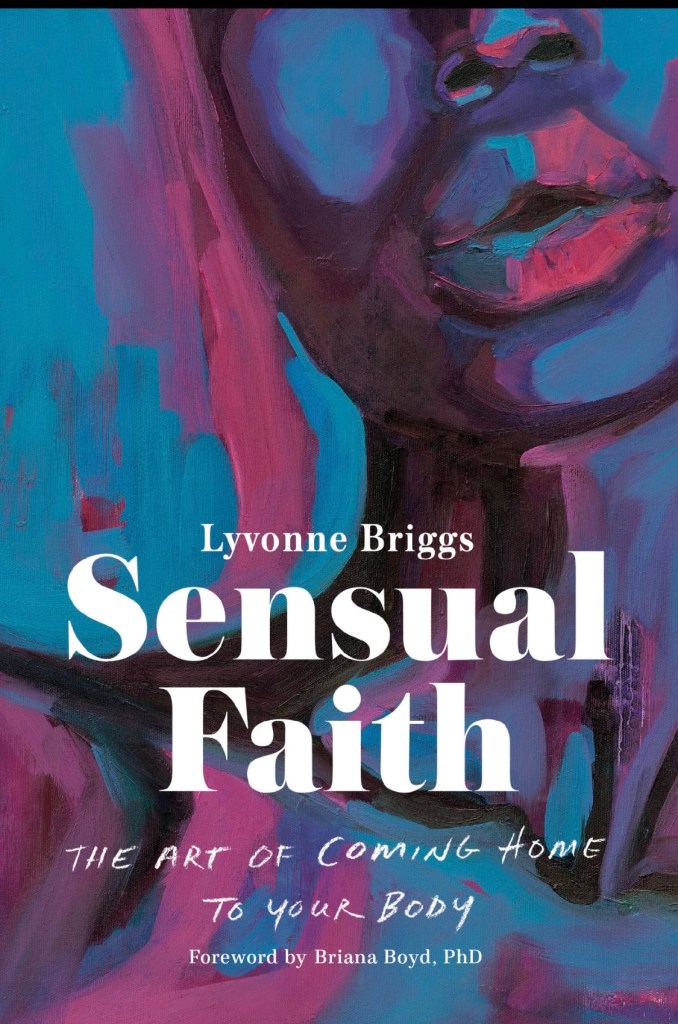
This morning, following my morning routine, in bed reading (with coffee skipped ahead this morning) I’m reading Sensual Faith: The Art of Coming Home to Your Body by Lyvonne Briggs. I’m reading a section called ‘Surthrivors’ a term Briggs created to try and capture how she was feeling, living after male sexual violence. She felt ‘survivor’ was too flat to describe/ define her experience when she was living/doing what she loved studying theology and religion, in community with loving people and was an acclaimed spoken word and slam poet. “I wasn’t just surviving, I was thriving!” Briggs wrote, hence pointing the more accurate term, ‘Surthrivor’. I love it when we Black women bend and twist language, divest from the standard to better express/ more fully express our feelings and experiences. That’s creative fugitivity for you (thank you Dal).
Briggs goes on to talk about how she got into the ministry so she could change how the church handles sexual abuse, not very well, as there is a silence around it. Or they blame demons instead of the actually men. I’m not here to talk about male sexual abuse. I’m not her to talk about the church. I’m not a religious person. I was brought up saying my prayers. I remember a black bible, creased leather, brought from Trinidad and Tobago with my dad when he stowed away to England. This black bible sat toad-like in the teak sideboard of my childhood living room. West Indian style living room, I may add. I gave up believing in a ‘God’ when my daddy died when I was 9 years old. I’ve now come around to the idea that we are Gods/ Goddesses ourselves, inside us. I’m spiritual rather than religious. So I’m not sure why I’m reading this book.
I lie. Yes I do know why I’m reading Sensual Faith. I followed a trail to this book left by Christina Cleveland and God is a Blackwoman. But also because of the subheading of Sacred Faith: The Art of Coming Home to Your Body, is a journey I always seem to be on.
Anyway. Back to the reading this morning which went on to discuss the worship centre in a church is called the ‘sanctuary’. When you the word ‘sanctuary’, does anyone else think of Quasimodo? ‘Sanctuary, sanctuary!’
A ‘sanctuary’ is a safe or holy place. I wrote a poem titled ‘sanctuary’ and it was about my mum. My mum’s home, body, arms. When she was alive, it was her I went to for safe harbour. I didn’t realise until she was gone. It has come a way for me to practice mothering my own children, through sanctuary for them. Once my mum died, I lost who and where I could return to for safety. I lost my home, my sanctuary when she died and I suppose I’ve been searching for sanctuary ever since, looking outside myself, looking for it in others ( husband for one!)
I don’t how long I’ve been in battle with my being, with my body, chastising her for not being enough. But also for being too much. Too fat. Too broad, too Black. But over the last few years, eyes open, something has been changing or shifting within me and how I view, treat and talk to my body. . Maybe that’s where my mum did me a disservice and where I’m making amends with my kids. I’m not sure she taught me how to find sanctuary within myself, within my own body.
Monday nights I dread. Not always. Just the last few months as I complete my level 3 diploma in counselling skills. I’m not jesting that I hate turning up for this course. And I never use ‘hate’ as a word usually, always thinking it’s too strong a word for a feeling. Too final without any redeeming features. But this is where we’ve got to with this course.
And it wasn’t always the case. I could blame the dark, cold nights I have to turn up for 3 hours of lecturing and talking in an empty, sterile office block. I could blame the electric fluorescent lighting that flickers and buzzes and can give me a bad head. But I would be lying. I’m here to be wide open and honest. So here goes!
This course is taking away pieces of my soul, week after week. And I’m not ashamed to say that I have contemplated dropping out week after week, researching for alternatives. I even enrolled on a supplementary course, decolonising counselling, that would tend to all the damage this course is doing, but I had to withdraw from that due to costs and timings.
If you’ve ever studied counselling and therapy, you’ll know that everything; theories and tools and practices are all taken from dead white guys. Dead white guys acting like Gods (and I don’t mean the internal Gods I’m just mentioned). White male, usually heterosexual and middle class theorists who pontificate that they know everything about what’s happening in everybody’s mental health. They have the solutions to make us feel/ do /be better. As it’s always the individual’s fault and can be traced back to their childhood, their mother? Bullshit!
It hurts to be fed this shite every Monday. In the beginning I pushed back and attempted to decolonise the teaching, the theory, the responses. Bringing in other theorists and arguments. Being the only Black face in the class, girl has to represent.
Until we got to week 9, we were exploring different types of power within the counsellor and client relationship. Power roles within the counselling arena. After a discussion, we were being presented with a list of ‘Further key aspects of power or perceived power’. And yes the list was not an exhaustive list and things could be added, the tutor said. This list did not include ‘race’, ‘ethnicity’, ‘culture’, and I voiced it as such. My comment was laughed at and dismissed as, ‘there’s always one’.
Always one who has to comment on what’s missing from the list? Or always one who has to bring up race? Who knows! I just know how this comment made me feel. Know your audience I say or was I being put into my place? This response indicated to me that this input, which a fundamentally the way white supremacy culture wields power through the hierarchy of the races. It’s the sea that we’re swimming in and to not mention is the usual state of affairs. This interaction indicated to me that this was never going to be on this course’s agenda. Me continuing to challenge the whitewashing of counselling and therapy, me constantly remarking on the culture that we’re operating in wasn’t enlightening my fellow students or suggesting that they become more aware of their ( and my own) unconscious biases. I realised I was just creating issues where they never saw issues. Problems where there are no problems. As race and racism is only a problem when there’s a Black person in the room. It’s Black people who have an issue with race as whiteness isn’t a race, right? Whiteness is a given.
After week 9, and tonight was week 15, I’ve silenced myself. I’ve disengaged from the course, no longer contributing. I turn up and get my attendance and keep my thoughts and comments and feelings to myself. I’m not giving anything of myself anymore to the group, to the course within the face to face sessions as I’ve received the message it’s not welcome, it’s not of value, it’s not relevant. I do not intend to waste my energy and heart and soul on this experience.
This hurts me. I’m making sanctuary for myself. I’m making this experience safe for myself. I’m keeping myself safe within myself, within my body as being in that classroom is no longer safe for me. And to explain that to them, I wouldn’t bother, as they wouldn’t get it. The can’t get it and it would also involve them listening to me, and me being heard, which ain’t happening.
I’m creating sanctuary for myself, within my body and its a practice. I’m using a self-soothing approach, self-talking, loving compassionate approach when I experience something that is harming, hurting, traumatic. I’m letting myself know, like that little girl inside me who needed to be loved and kept safe, I’m stroking my own chest over my heart and saying to her, saying to myself, ‘ You are love, Sheree. I’ve got you I understand why you are feeling unsafe. But I’ve got you. You’re dafe now.” I’m mothering myself. I’m making myself safe. I’m making myself sanctuary.
No amount of pampering can cure or stop that slow soul death I experienced being part of the system. Being a secondary English teachers within capitalism.
I was indoctrinated early to believe my worth was equal to how hard I worked. Even with a young son, I world get up early drop him off at nursery early to get into school extra early and be unpaid. I would work the full school day and stay late and be unpaid. And not complain. To then pick up my son late and spend very little time with him before bed and then I would work late into the night, marking and creating schemes of work and again all unpaid. And then repeat it all again for days, weeks, months and years.
“This is a Eurocentric, deeply white supremacist way of thinking and it is straight and ableist. It does not consider someone’s mental, physical, and emotional capabilities. … It does not consider offering space to dream, create, or simply partake in a longer lunch or even a nap.” Jennifer Mullan, Decolonizing Therapy.
I would do extra work, take on extra responsibilities, make sure I was seen being the ‘good’ teacher and look how good I am at handling pressure because I believed this is how I could prove that I was enough, I was good enough.
And there wasn’t just those internal pressures but there was also that external pressure that would flatter and coax and demand and make me feel that I wasn’t doing enough or that I was needed even more and only I could solve this problem or issue or be the one to stay late and sort it out.
I couldn’t rest and I shouldn’t rest and if I was feeling burnt out it was my fault. I should learn to manage my time better, eat better, do less and take care of myself. But how can you do that within a system which doesn’t allow it? That just keeps on rolling and takes you along with it through desire or force? I couldn’t afford to work less, to drop responsibilities as I needed the money to keep the roof over our heads, food on the table and clothes on our backs. Earning just enough to live from one pay check to the next. I felt trapped. I was trapped. Until I broke.
I got sick. Took time off. And stepped away. Self-care wasn’t the cure for burnout but it helped for a time as it gave me the time and space and clarity to realise that I wasn’t the problem. My burnout and breakdown wasn’t my fault. The problem was deeper than me. The root of the problem was the school, the education system, the businesses, the organisations, the media, the policies, the rules and expectations that kept me working to exhaustion, stressing about not doing enough, tired and struggling and giving more of my time and energy and heart to strangers than my own son.
“You cannot self-care or self-love your way out of systematic oppression.” Jennifer Mullan, Decolonizing Therapy.
I agree, however, I would argue that leaning more into self-care with slowing down and rest and learning to love myself through my reconnection with nature, did and continues to do so, provide the space and time and energy to question my conditioning, to agitate the ways things have always been done within capitalism, colonialism and patriarchy, to recognise the dehumanising, extractive and exploitative systems that are fixing to kill us and attempt to do something to stop it.
I continue on this path of decolonisation by starting with myself.