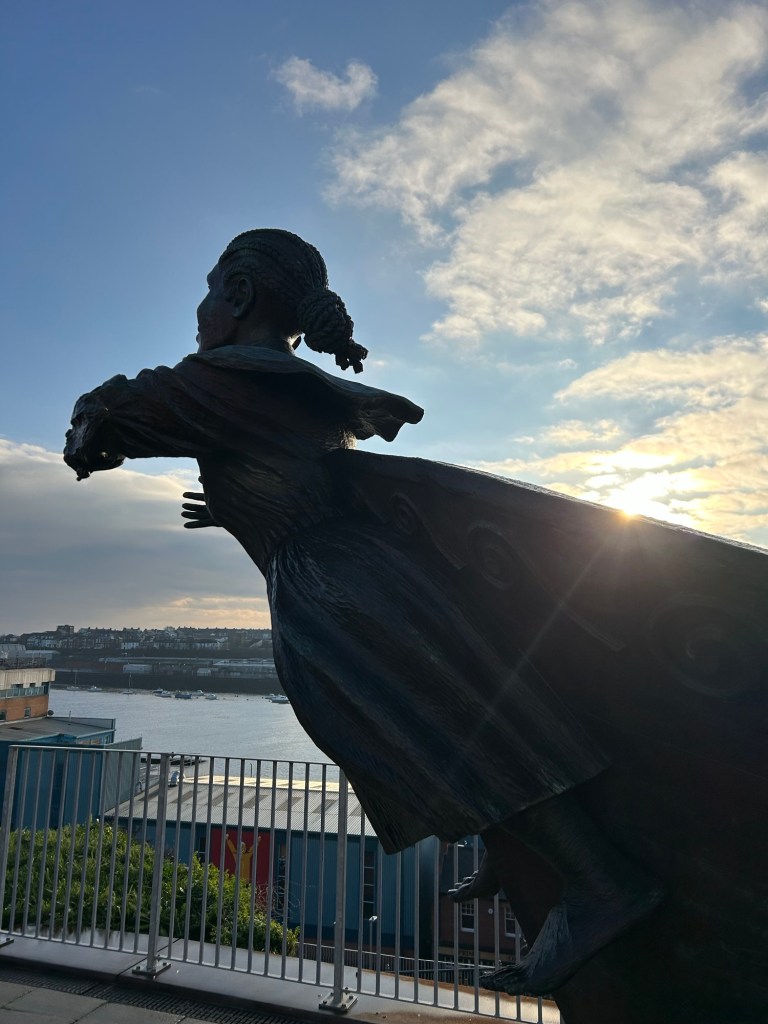
Walking into North Shields the other day, walking towards the Fish Quay where there is now accessible access connecting the centre of town down to the River Tyne, I caught sight of this sculpture of Mary Ann Macham.
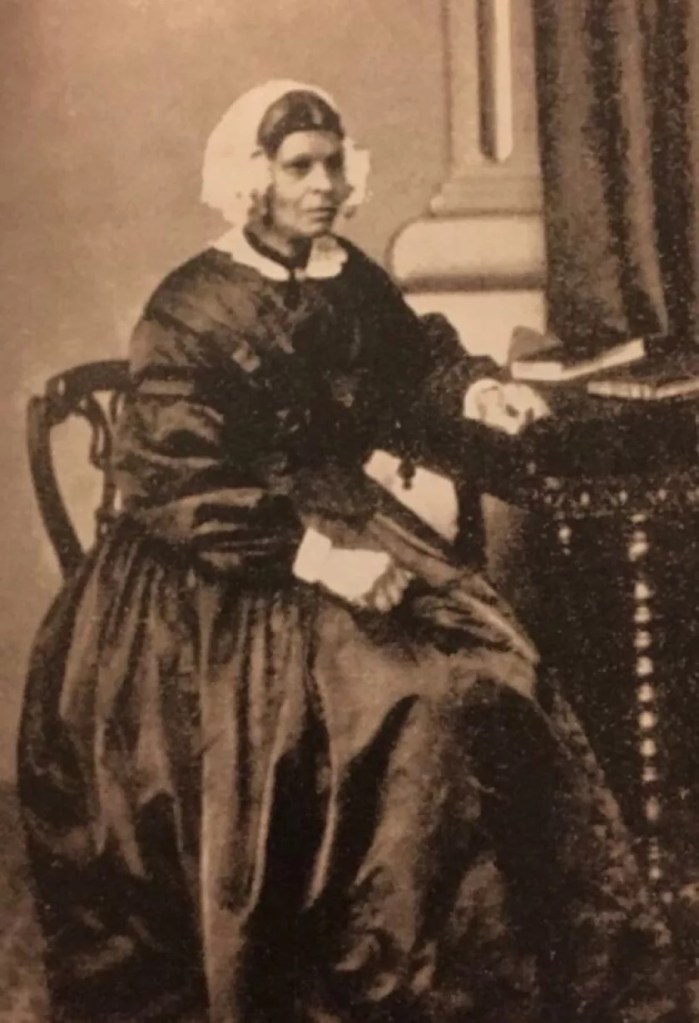
I first learned about Mary Ann in 2007, when I was researching the North-East’s involvement in the transatlantic slave trade to mark the bicentenary of its abolition.
I was writer in residence within the Literary and Philosophical society, researching their tracts and unearthing the names and lives of the once enslaved people who passed through and/or settled here.
I wrote a poem about Mary Ann, her escape and travel up to the North, and with the help of the Quakers, made a life for herself through working in service and getting married and living in North Shields. This was back in 1831 when she arrived here and lived for a further 60+ years as a free woman.
An aside here is how the Quakers at the forefront of the abolition movement here in the North- East, were against the slave trade and worked for the abolition but still held the racist beliefs of the day that white people were still superior to black people.
Mary Ann Macham told her story to a member of the Spence family, who she was in service to. There’s a lot that can be argued about the practice of black people, telling their stories to white people who wrote them down and how accurate these are as a true representation of their stories. But this is all we have now as ‘evidence’.
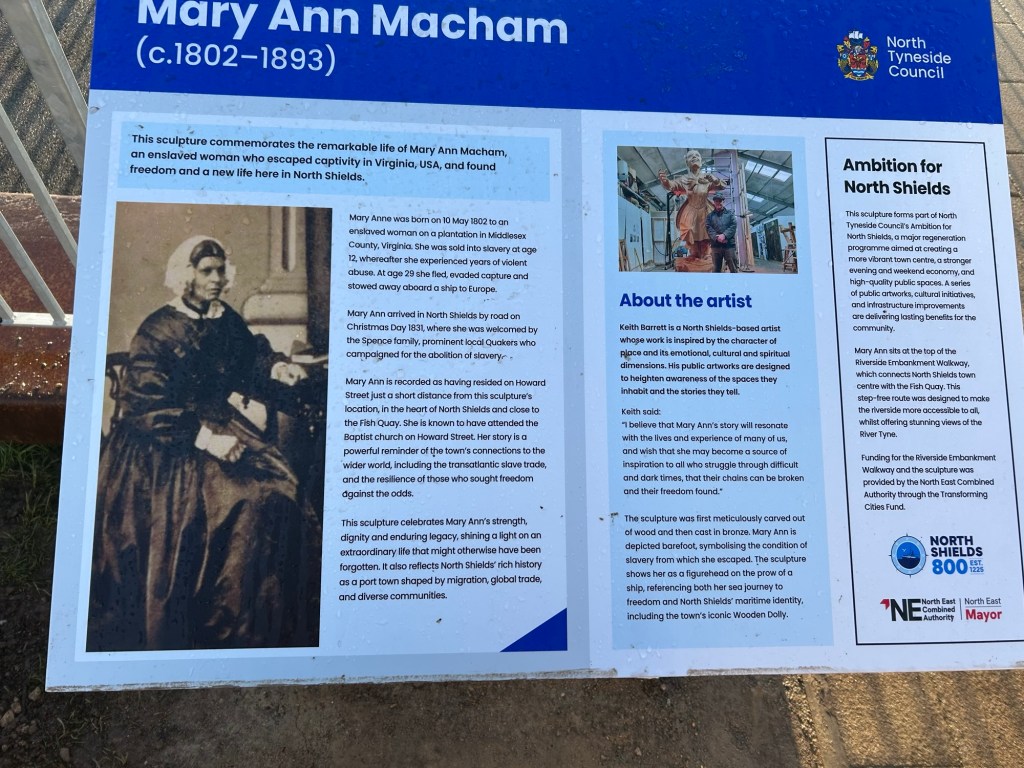
African Lives in Northern England completed research on Mary Ann Macham before this public statue and the local groups ‘found’ her.
I should be grateful and overjoyed that finally Mary Ann Macham is being remembered. That there is a public statue dedicated to her and that she is being reclaimed as part of the local community.
But something just doesn’t sit well with me. Maybe I’m being far too critical. Or maybe I’m just coming at it from a black woman’s point of view living within white supremacy culture?
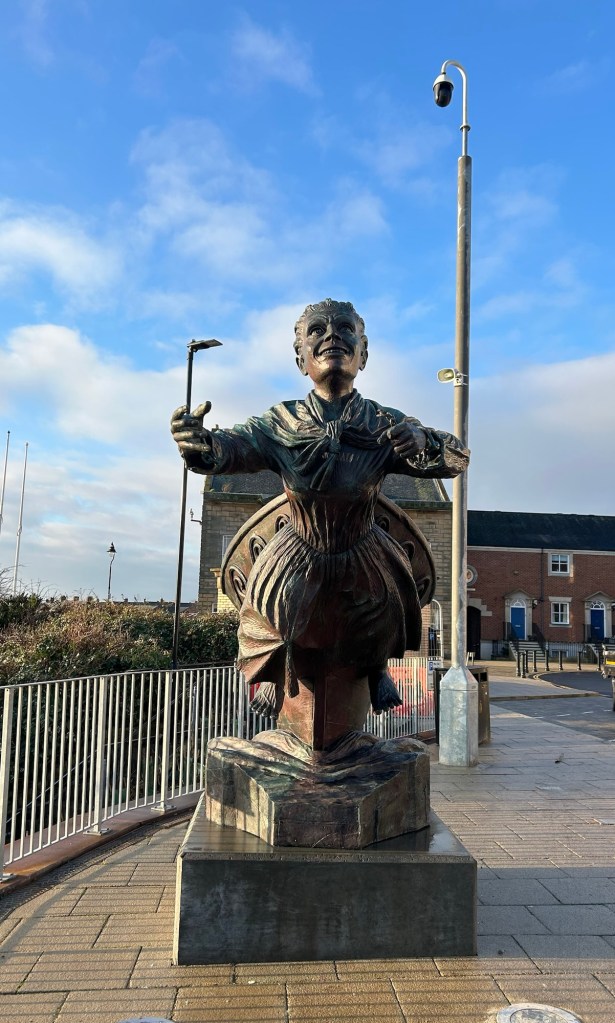
The press releases for this unveiling of the statue in November 2025, proceed to paint the impression that Mary Ann Macham has just been discovered. That this was hidden history that the locals have just uncovered and became fascinated with and had to find out more about. But unknown to whom?
If they had done their research they would have seen and also acknowledged the work completed in the past to shine a light on Mary Ann. But the story goes that they have just discovered her story. Or decided to just focused on only part of her story/life? Mary Ann Macham ( later Blyth through marriage lived until she was 92 years old).
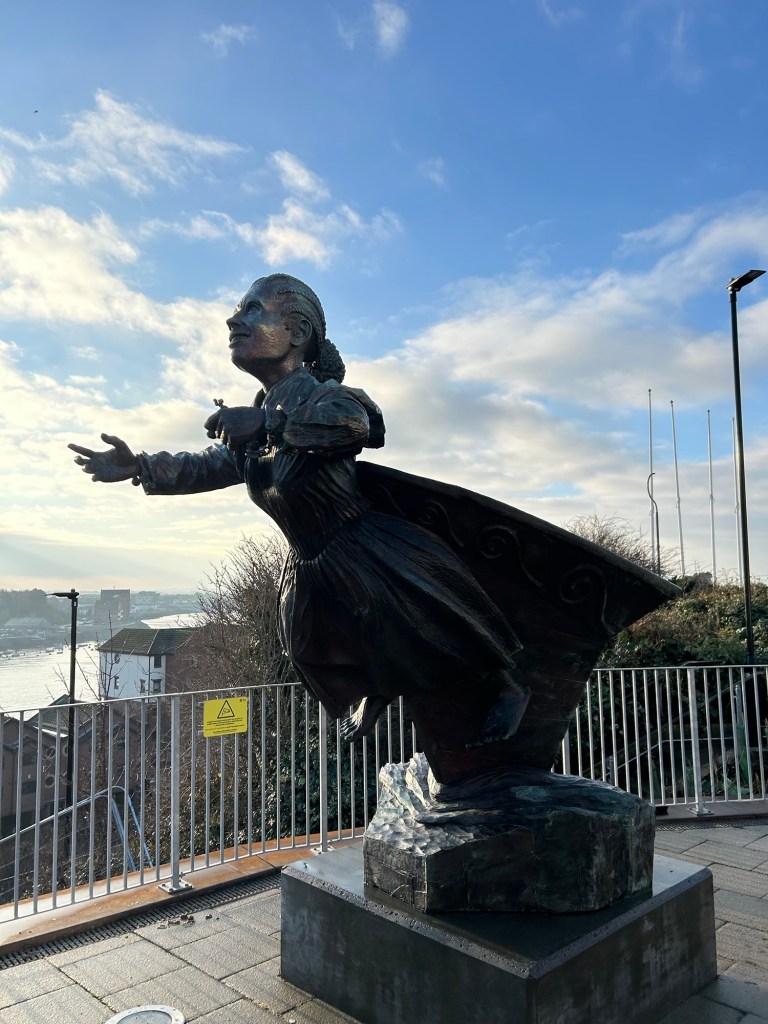
The local Sculptor Keith Barratt who created the piece has said to the local media that he wanted this sculpture to show that “she came from a place of great pain, but it’s also a story of human liberation, of breaking the chains and I feel that this is something universal that many people will understand”.
I suppose I have issue with how Mary Ann is framed within the story of her own life, which she doesn’t have control over maybe a bit then but definitely not now with how she is remembered.
I Love North Shields has more details about her life and attempts to create a bigger picture of her life before enslavement and after as a free woman living her life here in the north east. But frequently it has to be argued, the majority of time, Mary Ann is trapped within the ‘slave’ narrative perpetuated by white people. Although seeing her as ‘brave’ for plotting her escape, they still frame Mary Ann, tell her story within the role of once enslaved, and needing the help and support of kind Quakers. Sounds a lot like white saviorism. Then and now.
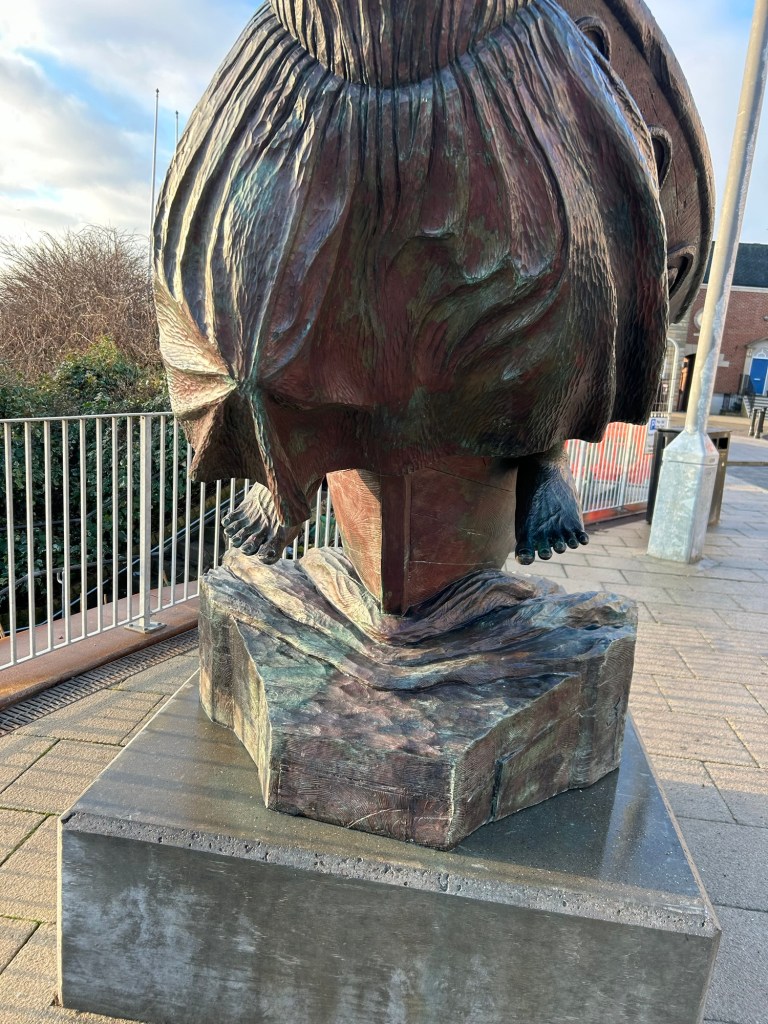
It’s almost like Mary Ann is stuck, encased in bronze, and barefoot to symbolise the condition of slavery. Enslavement she escaped from physically during her life, but trapped forever within this role in memorial because the white imagination cannot see/ grant Mary Ann her full humanity . The fullness of her life.
Time and time again, the mainstream constructs the stories they want to shed a light on and tell about people of the global majority which suits the narratives they’ve been running for centuries. The narratives where we don’t have agency or self-definition but are the objects, less than and victims. This is a means of control and domination.
This is why it’s important that we take every opportunity to tell our own stories. To control our own narratives. To leave these as archives for the people that come after we so they can be in no doubt that we lived big, beautiful, full lives on our own terms.
And is it me, or does the statue of Mary Ann Macham make her look like she’s white?
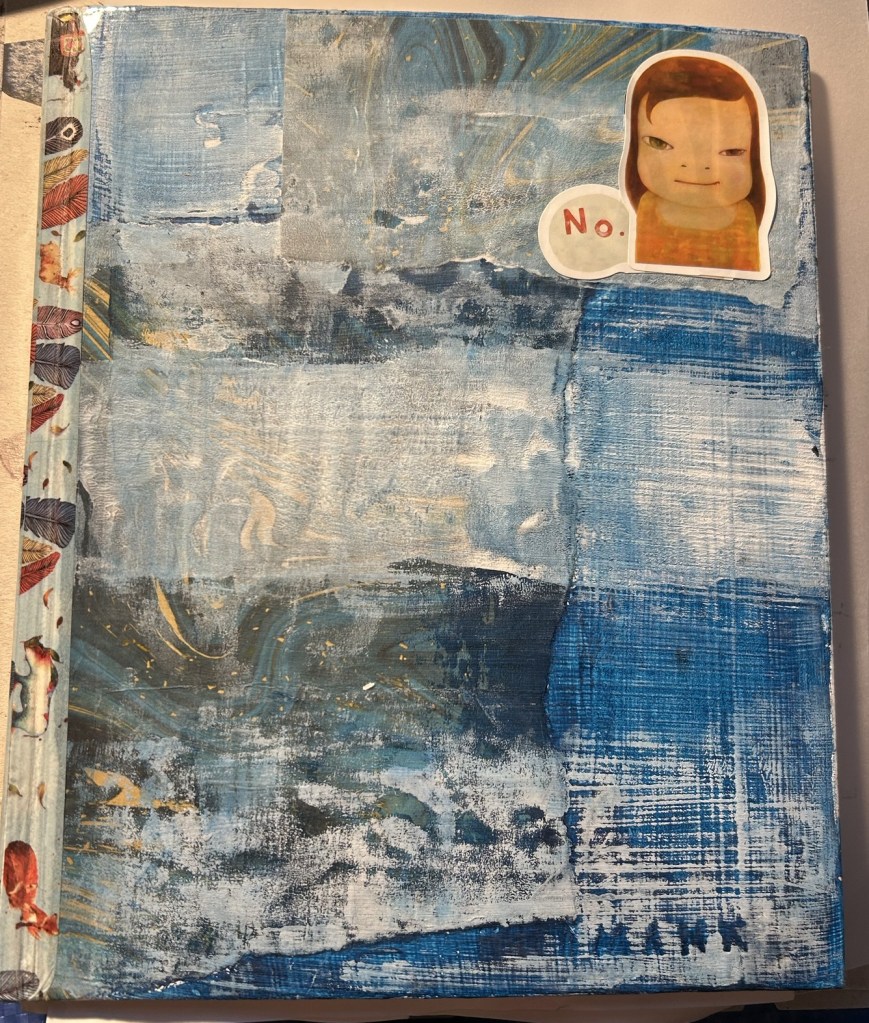
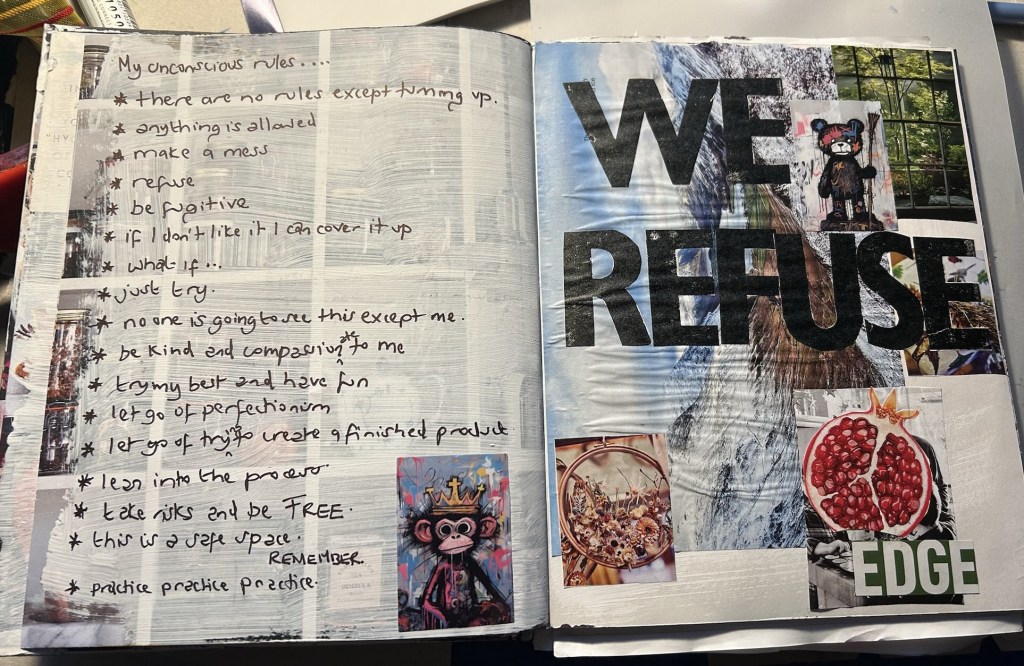
I’m not sure how my creative sketchbook differs from my visual journal. Intention maybe.
Perhaps, I think , I’m attempting to develop my art practice within a designated space. A study maybe.
I haven’t really been in the thick of my art making practice since the preparation for my Baltic exhibition back in 2022-3.
This was quickly followed with the writings and (re)drafts of Darkling, my poetry/hybrid collection published in October 2024.
After this 2025 has been a period of extended rest and refusal.
But something has been niggling me. The desire to create with paint again. the desire to play without expectations and outcomes/ products.
I’ve just scratched the itch through scrolling through Pinterest. Adding another abstract or landscape painting to a board that I’ll probably not look at again.
But it satisfied this niggling feeling. Until it didn’t.
It was going back into the classroom. Completing a few days of supply that pushed me over the edge.
The time I gave away for money. The time I’d lost pursuing my own pursuits. And realising that I wasn’t pursuing all the pursuits I wanted to pursue in the time I had/have.
So out came a creative sketchbook, inspired by the 30 days sketchbook challenge created by Cheryl Taves over at Insight Creative.
This is as much as I’m willing to share for now about the challenge, my creative sketchbook, processes and insights.
One of my rules is that it’s just for my eyes only. I want to see how this rule changes my practice. I want to create without fear but with curiosity. I want to give myself all the freedom without worrying about what others will think or say or comment on.
It’s not like I’m hanging on other people’s responses and reactions but I have gotten into a habit of just sharing anything and everything on my blog and I’m curious to see what happens when I keep things to myself.
Just for my eyes, heart, and soul only.
So far I’m enjoying the process of the challenge and I’m reflecting and paying attention to what makes my heart sing, what’s my creative vocabulary, what pushes my energies.
Do doubt whatever I explore within my creative sketchbook will be showing up in everything that I create. In everything who I {BE}. For sure.

In March the United Nations issued a report about Israel’s systematic use of sexual, reproductive and other forms of gender-based violence against Palestinian women since October 2023.
Those who shout long and hard about #womensrights have said fuck all about this abuse.
Perpetuating a system of oppression through gender-based violence and undermining self-determination is not coincidental.
But those who profess to be standing up for #womensrights say nothing.
Sexual and gender-based violence perpetuated across the Occupied Palestinian Territory is a strategy of war by Israel to demoralise and destroy Palestinians.
Those who shout long and hard about #womensrights have said fuck all about this abuse.
Israeli forces have destroyed sexual and reproductive healthcare facilities across Gaza. Medical support and equipment for safe pregnancies, postnatal care and neonatal care are decimated.
But those who profess to be standing up for #womensrights say nothing.
Women’s and girl’s reproductive right and autonomy as well as their right to life, health and dignity have been erased.
And yet these people, mostly white women, such as JK Rowling, who harp on about #womensrights and the so called threats posed by transgender people, say nothing about the Palestinian women and girls who are subjected to violence right now.
The deliberate starvation by Israel of Palestinian people has a devastating effect on pregnant women resulting in anaemia, malnutrition, miscarriages, stillbirths and undernourished newborns as lactating women cannot produce enough milk.
And yet these people here for #womensrights say nothing.
It would seem that those who claim to be champions of #womenrights pick and choose who has rights as women, fuck it, as human beings.
I had the pleasure of driving up the the Sill today for the opening of an exhibition to mark the 10th anniversary of Northumberland National Park and Kielder being designated an International Dark Sky Park.
Ten year again to the day 09 December 2013, this area, the largest in the UK, was recognised as an area of exceptional dark skies and should be protected.
I’m going to explore this further as well as this new word created to describe the pain and grief we feel around the loss of our dark skies: Noctalgia.
Sky grief.
The exhibition commissioned to mark the occasion as well as share the message that we all can be doing something to reduce our light pollution, we created by Beth Maddocks.
It involved a play with light and shadow, and paper and movement and sound. Exploring the nocturnal creatures and flora who depend upon the darkness to survive and who are being forced out as humans move in with their harsh electric lights.
I was inspired by the speeches and films and the exhibition and I’ve become curious.
More to come.
Happy April. Time for showers, blossom and light. Oh and poetry.
As I mentioned last week, I’m honouring National Poetry Month with the challenge of writing a poem a day.
I’ve set myself this task many times over the years, and I’ve always been amazed at the creations along the way. Poems have emerged onto the page that I didn’t even know were in me and needed expressing.
So today I come to the page with an open heart and a rough idea of the themes or issues I want to explore. But who knows with the creative process. Anything could happen.
Anyway day 1 – PAD/ 001
Trying to understand “the difference between poetry and rhetoric”
After Audre Lorde
The contested site of black settlement in England
is shrouded a heavy fog of amnesia. The wrong colour,
the wrong body, the wrong sound.
Read the history books, you’d think we just landed
the day before last. 400 years of being here, lost
in the mire, weighted down with size 10, Dr. Martens.
Like transplanted birds of paradise, West Indians
struggled to put down roots. Alien soil. On corners,
skylarking and limin’, jobs, homes and a little bit of peace
denied; harsh whispers on the bitterly cold wind.
The contested site of black settlement in England
is captured in stills. Images speak for themselves.
Black faces filling the frame; black blooms pressed
against hothouse glass. But still an absent presence in failed memories.

I recently talked about the coming of April and how more poetry would be appearing on here as I attempt to ‘play with words’.
You can not imagine the delight as well as confirmation I received this morning while reading an article for the commissioned essay I’m writing at the moment around (Black) Motherhood.
A bone of contention with me is when I see the words ‘mother’ and ‘motherhood’, even though I have birthed children, I do not see these terms applied to me. ‘Mother’ and ‘motherhood’ come with the connotations of white and whiteness for me.
Test it yourself. Be honest. When I first mentioned ‘mother’, what image came to mind for you? If not a white woman and child. I’ve seen image after image of the idea of motherhood, the natural beauty of ‘The mother’ and nine times out of ten the image is of a white woman and child. As if a Black woman is not/ cannot be seen as a mother, even though a Black woman is the source of the whole human race. Go look that one up!
Anyway, I’m going off topic here ( but not in terms of the hybrid essay I’m writing for the forthcoming special Demeter Press collection, The Mother Wave: Matricentric Feminism as Theory, Activism, and Practice (2023)).
Reading this article this morning, ‘ Conjuring the Ghost: A Call and Response to Haints’ by drea brown, there is a mention of poetry lying in the body, coming from that dark place within where our true spirits lies hidden and growing, argues Audre Lorde. But poetry is also our way, Black people’s way, or theorising and making sense of things. Through our stories, narratives, riddles, poetry; playing with words and language, we not only gain an understanding and reimagining of our lives but these are also tools of surviving.
As Black women, speaking from my lived- experience here, through our creativity, through our playing with language in such a spirited way, we enter in the process of not just theorising and strategising but also self-making and through this practice passing this on to others. Passing on this power to others. It’s what we do, have been doing through time. Starting with the mothering we do of ours and others babies

Too often we refuse to gaze
on something unpleasant to see.
Rubs against us all the wrong ways.
I don’t like to see an oak tree,
feel my neck snap. And my heart breaks
when there ‘s something unpleasant to see.
My words, a soundtrack for those taken;
blackmen whipped, flesh-eating scars, pain,
felt my neck snap and my heart broken.
Dead eyes and flashbulb smiles at the slain.
Who wants to look at these photographs?
Black guys, whipped, flesh-eating scars, pain.
Who has to deal with the aftermath
of bodies reshaped by tragedy?
Who wants to look at these photographs?
Callous grins surround,
too often we refuse to look.
Their bodies reshaped by tragedy
rubs us up the wrong way.

After Zak Ove
Come, follow me, young man, into the forest. Come. You like the sway of my hips, and my secret smile?
Then come, follow me, if you want to see more, to touch more. I’ll be all yours in the hidden forest away from the waging tongues.
Pay no mind to my necklace of antique nails or the weathered ropes I wear like a scarf or shawl. It’s just my unique style.
Come. Not yet. Don’t peak under my wide brimmed hat or under my long skirts. Patience, you naughty boy.
Come follow me and I’ll be all yours in time. Brass horns and trumpets I adorn because I love to make merry and dance.
African mask I wear because I know where my people come from. Smelling of jasmine and rose with a hint of decay. Come.
Pay no mind to the way I walk, one foot on the road and one beached tree trunk for a cow’s hoof in the grass. Come.
Come into the forest, deep into the forest where the trees are tall and thick and no one will hear you scream as you are lost and fall down a ravine.
Listen, I need you, handsome young soul, to keep my own beautiful. I feed off your fear and lostness and fall.
Listen I’m happy to own my own narrative again. They call me La Jablesse- she-devil.
Listen, I say, I’m a woman in control of who she be and who she chooses to take to forest, to bed, and to death.
 Living Wild Studios