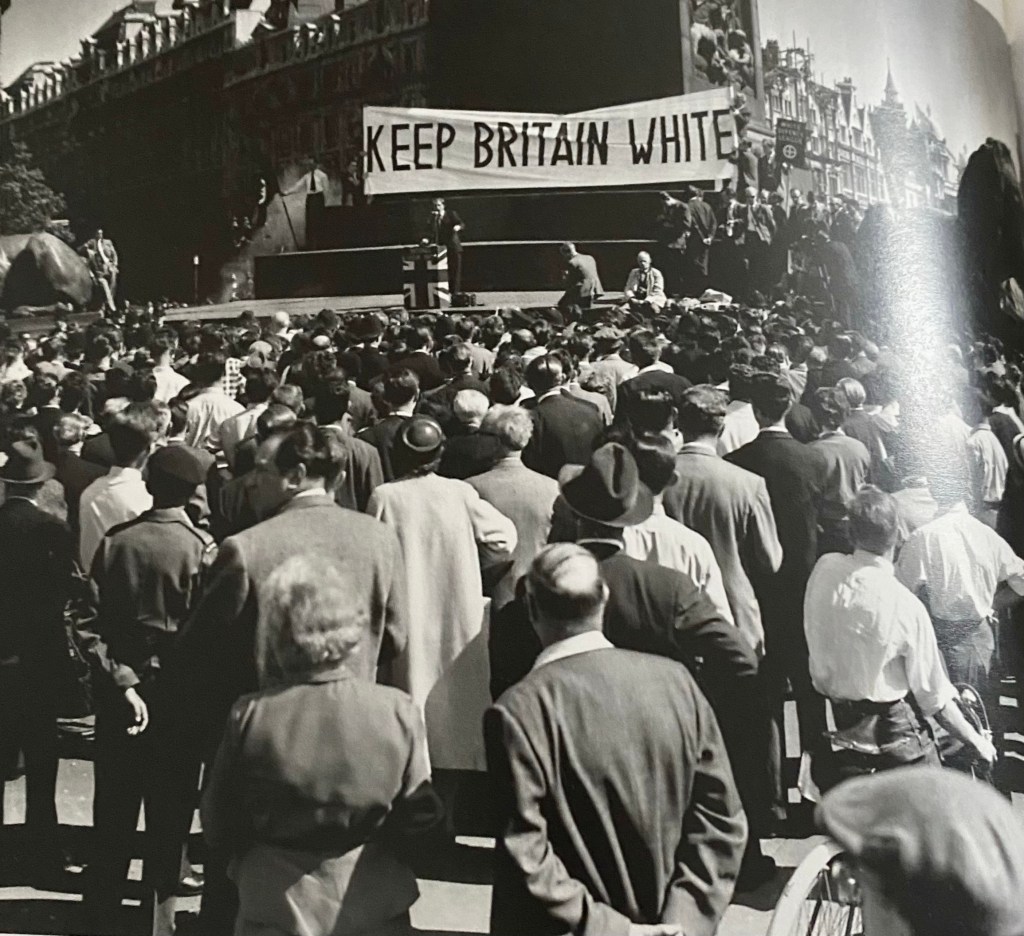
Stop the Coloured Invasion Protest Meeting, Trafalgar Square, London, 1959. Taken from Black Britain: A Photographic History, Ed’s. Stuart Hall and Paul Gilroy
a white banner shifts against Nelson’s Column, ‘KEEP BRITAIN WHITE.’
a bright white suspension of unwelcome and hate
ladies and gentlemen with heads turned up as if taking direction from God himself, listen to the message
from a man, on the platform, with Union Jack legs
as if whiteness and rightness runs through him like quickening sap/
the threat is real murmurs through the crowd/ a gathering searching for answers to stop the invasion
let me enter the scene/ from the extreme right/
let me mingle at the back/ near the man in a flat cap
let me feel the heat of the air/
let me sense the crackle of fear in their white, wholesome bodies
my body would be one of those coloured they want to stop
my body would be one of those aliens they want to exterminate
but what they don’t care to know is that this body belongs to a love evangelist
who’s at pains to show them how love can save us all
If I allowed curiosity and love to seep through the wounds, I wouldn’t be here now at the page trying to make sense of it.
A black girl walks through the meadow, enters the dark woods and forfeits her life. And I can’t but think if she was white …
Trust. Always difficult for me to hold, like light on burnt leaves. Like the coming of winter any day now.
The race talk, an accumulation of cautionary tales told through time, she, with earth in her voice, filled the void of rage with what was right for her soul. Joy.
When Petrified Trees Stand Up and March Into the Sea
I carve out solitude to wander wide open shores
sanddunes, pebbles and wooden limbs
Submerged a forest of trees so tall they flowed above the clouds
what we cannot control, we destroy and call it progress.
We advance like the tide to claim what we have no right to claim
concrete blocks, seaweed and dead seals, emerge from frothy waves and marram grass.
unseasonal storms uproot ancient trees while manmade concrete lines remain in tact in place in defence
here a legion of foreign bodies marched to expand an empire, build a wall then leave it to moss.
Bizzing dragonflies, shrubs of wax mirtle and the coconut vanilla scent of golden gorse
Some day soon all this will be gone,
gorse, grass, concrete wall,
washed away like blood as the sea returns to the source,
returns to where it belongs.
There’s a small hamlet, Low Hauxley nestled behind sand dunes along a long and quiet stretch of sandy beach on the Northumberland coast. Here along the high tide line stumps of an ancient forest are visible.
It is believed the stumps were preserved by peat and sand and are believed to date back to more than 7000 years and are the remains of Doggerland- an area of bogs, marches and forest that connected the British Isles to mainland Europe.
Archaeologists have also uncovered animal footprints and it is believed red deer, wild boar and brown bears would have roamed ancient Doggerland forest.
These petrified trees. This really blew my mind.
My name is Dr. Sheree Mack. I’m Creatrix : she who makes.
My practice manifests through poetry, storytelling, image and the unfolding histories of black people. I engage audiences around black women’s voices and bodies, black feminism, grief and healing, nature, identity and memory.
I advocate for black women’s voices, facilitating national and international creative workshops and retreats in the landscape, encouraging and supporting women on their journey of remembrance back to their bodies and authentic selves. This journey is supported and recognised by Mother Nature.
I’m the founder of Earth Sea Love, which is a social enterprise, offering opportunities to People of the Global Majority living in the north east of England to develop a deeper connection with/in nature.
The Earth Sea Love Podcast has developed out of these experiences and aims to change the narrative around who has a right to have a relationship with nature. I’ve recently been writer in residence for Northumberland National Park Authority. A black-led nature project I will add. At the moment I’m Creatrix in Residence for Hadrian’s Wall part of the 1900 years festival.
My Practice is a Healing Practice.
The Practice of ::SLOW:: is how I engage with my work and the world. Living within White Supremacy Culture, we are indoctrinated into certain principles and practices which benefit the few rather than the many.
Leaving aside racism and the systematic destruction of Black, brown and indigenous peoples, White Supremacy Culture, perpetuates the pursuit of perfectionism, product over process, and quantity over quality, to name but a few.
This means that the majority of us live our lives at speed, with a greater sense of urgency, with feelings of never being or doing enough, resulting in reduced contact to ourselves, our intuition and inner wisdom.
Slowing down supports me on my journey back to self and ultimately self-love and healing. Being and walking with/in nature teaches me how to slowdown and pay attention and just be.
Nature shows me that there is an abundance rather than a scarcity. It is through these practices that I fell in love with nature.
Nature and I are connected. We are one, therefore falling in love with nature, I fell in love with myself. This in turn means I turn up in life, in connection with others not only as a better version of myself but in a better place to offer love to other people.
I wasn’t really sure what to expect about this event or what I was going to share. But on reflection now, I’m so glad that I was invited to take part because I learned so much about peatlands within the UK, around the world and the special place they hold within the global climate crisis.
So much of my language around nature and the environment has been formed through white supremacy culture which has been biased on colonialism and imperialism and capitalist consumption. And of which I am at great pains now to unlearn and find a new language or it is just a re-memory of the language of my ancestors where there is no separation between us and nature.
Something that was raised last night by Khairani Barokka, which was totally new to my knowledge and way of thinking was that within indigenous communities gender was much more fluid and diverse. The binary system of male and female/ he and she which we take as a given now, as the norm, is a construction and part of the colonist program.
That the idea of “the coloniality of gender,” which might have seen the binary gender system in Europe but was not the case for indigenous populations around the world who were brutalised, moved off the lands and eliminated through genocide. This is going to require more reading on my part but it will be completed eagerly as it’s more evidence of how this system to live and breathe is a construct of power for a few white people over the rest of us all.
James Baldwin when interviewed after the SNCC Freedom Day demonstration in Selma, Alabama, October 1963 described what he saw there.
When was asked if he was afraid in the moment when the police were moving in on the African Americans waiting patiently to vote with guns and clubs and cattle prodders, Baldwin replied,
“ The thing is you get – you’re so scared – I was scared in the morning. Before it all began. And I was scared the first time I walked around there. But, later on, I wasn’t scared at all … Your fear is swallowed up by, you know … fury. What you really want to do is kill all those people.”*
* Quoted in Begin Again: James Baldwin’s America And It’s Urgent Lessons For Our Own, by Eddie S. Glaude Jr.
“The helmets were, you know, like a garden. So many colours.” James Baldwin *
‘It’s hard to be calm in a world made for whiteness. ‘ Austin Channing Brown
My last post, Black Fatigue, was written in a moment of anger, hence all the mistakes. Not mistakes in the argument or feelings but in the spellings and grammar. But I make no apologies. Sometimes it’s good for the soul, or good for me to let the anger out that I’m carrying around, moment to moment, daily.
It’s probably one of the rare occasions, I’ve allowed myself to vent as I have learned through years and experiences being an angry Black woman gets me nowhere. But the flip side, where has being an amicable and amenable Black woman got me? Probably well down the road of mental health issues and questionable wellbeing.
A week on, and I’m still sick and tired of the things playing out in my life as I move through this world in the body of a Black woman but still not recognised or treated as a fellow human being. I could even say that things have gotten worse as with time, more slights and ignorance and lack of awareness of their actions and inactions accumulate. Continue to accumulate as I get older but also as I attempt and fight to be met eye to eye with others as a human being deserving of living and striving within this world.
I oscillate between exhaustion and anger. Being depleted and fired up. And the worse thing of all is those that cause this suffering are oblivious to it. And even when I take the time and energy to point it out to them, how their actions are being unfair, unjust, unreasonable, and not seeing the situation in it’s totality they get on the defensive, do not engage with the issue, but deflect it away with comments like, ‘ I won’t engage with you when you’re being so aggressive.’
I stand by my post Black Fatigue. I just wish I’d mentioned emotional labour too. I can see now, as I reach 50 years old this year, that I have spent my lifetime trying to fit in. That means trying to be white. That is the only way to be let / given an inch in this game/ society/ life. I’m expected to be white because this is the cultural way of being. White people believe being white is right and good. Anything ‘other’ is wrong and should do everything right to become more white.
Now as I continue to question this standard, the way of operating in society, in the world, I’m going to become more and more angry and exhausted because I’m constantly being judged for being a Black female in a world made for whiteness. Everywhere I turn, in the street, on social media, on the TV, my self-esteem is being chipped away while living with the disparities in job opportunities, health care, education, and in the justice system. And I’m supposed to be happy and grateful when someone white talks about diversity and offers a crumb as if it’s taking a risk. And then if I have the audacity to ask for more, there’s tears.
I’ve taken a break from social media as I was falling into the comparison spiral trap as well as putting pressure on myself to produce. But I see now what I was doing was performing. This is my pain and this is my joy. I was striving for the viewer, for you, to see me, treat me, like a fellow human being. It appears it’s the only dance I know. I’ve spent a lifetime trying to be white at the same time as trying to convince/explain/ argue that I’m worthy, that I’m a fully functioning and feeling human being who deserves to be here for your discarded crumb. Fuck that for a game of soldiers.
I’m taking back control and my power so I can control my rage. Not to protect others but myself. I’ve got to make sure now that my anger doesn’t destroy me. I’m putting in emotional labour with me, for me now.
My reading habits this month have been flitting here and there and everywhere. I’ve found it difficult to concentrate and be disciplined enough to see a book through to the end. Being that said, when I did get into a book such as An America Marriage by Tayari Jones, I finished it in a day. Demonstrating that I just needed a book to grab and hold my attention to keep with it. But isn’t that usually the case? This book was fiction, something I’ve not been reading for a couple of months and the main characters were African-American. And it sang from the page right up to the end.
Still got all the books I’ve started this year on the go. Nature non-fiction book really, linked to my work, so with the lockdown, it makes perfect sense that I’m not rushing to complete these.
Here’s April’s readings:
1. An American Marriage by Tayari Jones
2. Afro-Persimism: An Introduction by Frank B. Wilderson III
3. Post Traumatic Slave Syndrome by Dr Joy Degruy
4. All Yarrow Magdalena’s zines
5. Black Girl Magic edited by Mahogany L. Browne, Idrissa Simmonds, and Jamila Wo




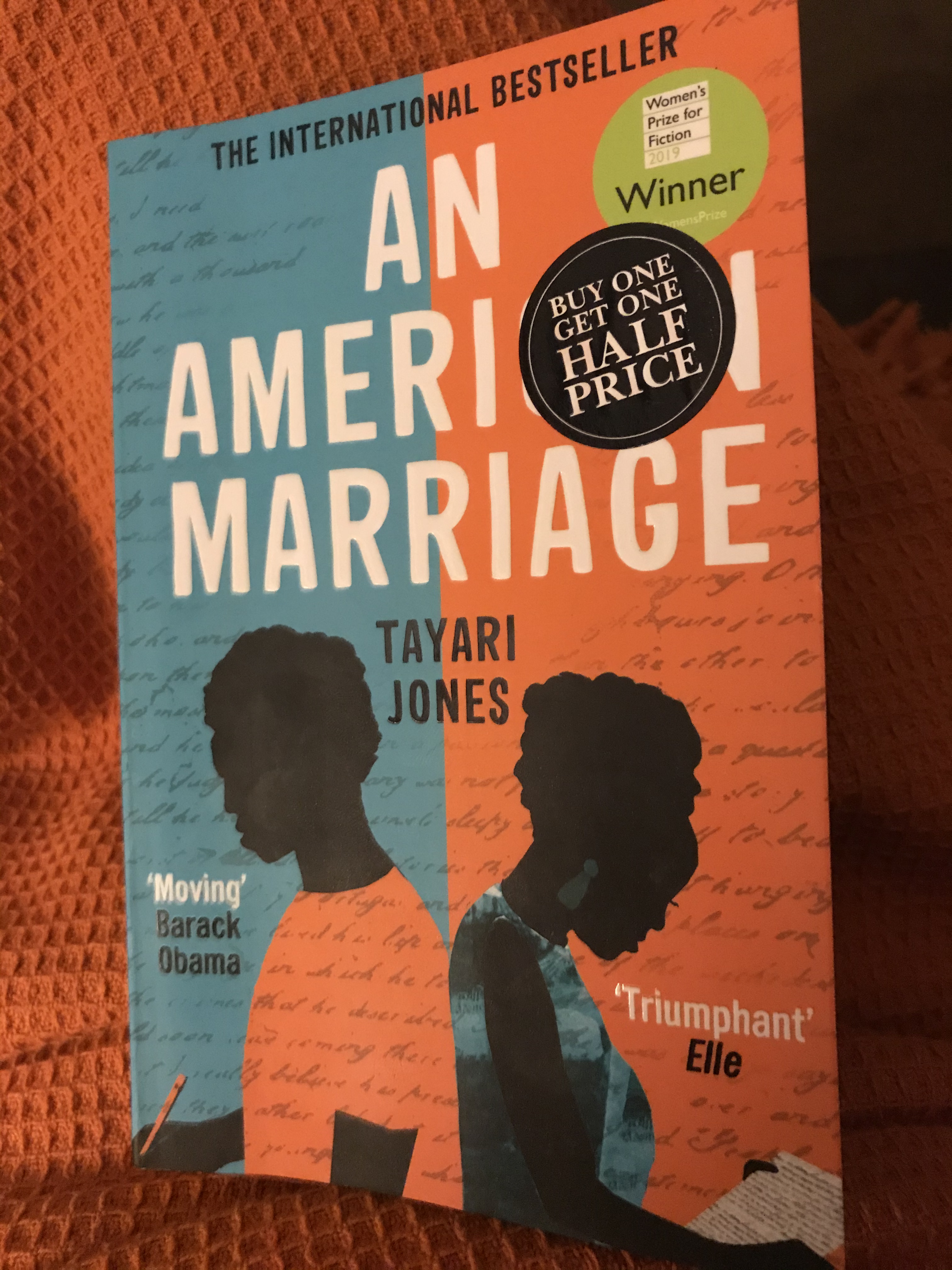 My reading habits this month have been flitting here and there and everywhere. I’ve found it difficult to concentrate and be disciplined enough to see a book through to the end. Being that said, when I did get into a book such as An America Marriage by Tayari Jones, I finished it in a day. Demonstrating that I just needed a book to grab and hold my attention to keep with it. But isn’t that usually the case? This book was fiction, something I’ve not been reading for a couple of months and the main characters were African-American. And it sang from the page right up to the end.
