Race
Ice Officer Says the Quiet Part Out Loud
youtube.com/shorts/YH9J0BioGMo
@reesewaters
How many of us have heard about Keith Porter Jr.?

I’ll tell you the truth, I heard about Keith Porter Jr. 1 day ago.
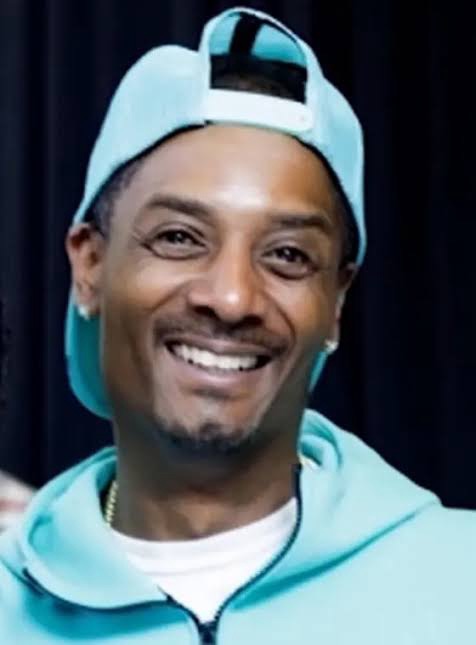
Keith Porter Jr., a 43 year old father of two girls. He loves fishing and spending time with his family. Laughing.
Keith fundraised for battered women’s shelters, supported street artists, advocated for health services. With real family and friends, real daughters and a real presence in his community, Keith Porter Jr. is no longer with us.
Rest in Power Keith.
On New Year’s Eve, in Northridge, Los Angeles, Keith was seeing in the new year with family and friends in his neighbourhood. Tradition was to fire a gun into the air in celebration.
An off duty ICE agent, heard the shots, and inserted himself into the situation. A situation he shouldn’t have been in as an ICE agent is supposedly trained in compliance, transportation, custody paperwork. Immigration.
ICE is not designed or trained in community engagement responses. community law enforcement.
It is argued that after a short verbal exchange, the ICE agent shot and killed Keith.
Official reports from federal agencies say the ICE agent was responding to an ‘active shooter situation’. The department of homeland security says Porter fired at the agent before he was killed (in cold blood).
Watch how they change the narrative. Remember Keith Porter Jr. the man laughing with his family, caring and empathetic will become the monster who deserves to be dead.
Family and community advocates dispute this claim, stating that there is no independent released video evidence showing Keith Porter Jr. posed an imminent threat or fired at the agent.
Rather than lethal force, this off duty ICE agent should have done his citizen’s duty and called local Police as this was not an immigration issue. This was not his jurisdiction, his authority.
Keith Porter Jr. became an imminent threat only when this ICE agent turned up.
ICE has no community engagement training. They might have authority but not in the community, they don’t have the judgement and empathy to be on the streets. But obviously this ICE agent, off duty, thought otherwise.
Nearly two weeks ago Keith Porter Jr. was shot and killed. And people, the average person, even those online are just starting to find out about this murder. Only after Renee Good’s cold bloodied murder.
There is selective outrage in America. As I wrote last week, I have no issue with the response to Renee Good – that’s how we should be respond in this situation.
But
#SayHisName
Keith Porter Jr.
His family had been struggling to get his story, his unlawful killing into the current media cycle. This just compounds what I’ve been saying about the lack of visibility in mainstream media of black people being unlawfully killed by law enforcement.
Be honest have you heard of Keith Porter Jr? But you’ve heard of Renee Good?
There are arguments we can put in place here . You might not have heard his name, Keith Porter Jr. because he was killed by an off duty ICE agent not on duty with a large crowd there. Might be because there’s little video evidence circulating around. But the main reason is because Keith Porter Jr. was a black man.
This is part of the reason for not using #SayHerName for Renee Good.
No one’s even heard of Keith Porter Jr. No national attention for his murder but within 24 hours everybody knew Renee Good’s name.
This is the very reason #SayHerName was created for the invisible black women and black men who are causalities of the state, of state terror.
And it’s only now that white people are waking up to this terror when black people have been enduring if for centuries. This is why I argue to consider the language used and to give credit and recognition for where it originated, why it was created in the first place.
And yet the same stories are being used to justify the unlawful killings of Renee Good and Keith Porter Jr. They were both pointing weapons at ICE agents, posed a threat and had to be eliminated.
I say
2 different people
2 different cities
but the same structural problem.
Later down the line this might get read as the one bad apple or one bad moment. But this is clearly a system which once hidden no longer neededs to remain hidden.
A system that is built without limits or accountability.
De facto special powers bestowed by the Trump administration on ICE that seem to supersede police powers. ICE is now inserting itself into everyday life and every day neighbourhoods. And as we are witnessing this very presence is killing people. Killing more and more people who weren’t even their targets.
But that no longer seems to matter.
As I’ve said before and I’ll say again, I don’t have an issue with the response to Renee Good – that’s how we should be responding in a situation like this. I just argue that the others, and there’s a long list that is growing of people who have been killed by ICE during this administration, deserve the same energy that is surrounding the murder of Renee Good.
As last time I checked, these are not animals, criminals or just talking points but human beings. Real human beings with grieving families. And this is something that gets forgotten in the media.
We need to continue to have these conversations and we need to keep fighting, on the small and large scale, against fascism near and far.
Antiracism is Anticapitalism -002

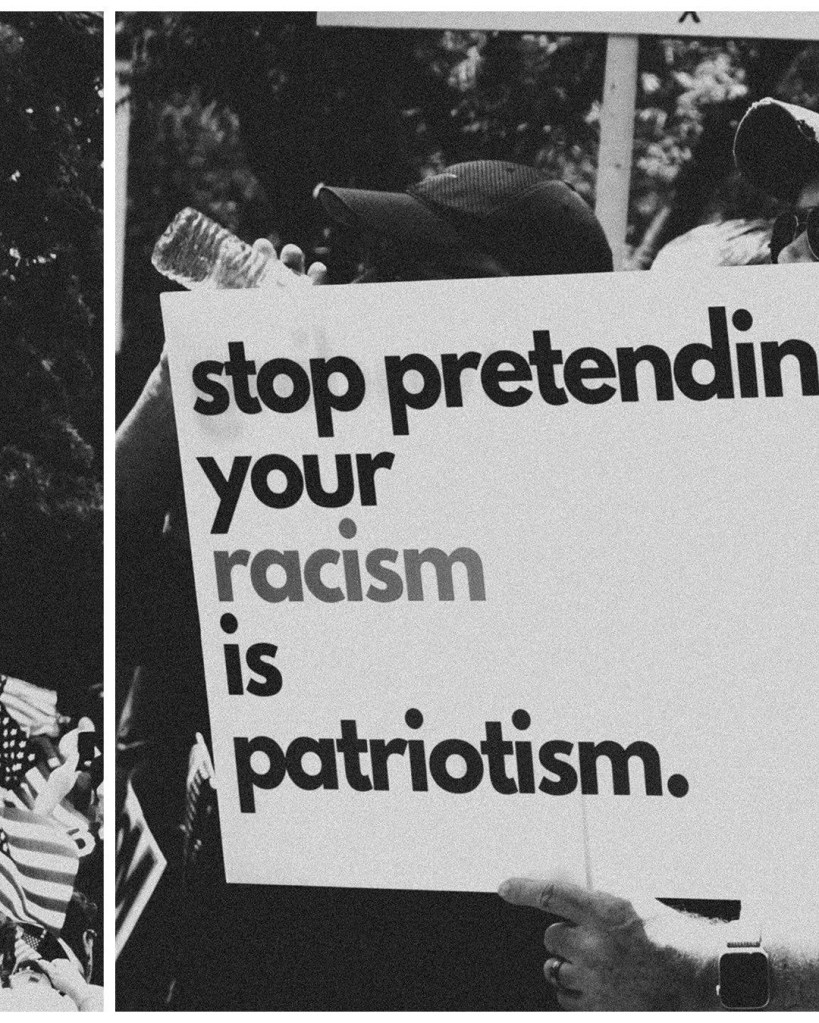
Last week and the week before was a deep dive into the far right rising within the UK. The raising the colours from one neighbourhood to another. The flags to stroke unity and patriotism is the hearts of every British subject. Right? Bullshit.
I know it’s not either/or thinking. I know it’s and/both. But having a conversation with these people is not possible. Listening doesn’t take place because those who hold far right tendencies see a black or brown face and instantly think inferior, immigrant, illegal. No right to be here. No rights at all as not really human. You can’t listen to something you don’t see.
Anyway, I was doing all this research into ‘raise the colours’ for my annual trip into Sunderland University for my lectures around antiracism.
I change them every year in line with my own learning and development in becoming antiracist. And really antiracism is anticapitalism. Has to be . But the different antiracism forums or organisations or groups operating at the moment that I’ve been part of haven’t received this memo. Their still operating under the guise that we need to come together as allies and educate people around privilege and fragility and be kinder to each other. Bullshit.
In the words of Fred Moten,
“I don’t need your help. I just need you to recognise that this shit is killing you, too, however much more softly, you stupid motherfucker, you know?”
So I’ve decided to release my 5 years of antiracism lectures I’ve prepared for Sunderland University over on my patreon account over the next month or so, as a sharing of knowledge and learning. Please consider checking it out. It should be free to access but sometimes these sites put in shit you don’t realise all in the name of progress. Bullshit. More like profit. Capitalism again.
But yeah should be free but if you fancy buying me a coffee, hit that button!
Anti-racism is anti-capitalism

I really appreciate it when you’ve bought a book and are ready to dive into it, but you’re just not feeling it. You can’t get into it. So onto the book shelf it goes, collecting dust. Maybe even taunting you.
And then, over time, into a different time, you pick up said book again and you dive into this time, deeply. It’s singing it’s message through you mind, body and soul.
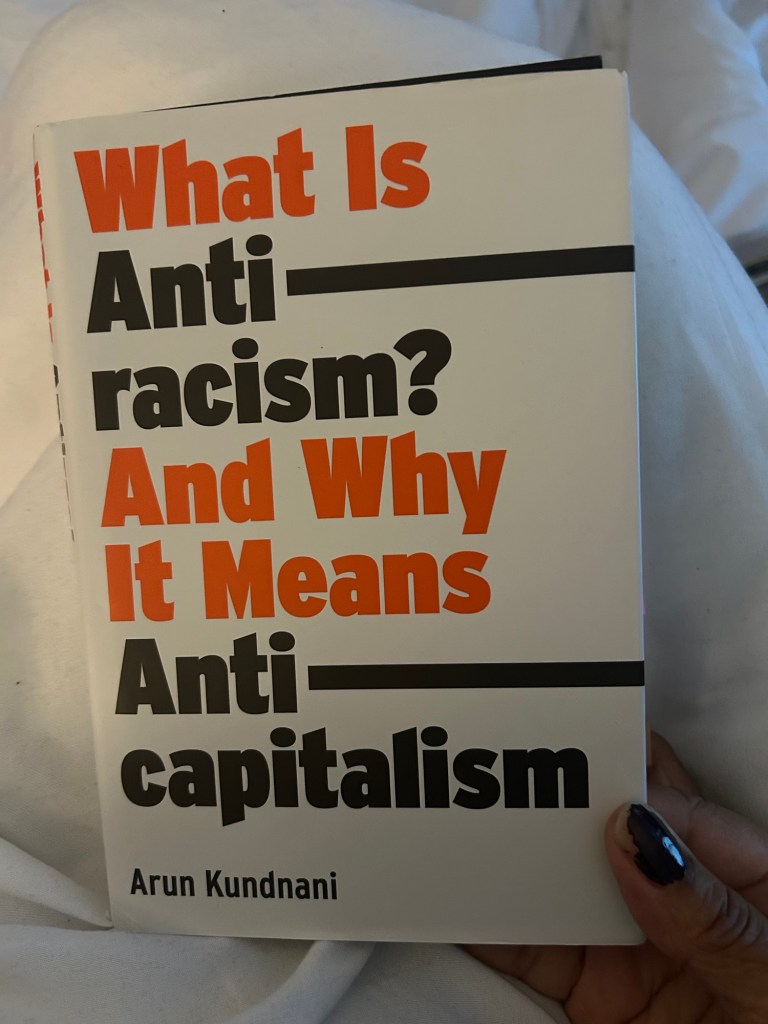
This practice happened for me with Women Who Run With Wolves by Clarissa Pinkola Estes and here it’s happened again with What is antiracism? by Arun Kundnani.
It’s that time of year again where I’m due to go back into Sunderland University and lecture within the Social Work Department around anti-racism. This started in 2020, in the pandemic and the Black Lives Matter uprisings around the world. Up until this point there had been no addressing of race and racism within social work training. And you could still say this is the case as one session, 2-3 hours long, is hardly making a dent into racism and its consequences. But I digress.
Anyway each year, my thinking and practices have changed as I’ve read more and developed more as an anti-racist, anti-capitalist agitator, organiser and activist.
I share my learnings and findings as I want to bring about change for everyone. And this transformation can’t be just limited to working on a personal level as the usual anti-racism training/ education would have us believe.
The problem is not just on an individual level, our unconscious biases etc, the problems are structural and are engrained into the bedrock of our societies, countries and communities.
Anyhow, this book What is antiracism? is not only giving me the historical evidence of racism, the term and practices, but is also sharpening my argument around how racism and classism go hand in hand and that you cannot have a revolution without black workers leading the way. As black workers have always fought for freedom and the dismantling of capitalism for everyone, not just for (white) workers as the revolutions within Europe have done.
We have the French Revolution in the 1700s, lead by the urban masses. We have the Russian Revolution lead by the vanguard party for the proletariat. But we have the Saint-Domingue Revolution in the 1700s lead by the enslaved for abolition of all enslavement in the colonies and Europe, in tandem with the French Revolution happening in Paris. The first time that black and white workers were fighting a common cause together on this scale.
Which revolution succeeded?
The revolution lead by the enslaved, black forced labour, which created the sovereign state of Haiti, a black revolution which had at its heart radical action to transform all societies.
This is what we need now.
Over Here Zine Festival 2025

Today, Dal and I were in Manchester as the Over Here Zine Festival again. I think is out third year there together, sharing a table of our creations and laughing far too loud for such a small room in People’s Museum in Manchester.
It was good to be in a space that was created for people of the global majority to share their zines. It’s usually a safe and supportive space. And it still is in some respects. But what is worrying is that more and more white people are infiltrating our safe spaces. I know that white people come in to see and buy our creations. I can this is who we are selling to, while we swap with each other. But at the same time, I noticed white people behind the curtain, on the wrong side of the tables selling zines. But I could be wrong?
An article I read the other year, titled ‘Ontological Expansiveness’ by Chris Corces-Zimmerman, Devon Thomas, Elizabeth A. Collins and Nolan L. Cabrera, where I learnt the language I needed to call out this sense of expansionof white people into black and brown spaces where maybe the ethos and intention is exclusivity.
Ontological Expansiveness is a theoretical framework used under the umbrella of Critical Whiteness Studies (CWS) that was conceptualized by Sullivan (2006) to describe the complex and nuanced relationships that exist among race, Whiteness, and space. Sullivan (2006) argues, “As ontologically expansive, white people tend to act and think as if all spaces – whether geographical, psychical, linguistic, economic, or otherwise – are or should be available to them to move in and out as they wish” (p. 10).
Corces-Zimmerman, Chris & Thomas, Devon & Collins, Elizabeth. (2021). Ontological Expansiveness. 10.1163/9789004444836_058.
I could be wrong, but how is feels to me, and how I’ve been experiencing things, is that white people think and act and move as if they have a right to be in any and all spaces. Sullivan suggests that White people tend to think of themselves as though they are the only people to exist or have worth in the world. Black and brown people just don’t come into the equation. Colonialism is the epitome of ontological expansiveness.
In this example as the zine festival, I’m talking about taking up physical space, but ontological expansiveness also applies to language and who white people claim ownership, through creating definition of what is proper English for example. What’s acceptable is the language and tone and style of whiteness, any other forms of communications are wrong. Yet that doesn’t stop white people wanting to use Ebonics or use the ‘N’ word. And then there’s the appropriate of our cultural practices .
As Sullivan (2006) states, White people frequently act as if, “The appropriate relationship is one of appropriation: taking land, people, and the fruit of others’ labor and creativity as one’s own” (p. 122). Frequently, instances of White people engaging in acts of cultural appropriation represent a fetishizing and exploitation of the language, customs, or practices
Corces-Zimmerman, Chris & Thomas, Devon & Collins, Elizabeth. (2021). Ontological Expansiveness. 10.1163/9789004444836_058.
of Communities of Color.
Of course white privilege is wrapped up in this but it’s not enough to say this privilege needs to be given up or shared. Before anything changes white people need to acknowledge what they are actually doing, but how are they going to do this if they are oblivious to what they are doing?
I invite white people to recognise that they will feel uncomfortable when they do enter spaces that are predominantly non-white and get used to it. As in that discomfort is the seed of change.
take me dancing, dancing in the rain

retro disco. good tunes. way back to our youth. we’re dancing. enjoying the tuuuunnnnneeees.
i kick off my shoes. barefoot in the grass. the cold september grass.
i look around. blond woman staring. pointing at me. talking to her man. me and my bare feet. laughing. i know she’s not saying anything good about me.
i stare back. she sees i see her. she tries to cover her tracks. too late. bitch. i see you.
before. i’d smile. make it appear as all is well. while i bleed from another wound inside.
before. i’d smile. make her feel better. while i die another death inside.
tonight. i ain’t smiling. i give her cut eye. i stare her down. she looks away first.
i continue to dance barefoot. smiling inside.
continuing to live and learn

“On the afternoon of May 16, 2020, about a week before George Floyd was killed by the police, twenty-one-year-old Tye Anders was accused by the Midland, Texas, police of running a stop sign. He pulled over in front of his ninety-year-old grandmother’s house.”
Excerpt From
We Refuse
Kellie Carter Jackson
There’s Anders pleading for his life. There’s many policemen with guns drawn pointed at him and there’s bystanders filming it all. One woman who’s filming this is also pleading for the police to not shot Anders saying he’s scared. Hasn’t there been enough killing of unarmed black people, killed just because of the colour of their skin?
Still no guns are lowered and Anders is on the ground clearly empty handed but the situation is just escalating as the police continue to train their guns on his body.
Anders’ ninety-years-old grandmother steps out of her house praying. With cane in hand she walks towards her grandson even though guns are trained in her direction.
There was still panic still bystanders screaming for the police to put their guns up. Some do but still one cop is walking towards Anders with his gun raised. Trying to move and push her out of the way, his grandmother doesn’t believe that her grandson won’t still be shot so she falls onto her grandson, protecting his body with her own body. Not longer after this with the police and crowd pushing and pulsating around her , she loses consciousness.
Anders is arrested for fleeing the police. His grandmother is taken to hospital.
Reading this story this morning made me cry. Not because of the police brutality or the disregard for human life, black life. But because of what the grandmother in the story did. She’s ninety-years-old, frail and only has her prays and body, but used both in protection, in an act of love.
“Her collapse was not a coincidence. Protection is powerful, beautiful, and sacrificial because protection is love. But she should not have needed to put her body between the police and her grandson to protect him.”
Excerpt From
We Refuse
Kellie Carter Jackson.
Protection. She should not have needed to, but she did put her body between the police and grandson to protect him. This act of courage broke my heart this morning. Had me weeping. Maybe it was the last straw that pushed me over the edge into the breakdown. Maybe it was my imagination seeing this playing out.
Maybe I’m just sick and tired of living in a world where white violence is justified and black violence is really self-defence but is never judged that way.
I’ve always been a supporter of care work but even more so now. As care work, along with rest are forms of protection. Through the way I {BE} with myself and others, and the work that I do for self and others, I’m tending daily to the mental, emotional, and physical needs and health of black people, so we are better equipped to survive and thrive within a hostile, brutal, grinning world.
Confronting Fascism
What are you most worried about for the future?

the undercurrent has always been present, simmering like lava just below the surface ready to rise up at weak points, at moment of disarray and hopelessness. hate shimmers like jewels to those who have little but promised more. clinging to the sharp edges of hate because it’s something to feel, to use as a weapon against others instead of the self. hate with fear, a lethal concoction corroding within as well as without.
1936. October. With a chill in the air, the blackshirts ruffled through the East End of London, snaking their territory, their Ayran rights. With Police fronting, they still couldn’t take the streets. Jews, Irish, Communists, Blacks, Labour activists, workers unite. Stand firm. Shoulder to shoulder, they shall not pass. Blackshirts, angry scrunched up faces, hearts riddled with hate and fear, shall not pass.