i’m protecting my peace so i have the energy for me, to {BE} in service for we, the we that looks/{BE} like me
this is all becoming clearer now
i’m not expending or wasting any more time, energy, attention on those (white) people who do not see me. or when they do see me, they do not see me as human
as Akwugo Emejulu says, the black woman can never be a human being
for decades i’ve spent time, energy, attention, through my practice and day to day life, trying to convince others ( white people) of my humanity. i would bend over backwards trying to get accepted, recognised, cherished as a fellow human being
look, please, i’m human. look, please, i feel, i hurt, i bleed. i breathe
no more. i am no longer prepared to play that role. dance this stupid dance. as i will never be accepted, recognised, loved as a human being. the system won’t allow it. (white) people won’t allow it
i’m no longer wasting my energy on proving jackshit
i’m refusing what has already been refused of me ( fugitivity)
i knowing who i be. i am smart, i am kind, i am important ( The Help). and i don’t need/want/entertain any (white) person to tell/grant/recognise me as such
and i’m no longer apologising/ playing it down or safe/ tempering for how i feel/act/ {BE} about this situation
as that just expends/takes/sucks out of me a whole heap and of other energy
As the wind rocks us, and the rain soothes us, Kiwi and I enjoy a little excursion.
Hardly little when we drove from our home to Portsmouth and then to Lymington to catch the ferry to the Isle of Wight.
I came here once before with my mum when I was in middle school I think. Or maybe high school. We brought my friend Judith too.
We stayed in a B & B and went to the beach everyday. It was gorgeous. Now looking back, it seems weird going away on holiday with a school friend. But that’s what we’d do back then.
I say weird, but here I am away with my Uni friend Alex and his partner. So go figure.
It’s forecast wind for the weekend and showers. So let’s see how it goes. I’m not complaining because I’m mighty cosy inside Kiwi.
I’m slowing all the way down. Appreciating the time and space, dropping out of time and space for a little while. I’m taking to {BEING} this more and more these days. Figuring out that rest, slow and {BEING} on my own terms is all I ever want in this life.
And I’m not going to given this. I have to take it.
For those of us who live at the shoreline… Audre Lorde
It will be 10 years this August that I started my visual journaling practice.
Then it was called Dreaming on Paper, as I completed the course of the same name by Lisa Sonora.
I needed a safe space to explore the tumult of my feelings and thoughts. I was going through a traumatic experience of escape really. Escape from the life I’d spent the past 12 years building up, that was took away in the flick of a Facebook post.
I ran away from the public, the writing community, my home as I travelled into the Scottish Highlands and Islands. To heal.
Visual journaling helped me heal. Helps me continue to heal.
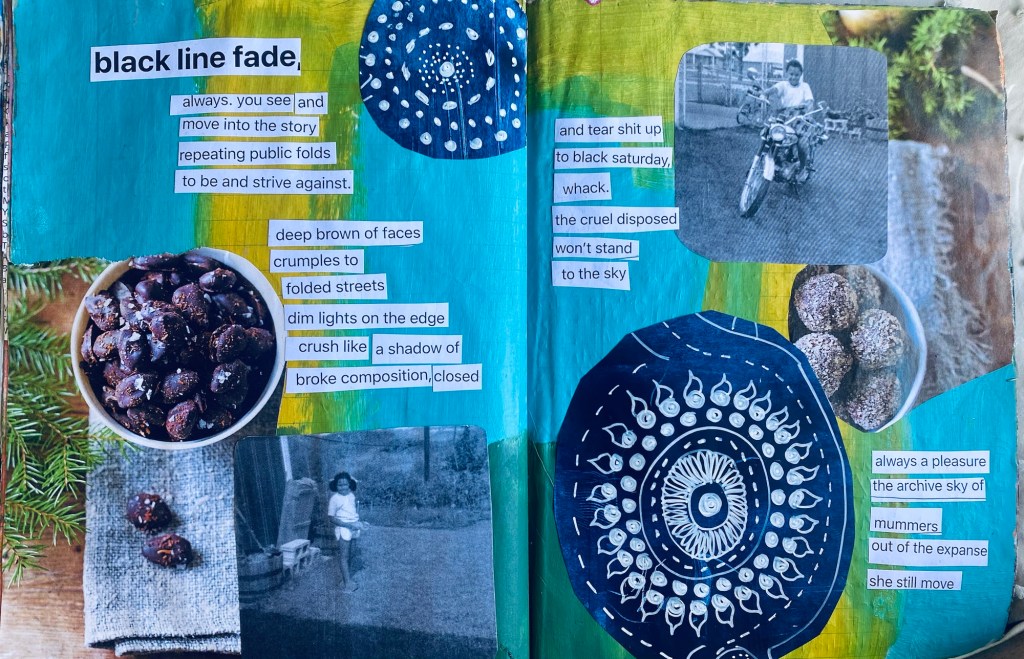
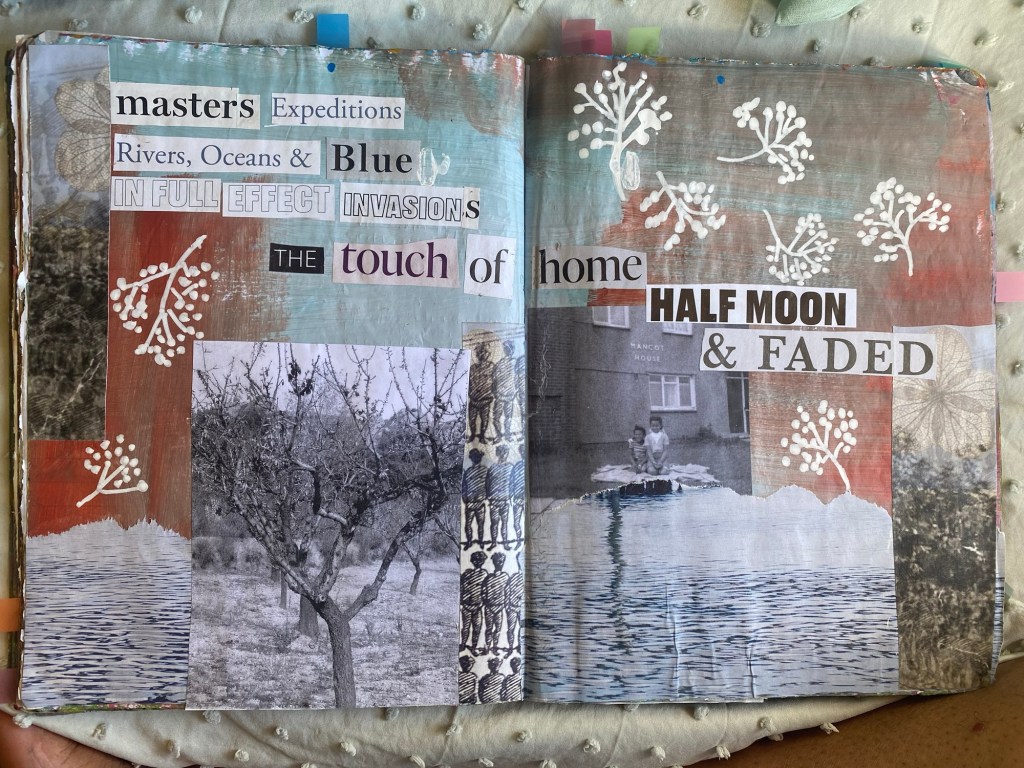
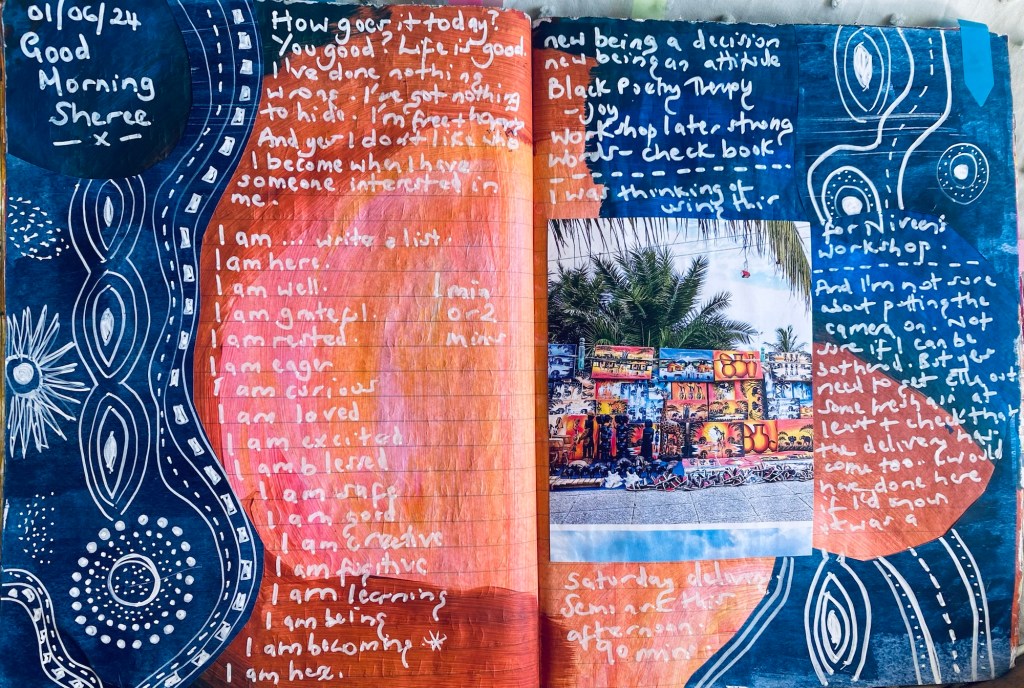
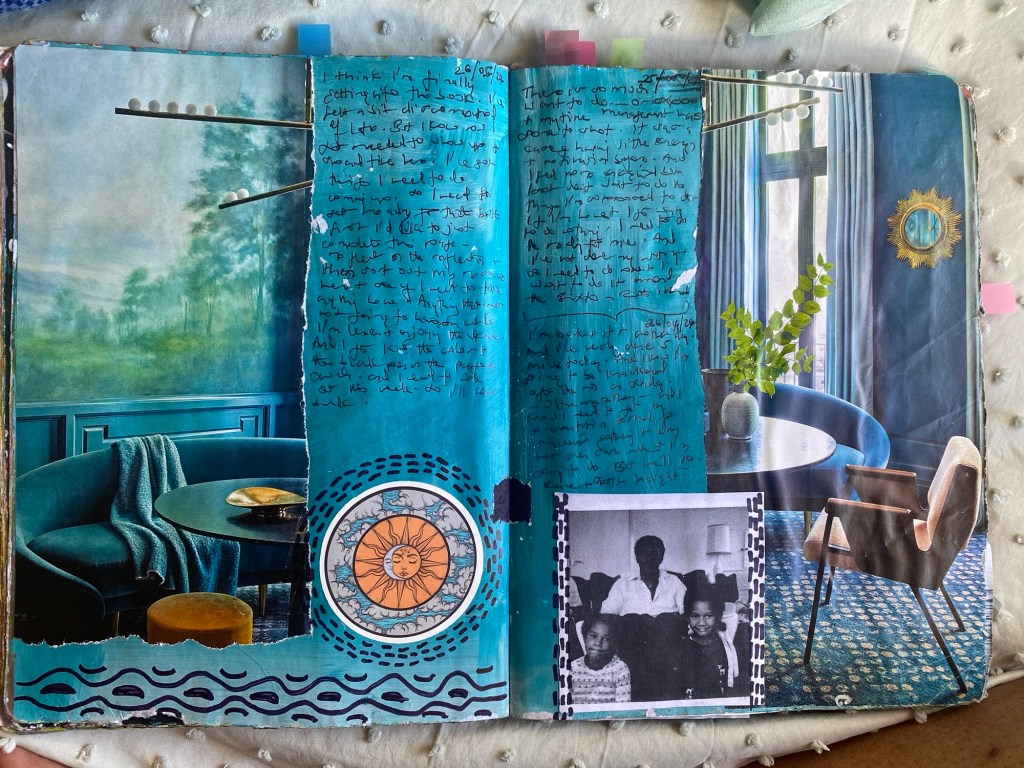
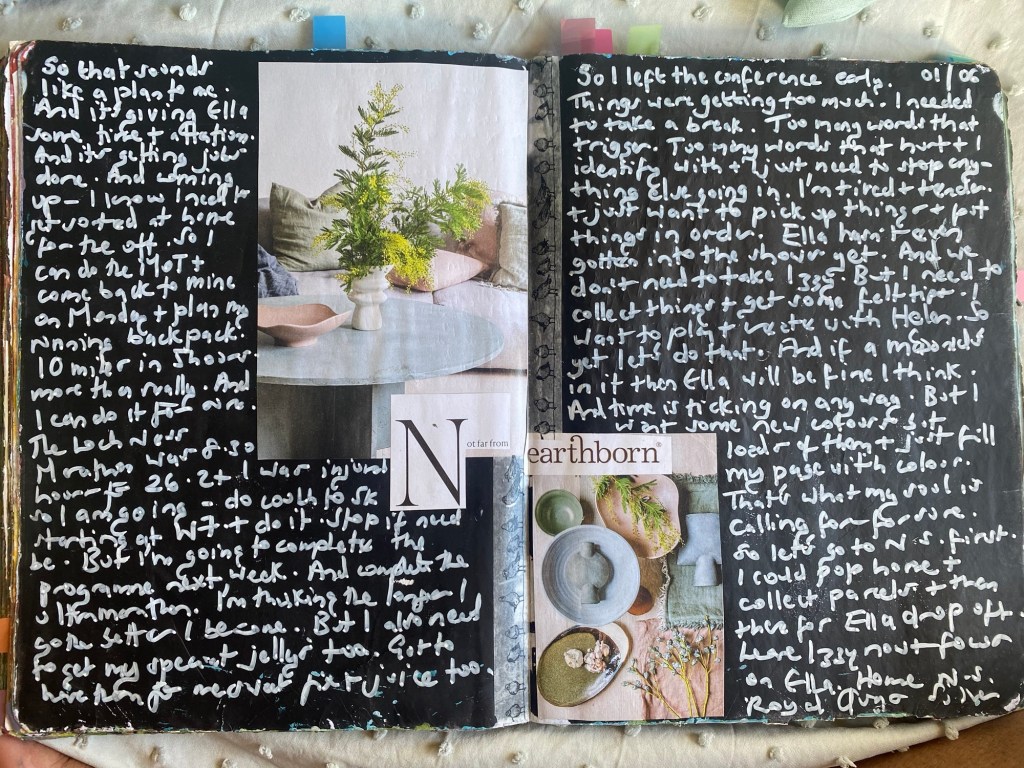
Overtime, I’ve come to understand my visual journal practice as a fugitive practice. Within these paints, images and words, dreams of freedom are planned out and eventually come to fruition. Projects, happenings, events – all on my own terms.
I mean, the whole point about escape is that it’s an activity. It’s not an achievement. You don’t ever get escaped. – Fred Moten
Within these visual journal spreads, I work out how to escape, how to get outside white supremacy culture while still having to be living on the inside. Coming to terms with the thought of that the outside can only occur from the inside. Being here.
Visual journaling is me trying to create an opening, a break in the fabric in which to slip on through into the otherside/ outside, into the woods running between the trees with the dogs barking at my feet. Creating beauty, creating a beautiful space in which to linger in while the terror rages around me.
Visual journaling is a safe space, is a nurturing space, is a free space.
I’m practicing how to show up in spaces, alone and with others, in fullness.
I’ve used wholeness before. Striving to get back to that sense of being whole, as we enter as already into this world. And then for the rest of our lives society and culture pull us away from our wholeness. When we realise, usually when much older and not giving a fuck, we spend our time and energy attempting to get back to that wholeness. This is a practice too, but to be whole sounds final and also out of reach.
Fullness. While fullness seems something that can be embraced now. In the present, moment to moment. Fullness for me gives the middle finger to those who have criticised me by saying I’m too much. Too Black. Too fat. Too loud. Too enthusiastic. Too Alive. Too much.
Fullness is me embracing my too-muchness and giving off that ‘don’t care less’ energy.
This piece was written back in 2020 and published on Medium. I’ve brought it over here to be part of my writing archive. I also feel that the case needed restating frequently. Did I say daily?
We queue with our shopping basket. This is the norm now. But we don’t complain. It keeps everyone safe. We’re at the front of the queue, for a change. My daughter and I. We’ve only come to the one shop. I let her ride her bike into town. She needs the exercise as she’d be happy in front of her screen all day. I probably would too, as at least she’s inside safe, connecting with her friends, and I get a moment to myself.
Front of the queue, but we hold back as the woman in front of us has just gone into the shop. There’s someone coming out at the same time. The store security guard is standing in the mix too. We allow a gap to form between us; the woman and the entrance and our bodies. Coming across from an adjacent shop, a man and woman stride. Stride into the front of the queue, ready to walk into the shop. I raise my voice just above my normal speaking voice to say to them, There’s a queue. We’re waiting to go into the shop too.
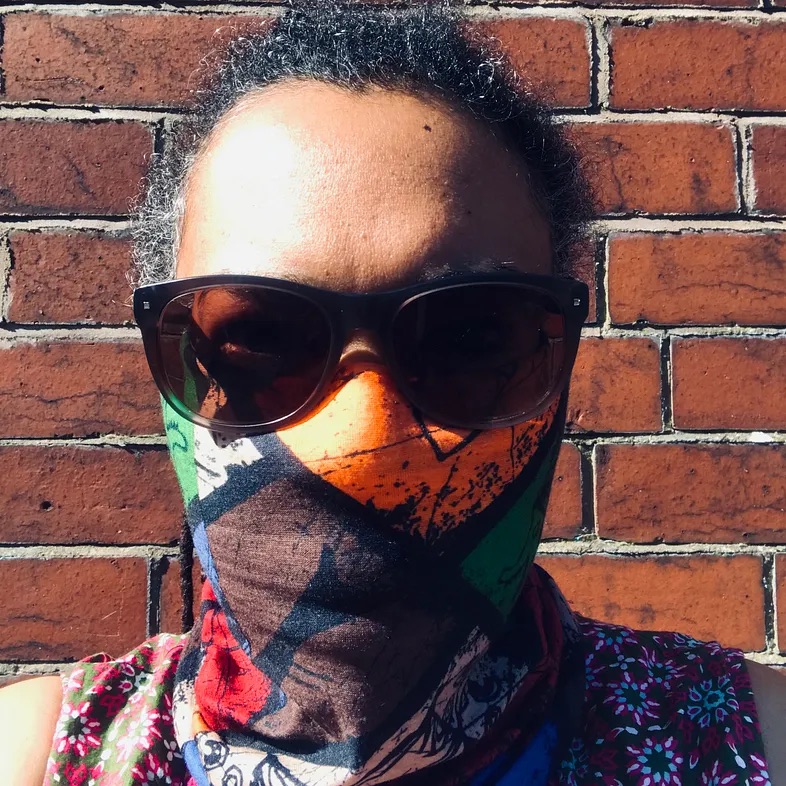
I think I’m smiling but how can they know? How can anyone tell if you’re smiling when you’re wearing face protection? By your eyes. I think by the eyes, you can tell if someone is smiling. It’s a warm, sunny day. I’m wearing sunglasses. Maybe they can’t see my eyes. They can only use my voice as means of communication.
Sorry, they say. We thought the queue was going the other way. They walk to join the queue behind us. I say, in a tone of voice which I think says I understand, No, the lady in front of us has just gone in and we’re waiting back here to giving everyone some space.
In the time it takes for the couple to walk and wait behind us, at the recommended 2 metres, the woman of the couple has already started saying in a loud enough voice for us to hear, Some people are just getting angry about the situation now, and there’s s no need for it. We walk into the shop.
Note: The angry Black woman stereotype portrays a black woman as sassy, ill-mannered, and ill-tempered by nature.
Walking back home, Ella walking with her bike, I approach what happened outside the shop, asking Ella if she heard what the woman said about people getting angry.
She was referring to me. I explained. She saw me as an angry Black woman. Do you think I was angry because you’ve seen me angry?
My daughter knows me. She knows I wasn’t angry and says so.
When you live in a society where you’re powerless, perceived as worthless and inferior, those who have power, believing themselves to be superior, spend their time telling others how they handle the situation isn’t right. They tell you that how you speak or act or response isn’t appropriate. You are wrong. They gaslight you, forcing you to doubt yourself; your actions and capabilities. You are at fault, always. You are wrong. You are silenced.
Back home, I talk to my husband, who’s a white man. I think if he’d been with us, the woman behind us, wouldn’t have uttered the angry line. He disagrees. She sounds like a woman who would have gotten annoyed if anyone had checked her behaviour, he said.
He has the right to think and say that. And maybe he’s right. Who knows? But to accept this explanation, I’d have to disallow what I feel about the situation. I’d have to make allowances once again for someone else’s behaviour, reaction and treatment of me. I’ve spent a lifetime of making allowances for other people’s treatment of me. How can I be sure that when they treat me unfairly, or discriminate against me that this isn’t how they treat everyone else? I don’t know. All I have is the way they make me feel. My lived experience as a Black woman.
All I know is that when I’m walking down the street and someone is coming towards me, it’s me who walks into the road to maintain social distancing. It’s me who walks into the gutter to keep us both safe. Would they do the same? I don’t know. I can’t take the risk to wait and find out either.
I’ve been socialised, fed the stereotype of the angry Black woman for so long, I police myself. I play my part. I don’t raise my voice. I don’t protest or question. It’s part of my make-up to check myself so I appear in society as passive and non-confrontational and unseen.
I wake up ( that is if I got any sleep) and give thanks.
Play Love Dimension by Beautiful Chorus a few times
Water out/ water in
Back to bed for Insight Timer medication or course
Read in bed
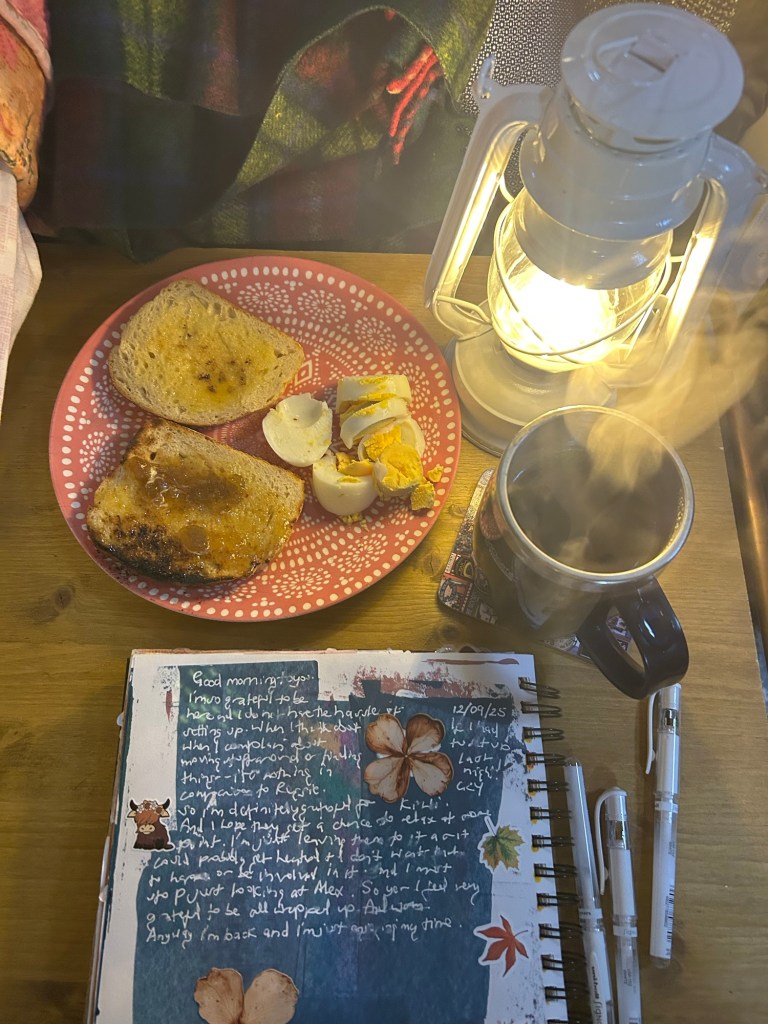
Make coffee and then journal in bed
Get up.
Strength training with free weights
Move my body – yoga/ walk/run/ swim
Greet the world with a smile.
What led you to this morning routine?*
Well I started on this find tuning of a morning routine at the beginning of January 2025, more or less. I was hibernating and I wanted to start a ritual that would anchor me into my life. Into the present moment at the same time as showing to myself that I am loved. I’ve done everything in my current morning routine at some point or other before but the putting them all together in some kind of coherent order is a first this year.
Did any ancient practices inspire you?
I’m not sure if a particular ancient practice inspired me. But maybe practices from my ancestral ancients might have subconsciously. If I remember living with my mum, back when I was in my 20s, she had a morning routine which I really didn’t notice then but can now. She’d get up early everyday, even though she wasn’t going to work, and go to the bathroom. Then make a cup of tea, open the windows and have a smoke. Maybe read at the same time but she’d claim the sitting room and the quiet. When she’d finish she’d make herself available for others.
For you, what is the importance of following a morning routine?
I hate routines usually. The predictability of them and the monotony gets on my nerves and I have to break out of them. But I think , in the past, this is because the routines and rituals have not been my own but have been imposed on me by external forces. I’ve mentioned when I was teaching before but also when I think of when I was studying creative writing. We were told if we wanted to be successful we should stick to one genre of writing and practice it in this way, using these techniques and following these rules. I found it all so restrictive. But here with this morning routine containing sacred rituals to myself, even if not carved in stone and open to change, I do not fight against the routine because I created. I feel that it is coming from a place of love for myself. This is my way of practicing self-love because I am giving myself the time and space each day so commune with myself and get my shit together ( or not!).

 Living Wild Studios