Usually I’m in the hate spectrum. I’ve internalised beliefs about the Black woman’s body that are oppressive and ugly that have been passed down through generation and generation.
I can’t remember a time that I haven’t felt that my body didn’t fit. That my body was too big, too fat, too Black. I’ve learned how to keep myself small, keep myself invisible( even while being hypervisible), keep myself safe.
Those moments when I’ve felt glory being within my body have been few and far between. And when I’ve got to that point of accepting my body, accepting myself, I can’t remember how I got there to get back there now.
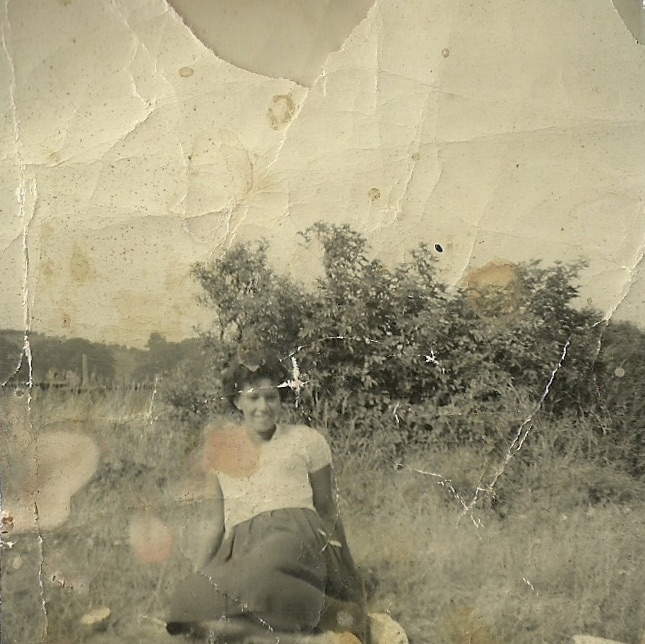
My mum was thin once. But most of my life I remember her as being overweight. I saw pictures of her slim and I asked her what happened. Even that question is loaded and judgmental and wrong.
She said when she had lost all the weight she wasn’t well and she wasn’t happy. She said she was happier being fat. I didn’t ask any further questions probably because I didn’t like her answer.
I’m pondering this now, here. Wondering and wandering around my body.
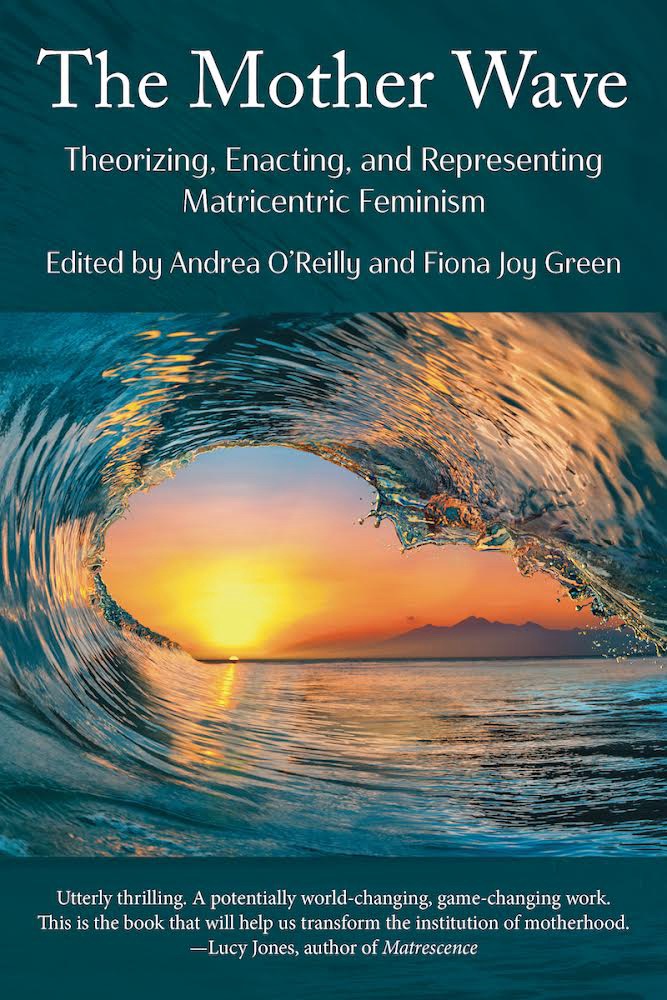
Utterly thrilling. A potentially world-changing, game-changing work. This is the book that will help us transform the institution of motherhood.
– Lucy Jones, author of Matrescence
The Mother Wave offers a welcome critical perspective on the liberal feminist orientation toward gender equality by showing how the focus on equality does not remedy patriarchal systems of oppression that continue to challenge women’s lives, nor does it account for the emancipatory potential in mothering experiences and the affirmation that diversely situated women continue to find in motherhood.
Foregrounding the lived experience of women and others who do the work of maternal care, the contributors make a strong case for matricentric feminism as a new framework: one that treats the maternal as an issue of both biological difference and a set of complex social identities. Informed by the African American feminist commitment to the epistemological importance of lived experience, on the one hand, and third-wave feminist commitment to intersectionality on the other, the collection claims and demonstrates through multidisciplinary analyses that maternity matters more than gender.
– Tatjana Takseva, Department of English Language and Literature / Women and Gender Studies Program, Saint Mary’s University
Toppling and recasting the idea of “waves” that, until now, correspond to stale time periods and stages of the feminist movement, The Mother Wave allows us to begin seeing matricentric feminism as a core feminist theory and burgeoning politic. Positioning mothers and motherwork at the center of feminism, and motherhood as perhaps the uniting experience among most women, O’Reilly and Green allow for a new “wave” of feminist scholarship and mother experience to take hold and crest – a matricentric wave. The editors introduce a vast array of scholarship and creative work within this volume that collectively helps us understand both consistent themes and new surges within this subfield of feminist thought and experience.
– Heather Dillaway, Illinois State University.
Matricentric feminism seeks to make motherhood the business of feminism by positioning mothers’ needs and concerns as the starting point for a theory and politic on and for the empowerment of women as mothers. Based on the conviction that mothering is a verb, it understands that becoming and being a mother is not limited to biological mothers or cisgender women but rather to anyone who does the work of mothering as a central part of their life. The Mother Wave, the first-ever book on the topic, compellingly explores how mothers need a matricentric mode of feminism organized from and for their particular identity and work as mothers, and because mothers remain disempowered despite sixty years of feminism. The anthology makes visible the power of matricentric feminism as it is theorized, enacted, and represented to realize and achieve the subversive potential of mothers and their contributions to feminist theory and activism. Contributors share the impact and influence of matricentric feminism on families and children, culture, art/literature, education, public policy, social media, and workplace practices through personal reflections, scholarly essays, memoir, creative non-fiction, poetry, and photography. The mother wave of matricentric feminism invites conversations with others and offers a praxis of feminism that aims to coexist, overlap, and intersect with others.
This is where you’ll find my own chapter called
‘I Am Becoming My Mother: Conjuring Black Motherhood on Our Own Terms’ which is a hybrid piece exploring my matrilineage which I mentioned throughout 2023 here.
Get your copy while you can and support Demeter Press.
“I pledge to go the distance for my mom or loved one in the month of May by walking 52.4 miles in her honour.”
This June, if my mum was still alive she’s be 81 years young. She was put on this earth to mother. If she could, she would have had a house full of kids. She lived her life through the kids she birthed, fostered and adopted and the grand babies she got the chance to hold before she was taken from us far too soon.
Even though she died at the ripe young age of 57, in her life time she’d already gone twice the distance, twice as hard and given twice as much love, care and time.
This May, GirlTrek, the largest national health movement for Black women and girls, is hosting Mamathon 2023, a walking challenge, where women pledge to walk 52.4 miles (about 2.5 miles a day) during the month of May to honor their mother or a caregiver in their lives.
“Walk in honor of a woman in your life. Walk because you are a mom and want to honor your motherhood by doing something healthy for yourself. Invite your friends and family to participate with you. This is how we grow the movement and spread joy and healing to the Black women we love.” said T. Morgan Dixon, GirlTrek cofounder.
With this in mind and as my mission for May, I walked out today with my daughter. We covered nearly 2 miles, most of which was full of chit-chat and memories of my mum and childhood. We’ll walk again tomorrow.
My mum
Rain or shine, my mum would get ready each day and walk out to the village store or post office. Running errands, but she knew the value of moving her body. Even while overweight and arthritic, she managed to walk down and up the steep bank and steps, from and to home. She put in the effort to walk the mile or so and didn’t complain in the process.
Sometimes, I forget the lessons and wisdom she passed on to me through her practices rather than her tellings. I’m doing this challenge to honour my mum and involve my daughter also.
I’m doing this challenge because it’s healing through the bloodline. Because it’s a healthy tradition. Because it’s impossible to not be transformed by the end.
I recently talked about the coming of April and how more poetry would be appearing on here as I attempt to ‘play with words’.
You can not imagine the delight as well as confirmation I received this morning while reading an article for the commissioned essay I’m writing at the moment around (Black) Motherhood.
A bone of contention with me is when I see the words ‘mother’ and ‘motherhood’, even though I have birthed children, I do not see these terms applied to me. ‘Mother’ and ‘motherhood’ come with the connotations of white and whiteness for me.
Test it yourself. Be honest. When I first mentioned ‘mother’, what image came to mind for you? If not a white woman and child. I’ve seen image after image of the idea of motherhood, the natural beauty of ‘The mother’ and nine times out of ten the image is of a white woman and child. As if a Black woman is not/ cannot be seen as a mother, even though a Black woman is the source of the whole human race. Go look that one up!
Anyway, I’m going off topic here ( but not in terms of the hybrid essay I’m writing for the forthcoming special Demeter Press collection, The Mother Wave: Matricentric Feminism as Theory, Activism, and Practice (2023)).
Reading this article this morning, ‘ Conjuring the Ghost: A Call and Response to Haints’ by drea brown, there is a mention of poetry lying in the body, coming from that dark place within where our true spirits lies hidden and growing, argues Audre Lorde. But poetry is also our way, Black people’s way, or theorising and making sense of things. Through our stories, narratives, riddles, poetry; playing with words and language, we not only gain an understanding and reimagining of our lives but these are also tools of surviving.
As Black women, speaking from my lived- experience here, through our creativity, through our playing with language in such a spirited way, we enter in the process of not just theorising and strategising but also self-making and through this practice passing this on to others. Passing on this power to others. It’s what we do, have been doing through time. Starting with the mothering we do of ours and others babies
If I allowed curiosity and love to seep through the wounds, I wouldn’t be here now at the page trying to make sense of it.
A black girl walks through the meadow, enters the dark woods and forfeits her life. And I can’t but think if she was white …
Trust. Always difficult for me to hold, like light on burnt leaves. Like the coming of winter any day now.
The race talk, an accumulation of cautionary tales told through time, she, with earth in her voice, filled the void of rage with what was right for her soul. Joy.
I’ve mentioned before how I’ve been granted a scholarship to participate in Susannah Conway’s Journal Love Club for a whole year.
It’s a gift that just keeps on giving. I get a prompt everyday, a growing community on Mighty Networks, people sharing practice and a live zoom call once a month.
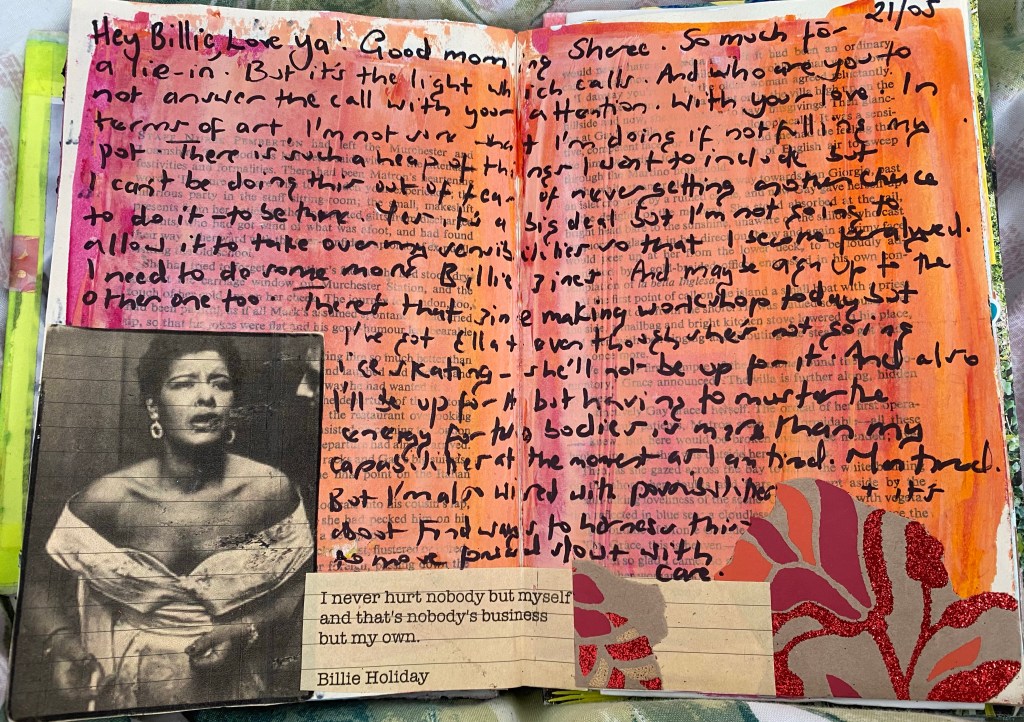
Usually, I start my day with my visual journal practice as above and then by the time I’ve done that the prompt from Journal Love Club has come through so I can continue and respond to that.
Journal Love Club Prompt 21/05
In the past, I’d be on my case for using so many different journals. I would also get confused by what went where and then lose stuff, not knowing where to find the gems. Now, I’m much more of a mind that if I’m showing up to the page, at all or once or twice or more, it’s all a win.
The common denominator between all these different journals is me. And this practice helps me along on this journey of getting back to me. The core me. The authentic me.
After today’s prompt which asked me to look over my recent journal entries to pull out themes; what’s been grabbing my attention, this entry came out:
“Nothing is a surprise when I look back and see what issues and ideas keep circulating the journal pages.
Identity, fear, never being good enough.
But then I started to switch things up in response to this prompt. I’ll never to good enough in a system which is stacked against me. In a system wired for us to aim for perfection even when we know it doesn’t exist. But more so, if it did exist it wouldn’t be available to me anyway.
So knowing this I surrender. I let go. Not give up, but surrender means not allowing time and energy to strive for this, to even fight it. But to use this energy and channel it into the things that are important to me. Not even taking into account the system, the white gaze but making my audience that little Black girl inside and the one in my house now.
And maybe through this I can heal as well as be a better mother to myself and my daughter.
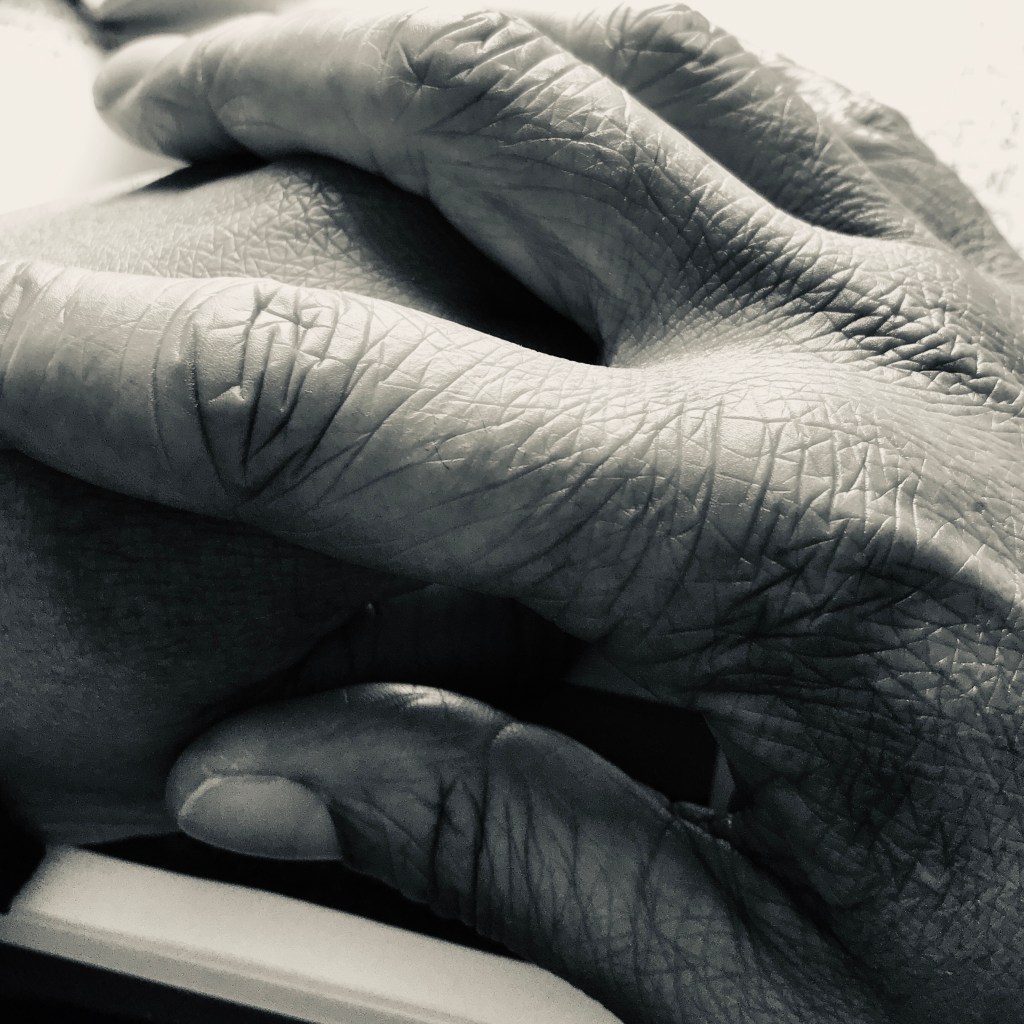
1. Her hands. I remember her hands. Calloused and worn. Working hands. Like mine. Her nails were pretty. Always had some length on them. Even if discoloured yellow. I blame the onions. Or tobacco. Her hands would take mine and squeeze them. She was there for me the squeeze said. The patting wrinkled light beige coloured hands. I’m here for you, they said.
2. I can just still catch her voice saying Sheree. It was a Geordie twang and not. It had an undertone of music. Of laughter. Of a joy for life. It was beautiful. Like she was; inside and out.
3. I haven’t forgotten her potato fritters. She made the best potato fritters. Golden discs of potato fried hot until edges crisp but centres, soft and buttery. I do make them now. In the oven. For health reasons. But they’re not the same. Nothing. No food tastes the same as she made.
4. I remember the beat of her heart. The way she’d pull me in for a cuddle. I could lay my head on her ample chest and listen to the hearty rhythm. How my arms circled around her warm plump frame and how I just melted into the moment, into her flesh. I was home and nothing else mattered.
5. I haven’t forgotten the arguments. The harsh words said. The way I dismissed her wisdom, her thoughts and feelings because I thought I had grown. That I knew it all. I’d lived in London. Had a profession. A standing. She returned to her village as a widow with two kids, needing the help of her parents. What did she know?
6. I know she ran from grief. Or is that me?
7. Grief is just love with no place to go.
8. But I remember her hands. Warm and calloused. And always giving.




 Living Wild Studios