Let us linger here in this room with the curtains closed with our other lives forgotten for a little while longer.
Let us not use words when our hands, lips and tongues can communicate our needs, our wants.
Let our breath be silken on our skin, let our bodies entwine still able to promise bloom and ripple.
Let us slow it all the way down, slowly, slow, so we can feel each stroke, each gliding smooth folding into each other.
Let us hear each others moans of joy, of wonder as our bodies wander together away from this room, this bed into our happy place where we can ride out the rest of our time here on earth.
Let us dream this lushness as we reach for each other, conjuring connection beyond the here and now, in the here and now.
Let us linger in the lingering light and just enjoy this afterglow, this pleasured pain like passing ships never to traverse these same desire lines ever again.
From about mid November 2024, I took myself off on a self-directed hibernation. I might have had to do some work in a school in December but mostly from then until today, the end of March, I’ve been resting. I withdrew from the world of responsibilities and work to take some much needed alone time. I went within, into the darkness and stillness. And now as I attempt to resurface and re-engage with the world, with great difficulty I may add, I’m taking this time to reflect on this practice and process of disappearing from the world for months on end.
Firstly, I think everyone should do it. And I don’t like using ‘should’ but here I’m going to make an exception. I know it’s a privilege to take time out of work and from seeking money for a certain period of time, and I recognise that, but wouldn’t it be a better world for everyone and even living thing, if we all could hit that stop button and rest?
For me through this retreat practice, everything is put into perspective. I give myself the time and space to reflect and process all the shit thats happening in this world. And I may not come back with the solutions but I do come back with an expanded capacity for joy and grace instead of just the feelings of overwhelm and defeat.
My time away has been good for the soul because I’ve been able to remember and reclaim my body-soul-spirit connection. I’ve been able to reclaim my connection to self, nature and other people. I’m been able to come home to myself and work out, gently, what is important to myself. What are my values and morals and am I living my life by them. If not then let’s recalibrate and get back on track. And I don’t mean the capitalist make as much money and the least connection and impact kind of track. I mean the track of being the best version of myself so I can show up for others in my family and community as the best version of myself for them.
I’ve taken this time away for me but at the same time, I hope as a role model. As an example to follow. Yes money is always going to be an issue. There is always not going to be enough to go around and to do the things I want to do or live the life I want to live. But at the same time, I can live more frugal. I can spend my money on experiences rather than on material stuff. And I can take the risk and say I’m not going to work or actively seek work for a few months while I rest, while I work on myself, while I {BE}.
Of course, my bank balance is screaming at the lack of money therein. Credit owed might be rising. And I could slip into panic mode and think I’ve got to get work, quick and fill the pot back up. But if I slipped right back into this panic mode and ran around like a chicken with no head, what would have been the point of the rest and withdrawal? All that calm and serenity and centred-ness that I’ve created over the last few months would have been for nothing. Gone in the blink of an eye, just like this time away seems to have passed.
This practice of rest and slowness, is part of my practice forever! There’s no switch that I switch back on to go back into work mode. I’m not a machine or a robot. I’m a living, breathing, feeling human being, even though there are some who have made me believe otherwise. I want and need to make sure that my life reflects my priorities and values and not just plays into the system which has never got my back.
As I’ve mentioned before, I writing about fugitivity. And for me part of using fugitivity as a method or practice, is me to take my body out of the systems of production and run. Run away from the rat race, run away from extraction and exploration and stop. Or linger in the time and space of rest and nothingness. Breathe deep and allow my body to come back to life. Allow my joyathon-o-meter to rise by feeding my soul with beauty which is there to see in the every day if only we allow ourselves that time and space to {BE}.
I haven’t just been sitting on my arse and doing nothing during this hibernation, even though a lot of the time was spent on doing nothing, allowing myself to get bored and seeing how it feels and what comes up and seeing what are my go tos to stop feeling all the feels. This has been a period of getting to know myself again, which is difficult if you’re bouncing from one job to another, one project to another, where the aims and intentions are not in my control or even anything I’ve agreed to.
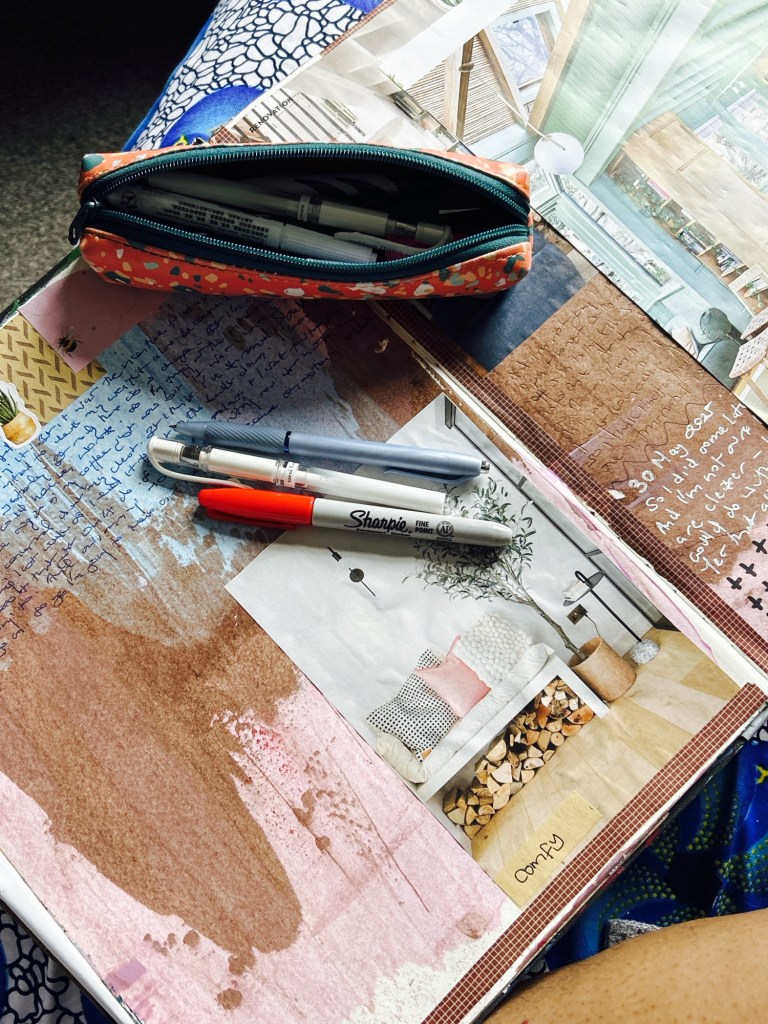
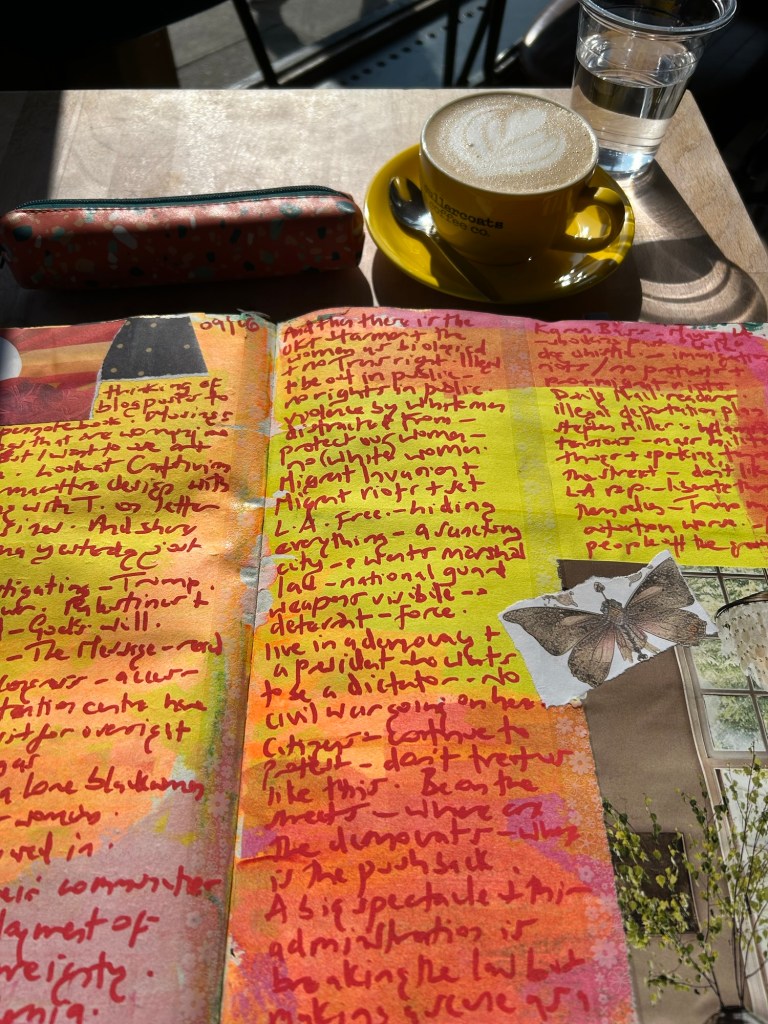
So yes day dreaming did enter the hibernation period. What also featured was reading and writing and walking. And sea swims and travel and alone time with nature. Home cooking, time with family and friends. Music and dancing and artwork and journalling. A lot of visual journalling. Nothing earth shattering but enough. Enough to make me realise that I’ve been running on empty, exhausted really and how harm was caused towards me and how I needed to heal.
Yes if anything, this time has been a time of healing. And this is an on-going process but I feel better equipped now to continue the healing journey.
So April is around the corner and I’ve really not got a lot of work on still. As I made the decision not to actively seek work while in hibernation also. Why take the time away from work commitments and then spend that time searching for work, applying here there and everywhere and getting stressed about finding work for my return? What nonsense is that.
So yes I might officially end my hibernation today, but I know I still have time for me as the work commitments are few and far between. But not stressing about the things I can’t control but will focus on the things I can control. I might start to gear up to putting our feelers for work but not full throttle. Not nice, don’t like. Again, I’m not going to waste this time away on moving out of zero effort into the max. I’m slowly easing out of my bear cave. I’m stretching slowly, reaching for the sky. Scratching my back against a tree trunk, and then I seat back down and admire the cherry blossom coming into bloom. I’m taking the time to thank Mother Earth for being with me and allowing me to rest and to resurface when I’m good and ready. I’m grateful for this time away. And I’m grateful to be able to return in my full glory as me.
I’m practicing how to show up in spaces, alone and with others, in fullness.
I’ve used wholeness before. Striving to get back to that sense of being whole, as we enter as already into this world. And then for the rest of our lives society and culture pull us away from our wholeness. When we realise, usually when much older and not giving a fuck, we spend our time and energy attempting to get back to that wholeness. This is a practice too, but to be whole sounds final and also out of reach.
Fullness. While fullness seems something that can be embraced now. In the present, moment to moment. Fullness for me gives the middle finger to those who have criticised me by saying I’m too much. Too Black. Too fat. Too loud. Too enthusiastic. Too Alive. Too much.
Fullness is me embracing my too-muchness and giving off that ‘don’t care less’ energy.
As they become known and accepted to ourselves, our feelings, and the honest exploration of them, become sanctuaries and fortresses and spawning grounds for the most radical and daring of ideas, the house of difference so necessary to change and the conceptualization of any meaningful action. Right now, I could name at least ten ideas I would have once found intolerable or incomprehensible and frightening, except as they came after dreams and poems. This is not idle fantasy, but the true meaning of “it feels right to me.” We can train ourselves to respect our feelings, and to discipline (transpose) them into a language that matches those feelings so they can be shared. And where that language does not yet exist, it is our poetry which helps to fashion it. Poetry is not only dream or vision, it is the skeleton architecture of our lives. It lays the foundations for a future if change, a bridge across our fears of what has never been before.
Audre Lorde, ‘Poetry is not a Luxury’, on Sister Outsider: Essays and Speeches (Trumansburg, NY: The Crossing Press, 1984), 37.
I’ve always felt nervous when meeting new people. Not because I’m worried about what they’ll think of me, but because at some point in the conversation I will no doubt be asked the question, “So, where do you come from?”
When a white person asks me, this question comes with the implicit assumption that I am not ‘from here’. They might think this is a simple question to ask but it is not a simple question for me to answer.
Should I say Bradford, West Yorkshire, where I was born and brought up until the age of ten? Or the North-East Coast where I live now with co- parenting my daughter? Or even London, where I went to University and got in touch with my ‘black’ side? Or Trinidad, Ghana, Barbados, Nigeria, and Sierra Leone where my ancestral roots lie?
When I was younger in the 1970s and living in Bradford, my dad didn’t talk about Trinidad, but we knew it was the land of his birth. One of the reasons we knew this was because of the black crushed velvet scroll that hung in our front room depicting the islands of Trinidad and Tobago. We didn’t even know he had siblings until, after 25 years of no contact, he received a letter from his sister, Tantie Gladys living in the United States, which started a new relationship with ‘family’.
After my dad’s death in 1981, all the silences changed. Our mum told us the stories our dad had told her but had decided not to tell us about his land, his family, his home. We moved to Newcastle then, to be closer to mum’s family.
It was being closer to my grandparents, listening to them talking and seeing photograph after photograph, that I began to understand my heritage. My maternal great granddad, my nana’s dad, was from the Gold Coast, now Ghana. Charles Mason was billed as the first black man in Newburn, our small village.
I knew that someday I would visit my ancestral lands, Trinidad, Ghana, Barbados, on my granddad’s side, and Sierra Leone and Nigeria, a new piece of information which places my Trinidadian family as descendants of slaves.
“Where will you be buried?” asks a friend. For her the answer is simple; born in England, lives and works in England, dies in England, buried in England. But for me, it’s a tricky question because frankly, I’m not sure where I’m from. I live in Nirth-East England, but I don’t call it home; it’s my base. I wouldn’t call Bradford home, even though I still carry the Yorkshire accent around with me.
‘Home’ as a concept is problematic as it makes visible such notions as gender, diaspora, identity, culture. ‘Home’ as a term includes the sense of ‘knowing home’, what and where home is. It also encompasses that feeling of ‘being at home’ or away from home. But most importantly, ‘home’ includes that matter of ‘belonging’. There are multiple and fluid meanings of home, from private to public, from physical to imagined. The idea of home is plural, a conflicting site of belonging and becoming.
‘Confused’ is one word that should be on my passport. In 2007, I took the plunge. I approached a visual artist friend and said, “I’m going to Trinidad and Tobago. Want to come?” At the time, I wasn’t sure what I was planning. I was excited, worried, nervous and scared. When I tried to visualize myself there all I could see was the touristy, travel brochure images of the Caribbean; blue sky, blazing heat, turquoise sea, crystal white sands and swaying palm trees. All my knowledge of my heritage was based upon Westernized sources, framing the islands in a certain way.
Having completed a visit to the Caribbean, I can not really imagine what it is/was like to live there, to be born there and grow up there, as my ancestors did. I am second and third generation of immigrants, depending of which side of my family is in focus. I do not have that first hand knowledge of ‘home’, be it the Caribbean or Ghana, but I do of England. As
Avtar Brah says, ‘home’, is a mythic place of desire in the diasporic imagination. Nostalgia is a sentiment of loss and displacement. My experience of my ancestral homelands is limited. In terms of nostalgia, I have a longing for places that are far removed from my everyday but are part of my identity. I may gain an impression of these places through my travels to them or through my family members, sadly all of which are now dead, except my sister. I have that sense of loss of place and of people. I use my writing to create those lost worlds.
There is a photograph of me, in holiday gear (green and white striped top and white cargos), grinning like an idiot, clinging tightly with two hands, onto the arm of a man I’ve just met ten minutes ago in Laventille, Port of Spain, Trinidad. My smile speaks of satisfaction, joy, relief and belonging. This man is a cousin I did not know I had. This embrace is one of ownership. He is family and he is mine. He is part of my past, my present in that photograph, and my future. The past is in our futures, in our nows. I carry with me the baggage of the past into my present and future. My Laventille visit was like going to collect baggage from the left luggage department,finding and claiming baggage that I didn’t know I had lost, but is now vital to me in my task of trying to know myself better.
This feeling of belonging, this split identity/mixedness of being/feeling British, Caribbean, African without exclusive claim to any of them is something difficult to live with, to function with.
This is an updated and redrafted extract taken from my 2010 PhD thesis, ‘A Drift of Many-Hued Poppies in the Pale Wheatfield of British Publishing’ Black British Women Poets 1978 – 2008
This piece originally was published over on Medium with Binderful. I’m drawing this piece into the Living Wild Studios archives. Because I can!
Image credit — Donovan Valdivia
“How difficult is it for one body to feel the injustice wheeled at another? Are the tensions, the recognition, the disappointments, and the failures that exploded in the riots too foreign?”
Claudia Rankin
In August 2014, there’s a summer of “hands up, don’t shoot” protests, in Ferguson, Missouri, in response to the unlawful shooting of Michael Brown Jr.. In November, Darren Wilson, the white Ferguson police officer responsible for Brown’s murder isn’t indicted. In December, filled with rage and helplessness, I organise the first ‘Black Lives Matter’ protest in the North of England; a political poetry reading at our city centre library. Together artists and writers, cram into a hot room on the top floor of a building made of glass, and pour out our rage and pain through our writings. Black people’s words. Our ancestors’ words.
I’m criticised by one Black woman, in particular, because I invite white poets to read. They could only read the words of Black people as this event is centring our lives. Black lives. A white people’s presence is not what this Black woman wants. She wants a safe Black only space. I respect and understand her views. We all want a safe space for Black people. But I feel we can achieve so much more when we work together, Black and white, to solve our society’s problems. I know where she’s coming from though; a place of pain and suffering and hatred. As Black people, for so long, we have endured so much hate and violence from the hands of white people. For far too long, we have been excluded from a share in the economic wealth our ancestors paid for with their lives to create. We’re sick and tired of being excluded from the abundantly spread societal table which our ancestors give the skins off their backs to forge. And this hurts.
In March 2017, there’s a ‘Stand Up to Racism’ demonstration in London, Miss Ella, my seven year old daughter, and I dance behind the sound system truck, towards Trafalgar Square. Crowds behind metal barricades line our route, with the Metropolitan Police shepherding us along. We shout, ‘Refugees are welcome here.’ Miss Ella, dressed as her superhero, Black Widow, looks as if she’s just stepped out of a Black Panther’s meeting. With her long brown hair blowing in the wind and her peachy fist punching the air, she’s learning long before I did how to use her voice to bring about change. She carries her homemade banner stating, ‘Black Lives Matter,’ high with pride and courage. Along the way, a white woman with screwed up face screams at us to shut up and go back home to where we come from. Disallowing our protests, devaluing our presence here.
I recognise where she’s coming from; a place of her ignorance and pain and hatred. As white working class, for so long, she’s been fed the lies that Black people and immigrants come over here and take their homes and jobs. For so long, the poverty they’re experiencing is down to these Black illegal criminal and not a capitalist system rigged in favour of a few priviledged people. We’re just as sick and tired of this too. And we know it hurts.
In May 2020, there’s ‘Black Lives Matter’, protests around the world. In response to the recent killings of George Floyd, Tony McDade, Ahmaud Arbery, and Breonna Taylor, to name just a few, the streets are talking through fire and smoke. Thousands take to the streets, Black and white, to demand justice for all our Black brothers and sisters who have been and continue to be murdered by state sanctioned violence.
I’ve grateful for their voices and bodies. This time, I protest through my words and art. As the Covid-19 pandemic still poses a real threat here in my part of the world. I’m a Black, fat woman carrying yet another target on my back. While protesting, the odds of getting molested and arrested, and not surviving the experience is higher for me than any white person. Just as the odds are greater for me of dying from the Coronavirus than a white person.
Black, Asian, and ethnic minorities in the Western world are dying at a disproportionately higher rate and number than white people during this pandemic. Many explanations for this reality have been voiced with the blame thrown at the feet of Black people. That it is our unhealthy bodies and behaviours which are spreading this disease, conveniently not addressing the inherent racism and systematic inequalities that have operated for over 400 years that has brought about this dis-ease, making our weathered bodies more susceptible to this virus.
‘We rather die on our feet than keep livin’ on our knees,’ taken from the James Brown song, ‘I’m black and I’m proud’, I feel this as we see thousands of Black people (and white people) take to the streets, even though there’s a greater risk to their lives than ever before. But I recognise where’s they’re coming from. We’ve had enough. We’ve endured enough. We’re not prepared to accept Black lives being devalued anymore.
This piece was written back in 2020 and published on Medium. I’ve brought it over here to be part of my writing archive. I also feel that the case needed restating frequently. Did I say daily?
We queue with our shopping basket. This is the norm now. But we don’t complain. It keeps everyone safe. We’re at the front of the queue, for a change. My daughter and I. We’ve only come to the one shop. I let her ride her bike into town. She needs the exercise as she’d be happy in front of her screen all day. I probably would too, as at least she’s inside safe, connecting with her friends, and I get a moment to myself.
Front of the queue, but we hold back as the woman in front of us has just gone into the shop. There’s someone coming out at the same time. The store security guard is standing in the mix too. We allow a gap to form between us; the woman and the entrance and our bodies. Coming across from an adjacent shop, a man and woman stride. Stride into the front of the queue, ready to walk into the shop. I raise my voice just above my normal speaking voice to say to them, There’s a queue. We’re waiting to go into the shop too.
I think I’m smiling but how can they know? How can anyone tell if you’re smiling when you’re wearing face protection? By your eyes. I think by the eyes, you can tell if someone is smiling. It’s a warm, sunny day. I’m wearing sunglasses. Maybe they can’t see my eyes. They can only use my voice as means of communication.
Sorry, they say. We thought the queue was going the other way. They walk to join the queue behind us. I say, in a tone of voice which I think says I understand, No, the lady in front of us has just gone in and we’re waiting back here to giving everyone some space.
In the time it takes for the couple to walk and wait behind us, at the recommended 2 metres, the woman of the couple has already started saying in a loud enough voice for us to hear, Some people are just getting angry about the situation now, and there’s s no need for it. We walk into the shop.
Note: The angry Black woman stereotype portrays a black woman as sassy, ill-mannered, and ill-tempered by nature.
Walking back home, Ella walking with her bike, I approach what happened outside the shop, asking Ella if she heard what the woman said about people getting angry.
She was referring to me. I explained. She saw me as an angry Black woman. Do you think I was angry because you’ve seen me angry?
My daughter knows me. She knows I wasn’t angry and says so.
When you live in a society where you’re powerless, perceived as worthless and inferior, those who have power, believing themselves to be superior, spend their time telling others how they handle the situation isn’t right. They tell you that how you speak or act or response isn’t appropriate. You are wrong. They gaslight you, forcing you to doubt yourself; your actions and capabilities. You are at fault, always. You are wrong. You are silenced.
Back home, I talk to my husband, who’s a white man. I think if he’d been with us, the woman behind us, wouldn’t have uttered the angry line. He disagrees. She sounds like a woman who would have gotten annoyed if anyone had checked her behaviour, he said.
He has the right to think and say that. And maybe he’s right. Who knows? But to accept this explanation, I’d have to disallow what I feel about the situation. I’d have to make allowances once again for someone else’s behaviour, reaction and treatment of me. I’ve spent a lifetime of making allowances for other people’s treatment of me. How can I be sure that when they treat me unfairly, or discriminate against me that this isn’t how they treat everyone else? I don’t know. All I have is the way they make me feel. My lived experience as a Black woman.
All I know is that when I’m walking down the street and someone is coming towards me, it’s me who walks into the road to maintain social distancing. It’s me who walks into the gutter to keep us both safe. Would they do the same? I don’t know. I can’t take the risk to wait and find out either.
I’ve been socialised, fed the stereotype of the angry Black woman for so long, I police myself. I play my part. I don’t raise my voice. I don’t protest or question. It’s part of my make-up to check myself so I appear in society as passive and non-confrontational and unseen.