This week saw me on my travels again as I visited Liverpool. I was there to see Of Monsters and Men, and the release of their new album, All is Love and Pain in the Mouse Parade at Jacaranda Baltic. Which was awesome. Intimate and heartfelt.
Before I met up for lunch with my son, I took a walk around Albert Dock and came across the sea barriers full of love locks. Apparently for years, people have come for miles to attach their own lock as a message of unbreakable love. There are some people that think this is an eyesore and that they are damaging the barriers. I say, WTF.
What does it really matter if people want to add to the tradition? What really is the problem? They’re metal barriers there for people’s safety why not add some locks to them as a symbol of love? They don’t weaken the barrier. Probably make them stronger.
Isn’t love supposed to make us stronger? Yes there’s pain and suffering, but a whole heap of joy that comes with it. I’m learning about love at the moment as I read All About Love, by bell hooks, in collaboration with a friend. We read and talk about it. And I’m finding this most useful in developing a new understanding of love. And I suppose I come from the perspiration that I talk about love as the foundation of all that I do/ {BE}. But how can I say this if I don’t really know what love is? Talk is cheap but true understanding and embodiment of love is another story.
Growing up, and I still feel as if I’m growing up or at least progressing in this process of becoming, but yes growing up, I constantly rejected core parts of myself in order to fit in, in order to be accepted and loved. There was also an element of protection too. Growing up I knew or sensssd that being too wild and too unresostrcted and out there could bring trouble my way. Be looked up, be beaten up, be killed.
But I’m not prepared to repress, reject core parts of myself anymore. I don’t do it anymore because all it does it hurt me and stops me living my life on my own terms. Living y life to it’s fullest potential because I’m focused on the fear and rejection instead.
It has taken years and practice for me to take down the internal prejudices against myself. They might have been fortification constructed for protection and rejection but they did not serve me then and certainly don’t serve me now. Yeah I still protect myself from harm. I think I got complacent recently with the sea and also within the recent counselling skills session, but I’m practicing this from a place of love, self-love rather than self-hate and disgust. And the feelings are totally different.
*not so mush a trigger warning but saying it anyways!
I am worthy of consent. I am safe. I can heal from sexual trauma. – Lyvonne Briggs
I’m writing. Or is it rambling? I’m not sure. It’s just that I’m reading at the moment. I’m in my cave (bed) hibernating and I’m reading so many different books. Fiction, non-fiction, poetry and there’s a cross over with what’s happening within my life with my reading ( Does that happen to you?). There’s an echo or a reinforcement for the things that are causing me grief at the moment, worrying the wound as I read and rest.
So writing things out, going long is a way of making sense of it all in the moment. It’s a way of gaining some kind of clarity for now. Not thinking of the future but thinking of gathering the threads at this moment to made make a something out of this mess of yarns.
My mum died when I was 27 years old. I’d just become a mother the year before. I’ve been hearing about the ‘mother wound’ lately. I’m not sure if I understand it completely. But when I hear it, I don’t jump into definitions and theories. For me it’s simply means when my mum died and left me to cope alone. Selfish I know. But I feel as is she left a gaping, bleeding wound that festers and hurts when I worry it. When I press on it, inspect it with my touch.
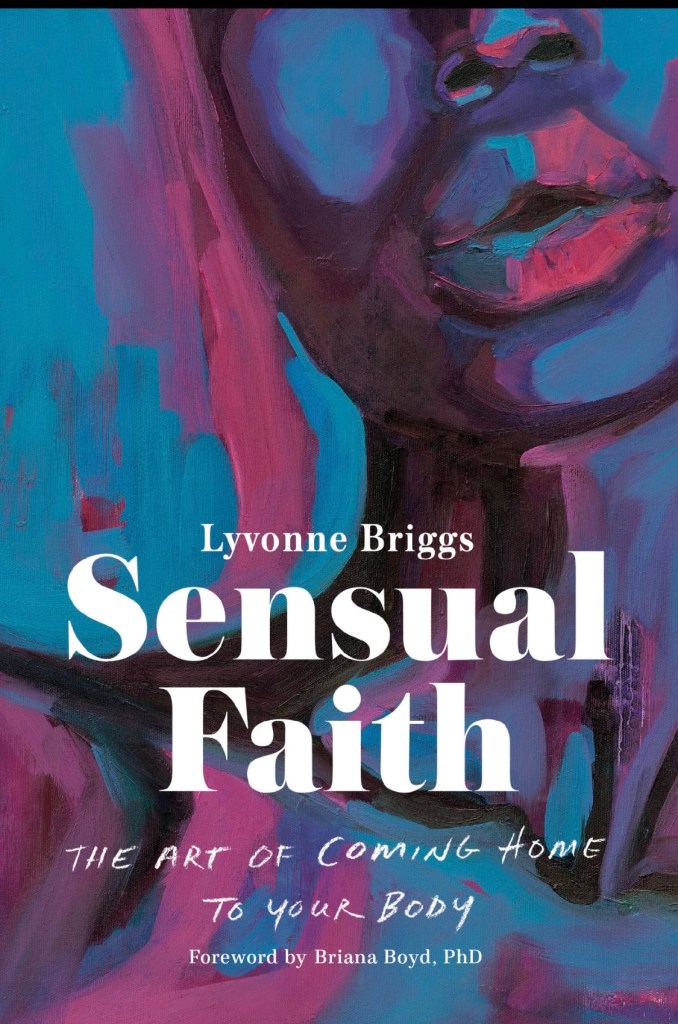
This morning, following my morning routine, in bed reading (with coffee skipped ahead this morning) I’m reading Sensual Faith: The Art of Coming Home to Your Body by Lyvonne Briggs. I’m reading a section called ‘Surthrivors’ a term Briggs created to try and capture how she was feeling, living after male sexual violence. She felt ‘survivor’ was too flat to describe/ define her experience when she was living/doing what she loved studying theology and religion, in community with loving people and was an acclaimed spoken word and slam poet. “I wasn’t just surviving, I was thriving!” Briggs wrote, hence pointing the more accurate term, ‘Surthrivor’. I love it when we Black women bend and twist language, divest from the standard to better express/ more fully express our feelings and experiences. That’s creative fugitivity for you (thank you Dal).
Briggs goes on to talk about how she got into the ministry so she could change how the church handles sexual abuse, not very well, as there is a silence around it. Or they blame demons instead of the actually men. I’m not here to talk about male sexual abuse. I’m not her to talk about the church. I’m not a religious person. I was brought up saying my prayers. I remember a black bible, creased leather, brought from Trinidad and Tobago with my dad when he stowed away to England. This black bible sat toad-like in the teak sideboard of my childhood living room. West Indian style living room, I may add. I gave up believing in a ‘God’ when my daddy died when I was 9 years old. I’ve now come around to the idea that we are Gods/ Goddesses ourselves, inside us. I’m spiritual rather than religious. So I’m not sure why I’m reading this book.
I lie. Yes I do know why I’m reading Sensual Faith. I followed a trail to this book left by Christina Cleveland and God is a Blackwoman. But also because of the subheading of Sacred Faith: The Art of Coming Home to Your Body, is a journey I always seem to be on.
Anyway. Back to the reading this morning which went on to discuss the worship centre in a church is called the ‘sanctuary’. When you the word ‘sanctuary’, does anyone else think of Quasimodo? ‘Sanctuary, sanctuary!’
A ‘sanctuary’ is a safe or holy place. I wrote a poem titled ‘sanctuary’ and it was about my mum. My mum’s home, body, arms. When she was alive, it was her I went to for safe harbour. I didn’t realise until she was gone. It has come a way for me to practice mothering my own children, through sanctuary for them. Once my mum died, I lost who and where I could return to for safety. I lost my home, my sanctuary when she died and I suppose I’ve been searching for sanctuary ever since, looking outside myself, looking for it in others ( husband for one!)
I don’t how long I’ve been in battle with my being, with my body, chastising her for not being enough. But also for being too much. Too fat. Too broad, too Black. But over the last few years, eyes open, something has been changing or shifting within me and how I view, treat and talk to my body. . Maybe that’s where my mum did me a disservice and where I’m making amends with my kids. I’m not sure she taught me how to find sanctuary within myself, within my own body.
Monday nights I dread. Not always. Just the last few months as I complete my level 3 diploma in counselling skills. I’m not jesting that I hate turning up for this course. And I never use ‘hate’ as a word usually, always thinking it’s too strong a word for a feeling. Too final without any redeeming features. But this is where we’ve got to with this course.
And it wasn’t always the case. I could blame the dark, cold nights I have to turn up for 3 hours of lecturing and talking in an empty, sterile office block. I could blame the electric fluorescent lighting that flickers and buzzes and can give me a bad head. But I would be lying. I’m here to be wide open and honest. So here goes!
This course is taking away pieces of my soul, week after week. And I’m not ashamed to say that I have contemplated dropping out week after week, researching for alternatives. I even enrolled on a supplementary course, decolonising counselling, that would tend to all the damage this course is doing, but I had to withdraw from that due to costs and timings.
If you’ve ever studied counselling and therapy, you’ll know that everything; theories and tools and practices are all taken from dead white guys. Dead white guys acting like Gods (and I don’t mean the internal Gods I’m just mentioned). White male, usually heterosexual and middle class theorists who pontificate that they know everything about what’s happening in everybody’s mental health. They have the solutions to make us feel/ do /be better. As it’s always the individual’s fault and can be traced back to their childhood, their mother? Bullshit!
It hurts to be fed this shite every Monday. In the beginning I pushed back and attempted to decolonise the teaching, the theory, the responses. Bringing in other theorists and arguments. Being the only Black face in the class, girl has to represent.
Until we got to week 9, we were exploring different types of power within the counsellor and client relationship. Power roles within the counselling arena. After a discussion, we were being presented with a list of ‘Further key aspects of power or perceived power’. And yes the list was not an exhaustive list and things could be added, the tutor said. This list did not include ‘race’, ‘ethnicity’, ‘culture’, and I voiced it as such. My comment was laughed at and dismissed as, ‘there’s always one’.
Always one who has to comment on what’s missing from the list? Or always one who has to bring up race? Who knows! I just know how this comment made me feel. Know your audience I say or was I being put into my place? This response indicated to me that this input, which a fundamentally the way white supremacy culture wields power through the hierarchy of the races. It’s the sea that we’re swimming in and to not mention is the usual state of affairs. This interaction indicated to me that this was never going to be on this course’s agenda. Me continuing to challenge the whitewashing of counselling and therapy, me constantly remarking on the culture that we’re operating in wasn’t enlightening my fellow students or suggesting that they become more aware of their ( and my own) unconscious biases. I realised I was just creating issues where they never saw issues. Problems where there are no problems. As race and racism is only a problem when there’s a Black person in the room. It’s Black people who have an issue with race as whiteness isn’t a race, right? Whiteness is a given.
After week 9, and tonight was week 15, I’ve silenced myself. I’ve disengaged from the course, no longer contributing. I turn up and get my attendance and keep my thoughts and comments and feelings to myself. I’m not giving anything of myself anymore to the group, to the course within the face to face sessions as I’ve received the message it’s not welcome, it’s not of value, it’s not relevant. I do not intend to waste my energy and heart and soul on this experience.
This hurts me. I’m making sanctuary for myself. I’m making this experience safe for myself. I’m keeping myself safe within myself, within my body as being in that classroom is no longer safe for me. And to explain that to them, I wouldn’t bother, as they wouldn’t get it. The can’t get it and it would also involve them listening to me, and me being heard, which ain’t happening.
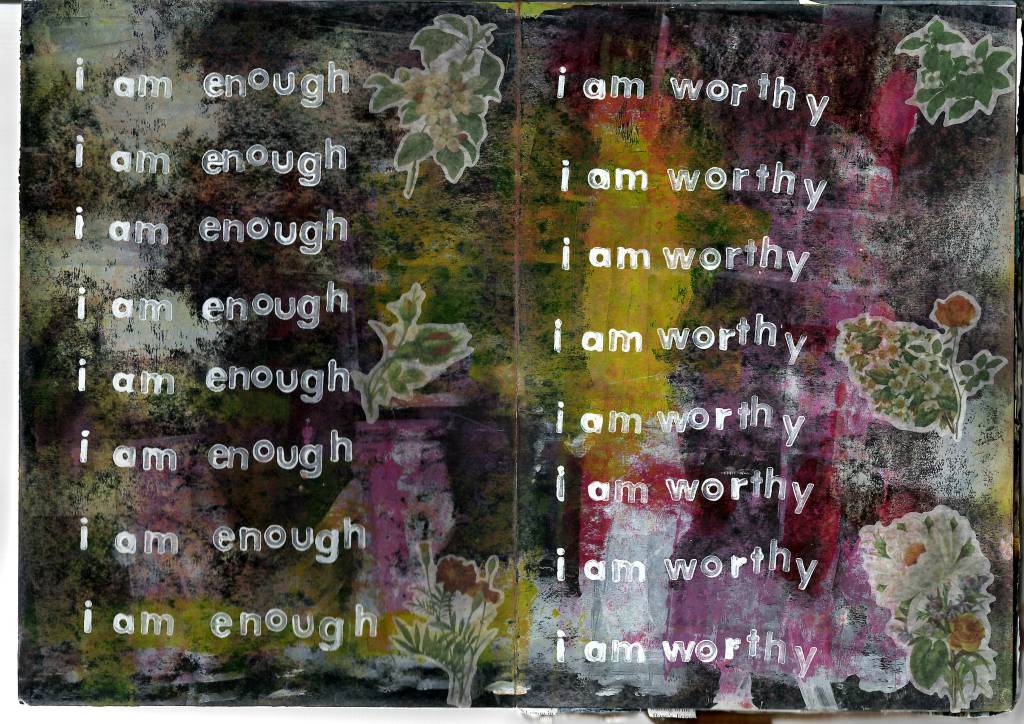
I’m creating sanctuary for myself, within my body and its a practice. I’m using a self-soothing approach, self-talking, loving compassionate approach when I experience something that is harming, hurting, traumatic. I’m letting myself know, like that little girl inside me who needed to be loved and kept safe, I’m stroking my own chest over my heart and saying to her, saying to myself, ‘ You are love, Sheree. I’ve got you I understand why you are feeling unsafe. But I’ve got you. You’re dafe now.” I’m mothering myself. I’m making myself safe. I’m making myself sanctuary.
(Speaking about Robert Lowell’s poetry) “Lowell removes the mask. His speaker is unequivocally himself, and it is hard not to think of Life Studies as a series of personal confidences, rather shameful, that one is honor-bound not to reveal.”
M. L. Rosenthal’s article “Poetry as Confession.”
I’m taking a four week confessional poetry course with midnight & indigo. Founded in 2018, midnight & indigo is a small publisher and literary journal that provides a space for Black women writers to share their narratives with the world.
Tw weeks in and I’m loving the course, Tell Me Something Real: How to Write Confessional Poetry. Not only is the tutor, Schyler Butler knowledgeable, and thorough providing great examples for poetry within this genre all from Black women, but the group of writers signed up for the course bring it every week with their insight and feelings around each poem we read and discuss.
And then we get to trial out what we’ve learnt through these close writings within our own writing, as the sessions finishes with time to write a first draft of a poem and then share it with the group. I’m enjoying what I’m coming up with after being inspired. Because in all honesty, from time I’ve been a confessional poet but have never smashed the term on it.
Confessional poetry in essence can be distilled to 4 main components.
Be of an intimate subject matter.
Use the first person.
Be autobiographical or seen/ appear to be.
Use skilled craftsmanship.
I’m working on a new body of work now. So still in the draft stage but I’ll share a poem from time here, as evidence of my appreciation and dance with this form of poetry.
White Women
Within my family, there are white women. White women who married black men. I forget, neglect the fact that their blood flows through mine.
Trace the past, a sea of faceless white is mine. The black men forefront, a mist of women behind. Their names, I don’t know or forget.
They are the enigma, shadows. Forget the cleaning and cooking, their duty and mine, they went against the grain, steadfast women.
In the corner of the frame, you white women are not forgotten. Your spirit is mine.
A Visual Journal Spread from The Country Journal of a Blackwoman (Northumberland), archive
Right now my practice is on display within The BALTIC: Centre for Contemporary Art.
As I was out of the country when the group exhibition, Hinterlands, launched on Friday 22 October, 2022, I managed to get into seeing it after such event the following week.
I really didn’t know what to expect as you visualise the end result, the culmination of months of hard work, dreaming and winging it. But to actually see it all come together in a white cube space is another thing.
I visited my archive last week, with my daughter, excited and nervous and unsure. I got to see The Country Journal of a Blackwoman(Northumberland) exhibited on level 3 of The BALTIC. I was shocked and surprised to see my work out of context within this space. It was an emotional as well as nerve wracking experience.
Because of my absence, I had to leave instructions about the installation as well as extensive notes and labels for each art piece. There are about 50 items if not more within this creative archive. It’s to be expected that things got lost or mislaid in translation. So my focus for this trip was to make sure everything was how I wanted it to be.
After some discussion and sending of correct audio files, everything is now complete and as I want it to be presented to the world.
I’m not sure how I feel that during the launch of the whole exhibition, that things were wrong or missing. But I do know that after seeing everything in terms of my contribution and making things right after my visit, I felt great relief and was able to enjoy the achievement. It was also weird to be there at the same time as seeing peel interacting with my work. I’m not sure I want to have many experiences like that as their reactions did affect my state of mind, pride and achievement. And it would be very unsetting, I feel, to be there and witness someone laughing and disrespecting my work. I think this is something I need to gain a thicker skin for. But right now, my skin is thin for a number of reasons, tat I might explore here in time.
I know I have to return now, to take in the rest of the group show as well as the rest of The BALTIC’s exhibitions for this season, as this is a strong presentation.
I’m honoured to be showing at the same time with them.
Of course more reflection and images to come around this achievement.
HINTERLANDS 22 October 2022 – 30 April 2023, BALTIC: Centre for Contemporary
I was brought up to treat books as sacred. They were a source of knowledge. You get your education and you’d have choices in life. You’d move on in the world. Have a better life than your parents before you.
Books were the gateway into this Paradise.
Each week, we would walk into town from our maisonette, along the busy dual carriageway. Once in town, we’d go to the market, to the one book stall and pick out a book. They were the tradition fairy tales with pictures and text.
If not them, then Enid Blyton books. For some reason, I felt the importance of books and the connection of them to my dad. He’d read us bedtime stories and I’d just love to be in his presence then. As he was softer and loving. Different from the angry man he was at all other times.
For some reason, who knows what goes through a child’s mind, I took to doodling in one of these fairy tale books. I want to say it was Snow White, but I could wrong.
A whole heap of scribbles and doodles took over the pages of this book. Why use the book when I had plenty of blank white paper? As I said who knows what goes through a child’s mind.
I just know that my father found the book and shouted at me with rage. And beat me. I’d done something wrong. I’d ruined the book. I’d ruined my chances of getting on in the world. I’d gone against the unwritten rule( or was a spoken one?) around how to respect books.
Older now, I hunt for books. I buy my own books. I read then. Some I don’t. Some I keep or give away. And some I purposefully, consciously make the decision to repurpose. Reclaim them.
I tear out pages and I cut these up. I smear paint on the pages left in the book. I stick images in them, tape, stickers. And yes I write in them. I write out my hopes and fears. My desires and dreams. My memories and traumas.
I think I was brought up right. To treat books as sacred. But it’s what you do with those books that count, I think. And a book has multiple uses/ purposes. I think. Multiple ways and means of instilling knowledge and opportunities and freedom.
It’s been a long journey for me to get to this point of choices. But I claim them all.
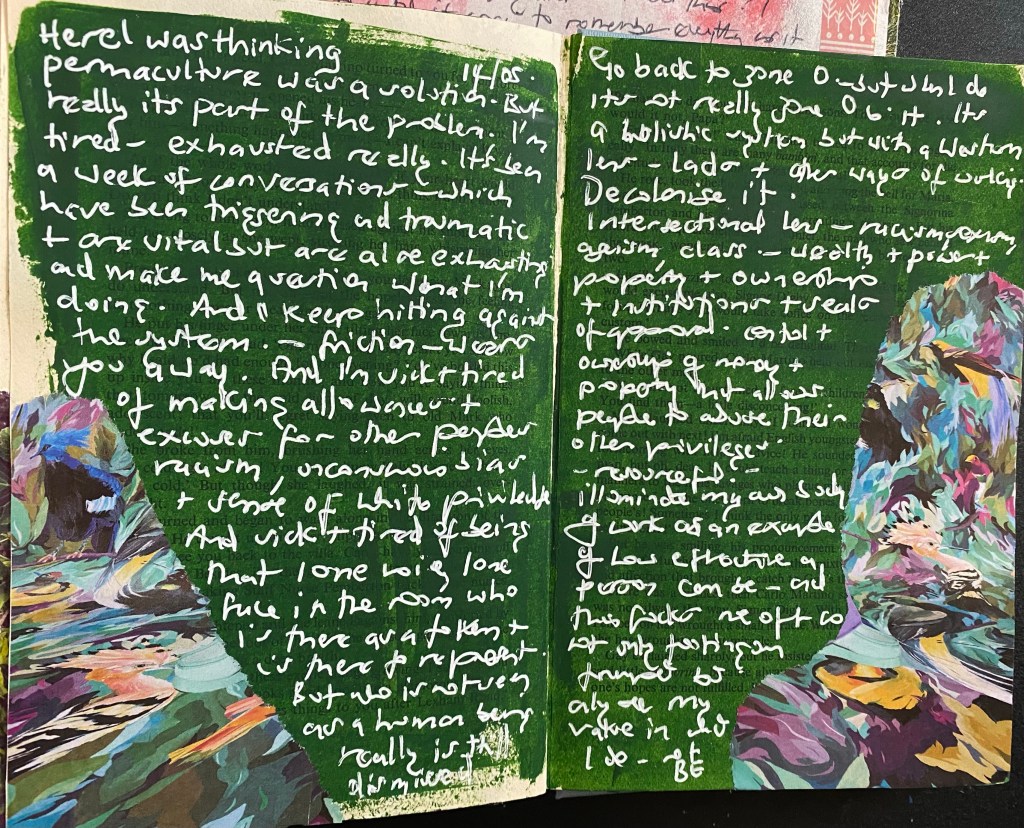
Sometimes I use my journal space for a rant. For a deep and meaning conversation with myself. It’s the space I can go to and be totally me and know I won’t be judged.
My visual journaling space is a time and place I can come to make sense of things that are bothering me. Which have me thinking and sometimes hurting. But it means getting it out on the page, gets it out of circulating around my body, mind and soul and pulling me down and holding me back.
Within these pages which are a mix of paints and images and words, I make sense of the world on my own terms. There might be other people’s voices that invade this space, but for the majority of time my voice reigns supreme. There is no where else in this world where my voice holds such sway as it does within this visual journal practice.
I get to try out different voices, registers, ideas and know it’s safe to show up here in all my fucked up glory.
This has been so appreciated and welcomed in these last few weeks when I’ve been stepping out more into the physical world as well as into new, expansive virtual adventures.
Knowing that I can come home to the page, after each encounter, good and bad, gives me permission and confidence to show up out there more and more as my whole self.
I really hadn’t heard of the book before this course but I was drawn to it as what I’d read from The New York Times review was that Pilate Dead from Toni Morrison’s Song of Solomon is mentioned and her missing navel.
In Song of Solomon Pilate’s “cut off from her people early” left without a trace of her physical connection to her mother. Pilate spends her life adrift not making any real connections with other people and places rootless and unrooted. But the flips side of this is independence and freedom.
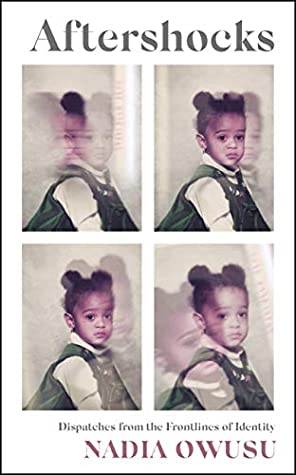
Nadia Owusu, through Afershocks, explores through her memoir her own rootlessness. What does it mean to be rooted? A daughter of an Armenian-American and a Ghanaian UN agency worker, Nadia is born into movement, travel diversity and trauma. She’s becomes fascinated with place because no place belonged to her.
Aftershocks takes it premise and structure from earthquakes, with shakes, rumbles foreshocks and upheaval affecting the narrative as it moves backwards and forwards in time. The present is marked by Nadia spending a week in a blue chair just rocking as she suffers a breakdown, after her whole world is devastated when she learns a different reason for her father’s death. A father she idolised since her mother abandoned her at the age of two and was fleeting in and out of her life since then.
I’m so enjoying reading this book as a reader but also as a writer as this means I’m carried along with the narrative, the shakes and rumbles along fault lines, at the same time as deconstructing it, exploring underneath the lines to find out how Nadia put this beauty together.
This is all helping me think about my own hybrid memoir and how this will be structured but also it’s giving me permission to put in stories and experiences that maybe I was shying away from before.
In the Author’s Note at the beginning of the book, Nadia states, “I write towards truth, but my memory is prone to bouts of imaginations. Other’s remember events differently. I can only tell my version.” This so hit a chord with me. A disclaimer at the beginning to let the read know this is the truth, but how one individual feels it and it might be embellished a bit.
And then when someone in the course group mentioned how they find Nadia so narcissistic in her writing, only focusing on her thoughts and feelings. I was like ‘HELLO!” This is her memoir, her story to tell, because who else is going to tell it?
Angelique, the course tutor said, while writing a memoir you walk a fine line. The line between narcissism and humility. When you can create the balance between the two extremes then you have yourself a brilliant memoir.
I can only say I’m working on it. And that brings me joy to say that, I’m working on it.
I would recommending this book, Aftershocks, as it’s so well written and even though details an individual’s life experiences up to the age of 28, there are still universal themes and episodes within this text that will not only draw you in with wonder and awe, but will also get you wandering down your own path of memories and natural disasters to try understand your own nuanced neurosis and make-up and sense of self.


 Living Wild Studios