*not so mush a trigger warning but saying it anyways!
I am worthy of consent.
I am safe.
I can heal from sexual trauma. – Lyvonne Briggs
I’m writing. Or is it rambling? I’m not sure. It’s just that I’m reading at the moment. I’m in my cave (bed) hibernating and I’m reading so many different books. Fiction, non-fiction, poetry and there’s a cross over with what’s happening within my life with my reading ( Does that happen to you?). There’s an echo or a reinforcement for the things that are causing me grief at the moment, worrying the wound as I read and rest.
So writing things out, going long is a way of making sense of it all in the moment. It’s a way of gaining some kind of clarity for now. Not thinking of the future but thinking of gathering the threads at this moment to made make a something out of this mess of yarns.
My mum died when I was 27 years old. I’d just become a mother the year before. I’ve been hearing about the ‘mother wound’ lately. I’m not sure if I understand it completely. But when I hear it, I don’t jump into definitions and theories. For me it’s simply means when my mum died and left me to cope alone. Selfish I know. But I feel as is she left a gaping, bleeding wound that festers and hurts when I worry it. When I press on it, inspect it with my touch.
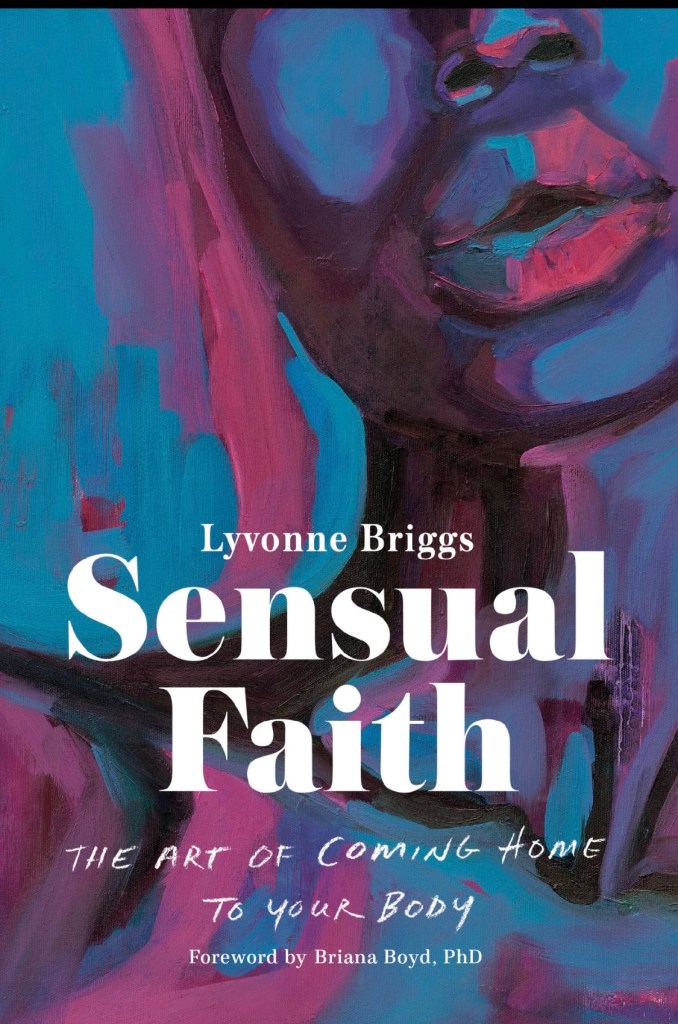
This morning, following my morning routine, in bed reading (with coffee skipped ahead this morning) I’m reading Sensual Faith: The Art of Coming Home to Your Body by Lyvonne Briggs. I’m reading a section called ‘Surthrivors’ a term Briggs created to try and capture how she was feeling, living after male sexual violence. She felt ‘survivor’ was too flat to describe/ define her experience when she was living/doing what she loved studying theology and religion, in community with loving people and was an acclaimed spoken word and slam poet. “I wasn’t just surviving, I was thriving!” Briggs wrote, hence pointing the more accurate term, ‘Surthrivor’.
I love it when we Black women bend and twist language, divest from the standard to better express/ more fully express our feelings and experiences. That’s creative fugitivity for you (thank you Dal).
Briggs goes on to talk about how she got into the ministry so she could change how the church handles sexual abuse, not very well, as there is a silence around it. Or they blame demons instead of the actually men. I’m not here to talk about male sexual abuse. I’m not her to talk about the church. I’m not a religious person. I was brought up saying my prayers. I remember a black bible, creased leather, brought from Trinidad and Tobago with my dad when he stowed away to England. This black bible sat toad-like in the teak sideboard of my childhood living room. West Indian style living room, I may add.
I gave up believing in a ‘God’ when my daddy died when I was 9 years old. I’ve now come around to the idea that we are Gods/ Goddesses ourselves, inside us. I’m spiritual rather than religious. So I’m not sure why I’m reading this book.
I lie. Yes I do know why I’m reading Sensual Faith. I followed a trail to this book left by Christina Cleveland and God is a Blackwoman. But also because of the subheading of Sacred Faith: The Art of Coming Home to Your Body, is a journey I always seem to be on.
Anyway. Back to the reading this morning which went on to discuss the worship centre in a church is called the ‘sanctuary’. When you the word ‘sanctuary’, does anyone else think of Quasimodo? ‘Sanctuary, sanctuary!’
A ‘sanctuary’ is a safe or holy place. I wrote a poem titled ‘sanctuary’ and it was about my mum. My mum’s home, body, arms. When she was alive, it was her I went to for safe harbour. I didn’t realise until she was gone. It has come a way for me to practice mothering my own children, through sanctuary for them. Once my mum died, I lost who and where I could return to for safety. I lost my home, my sanctuary when she died and I suppose I’ve been searching for sanctuary ever since, looking outside myself, looking for it in others ( husband for one!)
I don’t how long I’ve been in battle with my being, with my body, chastising her for not being enough. But also for being too much. Too fat. Too broad, too Black. But over the last few years, eyes open, something has been changing or shifting within me and how I view, treat and talk to my body.
.
Maybe that’s where my mum did me a disservice and where I’m making amends with my kids. I’m not sure she taught me how to find sanctuary within myself, within my own body.
Monday nights I dread.
Not always. Just the last few months as I complete my level 3 diploma in counselling skills. I’m not jesting that I hate turning up for this course. And I never use ‘hate’ as a word usually, always thinking it’s too strong a word for a feeling. Too final without any redeeming features. But this is where we’ve got to with this course.
And it wasn’t always the case. I could blame the dark, cold nights I have to turn up for 3 hours of lecturing and talking in an empty, sterile office block. I could blame the electric fluorescent lighting that flickers and buzzes and can give me a bad head. But I would be lying. I’m here to be wide open and honest. So here goes!
This course is taking away pieces of my soul, week after week. And I’m not ashamed to say that I have contemplated dropping out week after week, researching for alternatives. I even enrolled on a supplementary course, decolonising counselling, that would tend to all the damage this course is doing, but I had to withdraw from that due to costs and timings.
If you’ve ever studied counselling and therapy, you’ll know that everything; theories and tools and practices are all taken from dead white guys. Dead white guys acting like Gods (and I don’t mean the internal Gods I’m just mentioned). White male, usually heterosexual and middle class theorists who pontificate that they know everything about what’s happening in everybody’s mental health. They have the solutions to make us feel/ do /be better. As it’s always the individual’s fault and can be traced back to their childhood, their mother? Bullshit!
It hurts to be fed this shite every Monday. In the beginning I pushed back and attempted to decolonise the teaching, the theory, the responses. Bringing in other theorists and arguments. Being the only Black face in the class, girl has to represent.
Until we got to week 9, we were exploring different types of power within the counsellor and client relationship. Power roles within the counselling arena. After a discussion, we were being presented with a list of ‘Further key aspects of power or perceived power’. And yes the list was not an exhaustive list and things could be added, the tutor said. This list did not include ‘race’, ‘ethnicity’, ‘culture’, and I voiced it as such. My comment was laughed at and dismissed as, ‘there’s always one’.
Always one who has to comment on what’s missing from the list? Or always one who has to bring up race? Who knows! I just know how this comment made me feel. Know your audience I say or was I being put into my place? This response indicated to me that this input, which a fundamentally the way white supremacy culture wields power through the hierarchy of the races. It’s the sea that we’re swimming in and to not mention is the usual state of affairs. This interaction indicated to me that this was never going to be on this course’s agenda. Me continuing to challenge the whitewashing of counselling and therapy, me constantly remarking on the culture that we’re operating in wasn’t enlightening my fellow students or suggesting that they become more aware of their ( and my own) unconscious biases. I realised I was just creating issues where they never saw issues. Problems where there are no problems. As race and racism is only a problem when there’s a Black person in the room. It’s Black people who have an issue with race as whiteness isn’t a race, right? Whiteness is a given.
After week 9, and tonight was week 15, I’ve silenced myself. I’ve disengaged from the course, no longer contributing. I turn up and get my attendance and keep my thoughts and comments and feelings to myself. I’m not giving anything of myself anymore to the group, to the course within the face to face sessions as I’ve received the message it’s not welcome, it’s not of value, it’s not relevant. I do not intend to waste my energy and heart and soul on this experience.
This hurts me.
I’m making sanctuary for myself. I’m making this experience safe for myself. I’m keeping myself safe within myself, within my body as being in that classroom is no longer safe for me. And to explain that to them, I wouldn’t bother, as they wouldn’t get it. The can’t get it and it would also involve them listening to me, and me being heard, which ain’t happening.
I’m creating sanctuary for myself, within my body and its a practice. I’m using a self-soothing approach, self-talking, loving compassionate approach when I experience something that is harming, hurting, traumatic. I’m letting myself know, like that little girl inside me who needed to be loved and kept safe, I’m stroking my own chest over my heart and saying to her, saying to myself, ‘ You are love, Sheree. I’ve got you I understand why you are feeling unsafe. But I’ve got you. You’re dafe now.”
I’m mothering myself. I’m making myself safe. I’m making myself sanctuary.