Gaining Clarity

I’m been talking here about finding my tribe. About my search for comrades in solidarity. I’ve remained pine in the process, for real. From one particular source I asked for further reading, as something was niggling me. Id expressed my concerns in terms of using the oppressors language as well as, well I felt as, the lack of warmth, kindness, care and love. And then through the further reading it all became clear. This was my response.

I believe that there needs to be unity to fight all oppressions. You can’t fight racism without fighting against capitalism.

But I realise through this further reading where my concerns lie. It’s not in the socialist/Marxist movement as a whole but it’s with the people who make up the movement.

I’m not sure if the people of the movement have/ or continue to take the time to work on their own racism. There seems to be a given that because the movement is against all oppressions that it means those who are part of the movement can’t be racist or sexist because they say they are against all forms of oppression. Saying it is one thing. Practising it is another.

In practice there is still the use of the oppressors language as I’ve mentioned before. Using ‘non-white’ or ‘minorities’ is offence as they still centre whiteness which is used for division and oppression.

The articles mention the BPP alienating white people because of their support for Black Nationalism and Separatism, and their language used around Black Power. You even mentioned yourself that we can’t fight capitalism through language and its use. Modifying language is not going to bring about material change you say.

And yet it is language the party is using to rally the masses, to bring people together.
Language is the tool of persuasion no? Language is the tool of education.

But if that language continues to use the language of the oppressor and is offensive to certain groups of people, they are accused of being confused, ill informed and falling into the identity politics trap again.

However, from my experience, through reading the literature of the party, I feel that the language used reflects a party line where the people behind that line are not continuing to work on their own racism/ biases while focusing their efforts on society’s ills, outside of themselves.

I do not feed into white supremacy culture with the characteristics of either/or. I believe in and/both. That means for me, there has to be the work on the individual’s internalised racism and sexism at the same time as working against oppressions within society. Working on our own blind spots and prejudices can only benefit the movement as a whole. Where this fails to take place is where the oppressors divide and rule become fixed without our recognition of it.

To say that ‘non-white’ is every day language, quote, ‘commonly understood by ordinary people as respectful ways to refer to some people who are oppressed’, as a black person being referred to as ‘non-white’ is offensive to me and I’m not really bothered if other black people are okay with it. I might be falling into an identity police trap but one my identity is not built on my relation to whiteness that is racism. Two, if someone says they find it offensive and that is not recognised or is questioned and explained away as being the norm is denying that person’s experience which is racist. Three, to bring this up then to have it dismissed as being defensive and accusing someone of being a bigot/ racist and dismissed as a distraction from the cause is another example of an individual failing to check themselves and work on themselves to combat their racism/ discrimination tendencies.

I work on myself daily to check my prejudices or biases or judgments and blind spots. I only wish more people would also as I do believe the world would be a better place because of it. Movements and societies are groupings made up of individuals. Working on the individual at the same time as the collective can only strengthen that connection and keep moving it forward in an effective way, I believe.

If we think about what is happen in the USA today, and the ICE raids within every community. The Latino community is coming out and asking where are the black people why are they not out here on the streets with them protesting? Why are they sitting this fight out etc.?
Black people are tired, esp. black women. Black people told everyone to vote for Kamala Harris and they didn’t listen. They voted for Trump. And now he is doing all that he said he would do.

Now people are asking for black people once again to put their bodies on the line. And yeah this is a prime example of the ruling class dividing and ruling. Pitting one group against another. But what is true there and what is true here, black people only make up a small percentage of the population. In the states 12% here 4% with other ethnicities. And yet it is expected for us to save the world. ( Aside here we might be termed ‘minorities’ within these countries but we are the global majority. I don’t use ‘minorities’ because it is used as language of control. Black Feminism or Third World Feminism has always been global in its remit).

It is expected for black people to put aside those differences which on a daily effect our life chances. Our lives in terms of life and death. And this is not feeding into a victim hierarchy and who’s suffering is more than someone else’s. It’s a reality. Black people, black women do not just suffer violence and brutality from the state but do so from person to person in their every day and yet black feminism still criticises and attempts to bring material change for all through fighting all oppressions including capitalism and yet if they ‘fail’ to bring about material change it is because of ill-fighting or confusion in their ideology but no mention of doing this within a racist/ sexist society that does not see Black women as anything except mules of the world. Not either/or but and/both.

As black women we continue to not be seen as human. Read Fugitive Feminism by Akuwgo Emejulu to understand this, which is anti-capitalist, anti-imperialist and anti-colonialist. It’s arguing for a rejection of the whole system. A refusal of what has already been refused to us. Other ways of being are possible.

Marx himself saw the future of capitalism as self-destruction and a social mode of production being the outcome. Fugitive Feminism is being/working now with the other possibilities. It’s about creating an outside while still on the inside. Creating spaces of liberation and joy on our own terms. It’s not waiting until then for it to be now. It’s collective and speculative and might be fostered by black women but can be utilised for all, all oppressions including capitalism and the class struggle.
It is probably dismissed though because it comes from the mouths, minds and hearts of black women.

Thanks for all these readings. They have helped in clarifying where I stand. In solidarity but at the same time in my own fullness and power which I lend to any movement which recognises this and works with me to bring about dismantling all oppressions for all people.

The reply I got, was thanks, I’ll reflect on it, and wish you luck on finding your people.

I’m sharing it here as I don’t want my realisation to do to waste. The words I shared to go to waste, as I’m still open for the conversation, still open to standing together.
when the world is burning, what can we do?

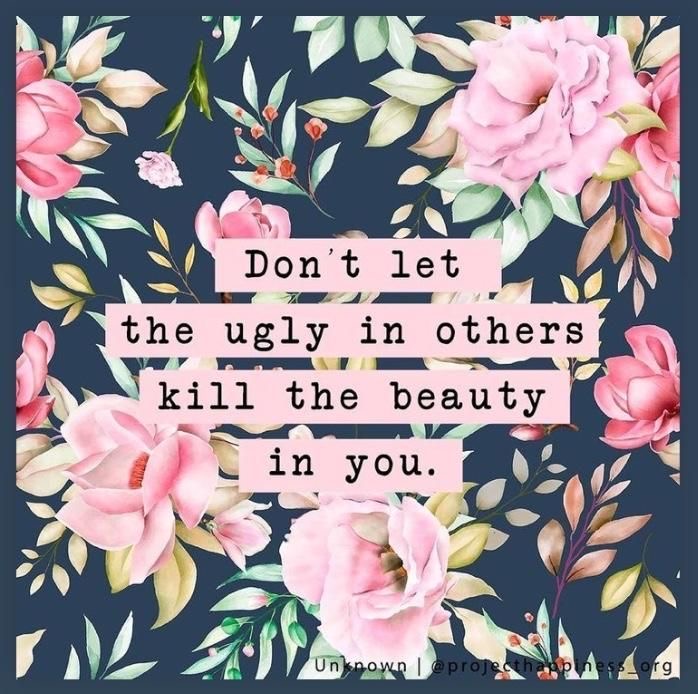
when the world is burning, what can we do? we can make fucking art. that’s what we can do!

“You can’t help it. An artist’s duty, as far as I’m concerned, is to reflect the times.”

― Nina Simone

sometimes i feel so small and insignificant. and what can i do that would make a difference? the world is burning. people are being exterminated. genocide over and over around the world, not just Gaza. Sudan, Yemen, Syria, Democratic Republic of Congo. genocide is history repeating itself. just in the last few days, a landmark Aboriginal-led inquiry has found that british colonists committed genocide against australia’s Indigenous population in victoria in the 1830s. why has it taken so long for this to be vindicated when the people themselves know when they have been dehumanised and persecuted? nations/ governments commit genocide because they think they can get away with it. no one seems to hold them to account.

what can I do when, as an artist, when the world has gone to shit? make art. that’s what i can do and that’s what were supposed to do.

it’s out duty to reflect the times. but the world is making it really hard for us not to do this. the world is working really hard to silence us. to suppress us. to keep us operating on fear and to box us in. all these social media platforms are owned by oligarchs who own and control us. we are discouraged from telling the truth. and when we tell the truth is is filtered, distorted and manipulated.

and yet. i remember. we need art. people need art. art helps use process our feelings and emotions. through art we can learn, heal and feel. art helps us to be in touch with ourselves and each other. art connects. art helps us reflect.

art gives me the words or the language for the things i didn’t know i needed to express to process to reflect to share. here in my little space on tin-ternet, i’m not bought or controlled. i’m not silenced or afraid. i embrace my duty as an artist to make art by any means necessary.

i hope you will join me in creating and reflecting the times. let’s not sit in our fears but connect in our strengths.

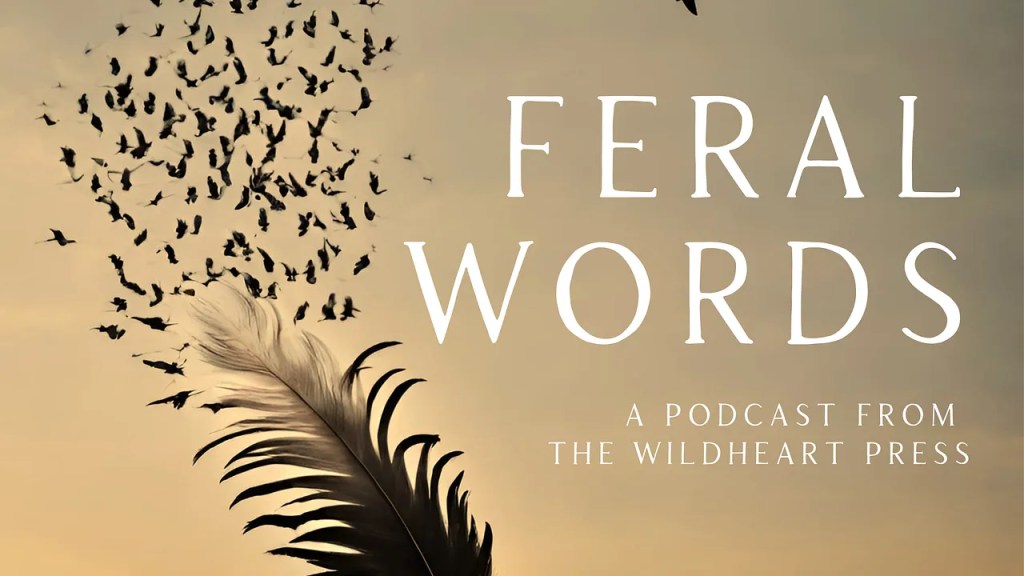
Feral Words POdcast

Ohhh I love coming on here and sharing goodness. 

I had the pleasure of talking to Eleanor Cheetham from The Wildheart Papers on their podcast Feral Words last week.

It was so good to have a deep dive into my practice, my work around fugitivity and refusing to perpetuate white supremacy culture. And it was all welcome at Feral Words. Nothing off limits and it was so liberating to try and make sense of all the concepts and ideas and feelings that are circulating within and without of me at the moment in time. A very disturbing time. 

Writing as Resistance, Reclamation and Ritual, is the episode.

I’d like to thanks Eleanor for again holding space for me and my creations with care, grace and joy.

Here’s the link for the podcast . Please take a minute when you get a minute or two. 

And also check out The Wildheart Papers here on Substack too.

The Sinners Series – 002

I’d seen the trailers. And forgot. It was already out a week or so when I realised and I only had a small window of time before I was off on my travels again.

So on the spur of the moment. I booked my ticket, walked and bussed there. A late night showing. I’d be coming home in the dark.

I should say, I have a love /hate relationship with horror movies. I get scared easily. I’m very impressionable. And images especially horrific ones haunt me afterwards. But I also enjoy being scared. In a weird twisted way. It’s an adrenaline rush.

This film has vampires. And I was travelling home alone. Considering walking ( I didn’t my after all).

The cinema wasn’t really full. I settled in and right from the beginning of Sinners directed my Ryan Coogler, I knew I was going to be in for a treat. The cinematic colours and quality of the film, shot in IMAX and 70mm film, pulled me into the world created.

Set on 1932 in the Mississippi Delta, during Jim Crow, a musical supernatural action film was a beauty to behold. Michael B Jordan playing a double role as the twins Smoke and Stake, I was gripped.

Of course I jumped and screamed all at the right parts but I also got lost in the characters and their relationships and the horror of it all. The death, grief, pain and joy.

If you haven’t seen Sinners, please go see it. Best movie for this year, best movie by far for a long time. This is a movie I have no qualms about haunting me.

My Wall of Fugitivity

I’ve got a chapter to write and it’s going nowhere fast.

I hate it when I think I have all the time in the world to complete a writing task and then I procrastinate.

I know I procrastinate because it’s important to me. Very important to me and I don’t want to get it wrong. So I do nothing instead.

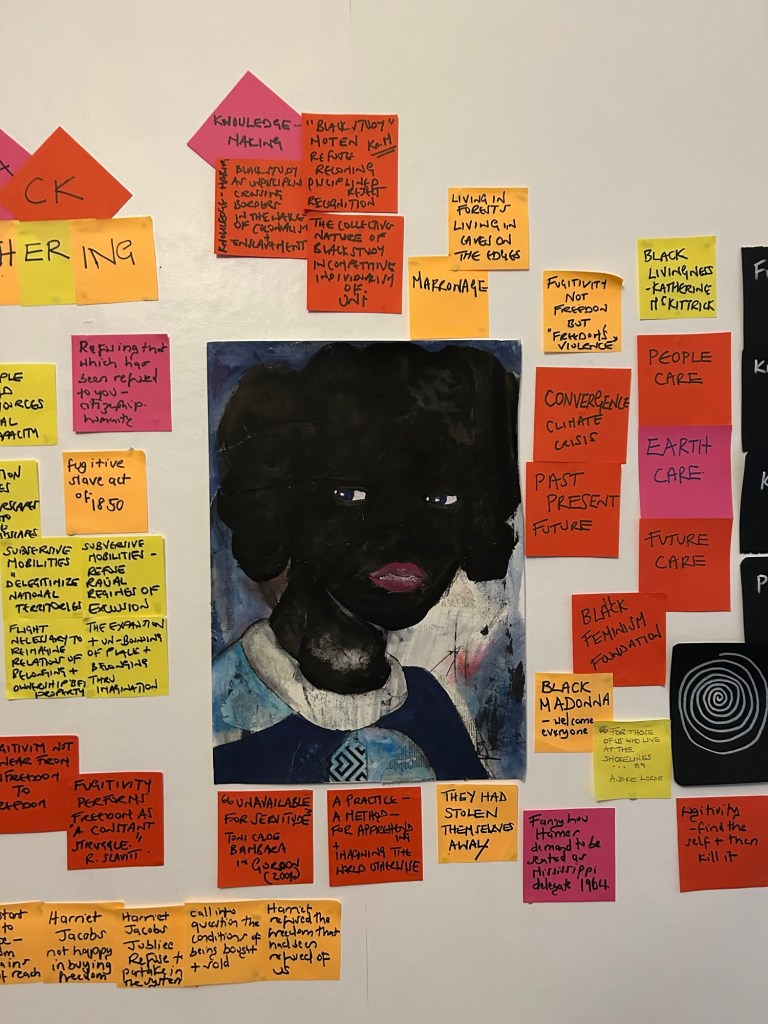
Well not really nothing. This is my bedroom wall, where I’ve started to put up post-it notes to help me with the chapter on fugitivity.

This makes me feel as if I’m doing something. Seeing this everyday also, I hope, makes something go into my creative brain subconsciously. I’m hoping that living with it makes the wheels start turning and connections being made.

What I’m learning with fugitivity is that is’s not linear. Not a straight line from captivity to freedom, from unfreedom to freedom. It is argued that fugitivity performs freedom ‘as a constant struggle’ ( R. Slavitt cited in Davis, 2016).

This I hold close as I attempt ( struggle!) to write this chapter around fugitivity as this is not going to be a linear chapter from A to B to C etc. This chapter with its content and structure and form will be dancing with unfreedom and freedom, constantly struggling to convey meaning around fugitivity at the same time as remaining free from the academic frameworks and restricts and expectations.

In order to write about fugitivity I need to take on board fugitive methods and practices.

I’m spiralling and circling back and forth in a good way, in an honest way and hopefully the chapter will be the result.

Drinking Fugitivity – Found PoetryFilm

Drinking Fugitivity: Found PoetryFilm

This short piece is a mash up of a certain clip from Joaquina de Angola: Memory of a Liberation by Aida Bueno Sarduy and music from Insight Timer, called You.

Seen recently in Barcelona at CCCB, Joaquina de Angola: Memory of a Liberation by Aida Bueno Sarduy is an audiovisual installation that recovers the story of Joaquina, a young woman enslaved on a plantation in Brazil, and her escape.

From the exhibition’s text details it reads:

“A work about archived, forgotten, and silenced voices in the history of slavery and colonialism.
This audiovisual installation brings to life the act of “unarchiving” an event recorded in colonial history as an escape. A 15-year-old enslaved girl fled the plantation where she lived, and her owner, after an unsuccessful search, placed an ad in the newspaper offering a reward to whoever found her. The archive reveals nothing more about this incident: it merely collects it as a piece of data.
This piece challenges the oblivion, archiving, and silencing of this character. To unarchive, in this context, becomes an artistic and political act that brings Joaquina de Angola out of the shadows of the document, removing her gag and chains so that she can tell her own story. This act not only questions the record but also raises questions and delves into its details. It is an inquiry that brings Joaquina back to life and acknowledges her as a cimarrona, calling upon ancestral memory as well as imagination, intuition, and spirituality.
Since the beginning of colonization in Brazil, alliances and exchanges of extraordinary significance have taken place between Indigenous peoples and enslaved Africans, but these have also been silenced. The presence of entities known as caboclos (Indigenous spirits) in all Afro-Brazilian religions is perhaps the most consistent and profound evidence of this. Amazonian peoples, Indigenous peoples from across Brazil, and quilombola communities—formed by Afro-descendant peoples—have shared ancestral struggles for the defense of their territories and against colonization and exploitation. The installation speculates on these possible Afro-Indigenous alliances in Joaquina de Angola’s journey toward freedom.”

This extracted masheup with music created above by myself, hence a found poetry film, is my take at a beginning of exploring fugitivity. I’ve been living, breathing, talking, practicing fugitivity for a few years now. I’ve mentioned it before, and it was Dal Kular who first introduced the term of me via her then newsletter, Field Notes. Dal said at the beginning of Jan 2023,

“Whatever the out-there-in-the-world fuckery is going on in 2023, I declare myself a CREATIVE FUGITIVE. A way of living in this world but not of it.”

Her take on creative fugitivity has stuck with me. I’ve gone on to read more around fugitivity. I’m even writing a chapter, at the moment, around black mothering and fugitivity. Fugitivity is taking over my life. And again I’m creating a project here in my portfolio to collect my wanderings and wonderings around this concept and way of being.

For me in a nutshell, fugitivity is the act of flight. It is the withdrawing of my labour and consent in the current system of white supremacy culture, capitalism, imperialism, colonialism. Fugivitiy is refusal and resistance. Divesting from the current way things are playing out as the few hoard the wealth of the world at the expense of the many.

Originally the fugitive was the runaway, the escapee. Hence why the audio-visual installation and consequent fugitive poetry film was created. I’m starting from the origins of the escaping enslaved. Running, fleeing captivity towards freedom. Freedom being the end point, the destination but in the process of escaping, there is the in-between space between what they were fleeing from and fleeing to. And here in this liminal space is where fugitivity is ripe.

There/ here is the lingering in the midst of flight, where I choose to SLOW down and be. To linger with nature. To seek my joy and pleasure in the world around me on my own terms.
Fred Moten in conversation with Saidiya Hartman, both of whom we will be exploring further, said,

“I often use – and I always think of it in relation to Fannie Lou Hamer, because it’s just me giving a theoretical spin on a formulation she made in practice: to refuse that which has been refused to you. And that’s what I’m interested in.”

That is fugitivity as a method, kin-making and place-making, as a practice that I intend to explore within this project archive.

On A Reading Tip

Quantity over quality is a characteristic of whet supremacy culture. Say like with social media, we are wired to focus on the numbers. The number and amount of followers, likes, comments gives us the buzz. Keeps us returning usually. Rather than the quality of interactions. The quality of connections.

But in this instant when I say I’m on a reading tip and boast that I’ve read 12 books already this year, fiction, poetry and non-fiction, I’m taking the buzz of the numbers because I know they were quality reads.

Last year saw me fall off my reading horse. Reading was only happening when I had an extended amounts of time off the clock. Summer reading mostly. I didn’t have the bandwidth or desire to read at any other times. I was too antsy and not able to settle, as too many demands were pulling on my attention.

So I’m really happy that this hibernation season has seen me dive back into books. Physical and digital books. I do not care which as long as I’m reading, expanding my thinking and formulating new pathways of understanding and connection.

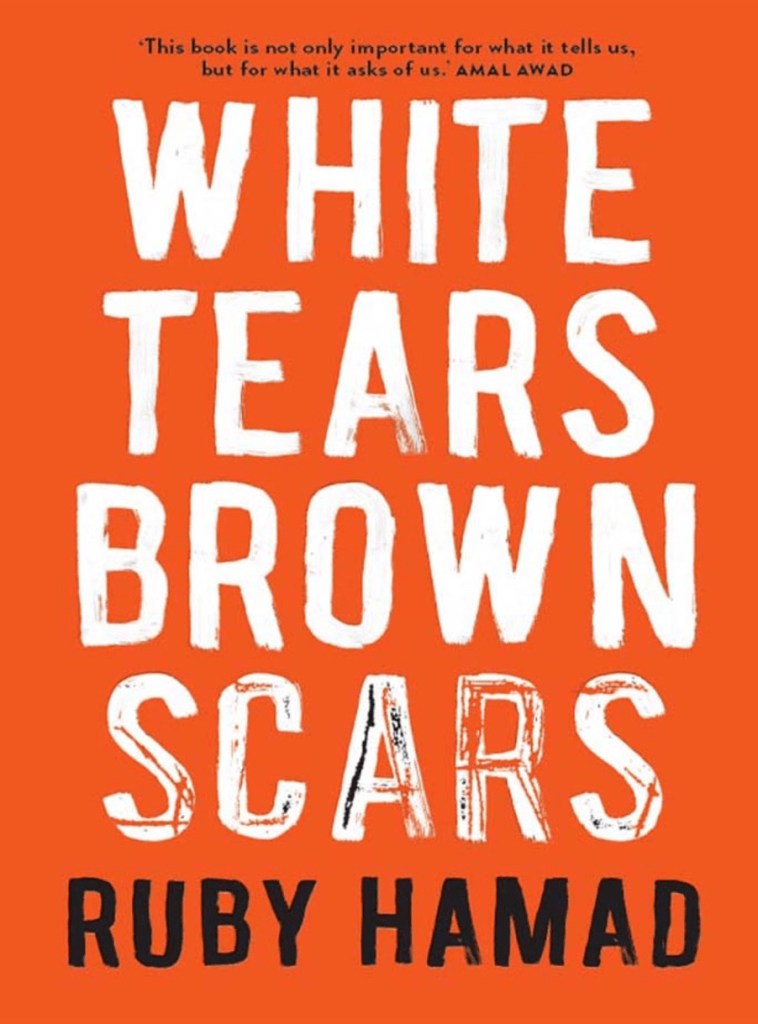
So White Tears Brown Scars by Ruby Hamad was completed yesterday. And it so feeds into my experiences with white women. Even though they’ve caused offence, been racist that is, it’s me who’s consoling them and making sure their feelings are not too hurt. Or it’s me having to apologise because my reaction to their racism or them touching my hair without my consent has been deemed far too aggressive and not very collaborative by the organisation or group I was working with.

They are used as a weapon, white tears, to shut down the conversation. To get the white person out of an uncomfortable situation and out of having to look at themselves and their behaviours.

It was so validating to read this book and recognise that it doesn’t just happen to me and that this is a centuries old tactic of the damsel in distress. And that damsel is white as Black and Brown women have never been deemed woman enough to protect. And all this shit is wearing thin with Black and Brown women. Believe.

This book was an extension of an article Ruby Hamad wrote back in 2018 for The Guardian. You can read it there and just know that one Black woman, Lisa Benson, who was working as a journalist at the time got fired for simply sharing this article because it was deemed ‘an attack on white women’. White tears in action right there!

Supporting Words of the Year

My word of the year is LUSH. And I’ve shared about my reasoning around choosing LUSH, here. On a basic level, I just love saying the word. By the end of the year, I know those around me are going to be sick of hearing the word, LUSH. But I know I’m not going to stop saying/ using/ projecting LUSH.

LUSH needs support moving forward. LUSH needs to spread throughout my life and practice. LUSH is my mantra and I want to direct this energy into bringing about change in my life. Going with the flow at the same time as maybe directing the flow. For me it is all about energy, and for the last couple of years, my energy has been warped, abused, stagnant and awry. So 2025 is me taking it back.

LUSH is a start. And to support this feeling, I have three other words that are coming into the mix, which are coming to my aid and will be used as my guiding forces, this year and beyond, along with LUSH.

So what are these words I hear you ask?

DREAM
CONJURE
FUGITIVITY

For me these supporting words feed into LUSH as well as each other. They all I feel have a sense of magic and possibility about them.

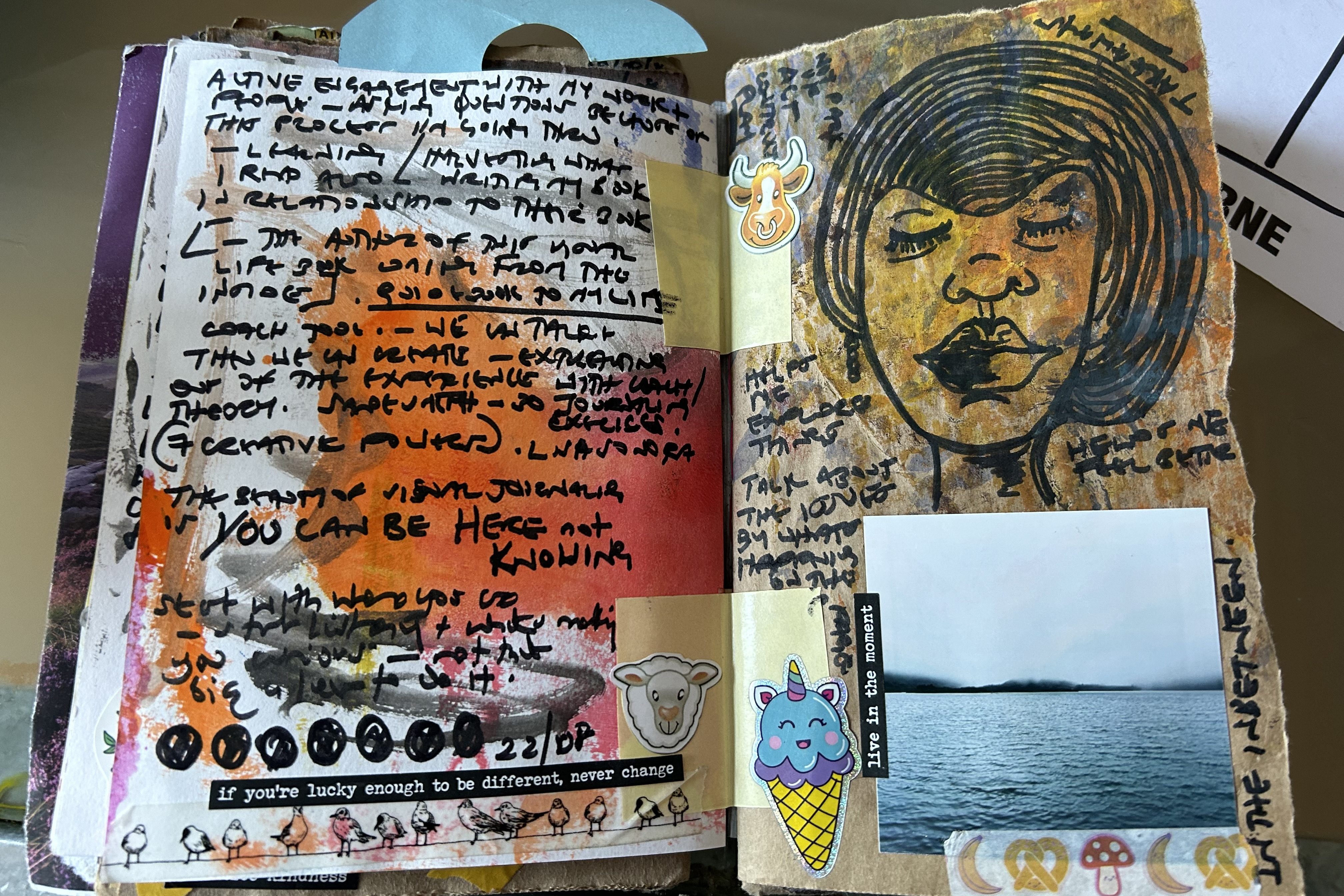
TO DREAM. I think I do this daily through my visual journaling practice. Everything that comes to fruition in my life, things that I make happen for me and others, starts on the page, starts within my visual journalling. This year, I’m adding some more energy, potent energy into those pages as I intend to dream big, dream bold, dream beautiful.

TO CONJURE. This is where the magic lies. I love the word conjure. It has come to take on more meaning over the last couple of years as I’ve explored it in relation to Black Feminism, Black women and another way of knowing. Another way of being in this world which draws upon our ancestors, Mother Nature and our innate wisdom. I want to conjure with intention this year and be open to what appears, what happens. I want to step into my power as a CONJUR WOMAN ( See Romare Bearden) and appreciate all the layers.

FUGITIVITY. I have Dal Kular to thank for bringing this word into my life as well as supporting and inspiring me in the use of it too. Fugitivity is state of being and movement. It’s a way of moving through this world where you are your own authority and guide. You refuse that which has been refused. It’s a divestment from white supremacy culture, the structures and systems which state that I will never be good enough, white enough, human enough. Another life, another way of being is possible. And I’m exploring the possibilities.

I’m mighty happy with the supporting words this year I have with LUSH, because already sharing them here and thinking/ feeling on them, in the process they are already bringing about change, SLOWNESS as well as JOY.

Have you decide on your word of the year yet? Are you going to support that word with some other words? Let me know in the comments, I’m interested.