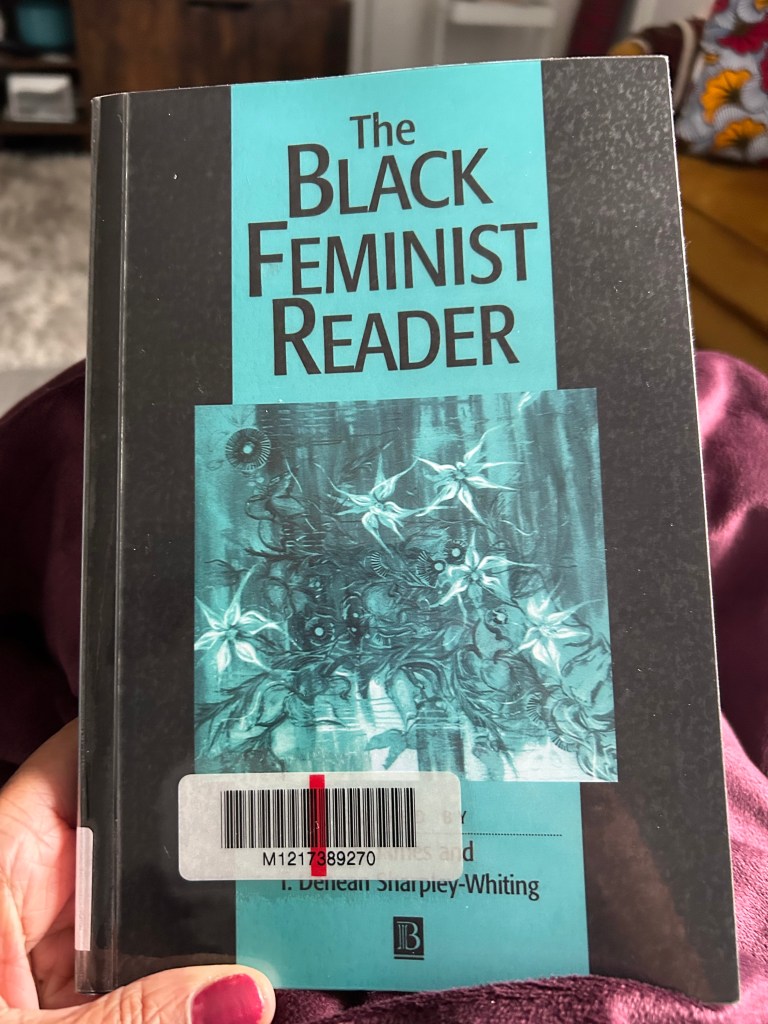
The Black Feminist Reader

I’ve got time on my hands to read. A reading week as we used to say at Uni. Why? Well that’s another story, I’ll tell you at another time, maybe.

For now, I’m getting my teeth into something that will make me feel better, or feel as if I’m getting somewhere with my self-study/permaculture diploma design/ ways of being.

I’m reading The Black Feminist Reader edited by Joy James and T. Denean Sharpley-Whiting. And I’m heartened to read in the first essay in the collection by Barbara Christian, ‘The Race for Theory’, that along with her Black sisters, Christian has not rushed to create abstract theories around how to read Black women writers/ Black women’s literature. The argument goes that there are countless Black women around the world, women colour around the world, and one single set of ideas cannot be applied to such diversity.

As Christian goes on to argue, “There is, therefore, a caution we feel about pronouncing black feminist theory that might be seen as a decisive statement about third world women. This is not to say we are not theorizing. Certainly our literature is an indication of the ways in which our theorizing, of necessity, is based on our multiplicity of experiences.” ( p.20)

Instead of being seduced into the academy, being at the centre, desiring/ claiming what might seem like power within the hierarchy of old traditional departments of knowledge, where the Black female experience is subordinate to others, ” We can pursue ourselves as subjects”. ( p.21)

This is music to my ears as I have always found it difficult to pin down what is Black Feminist Theory. What does it entail? What are the tools of engagement? What methods should be employed to reading Black women writers?

But that’s where I’ve been going wrong, thinking about theory. As for me theory was legitimisation. Writing dies if it’s not being talking about, theorised. But now I understand that :

  1. Theory has been their way, their terms, their approaches ( p. 16)
  2. Theory has been more about how clever the theorist is than about the writing or writer
  3. Theory is prescriptive and it ought to have something to do with practice (p.13)
  4. Theory is about those masters who have long gone and not about the here and now.

And as Christian states, and I totally agree, “But what I write and how I write is done in order to save my own life. And for me I mean that literally. For me literature is a way of knowing that I am not hallucinating, that whatever I feel/ know is.”(p. 21)

So I’m following Christian in my pursuit of what Black Feminism(s) is by having no fixed method of enquiry or even results. My method relates to what I read and the historical context of the writers I read and “to the many critical activities in which I am engaged, which may or not involve writing.” ( p.22)

So there is no set method within Black Feminist Theory and is influenced by practice, no prerequisite of a new theory as every work suggests a new approach, forcing me to think differently.

“As risky as that might seem, it is, I believe, what intelligent means – a tuned sensitivity to that which is alive and therefore cannot be known until it is known.”( p. 22)
Creating a Black Feminism Archive

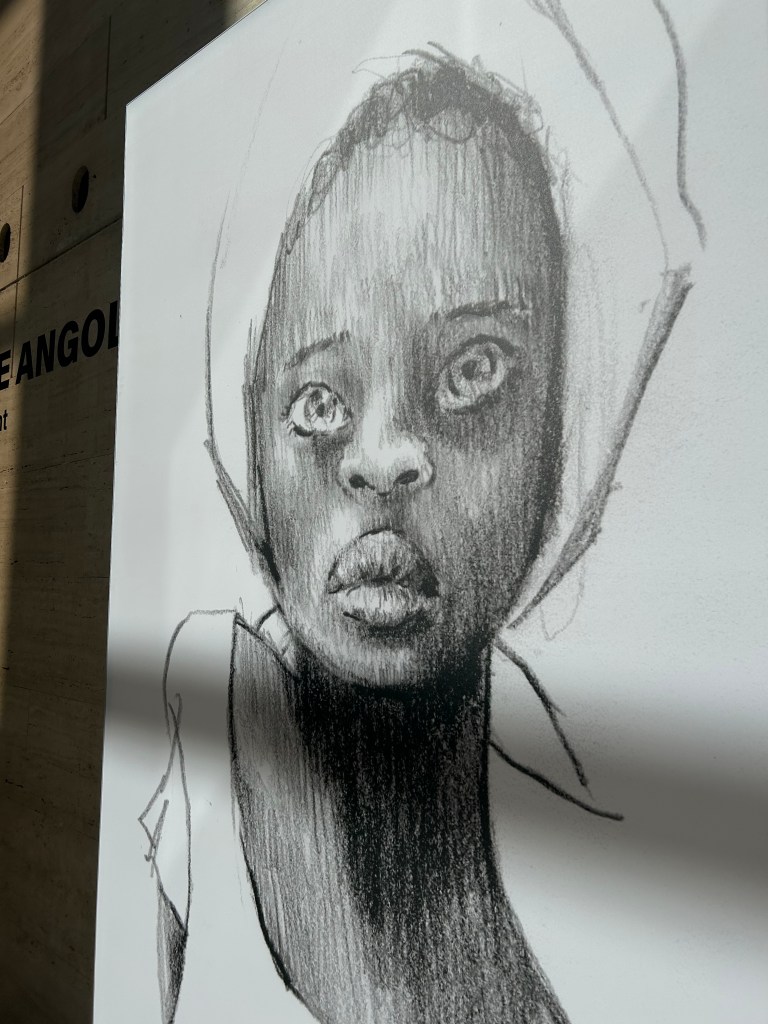
Joaquina de Angola

Okay where to begin..
That has been the issue – worried about where to begin has stopped me beginning.
But now I’ve got to begin as I need to get it out of me onto
the page, in order to create some kind of sense of it all.
So maybe I’ll begin with the Combahee River Collective (CRC).

I’m diving into the realms of Black Feminism- thought and theory and practices.

I’ve already been in the thick of it for years, with me first coming to Black Feminism through my degree and then masters and then this forming the foundation really of my PhD when I traced the tradition of Black British Women’s Poetry. But retaining knowledge and theory is difficult when I keep putting new things in my brain.

I don’t want to be an expert on Black Feminism but I do want to revisit it and consider it’s premise again in light of recent readings and experiences.

So I begin with the Combahee River Collective Statement, 1977. And I’m not saying that this is the beginning of Black Feminism. But I’m using it as a marker along the way.
I figure if I keep this statement in clear view, using it like a signpost then I can’t stray too far off the path.

This exploration of Black Feminist thought is going to be a new folder within this website’s portfolio as this is area of research is something I plan to keep returning back to and adding to as I continue to re-familiarise as well as extend my thinking and practices around Black Feminism.

So what is the Combahee River Collective Statement all about.
Well first you can was the full statement here.

It has been argued that this statement issue by a collective of Black women in Boston in 1977 who came together after witnessing an recognising the racism within the women’s movement and the sexism within the race/ civil rights movement, was based on the reality that Black women’s experiences cannot be reduced to either race or gender but have to be understood on their own terms.

Combahee River Collective Statement introduced to the world terms such as “interlocking oppression” and “identity politics.” Formed in 1974, The Combahee River Collective (CRC) was a radical Black feminist organisation which took it’s name from Harriet Tubman’s 1853 raid on the Combahee River in South Carolina that freed 750 enslaved people.

It might have been The Kimberlé Crenshaw in 1989 who coined the phrase “intersectionality” but it was CRC who articulated the analysis that underpins the meaning of intersectionality. The idea that multiple oppressions reinforce each other to create new categories of suffering, these interlocking oppressions, happening simultaneously, renders the Black woman’s position in society unique and most direr.


As the statement begins:

“The most general statement of our politics at the present time would be that we are actively committed to struggling against racial, sexual, heterosexual, and class oppression, and see as our particular task the development of integrated analysis and practice based upon the fact that the major systems of oppression are interlocking. The synthesis of these oppressions creates the conditions of our lives. As Black women we see Black feminism as the logical political movement to combat the manifold and simultaneous oppressions that all women of color face.”

It goes on to state:

“Merely naming the pejorative stereotypes attributed to Black women (e.g., mammy, matriarch, Sapphire, whore, bulldagger), let alone cataloguing the cruel, often murderous, treatment we receive, indicates how little value has been placed upon our lives during four centuries of bondage in the Western Hemisphere. We realize that the only people who care enough about us to work consistently for our liberation are us. Our politics evolve from a healthy love for ourselves, our sisters and our community which allows us to continue our struggle and work”.

CRC comes to the conclusion that:

“We might use our position at the bottom, however, to make a clear leap into revolutionary action. If Black women were free, it would mean that everyone else would have to be free since our freedom would necessitate the destruction of all the systems of oppression”.

And this would come to pass through the practice of the revolutionary politics of Black Feminism.

How might we divest from the human?

I’ve been reading. When I read, I feed my wonder and imagination. When I read, I fill up with ideas and dreams and plans.

Reading expands my mind and expands my understanding of the world I navigate.

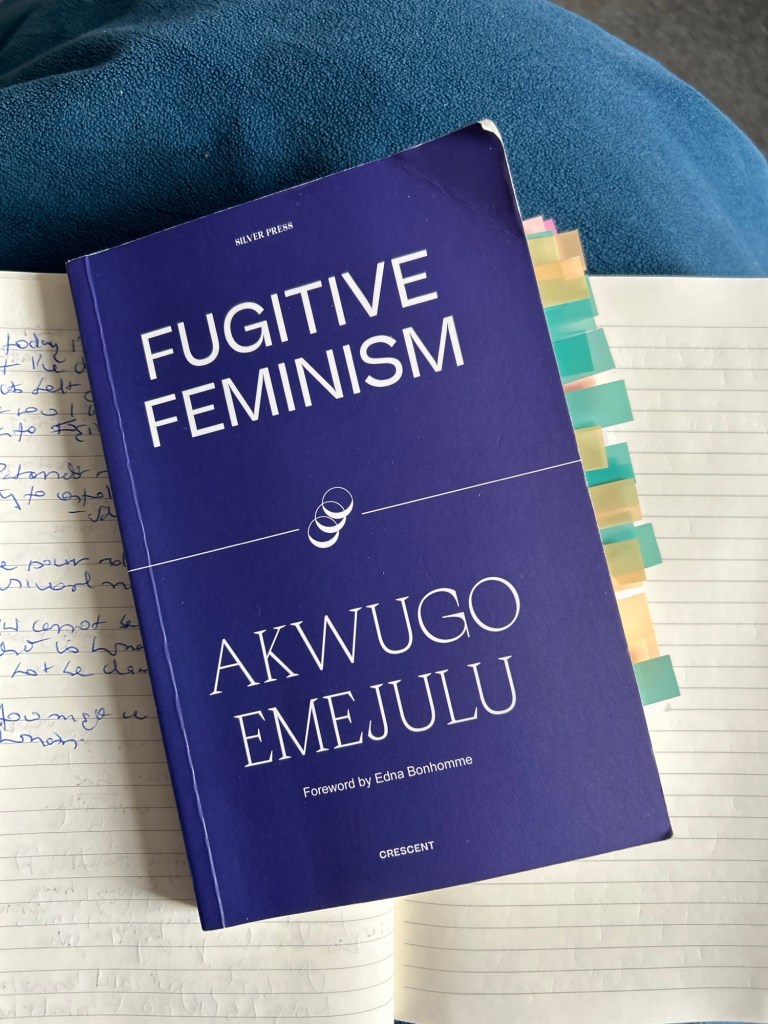
I cannot stress or emphasise enough how much my world has been rocked or even burnt down since my reading and continued reading of Fugitive Feminism by Akwugo Emejulu.

This isn’t like anything I’ve read before because it goes against everything I’ve been trying to do for the last 50 years; to prove the humanity of Black people, of myself so we can finally be accepted and loved.

But what if we’ll never be accepted? Never be accepted as human beings because who gets to claim humanity is bound up with whiteness, bound up with white supremacy culture?

What if being a human is a construct and is defined by those with the power and was never constructed to allow us, people of the global majority to be as such?

So if I claim non-human what are the possibilities for my being?

This is where I’m heading. This is the space I’m navigating now. I’m making changes from the inside out. In a cellular level this speaks truth and blessings to me. How I {BE} is changing and it includes a whole more ‘fuck offs’. Well that’s how it’s shown up my so far!