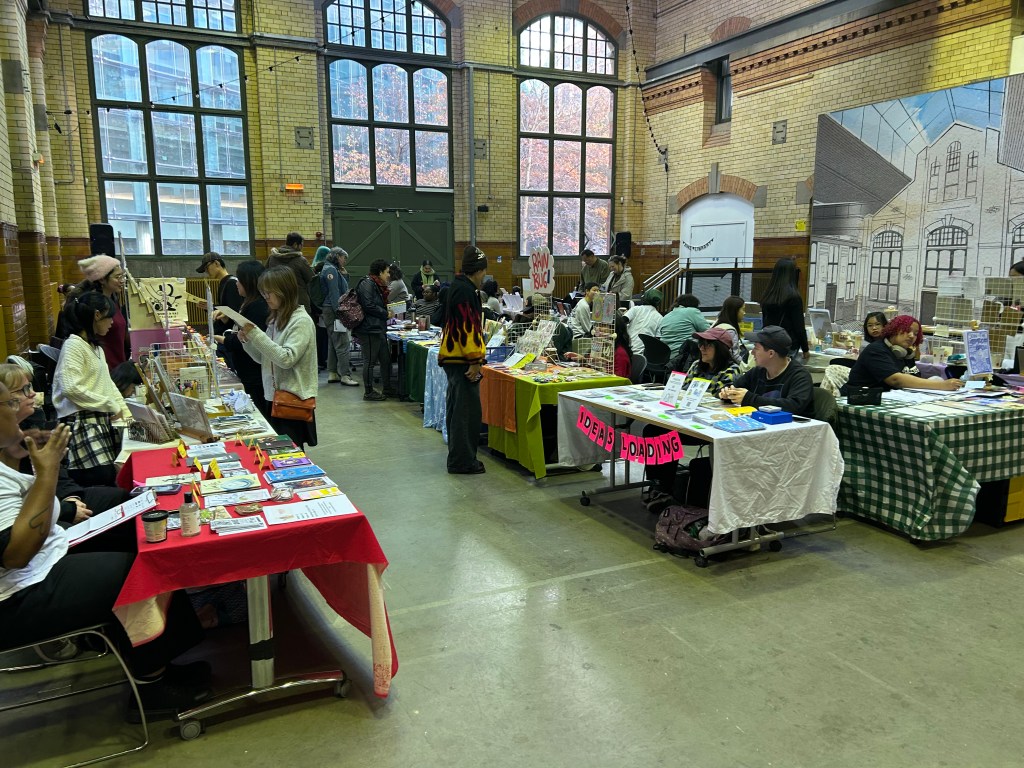
Today, Dal and I were in Manchester as the Over Here Zine Festival again. I think is out third year there together, sharing a table of our creations and laughing far too loud for such a small room in People’s Museum in Manchester.
It was good to be in a space that was created for people of the global majority to share their zines. It’s usually a safe and supportive space. And it still is in some respects. But what is worrying is that more and more white people are infiltrating our safe spaces. I know that white people come in to see and buy our creations. I can this is who we are selling to, while we swap with each other. But at the same time, I noticed white people behind the curtain, on the wrong side of the tables selling zines. But I could be wrong?
An article I read the other year, titled ‘Ontological Expansiveness’ by Chris Corces-Zimmerman, Devon Thomas, Elizabeth A. Collins and Nolan L. Cabrera, where I learnt the language I needed to call out this sense of expansionof white people into black and brown spaces where maybe the ethos and intention is exclusivity.
Ontological Expansiveness is a theoretical framework used under the umbrella of Critical Whiteness Studies (CWS) that was conceptualized by Sullivan (2006) to describe the complex and nuanced relationships that exist among race, Whiteness, and space. Sullivan (2006) argues, “As ontologically expansive, white people tend to act and think as if all spaces – whether geographical, psychical, linguistic, economic, or otherwise – are or should be available to them to move in and out as they wish” (p. 10).
Corces-Zimmerman, Chris & Thomas, Devon & Collins, Elizabeth. (2021). Ontological Expansiveness. 10.1163/9789004444836_058.
I could be wrong, but how is feels to me, and how I’ve been experiencing things, is that white people think and act and move as if they have a right to be in any and all spaces. Sullivan suggests that White people tend to think of themselves as though they are the only people to exist or have worth in the world. Black and brown people just don’t come into the equation. Colonialism is the epitome of ontological expansiveness.
In this example as the zine festival, I’m talking about taking up physical space, but ontological expansiveness also applies to language and who white people claim ownership, through creating definition of what is proper English for example. What’s acceptable is the language and tone and style of whiteness, any other forms of communications are wrong. Yet that doesn’t stop white people wanting to use Ebonics or use the ‘N’ word. And then there’s the appropriate of our cultural practices .
As Sullivan (2006) states, White people frequently act as if, “The appropriate relationship is one of appropriation: taking land, people, and the fruit of others’ labor and creativity as one’s own” (p. 122). Frequently, instances of White people engaging in acts of cultural appropriation represent a fetishizing and exploitation of the language, customs, or practices
Corces-Zimmerman, Chris & Thomas, Devon & Collins, Elizabeth. (2021). Ontological Expansiveness. 10.1163/9789004444836_058.
of Communities of Color.
Of course white privilege is wrapped up in this but it’s not enough to say this privilege needs to be given up or shared. Before anything changes white people need to acknowledge what they are actually doing, but how are they going to do this if they are oblivious to what they are doing?
I invite white people to recognise that they will feel uncomfortable when they do enter spaces that are predominantly non-white and get used to it. As in that discomfort is the seed of change.
 Living Wild Studios