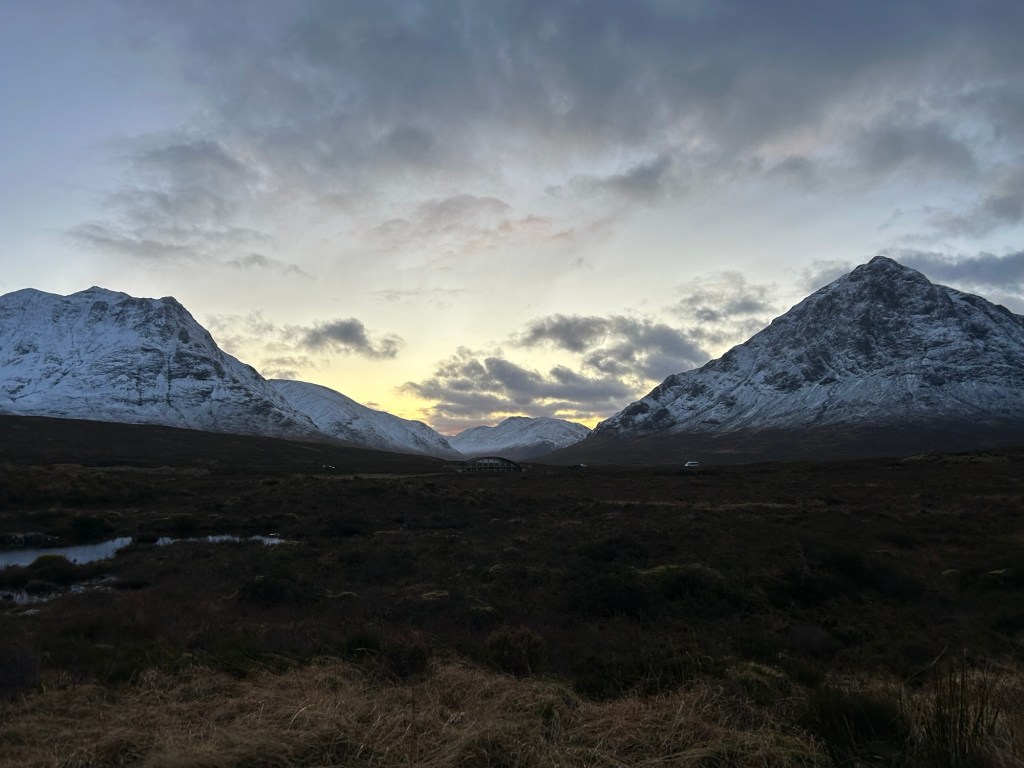
I’ve taken quite a shine to Loch Morlich. It’s a place that keeps on giving. And a place I long to return. I leave it with a renewed commitment to my self-love journey. To devoting more time, care and attention to myself. Diverting the attentions I might have been giving out willy-nilly to other people, thoughtlessly, I redirect back to the source. Me.
7am, Loch Morlich
I entered the loch today as the sun was rising. I broke the surface of the loch, with its shards of ice and glided out. Slow expansive circles ripped upon the lochs surface as I took slow, cold strokes. It was freezing and it was painful, but I didn’t want to stop, to get out and leave the loch. But I did.
My finger tips were white for a long time after my swim. I used hot water to bring back some feeling into them. They were so painful. But this pain, along with my body submerged without the frozen loch, are all a reminder to feel again, to live my life to the fullest and give thanks in the process.
Yesterday, I clocked up 17 miles on my walk into Aviemore and back. So today was a talking it easy kind of day. But I still needed to move my body. To explore the camp site and be with the loch. So a morning walk it was.
Sun just up. Loch serene.
10am, River into Loch
Some days, to keep the creative juices flowing and the blood pumping, I take a walk out. Stretch the legs and clear the head. All those great thinkers from time have sworn by taking a walk and a problem is solved.
Sun up. River flowing.
2pm, Loch Morlich
As the afternoon wears on, I usually get a slump in energy levels. If I was home, I’d crawl under a blanket and ride out the low energy. Picking on myself for being so lazy and not doing something to shift my energy. Today I got back out to the loch and noticed a nip in the air. A rise in the wind speed and a reluctance to get into the water.
Sun descending. Loch rippled.
5.30pm, Loch Morlich
The aim was to enter the loch with the sun going down. But I couldn’t be arsed. There were too many people round. I was the only Black body around for miles as well as the only body I’d seen for my stay entering the loch. I was too tired to be singled out any further. So I walked the loch. Around to the point of the sun going down and the loch taking on the colours of dusk. I was glad I walked out again.
It’s been a while since I’ve taken you on a photowalk. With the nights getting lighter, and being away in Kiwi, I felt the urge to watch the sun go down over Loch Morlich.
When Kiwi and I were coming back from Glencoe in the New Year, we planned to stop off at Loch Morlich on route but it had snowed and more forecast. I’d never been to the loch before so I erred on the side of caution promising myself that we would return some other time.
That’s a practice of mine. To not run around like a blue arsed fly trying to fit everything in/ see/do everything but to leave something to come back for. A reason to return.
We were due to return to Loch Morlich in January but after my fall, I postponed it till this week.
So here we are parked up at Glenmore Campsite nestled in Glenmore Forest and kissing Loch Morlich.
Of course I’ve already been in the loch and it was fucking cold. I was tingling with renewed life afterwards though.
Enough energy therefore to take you on a photowalk as the evening draws in.
For years, I used to travel into Scotland, maybe with work in Dunbar or Edinburgh, and stop off on route at this beach, Thorntonloch Beach.
It’s nothing spectacular, apart from stretching out at the feet of Torness Power Station, but it would be a good place to stop and stretch my legs and calm my spirit.
I remember stopping there on my first trip to Iceland and being all giddy as I watched the waves roll in. That was May 2016.
I say all this because for the last few years and the last few trips across the border, I haven’t stopped and walked this beach.
I do not know why. Maybe I didn’t want to step back into a former Sheree. Maybe I didn’t want the hassle of sand in my toes. Or maybe I just didn’t register why I really used to stop at this beach.
I used to stop at this beach, to just be. To breathe. To be present.
Torness Power Station, Dunbar
And this time as I skip across the border, I pull over, park up and just be with the beach and sea.
When my sixth form tutor advised me when I said I wanted to be a teacher, that I’d be better off serving in a shop, I felt I needed to prove him wrong.
That I could be a teacher and a good one at that. I studied hard, got to Uni, struggled financially and to dropped out to gain employment. But that didn’t work out, so I returned to complete the degree and then went on to train at the Institute of Education in Secondary English and Geography.
I had to prove that tutor wrong but I also had to be a positive role model for kids who looked like me; brown and black students.
So inner city London teaching was where I got my first teaching job. I didn’t realise the school was under space measures as a failing school. Every term we were inspected to make sure we improved and got out of special measures. But I loved it as I felt as if I was making a difference.
With my rose- tinted spectacles still on, I didn’t realise I was propping up a system with its purpose to create factory fodder rather than free-thinking individuals.
Fast-forward to teaching in the north east with curriculum responsibility. Actually teaching in the same school I went to as a kid. Some of the teachers who used to teach me were still there including that sixth form tutor who said I would be better off working in a shop.
I showed him he was wrong.
But I also realised during this period, that I was wrong. I was in the wrong career. Not only was the hours long and tasks never ending. Not only was there a distinct lack of creativity.
But I was bored and frustrated by all the rules, timetables and regulations. Basically at every point or time in the school day, everyone knew where to find me. In the same classroom teaching the same stuff. Life was controlled by the bells and the timetable never changed from each week to the next.
I was bored and when I tried to bring in some fun and excitement by inviting guests and creatives, I was told that this is not the way to teach. It’s just not done that way.
I was dying from the inside out. Little pieces of my soul were being eaten away from the rules, the controls, the regulations. I had to go.
I jumped ship without a net and suddenly I was no longer bored but full of wonder and curiosity and fear of the unknown but so much more energy for life. And willingness to explore.
This short piece is a mash up of a certain clip from Joaquina de Angola: Memory of a Liberation by Aida Bueno Sarduy and music from Insight Timer, called You.
Seen recently in Barcelona at CCCB, Joaquina de Angola: Memory of a Liberation by Aida Bueno Sarduy is an audiovisual installation that recovers the story of Joaquina, a young woman enslaved on a plantation in Brazil, and her escape.
“A work about archived, forgotten, and silenced voices in the history of slavery and colonialism. This audiovisual installation brings to life the act of “unarchiving” an event recorded in colonial history as an escape. A 15-year-old enslaved girl fled the plantation where she lived, and her owner, after an unsuccessful search, placed an ad in the newspaper offering a reward to whoever found her. The archive reveals nothing more about this incident: it merely collects it as a piece of data. This piece challenges the oblivion, archiving, and silencing of this character. To unarchive, in this context, becomes an artistic and political act that brings Joaquina de Angola out of the shadows of the document, removing her gag and chains so that she can tell her own story. This act not only questions the record but also raises questions and delves into its details. It is an inquiry that brings Joaquina back to life and acknowledges her as a cimarrona, calling upon ancestral memory as well as imagination, intuition, and spirituality. Since the beginning of colonization in Brazil, alliances and exchanges of extraordinary significance have taken place between Indigenous peoples and enslaved Africans, but these have also been silenced. The presence of entities known as caboclos (Indigenous spirits) in all Afro-Brazilian religions is perhaps the most consistent and profound evidence of this. Amazonian peoples, Indigenous peoples from across Brazil, and quilombola communities—formed by Afro-descendant peoples—have shared ancestral struggles for the defense of their territories and against colonization and exploitation. The installation speculates on these possible Afro-Indigenous alliances in Joaquina de Angola’s journey toward freedom.”
This extracted masheup with music created above by myself, hence a found poetry film, is my take at a beginning of exploring fugitivity. I’ve been living, breathing, talking, practicing fugitivity for a few years now. I’ve mentioned it before, and it was Dal Kular who first introduced the term of me via her then newsletter, Field Notes. Dal said at the beginning of Jan 2023,
“Whatever the out-there-in-the-world fuckery is going on in 2023, I declare myself a CREATIVE FUGITIVE. A way of living in this world but not of it.”
Her take on creative fugitivity has stuck with me. I’ve gone on to read more around fugitivity. I’m even writing a chapter, at the moment, around black mothering and fugitivity. Fugitivity is taking over my life. And again I’m creating a project here in my portfolio to collect my wanderings and wonderings around this concept and way of being.
For me in a nutshell, fugitivity is the act of flight. It is the withdrawing of my labour and consent in the current system of white supremacy culture, capitalism, imperialism, colonialism. Fugivitiy is refusal and resistance. Divesting from the current way things are playing out as the few hoard the wealth of the world at the expense of the many.
Originally the fugitive was the runaway, the escapee. Hence why the audio-visual installation and consequent fugitive poetry film was created. I’m starting from the origins of the escaping enslaved. Running, fleeing captivity towards freedom. Freedom being the end point, the destination but in the process of escaping, there is the in-between space between what they were fleeing from and fleeing to. And here in this liminal space is where fugitivity is ripe.
There/ here is the lingering in the midst of flight, where I choose to SLOW down and be. To linger with nature. To seek my joy and pleasure in the world around me on my own terms. Fred Moten in conversation with Saidiya Hartman, both of whom we will be exploring further, said,
“I often use – and I always think of it in relation to Fannie Lou Hamer, because it’s just me giving a theoretical spin on a formulation she made in practice: to refuse that which has been refused to you. And that’s what I’m interested in.”
That is fugitivity as a method, kin-making and place-making, as a practice that I intend to explore within this project archive.
Okay where to begin.. That has been the issue – worried about where to begin has stopped me beginning. But now I’ve got to begin as I need to get it out of me onto the page, in order to create some kind of sense of it all. So maybe I’ll begin with the Combahee River Collective (CRC).
I’m diving into the realms of Black Feminism- thought and theory and practices.
I’ve already been in the thick of it for years, with me first coming to Black Feminism through my degree and then masters and then this forming the foundation really of my PhD when I traced the tradition of Black British Women’s Poetry. But retaining knowledge and theory is difficult when I keep putting new things in my brain.
I don’t want to be an expert on Black Feminism but I do want to revisit it and consider it’s premise again in light of recent readings and experiences.
So I begin with the Combahee River Collective Statement, 1977. And I’m not saying that this is the beginning of Black Feminism. But I’m using it as a marker along the way. I figure if I keep this statement in clear view, using it like a signpost then I can’t stray too far off the path.
This exploration of Black Feminist thought is going to be a new folder within this website’s portfolio as this is area of research is something I plan to keep returning back to and adding to as I continue to re-familiarise as well as extend my thinking and practices around Black Feminism.
So what is the Combahee River Collective Statement all about. Well first you can was the full statement here.
It has been argued that this statement issue by a collective of Black women in Boston in 1977 who came together after witnessing an recognising the racism within the women’s movement and the sexism within the race/ civil rights movement, was based on the reality that Black women’s experiences cannot be reduced to either race or gender but have to be understood on their own terms.
Combahee River Collective Statement introduced to the world terms such as “interlocking oppression” and “identity politics.” Formed in 1974, The Combahee River Collective (CRC) was a radical Black feminist organisation which took it’s name from Harriet Tubman’s 1853 raid on the Combahee River in South Carolina that freed 750 enslaved people.
It might have been The Kimberlé Crenshaw in 1989 who coined the phrase “intersectionality” but it was CRC who articulated the analysis that underpins the meaning of intersectionality. The idea that multiple oppressions reinforce each other to create new categories of suffering, these interlocking oppressions, happening simultaneously, renders the Black woman’s position in society unique and most direr.
As the statement begins:
“The most general statement of our politics at the present time would be that we are actively committed to struggling against racial, sexual, heterosexual, and class oppression, and see as our particular task the development of integrated analysis and practice based upon the fact that the major systems of oppression are interlocking. The synthesis of these oppressions creates the conditions of our lives. As Black women we see Black feminism as the logical political movement to combat the manifold and simultaneous oppressions that all women of color face.”
It goes on to state:
“Merely naming the pejorative stereotypes attributed to Black women (e.g., mammy, matriarch, Sapphire, whore, bulldagger), let alone cataloguing the cruel, often murderous, treatment we receive, indicates how little value has been placed upon our lives during four centuries of bondage in the Western Hemisphere. We realize that the only people who care enough about us to work consistently for our liberation are us. Our politics evolve from a healthy love for ourselves, our sisters and our community which allows us to continue our struggle and work”.
CRC comes to the conclusion that:
“We might use our position at the bottom, however, to make a clear leap into revolutionary action. If Black women were free, it would mean that everyone else would have to be free since our freedom would necessitate the destruction of all the systems of oppression”.
And this would come to pass through the practice of the revolutionary politics of Black Feminism.