i’ve been searching for my tribe and i’m still searching

I’ve been seeking people, groups and organisations that I can become part of.

After a life changing anti-racism training session, which I no longer call it as such, where I realised that what I’ve been doing is really just continuing to centre whiteness and uphold white supremacy culture through this training, I feel the need to not be alone any longer in my views and activism.

I need comrades and solidarity in action.

This search for my tribe has seen me reaching out to the Revolutionary Communist Party( RCP) and the Revolutionary Communist Group – Fight Racism, Fight Imperialism, The Ella Baker School of Organising and their recent conference in London titled Defeating Narratives of Division and just yesterday, attending a meeting of the North East Anti-Racism Coalition. Let’s explore each of these experiences in turn as there has been much learning as well as clarification of where I stand in the mix.

First, my main concern around the anti-racism training I’d been doing for the last five years was that it wasn’t looking at the class system, oppression through class which is a result of capitalism. It really isn’t critical enough, or even analysing capitalism and how this is our common enemy. Through focusing on whiteness, white privilege and white supremacy culture is fails to acknowledge and really get to the roots of what and where racism came about. Race was the creation of the rich landowners afraid of the workers, both black and white, rising up and revolting. So they created the elevated status of whiteness, and the white class to bestow certain right and privileges on to the poor white workers who shipped over to the Americas for a better life form England as a means of separating them from this black workers they were so recently working side by side with. To continue to maximise profit through brutal working conditions the white working class was created, whiteness was now at the top of the hierarchy and could weld power over black workers who were once their comrades and fellow sufferers.

I realised that the common enemy is capitalism. We may have differences but we can find that common ground and come together to fight for better lives and conditions, or even destroy the whole capitalist system as then everyone, every worker would be better off. The means of production and money and gains within society would the shared out equally to all members of community. No one would be ruling over another, no bourgeois as Marxists would say.

I was looking for comrades and solidarity not allyship so I started to explore the Revolutionary Communist Party UK which split off from the Revolutionary Communist Group ( Fight Racism, Fight Imperialism) in 1978. I’ve been exploring them both really once I established the distinction between them. I’ve reached out to both, subscribed to the newspaper, Fight Racism, Fight Imperialism and bought some books. I must say it’s kind of like a labyrinth to try and get involved. The need for some connection or someone to just respond in an email what they are doing and how someone like me could get involved was needed. They want to talk to you on the phone and share what they are doing and almost interview me in terms of what I’m looking for or do or think. I’ve felt at times as if I was being tested for something.

Then I received a long essay to read. Marxism ‘v’ Identity Politics, which is what the RCP stands behind and I assume RCG ( FRFI) do also. It’s a long read but I persevered. From the beginning by back was up because they were talking about women, and women being slaves to men and being oppressed before capitalism was created. I got the feeling that when they were mentioning women they were referring to white women. But I read on. And in all honesty I cannot stand behind this document if this is what Marxist and Communists stand for.

I know within this document , it is repeated that Marxists stand against all oppressions and yet it still uses the language of the oppressor in terms of using ‘immigrants and non-whites’ and ‘oppressed minorities’ . I find its tone offensive, condescending and dismissive.

Failing to acknowledge that Third World/ Black Feminism has always been about fighting all oppressions for the betterment of all, being anti-capitalist, anti-imperialist etc. I feel where feminism is mentioned within the article it is just referring to white feminism.

I do take on board and agree to a certain degree that intersectionality and identity politics are divisive. I have tended to adopt an intersectional approach to issues now. But I have to take issue with the lack of respect and care demonstrated towards people’s difference within the piece. It almost feels as if the document is calling people who fight along identity lines against oppression as stupid or near sighted and just thinking of the individual.

There is a case for being forceful and adamant about what Marxism stands for, but I just didn’t feel the care and kindness and joy within the piece which I seek within any movement I am part of.

So I’ve left my Marxist/ Communist involvements there as they focus on the workers, as capitalism, imperialism, colonialism are the problems, we can come together and fight together on but not at the expense of love as the foundation. I felt the love and joy at the recent Defeating Narratives of Division conference in London with the Ella Baker School of Organising but I think this was coming directly from the creatives present as well as the gay and trans-people present. That’s how we want our movement to feel, joyful , respectful and loving and caring for each other. I am still waiting to hear back from the organisers of this conference in how I can get more involved.

Finally, yesterday I took a trip to Hartlepool to attend the North East Anti-Racism Coalition gathering so find out what they are all about and up to. Formed in 2024, they aim to make the North East a region that actively opposes racism and hatred based on religious identity. I was interested in finding out about their journey this far, what they stand for and what are their next steps. It was well attended, with the majority of people being white. After details about how the coalition has developed and where they see things going focusing on campaigns, membership, raising awareness and learning, we were tasked, our tables, to introduce ourselves and why we were there. I was the only black person on the table and while I said I was there to agitate, others were there to gain information to take back to their organisations, maybe not realising that they were also there to give not just take. But let’s go on.

Next was the keynote speaker, Matt Storey from Cleveland Office of the Police and Crimes Commission. He gave a powerful speech about how diversity within the region is a positive, a strength and how they are standing up against the racist riots of last summer, but he frequently referred to people of the global majority within the region as immigrants, or refugees and asylum seekers, people who had come here on boats so to speak, not once referring to the black and brown people who were born here in the UK, or the region who have been here for hundreds of years. For me this is just playing into the narrative that we do not belong here. There was talk of fighting and defending these diverse groups of people, again falling into the white savourism narrative. I am not your victim, I do not need saving, I need comrades and solidarity. We don’t need any more heroes thank you.

From here it was to get into working groups to focus on such things as membership, campaigns, learning hubs, and research. Let’s just say something about their research. It was billed as if the coalition was going to share some research. The person presenting their findings another white person came to the conclusion that more research was needed and was beyond the scope of the working group and should be taken on board by the wider/ whole coalition. The research proposed, you guess it, a survey of black and brown people in the region to share their experiences of racism. It can be done anonymously but if you give your contact details you will be put into a prize draw to win £100 in shopping vouchers. So please share with your networks as the deadline is 18 July.

Of course everything I’ve just said there about the survey is done in a sarcastic tone as I am not promoting people of the global majority in the region to complete this survey as from my point of view there is plenty of research completed which demonstrate racism exists. Maybe they want some up to date data after the riots of 2024, but still I’m sure there is research out there where they wouldn’t have to exploit or expect us to share our experiences once more or fall into this habit of having to prove it exists once again. There was no mention or indication as to what this research would be used for afterwards either.

I joined the campaign working group to see what was happening there. One question we talked about in smaller groups was how can we build better connections across difference. Things that came up was attempting to find that common ground, where there is mutuality over issues that we can come together on and work together on to bring about change for everyone. Yes I can get behind this.

But then, from the few other black and brown people who were part of this small group, I got the impression that is was a competition to share as many stories and instances of when and where they experienced racism. Of course the white people in the group were lapping this up but I felt it was again a way to prove that racism exists and is happening or has been happening within the region for generations. And this is true, but for me I am past trying to convince anyone that racism exists. For me it is a given, let’s move on. For me it’s just treading water.


And the last point, from another group’s feedback, a white woman speaking said that it would be really important for building connections to hear first hand from black and brown people about their lived experiences around racism. It helps others to understand it, she said. And I disagreed saying it just re-traumatises someone to retell their experiences of racism again and again to strangers, no doubt. A black man disagreed stating that we should be sharing, telling our stories. And I just said well from personal experience, I’d rather not be triggered and again it’s as if we are spending our energy on trying to prove it exists. That racism exists. I’d rather focus on our joy, black joy which white people do fin threatening but at least ti would demonstrate we’re not just cardboard cut outs created to experience race and racism.

After this I left. I left early because I’d had enough. I felt as if I was on different page to people who where at the event. I know it’s not an either/ or, it’s a both/and. But for me what was lacking was listening to each other. People were talking over each other, people were there to take at the same time as be heard, but there wasn’t much giving and listening.

I know I’m a lone wolf in terms of being fugitive. In terms of the way I think and operate. I listen and consolidate and try to meet a consensus but there was just not enough respect and comradeship within the room for me. It was very transactional and very little care and love and kindness.

So I’m still on the hunt for my tribe. I wanted to contribute to whatever was happening already. Contribute to the flow already happening. But as of yet I have not found this space. Maybe need to create my own that can hold all the contradictions and differences but is build on solidarity, respect, kindness, care and love.
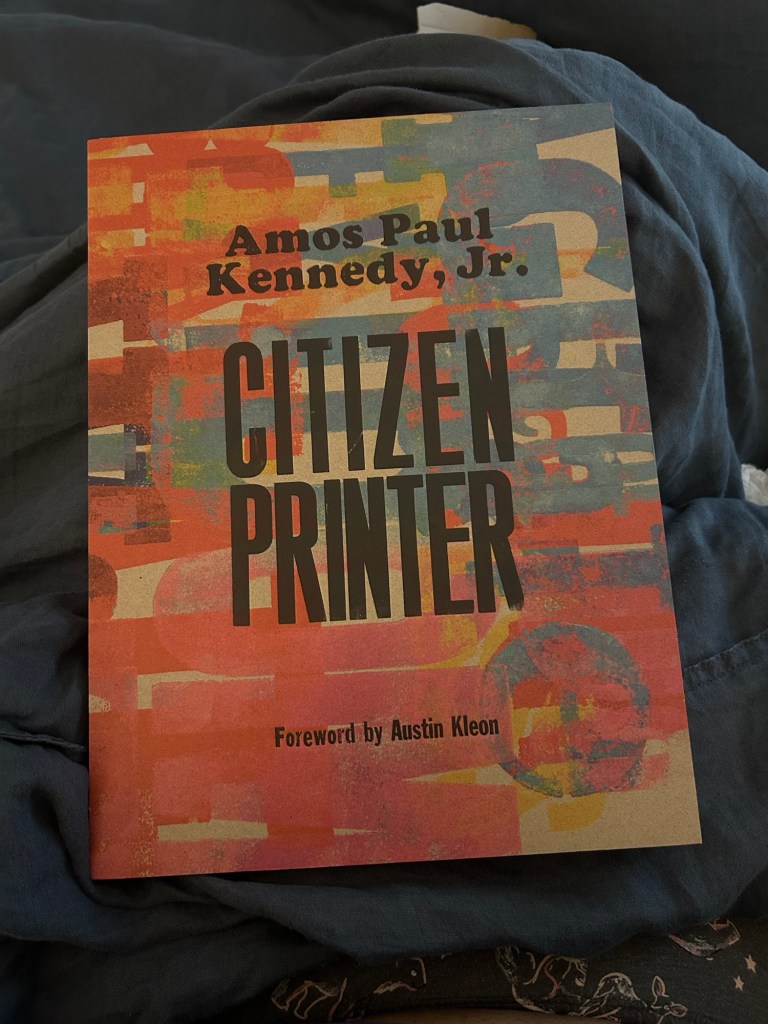
My bedtime lover(s)

A book is much more faithful than a lover I think.

A book can open you up to so many different experiences at the same time as reaffirming everything you’ve been feeling and thinking and struggling with.

I’m not sure a lover can do all that for me. But many more than one lover could?

Hence spending copious amounts of time in bed with books.

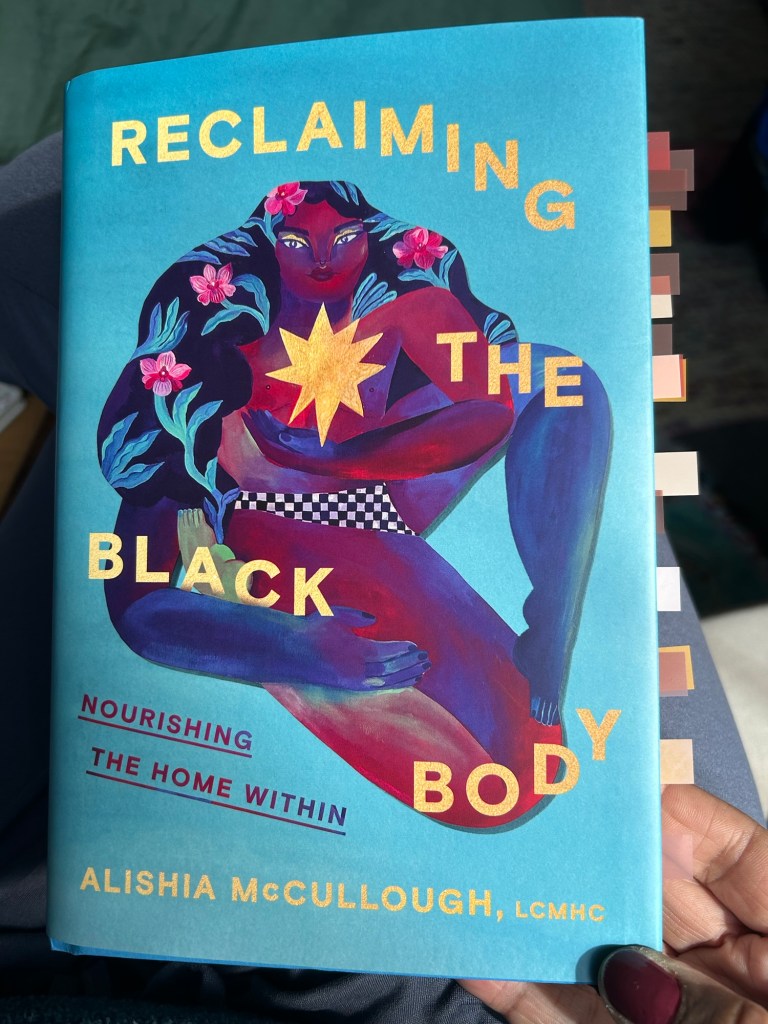
Reclaiming the Black Body: Nourishing the Home Within by Alisha McCullough is one of my current reads.

I used to be of the persuasion to read one book at a time. Devote all my time, focus and attention to one book in order to reap the glory/ knowledge/ whatever!

But these past few years, as I’ve become thirsty for stimulation and attempting to find like-minded people/ theories/ lovers, I’m moved into reading multiple books simultaneously, also known as “syntopical reading”.

And these books are not on the same topic either. They range from poetry around grief, non-fiction on gardening, personal essays around deep time, romantic and crime novels and short stories about myths and history. The list goes on!

I’m so enjoying this eclectic and multiple reading practice as it’s keeping me engaged, creating unique and original connections and it’s keeping me feeling loved.

By me.

So one of my current squeezes is Reclaiming the Black Body and I’m devouring it in small digestible bites because it is speaking to my soul.

This book is calling to attention the deep-seated, long-time, disproportionate amount of trauma, violence, marginalisation, discrimination, and adverse childhood experiences of Black women and femmes, and confounded by misognoir and racism, how we have learned to cope with it all through increased imbalanced eating behaviours.

Usually called “eating disorders” but even using that language implies that the individual is to blame and implying that some of us are just not equipped to nourish our bodies and do not know how to look after ourselves.

‘Disorder’ implies stigma and comes from the Western health ‘care’ system which from time has excluded and harmed Black people.

So this book is a balm for the wounds of silent struggles Black women and femmes have been going through around eating imbalances including myself. And is a vindication that we’re not fucked up and broken and just beasts, being less than human but that we are doing our best with the tools that we have to strive and thrive within a system that is hell-bent, historically and now, to demonise the Black body.

I will continue to cosy up with this book and others in bed, night and day, as reading is hitting the spot!

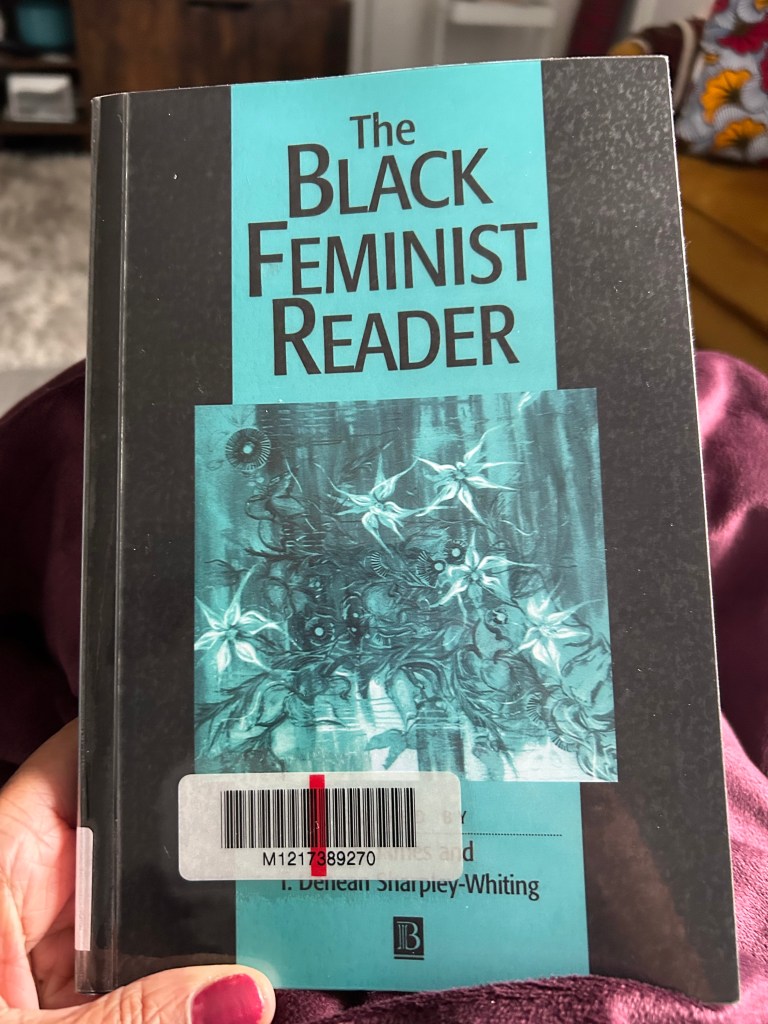
The Black Feminist Reader

I’ve got time on my hands to read. A reading week as we used to say at Uni. Why? Well that’s another story, I’ll tell you at another time, maybe.

For now, I’m getting my teeth into something that will make me feel better, or feel as if I’m getting somewhere with my self-study/permaculture diploma design/ ways of being.

I’m reading The Black Feminist Reader edited by Joy James and T. Denean Sharpley-Whiting. And I’m heartened to read in the first essay in the collection by Barbara Christian, ‘The Race for Theory’, that along with her Black sisters, Christian has not rushed to create abstract theories around how to read Black women writers/ Black women’s literature. The argument goes that there are countless Black women around the world, women colour around the world, and one single set of ideas cannot be applied to such diversity.

As Christian goes on to argue, “There is, therefore, a caution we feel about pronouncing black feminist theory that might be seen as a decisive statement about third world women. This is not to say we are not theorizing. Certainly our literature is an indication of the ways in which our theorizing, of necessity, is based on our multiplicity of experiences.” ( p.20)

Instead of being seduced into the academy, being at the centre, desiring/ claiming what might seem like power within the hierarchy of old traditional departments of knowledge, where the Black female experience is subordinate to others, ” We can pursue ourselves as subjects”. ( p.21)

This is music to my ears as I have always found it difficult to pin down what is Black Feminist Theory. What does it entail? What are the tools of engagement? What methods should be employed to reading Black women writers?

But that’s where I’ve been going wrong, thinking about theory. As for me theory was legitimisation. Writing dies if it’s not being talking about, theorised. But now I understand that :

  1. Theory has been their way, their terms, their approaches ( p. 16)
  2. Theory has been more about how clever the theorist is than about the writing or writer
  3. Theory is prescriptive and it ought to have something to do with practice (p.13)
  4. Theory is about those masters who have long gone and not about the here and now.

And as Christian states, and I totally agree, “But what I write and how I write is done in order to save my own life. And for me I mean that literally. For me literature is a way of knowing that I am not hallucinating, that whatever I feel/ know is.”(p. 21)

So I’m following Christian in my pursuit of what Black Feminism(s) is by having no fixed method of enquiry or even results. My method relates to what I read and the historical context of the writers I read and “to the many critical activities in which I am engaged, which may or not involve writing.” ( p.22)

So there is no set method within Black Feminist Theory and is influenced by practice, no prerequisite of a new theory as every work suggests a new approach, forcing me to think differently.

“As risky as that might seem, it is, I believe, what intelligent means – a tuned sensitivity to that which is alive and therefore cannot be known until it is known.”( p. 22)

Comfort Reading

This piece was published over in Binderful’s Medium page back in 2020. I’m republishing them here as I revisiting the writing, the wisdom as well as create my archives.

What are you reading that is bringing you comfort during this pandemic?

When Amy (Mama Scout) asked me about what I’m reading during these troubling times of the pandemic, my first thought was, what am I NOT reading? As the spaciousness within my life has opened up, I’m grateful to be able to slow down and lose myself in practices that feed my soul.

I read the news, maybe once every two days, to keep abreast of developments around the world. I’ve always read world news, as I might live in the UK, an island, but I believe we’re all connected, humans and non-humans. What’s happening to you, is happening to me also. We are one. I love lingering over longer articles and reports in The Guardian, The New Yorker and The Atlantic. Also Orion Magazine is releasing daily previously unreleased articles from it’s archives to read for free. These are a welcomed gift.

My guilty pleasure is crime fiction. After a lifetime of reading about crimes happening around the world, I love Nordic Noir, I’ve recently gotten into the mystery series with DCI Ryan set on my doorstep in the Northeast of England by L J Ross. Taking iconic buildings and monuments within the region, such as Cragside House, the Sycamore Gap tree, the bridges over the River Tyne, as the settings, a series of murders are carried out and a team of detectives, who the reader grows to love, try to solve them while trying to have normal loving relationships themselves. I love recognising places and streets and people even within the pages of these novels.

My weak spot is personal essays. Probably because I’m in the process of creating a mixed-genre memoir which includes personal essays, poetry, images, collage, quotes and photography, I gravitate to those writers I wish I could write like such as Roxane Gay, Audre Lorde and Terry Tempest Williams.

So at the moment, I’m reading Alexandra Chee, How To Write An Autobiographical Novel which is so illuminating about his time growing up, in the 80s, through identity politics and navigating his way while unbelonging. I’ve just started, Thick, a collection of essays by Tressie McMillan Cottom, which have the black woman’s body at the centre of the debate for a change. A mixture between the personal and the academic, I find myself reading sections and nodding my head or even shouting out loud, ‘Yes.’

And finally, to my shame, I’ve just restarted Becoming, by Michelle Obama, after watching the documentary on Netflix. When the memoir first came out a couple of years ago, I started it but I didn’t get far. They say you fall into a book when it’s the right time for you; when you’re ready. Well I’m ready now. I’m absorbing Michelle’s vulnerable words of wisdom, checking in and checking myself. Reasons for reading; to keep checking in with myself, how I’m feeling, what is what I’m reading bringing up in me. At the same time as checking myself, doing the work on myself, to make sure I’m moving through this world as the best version of me.

Drinking Fugitivity – Found PoetryFilm

Drinking Fugitivity: Found PoetryFilm

This short piece is a mash up of a certain clip from Joaquina de Angola: Memory of a Liberation by Aida Bueno Sarduy and music from Insight Timer, called You.

Seen recently in Barcelona at CCCB, Joaquina de Angola: Memory of a Liberation by Aida Bueno Sarduy is an audiovisual installation that recovers the story of Joaquina, a young woman enslaved on a plantation in Brazil, and her escape.

From the exhibition’s text details it reads:

“A work about archived, forgotten, and silenced voices in the history of slavery and colonialism.
This audiovisual installation brings to life the act of “unarchiving” an event recorded in colonial history as an escape. A 15-year-old enslaved girl fled the plantation where she lived, and her owner, after an unsuccessful search, placed an ad in the newspaper offering a reward to whoever found her. The archive reveals nothing more about this incident: it merely collects it as a piece of data.
This piece challenges the oblivion, archiving, and silencing of this character. To unarchive, in this context, becomes an artistic and political act that brings Joaquina de Angola out of the shadows of the document, removing her gag and chains so that she can tell her own story. This act not only questions the record but also raises questions and delves into its details. It is an inquiry that brings Joaquina back to life and acknowledges her as a cimarrona, calling upon ancestral memory as well as imagination, intuition, and spirituality.
Since the beginning of colonization in Brazil, alliances and exchanges of extraordinary significance have taken place between Indigenous peoples and enslaved Africans, but these have also been silenced. The presence of entities known as caboclos (Indigenous spirits) in all Afro-Brazilian religions is perhaps the most consistent and profound evidence of this. Amazonian peoples, Indigenous peoples from across Brazil, and quilombola communities—formed by Afro-descendant peoples—have shared ancestral struggles for the defense of their territories and against colonization and exploitation. The installation speculates on these possible Afro-Indigenous alliances in Joaquina de Angola’s journey toward freedom.”

This extracted masheup with music created above by myself, hence a found poetry film, is my take at a beginning of exploring fugitivity. I’ve been living, breathing, talking, practicing fugitivity for a few years now. I’ve mentioned it before, and it was Dal Kular who first introduced the term of me via her then newsletter, Field Notes. Dal said at the beginning of Jan 2023,

“Whatever the out-there-in-the-world fuckery is going on in 2023, I declare myself a CREATIVE FUGITIVE. A way of living in this world but not of it.”

Her take on creative fugitivity has stuck with me. I’ve gone on to read more around fugitivity. I’m even writing a chapter, at the moment, around black mothering and fugitivity. Fugitivity is taking over my life. And again I’m creating a project here in my portfolio to collect my wanderings and wonderings around this concept and way of being.

For me in a nutshell, fugitivity is the act of flight. It is the withdrawing of my labour and consent in the current system of white supremacy culture, capitalism, imperialism, colonialism. Fugivitiy is refusal and resistance. Divesting from the current way things are playing out as the few hoard the wealth of the world at the expense of the many.

Originally the fugitive was the runaway, the escapee. Hence why the audio-visual installation and consequent fugitive poetry film was created. I’m starting from the origins of the escaping enslaved. Running, fleeing captivity towards freedom. Freedom being the end point, the destination but in the process of escaping, there is the in-between space between what they were fleeing from and fleeing to. And here in this liminal space is where fugitivity is ripe.

There/ here is the lingering in the midst of flight, where I choose to SLOW down and be. To linger with nature. To seek my joy and pleasure in the world around me on my own terms.
Fred Moten in conversation with Saidiya Hartman, both of whom we will be exploring further, said,

“I often use – and I always think of it in relation to Fannie Lou Hamer, because it’s just me giving a theoretical spin on a formulation she made in practice: to refuse that which has been refused to you. And that’s what I’m interested in.”

That is fugitivity as a method, kin-making and place-making, as a practice that I intend to explore within this project archive.

Octavia E. Butler

I’m fixing to read all 12 novels and the one short story collection of Octavia E. Butler this year. The time has come to make intimate with this pioneer of science fiction, speculative fiction and wisdom.

Watch this space!

Life Writing

During my time of hibernation, (have I mentioned that here?) I’m resting of course but I’m also writing and dreaming and catching up on the things I want to do with my time and energy.

Another one of my abstracts was accepted for a special publication by Demeter Press around mothering and life writing. I completed an essay in 2023, around my Black Matrilineage and last year I complete an essay around Black Mothering and Creativity. This is probably going to have to be redrafted this year, but in all honesty I was just happy to submit something, as I had a major block around this essay. I think it was because I allowed my creativity and energy to be sucked into other people’s creative dreams and lost sight of my own last year. So when it came to writing the essay my well was dry.

Anyway, I’ve started the reading and writing around my third essay now which is all about Black mothering and fugitivity. I love fugitivity and it is one of the supporting words for 2025. As I mentioned before, I’ve been exploring fugitivity for the last few years and what this means as a practice. So I’m mighty pleased in having the time and space to explore it further and deeper through writing this essay.

While going over my abstract again and riffing off from it, I remember my creative non-fiction novella I created called rubedo. I think this came out in July 2016, after the 2015 shit hit the fan episode in my life. rubedo was my exploration of this time in my life and how I got through it. It was through finding myself after years of repression and not listening to my inner wisdom that I came to be who I am today.

Anyway, I revisited rubedo with this chapter/ essay in mind, realising that 2025 is 10 years since this episode in my life. It sometimes feels as if it was just yesterday. I know I felt it keenly last year when Darkling came out. Darkling is my first poetry collection since Laventille (2015) and the shitstorm episode. And to tell the truth, I’m waiting for the the shit to hit the fan again, as I’m sure there are people picking their way through Darkling as I type to try and find evidence of plagiarism again. As they say once a plagiarist always a plagiarist! It’s not a term or label I identified with then or do now. As that’s not me, that’s not who I am but that didn’t stop people then or now from looking for the evidence to prove/support it.

But I’m not here to talk about that. What struck me about rubedo is the raw honesty of it all. And how writing, writing it all out literally saved my life. I’m so grateful that Ian brae enough to pick up my pen and writing through the shit to now.

Here is what I wrote about my capacity to love no matter what:

“But something does inside die this day. And the days that follow. Something
inside of me, the capacity to have patience and make allowances for other
people’s bullshit was destroyed during this lynching. No doubt, using the term
‘lynching’ will invite criticism. I know when Andy Croft my publisher used the
term to condemn what was happening to me on social media he received a
fair amount of criticism. But I do not use this word lightly.


Ironically, in the months leading up to my death by social media, I was
researching and writing poems about lynchings in America. I was referring to
the postcard images that were collected as souvenirs by the spectators of
lynchings at the time. There were those people who got their hands dirty
during a lynching, who actually tied the knot of the noose, beat the victim,
mutilated the bodies. And there were those who came along to watch the
spectacle. Viewing the death of another human being as just another social
event, a festival, something to be enjoyed. Both killers and spectators relish
the sport.

This in my opinion is what happened to me. A public lynching and
souvenirs where taken. One person on Facebook, joined in the thread of
conversation with a comment as a means of marking it. This person was
rubbing their hands with relish, saying that they didn’t want to miss a thing as
this spectacle was just too good to let pass by.


When I died this cruel death something inside broke. I’ve recently come to
realise that is was my heart that broke that night. I’ve been visualising my
heart with a rose in the centre. This rose is closed. This I read as a symbol of

me shutting down, dying inside, shutting off the natural flow of love from my
heart for my family, friends, for the world around me. My heart was broken, so
I have been denying myself and others love. I’ve been living in fear, fear of it
being hurt again, fear of my heart being broken again, fear to love.
In a way, this had to happen to me. For one, I’ve always disliked that capacity
in me to keep forgiving others, letting them back into my life when they’d let
me down and not lived up to my expectations. I’ve taken on board the
responsibilities of others, thinking I’ve had too high standards and I’d been
unfair. That capacity has been obliterated. I can’t take anybody’s bull shit
anymore. But at the same time, this capacity to forgive is part of my large
capacity to love. And if this is who I’m really are , then I shouldn’t fight it any
longer but accept it.


My true self is my capacity to love, to love fiercely and powerfully. I accept
that now and I’m no longer blocking up my love. I can’t live in constant fear of
being hurt, of getting my heart broke again because then I would not be living
true to my capacity, true to me. I would just not be living at all.

I’m so pleased that since then I have found others, such as bell hooks and Joy James, who write about revolutionary/ radical love and validate my ways of loving, which at times hurts me but also brings me a while heap of joy also. You can’t love without the expectation or knowledge of getting hurt.