I applied to Arts Council England for a Developing Your Creative Practice grant mid 2025. It was unsuccessful.
Undeterred, I resubmitted it under the project grant scheme. I was notified of being successful just before Christmas 2025.
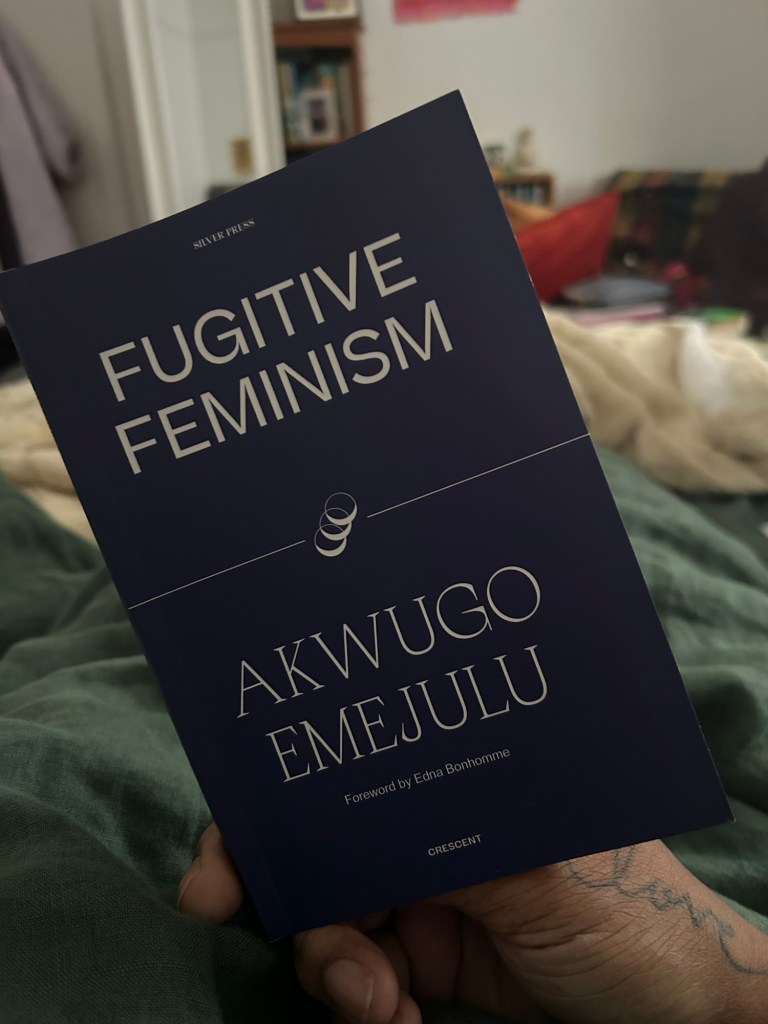
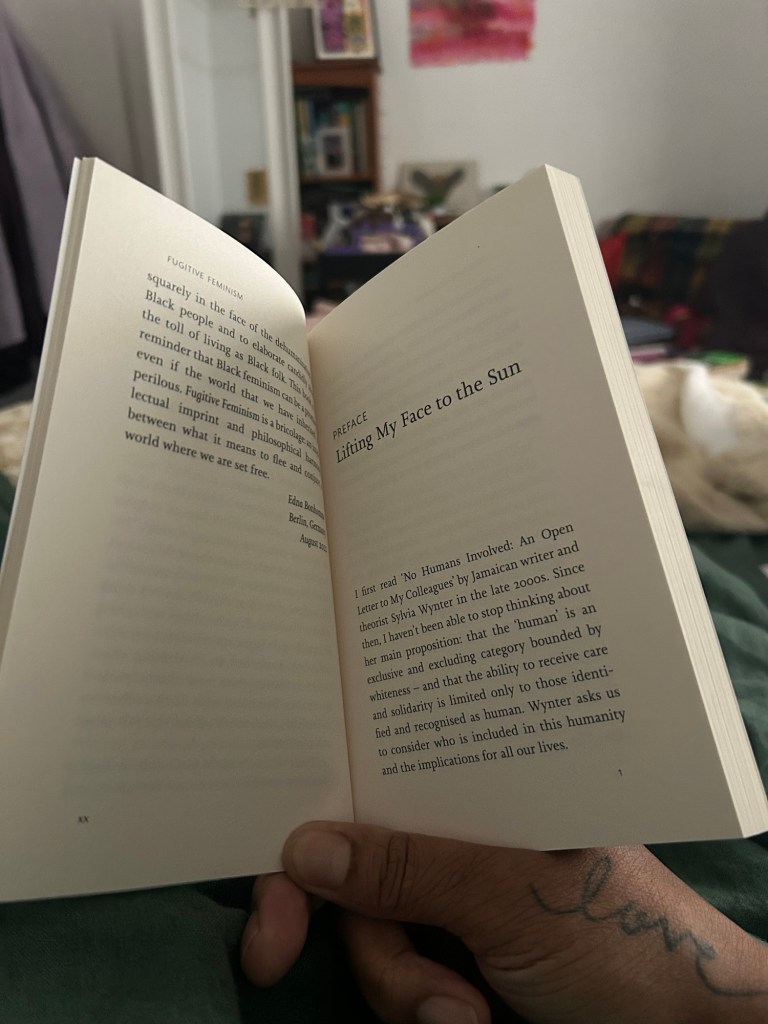
Practicing Creative Fugitivity is its name, and it involves researching fugitive practice. It also involves reading in community Fugitive Feminism by Akwugo Emejulu.
A study circle of women of the global majority.
When did you first learn that you were a non-human?
The question that opens the first chapter of the text Fugitive Feminism.
A question that hits me in my gut with its open, blatant honesty and curiosity.
A question which niggles at a truth that I’ve not wanted to face up to as it would mean that I’ve spent a lifetime trying to demonstrate, prove, live up to an unattainable category of being human.
Human as a category was never created to include someone like me within it.
Human = Whiteness
Human v Non-Human
You can’t have the light without the dark.
All constructs to create hierarchies. A hierarchy where white, EuroAmerican, able bodied, middle class, cis-gendered, college educated and suburban men reign supreme. Superior.
Conceptual Other. No Humans Involved. The Lack of the Human.
Black women. Outside. Out Outside.
Our exclusion determines the borders/ boundaries of the human.
But consider this …
If Black women were free, it would mean that everyone else would have to be free since our freedom would necessitate the destruction of all systems of oppression.
Combahee River Collective
Where the excitement lies for me and others, is once we realise that Black women cannot be human, then with the support of this book in community, let’s consider what if ‘human’ cannot and should not be reclaimed?
Speculate. Speculation. Speculative.
How might we divest from the human?
That the non-human Other actually decentres the human. Move beyond human to something otherwise.
Something else.
Becoming ( something else).
Thinking of how to be/ how to live beyond the binary of human v non-human could produce the means of improving our community/society/our planet.
Centring the human ( v non-human/ othering all else) has got us into the shit we’re facing now in terms of ecological disaster.
Finding a way to decentre the human, divest from what this concept / construction means and how it operates has to be the way forward.
Fugitive Feminism is the doorway into another way of being. A portal into an alternative world built upon the Black Feminist politics of liberation.
The path ahead is not clear or defined. It’s slippery and ambiguous. It’s experiential and experimental. Yet full of possibilities. Caring not harmful possibilities.
Speculative. Suggestive. Spacious.
And it starts and continues with the act of refusal. Refusal of the way things are right now.
Refusal of being defined by others to fit into their definition of humanity ( whiteness).
Refusal of being extracted and exploited for the benefits of a few.
Refusal of being non-human.
Refusal of being outside of humanity.
Refusal of the whole concept of human/whiteness/ fascist.
Refusal of these limitations when i, we, i and i can be something else beyond humans.
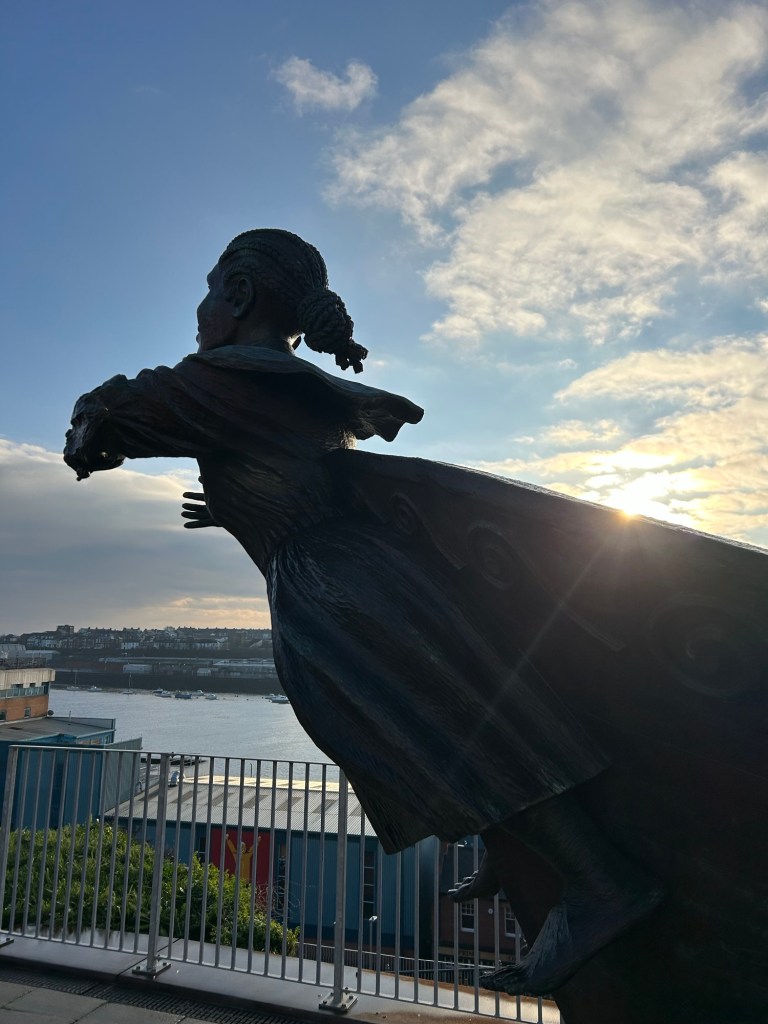
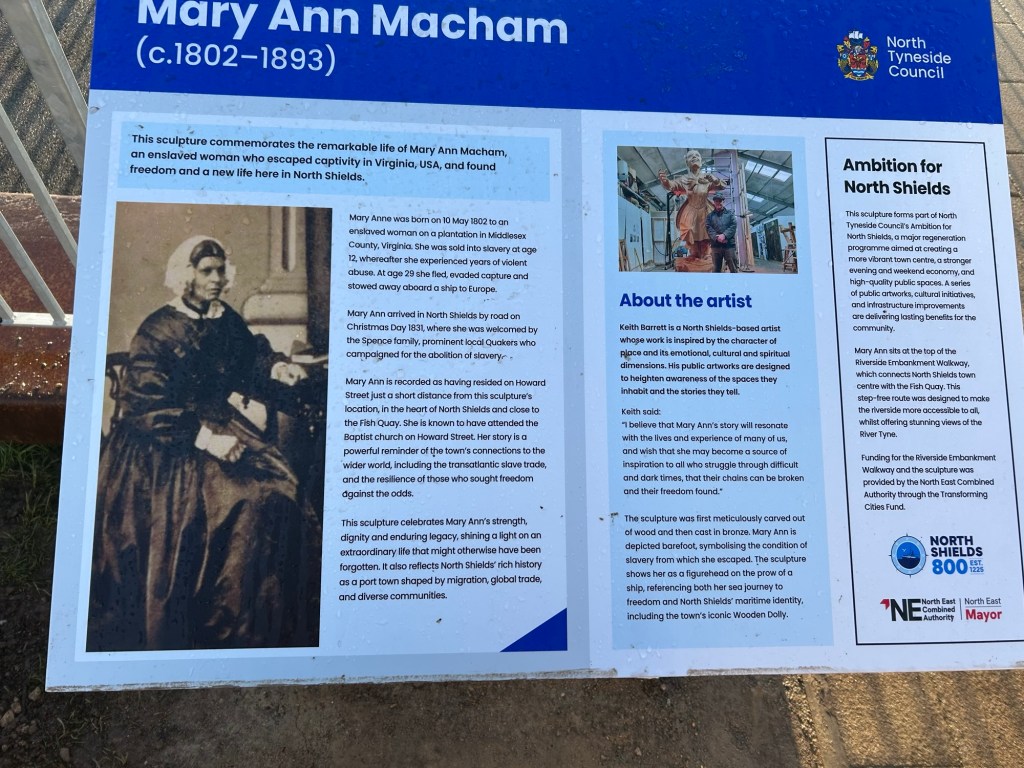
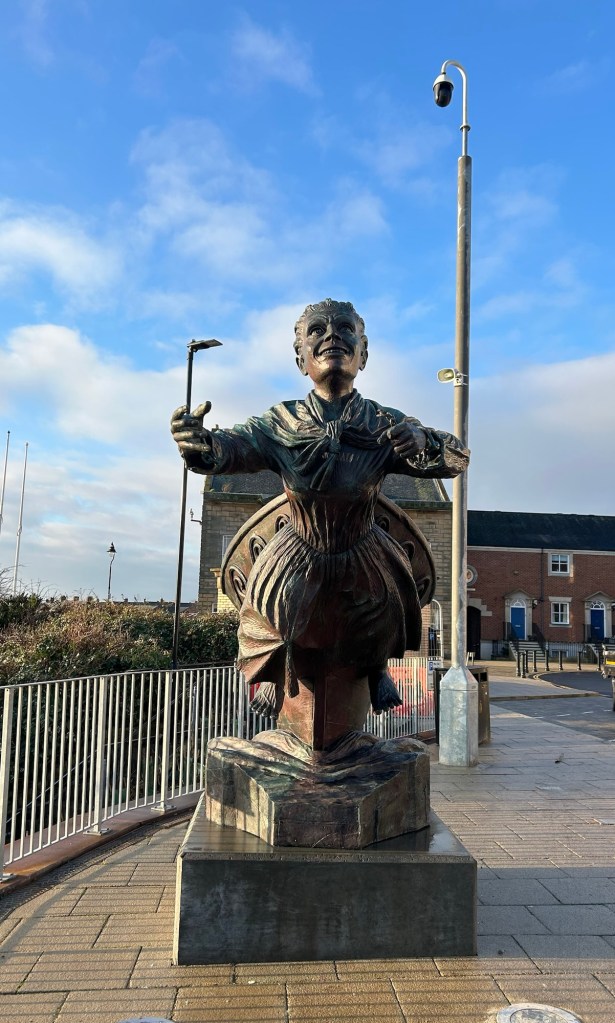
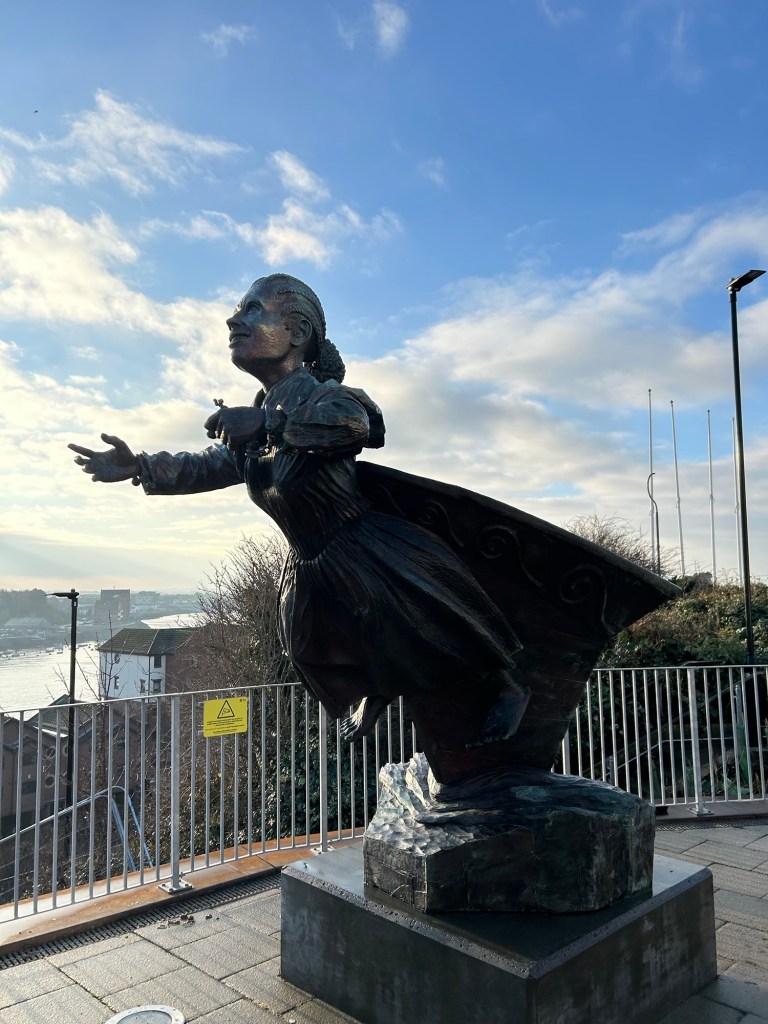
Walking into North Shields the other day, walking towards the Fish Quay where there is now accessible access connecting the centre of town down to the River Tyne, I caught sight of this sculpture of Mary Ann Macham.
I first learned about Mary Ann in 2007, when I was researching the North-East’s involvement in the transatlantic slave trade to mark the bicentenary of its abolition.
I was writer in residence within the Literary and Philosophical society, researching their tracts and unearthing the names and lives of the once enslaved people who passed through and/or settled here.
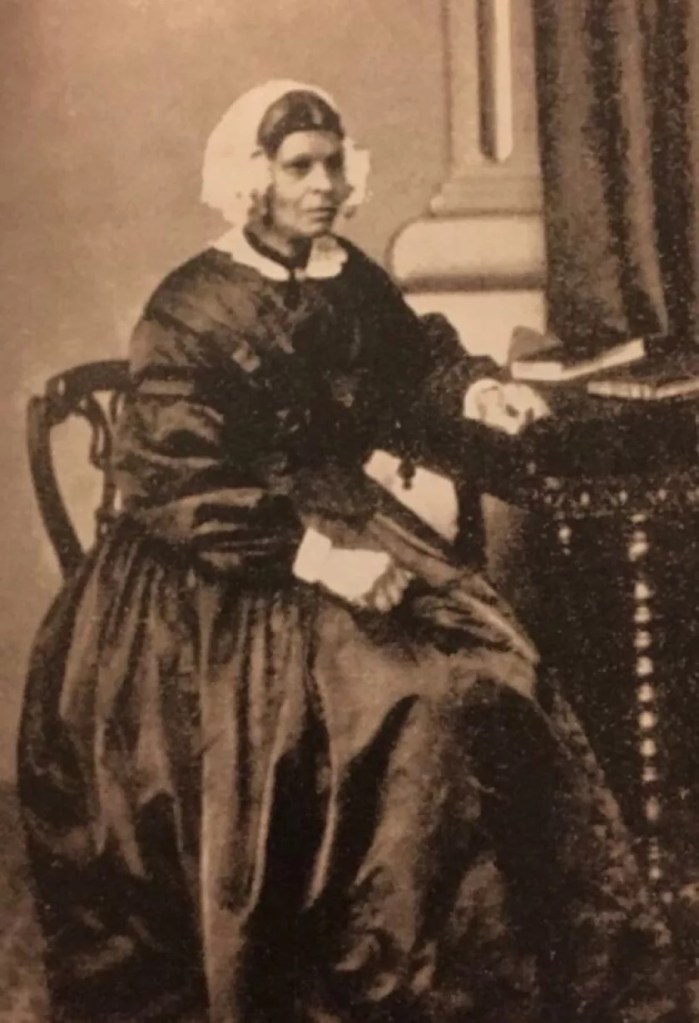
I wrote a poem about Mary Ann, her escape and travel up to the North, and with the help of the Quakers, made a life for herself through working in service and getting married and living in North Shields. This was back in 1831 when she arrived here and lived for a further 60+ years as a free woman.
An aside here is how the Quakers at the forefront of the abolition movement here in the North- East, were against the slave trade and worked for the abolition but still held the racist beliefs of the day that white people were still superior to black people.
Mary Ann Macham told her story to a member of the Spence family, who she was in service to. There’s a lot that can be argued about the practice of black people, telling their stories to white people who wrote them down and how accurate these are as a true representation of their stories. But this is all we have now as ‘evidence’.
African Lives in Northern England completed research on Mary Ann Macham before this public statue and the local groups ‘found’ her.
I should be grateful and overjoyed that finally Mary Ann Macham is being remembered. That there is a public statue dedicated to her and that she is being reclaimed as part of the local community.
But something just doesn’t sit well with me. Maybe I’m being far too critical. Or maybe I’m just coming at it from a black woman’s point of view living within white supremacy culture?
The press releases for this unveiling of the statue in November 2025, proceed to paint the impression that Mary Ann Macham has just been discovered. That this was hidden history that the locals have just uncovered and became fascinated with and had to find out more about. But unknown to whom?
If they had done their research they would have seen and also acknowledged the work completed in the past to shine a light on Mary Ann. But the story goes that they have just discovered her story. Or decided to just focused on only part of her story/life? Mary Ann Macham ( later Blyth through marriage lived until she was 92 years old).
The local Sculptor Keith Barratt who created the piece has said to the local media that he wanted this sculpture to show that “she came from a place of great pain, but it’s also a story of human liberation, of breaking the chains and I feel that this is something universal that many people will understand”.
I suppose I have issue with how Mary Ann is framed within the story of her own life, which she doesn’t have control over maybe a bit then but definitely not now with how she is remembered.
I Love North Shields has more details about her life and attempts to create a bigger picture of her life before enslavement and after as a free woman living her life here in the north east. But frequently it has to be argued, the majority of time, Mary Ann is trapped within the ‘slave’ narrative perpetuated by white people. Although seeing her as ‘brave’ for plotting her escape, they still frame Mary Ann, tell her story within the role of once enslaved, and needing the help and support of kind Quakers. Sounds a lot like white saviorism. Then and now.
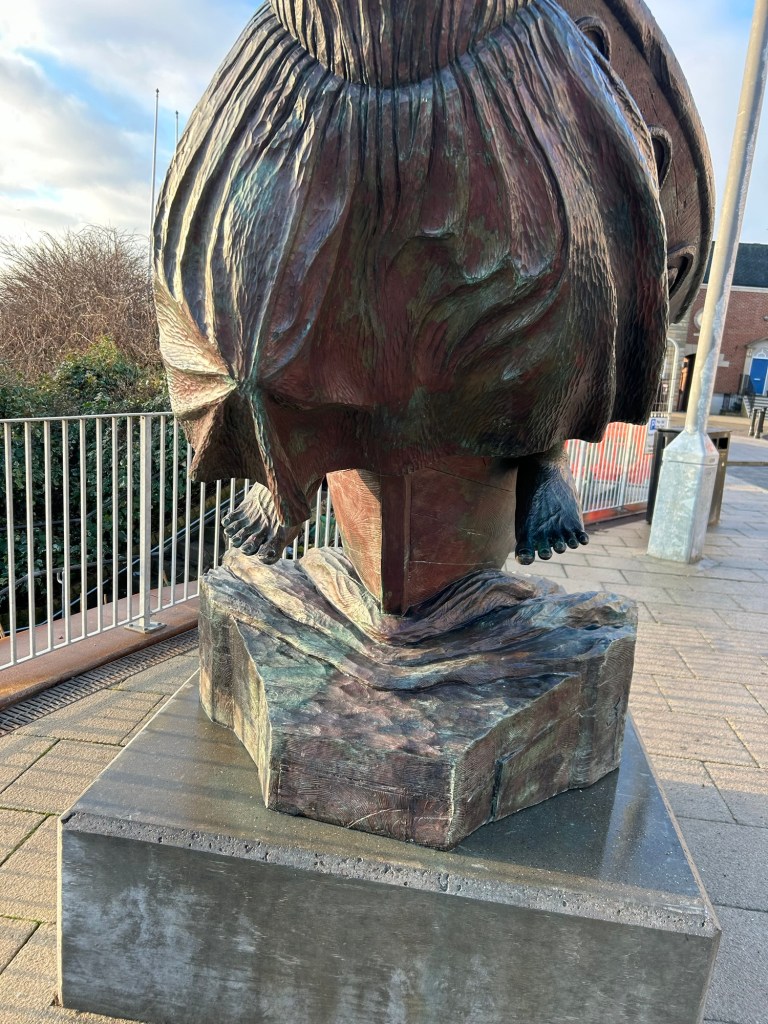
It’s almost like Mary Ann is stuck, encased in bronze, and barefoot to symbolise the condition of slavery. Enslavement she escaped from physically during her life, but trapped forever within this role in memorial because the white imagination cannot see/ grant Mary Ann her full humanity . The fullness of her life.
Time and time again, the mainstream constructs the stories they want to shed a light on and tell about people of the global majority which suits the narratives they’ve been running for centuries. The narratives where we don’t have agency or self-definition but are the objects, less than and victims. This is a means of control and domination.
This is why it’s important that we take every opportunity to tell our own stories. To control our own narratives. To leave these as archives for the people that come after we so they can be in no doubt that we lived big, beautiful, full lives on our own terms.
And is it me, or does the statue of Mary Ann Macham make her look like she’s white?
Okay where to begin.. That has been the issue – worried about where to begin has stopped me beginning. But now I’ve got to begin as I need to get it out of me onto the page, in order to create some kind of sense of it all. So maybe I’ll begin with the Combahee River Collective (CRC).
I’m diving into the realms of Black Feminism- thought and theory and practices.
I’ve already been in the thick of it for years, with me first coming to Black Feminism through my degree and then masters and then this forming the foundation really of my PhD when I traced the tradition of Black British Women’s Poetry. But retaining knowledge and theory is difficult when I keep putting new things in my brain.
I don’t want to be an expert on Black Feminism but I do want to revisit it and consider it’s premise again in light of recent readings and experiences.
So I begin with the Combahee River Collective Statement, 1977. And I’m not saying that this is the beginning of Black Feminism. But I’m using it as a marker along the way. I figure if I keep this statement in clear view, using it like a signpost then I can’t stray too far off the path.
This exploration of Black Feminist thought is going to be a new folder within this website’s portfolio as this is area of research is something I plan to keep returning back to and adding to as I continue to re-familiarise as well as extend my thinking and practices around Black Feminism.
So what is the Combahee River Collective Statement all about. Well first you can was the full statement here.
It has been argued that this statement issue by a collective of Black women in Boston in 1977 who came together after witnessing an recognising the racism within the women’s movement and the sexism within the race/ civil rights movement, was based on the reality that Black women’s experiences cannot be reduced to either race or gender but have to be understood on their own terms.
Combahee River Collective Statement introduced to the world terms such as “interlocking oppression” and “identity politics.” Formed in 1974, The Combahee River Collective (CRC) was a radical Black feminist organisation which took it’s name from Harriet Tubman’s 1853 raid on the Combahee River in South Carolina that freed 750 enslaved people.
It might have been The Kimberlé Crenshaw in 1989 who coined the phrase “intersectionality” but it was CRC who articulated the analysis that underpins the meaning of intersectionality. The idea that multiple oppressions reinforce each other to create new categories of suffering, these interlocking oppressions, happening simultaneously, renders the Black woman’s position in society unique and most direr.
As the statement begins:
“The most general statement of our politics at the present time would be that we are actively committed to struggling against racial, sexual, heterosexual, and class oppression, and see as our particular task the development of integrated analysis and practice based upon the fact that the major systems of oppression are interlocking. The synthesis of these oppressions creates the conditions of our lives. As Black women we see Black feminism as the logical political movement to combat the manifold and simultaneous oppressions that all women of color face.”
It goes on to state:
“Merely naming the pejorative stereotypes attributed to Black women (e.g., mammy, matriarch, Sapphire, whore, bulldagger), let alone cataloguing the cruel, often murderous, treatment we receive, indicates how little value has been placed upon our lives during four centuries of bondage in the Western Hemisphere. We realize that the only people who care enough about us to work consistently for our liberation are us. Our politics evolve from a healthy love for ourselves, our sisters and our community which allows us to continue our struggle and work”.
CRC comes to the conclusion that:
“We might use our position at the bottom, however, to make a clear leap into revolutionary action. If Black women were free, it would mean that everyone else would have to be free since our freedom would necessitate the destruction of all the systems of oppression”.
And this would come to pass through the practice of the revolutionary politics of Black Feminism.
(Speaking about Robert Lowell’s poetry) “Lowell removes the mask. His speaker is unequivocally himself, and it is hard not to think of Life Studies as a series of personal confidences, rather shameful, that one is honor-bound not to reveal.”
M. L. Rosenthal’s article “Poetry as Confession.”
I’m taking a four week confessional poetry course with midnight & indigo. Founded in 2018, midnight & indigo is a small publisher and literary journal that provides a space for Black women writers to share their narratives with the world.
Tw weeks in and I’m loving the course, Tell Me Something Real: How to Write Confessional Poetry. Not only is the tutor, Schyler Butler knowledgeable, and thorough providing great examples for poetry within this genre all from Black women, but the group of writers signed up for the course bring it every week with their insight and feelings around each poem we read and discuss.
And then we get to trial out what we’ve learnt through these close writings within our own writing, as the sessions finishes with time to write a first draft of a poem and then share it with the group. I’m enjoying what I’m coming up with after being inspired. Because in all honesty, from time I’ve been a confessional poet but have never smashed the term on it.
Confessional poetry in essence can be distilled to 4 main components.
Be of an intimate subject matter.
Use the first person.
Be autobiographical or seen/ appear to be.
Use skilled craftsmanship.
I’m working on a new body of work now. So still in the draft stage but I’ll share a poem from time here, as evidence of my appreciation and dance with this form of poetry.
White Women
Within my family, there are white women. White women who married black men. I forget, neglect the fact that their blood flows through mine.
Trace the past, a sea of faceless white is mine. The black men forefront, a mist of women behind. Their names, I don’t know or forget.
They are the enigma, shadows. Forget the cleaning and cooking, their duty and mine, they went against the grain, steadfast women.
In the corner of the frame, you white women are not forgotten. Your spirit is mine.
As my great nana Rosa ( the wee ginger lass who hooked up with the Ghanaian sailor) used to ask, ‘How you fizzing?’
There was a time when people lived their lives in deep connection with the Natural world. We lived, worked, ate, and designed our days and even our homes around the cycles and seasons of the planet, in sync with the Earth we depend on. That connection kept us grounded, mindful, and, in many ways, healthier in mind and body.
Today, research shows that 93% of our lives are spend indoors – and that was before the pandemic!
You don’t even have to be a nature lover to know that can’t be good for us. In fact, we’re coming to understand that so many of the world’s most pervasive problems – from heart disease, depression, and poor sleep, to droughts, wildfires, and rising oceans – can be traced to our personal and societal disconnection from the Earth and from our own “true nature” as humans.
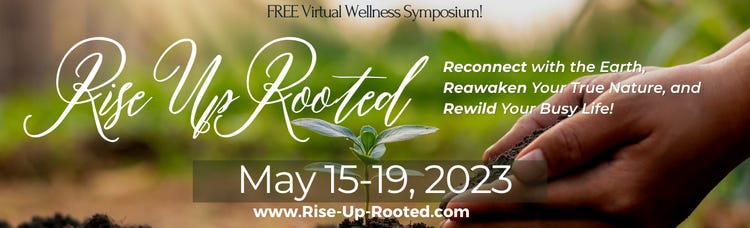
That is why I’m delighted to share with you today an upcoming event created specifically to address this damaging disconnection with simple, practical tools you can apply to your life right away – no matter how busy you are.
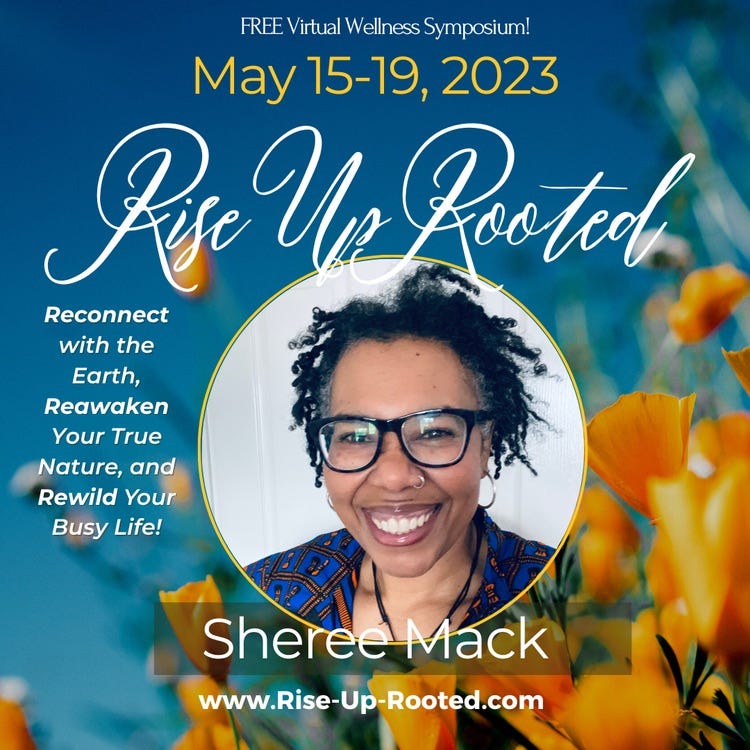
🌳 The Rise Up Rooted Global Wellness Symposium 🌳
Reconnect with the Earth, Reawaken Your True Nature, and Rewild Your Busy Life!
I’m proud to be a featured speaker at this event where I’ll be talking about healing with/in nature. I’ll be talking on WEDNESDAY, MAY 17th and it will be available for participants to watch for 48 hours.
And don’t worry – this event isn’t going to monopolize your week. Alex is committed to serving busy people so none of the interviews run longer than 45 minutes. So you’re sure to get all of the wisdom and none of the fluff.
Here are some of the other topics you can look forward to during this info-packed week:
🍃 Digital Detox: How to Rewild Your Brain and Body with Tracy James
🍃 Food, Nature, & Human Health with Robin Richardson
🍃 The Natural Path to Beauty & Self-Care with Face Yoga with Danielle Collins
🍃 Heal Your Home, Heal Your Body with Charlie Lemmer
🍃 Exploring Ancient Wisdom in Nature for Challenging Times with Beth Norcross
🍃 Pachamama is Calling with Mariela Maya
🍃 Nature as Creative Muse with Cathy Nichols
🍃 How to Use the Metaphor and the Wisdom of the Five Seasons to Guide and Inspire Us withKaryn Prentice & Elaine Patterson
🍃 Black British Women: Reclaiming the Landscape withSheree Mack ( WEDNESDAY, MAY 17th and will be available for participants to watch for 48 hours).
🍃 Guiding Changemakers from Burnout to Renewal withDevorah Brous
🍃 Regenerative Design for Life and Landscape with Keri Evjy
🍃 The Healing Power of Trees in Cities with Jackee Holder
🍃 Telling Your Own Nature Story from Your Soul with Devorah Spilman
🍃 Bringing Children Back Into Nature with Ellen Dee Davidson
🍃 Walking in Nature: The 20-Minute Miracle Cure with Alex Strauss
…and many more!
You really don’t want to miss this.
You can attend the Rise Up Rooted Global Wellness Symposium completely FREE. When you register, you’ll be notified each day when the various interviews are available.
PS – The amount of practical wisdom you will get access to for FREE during this event has the potential to dramatically change the rest of 2023 for you (not to mention the rest of your life!) I recommend you make the time. Click here to register.
PPS – Got a friend who could use a dose of Nature’s medicine? Please forward this invitation. All are welcome!
 Living Wild Studios