I applied to Arts Council England for a Developing Your Creative Practice grant mid 2025. It was unsuccessful.
Undeterred, I resubmitted it under the project grant scheme. I was notified of being successful just before Christmas 2025.
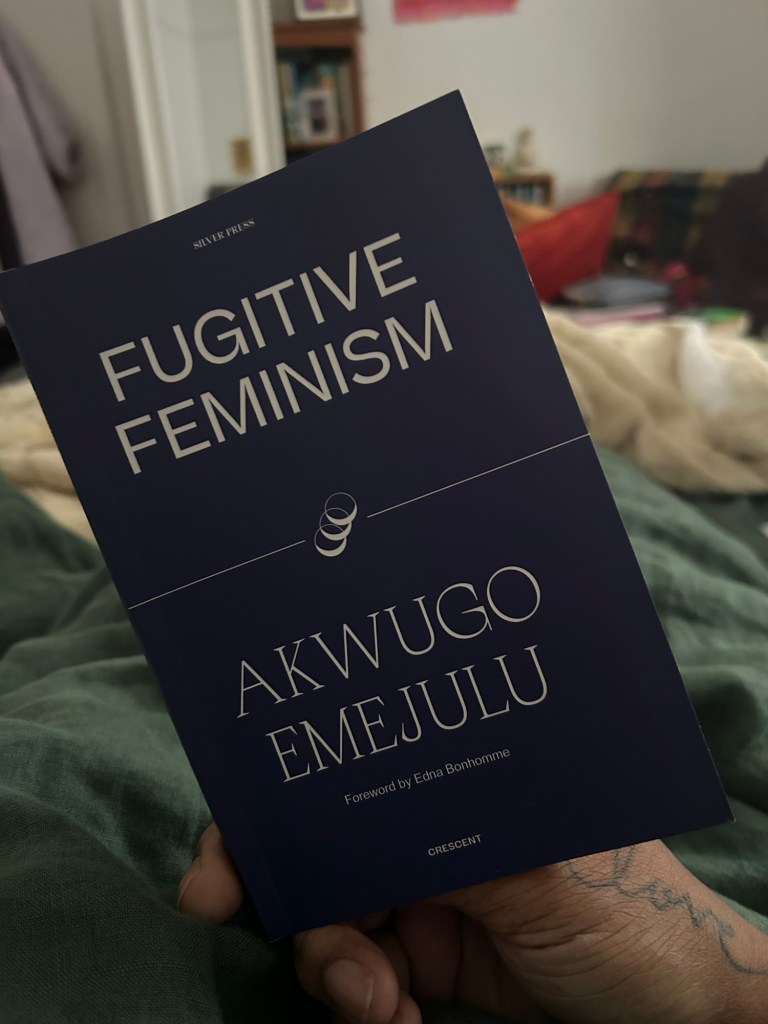
Practicing Creative Fugitivity is its name, and it involves researching fugitive practice. It also involves reading in community Fugitive Feminism by Akwugo Emejulu.
A study circle of women of the global majority.
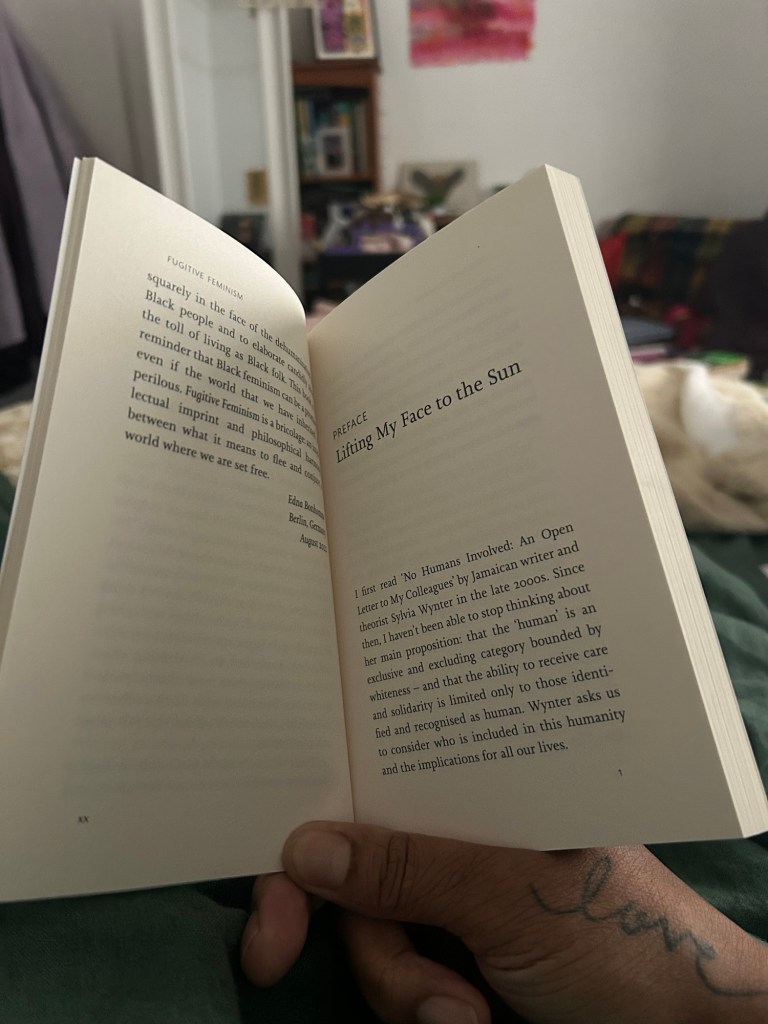
When did you first learn that you were a non-human?
The question that opens the first chapter of the text Fugitive Feminism.
A question that hits me in my gut with its open, blatant honesty and curiosity.
A question which niggles at a truth that I’ve not wanted to face up to as it would mean that I’ve spent a lifetime trying to demonstrate, prove, live up to an unattainable category of being human.
Human as a category was never created to include someone like me within it.
Human = Whiteness
Human v Non-Human
You can’t have the light without the dark.
All constructs to create hierarchies. A hierarchy where white, EuroAmerican, able bodied, middle class, cis-gendered, college educated and suburban men reign supreme. Superior.
Conceptual Other. No Humans Involved. The Lack of the Human.
Black women. Outside. Out Outside.
Our exclusion determines the borders/ boundaries of the human.
But consider this …
If Black women were free, it would mean that everyone else would have to be free since our freedom would necessitate the destruction of all systems of oppression.
Combahee River Collective
Where the excitement lies for me and others, is once we realise that Black women cannot be human, then with the support of this book in community, let’s consider what if ‘human’ cannot and should not be reclaimed?
Speculate. Speculation. Speculative.
How might we divest from the human?
That the non-human Other actually decentres the human. Move beyond human to something otherwise.
Something else.
Becoming ( something else).
Thinking of how to be/ how to live beyond the binary of human v non-human could produce the means of improving our community/society/our planet.
Centring the human ( v non-human/ othering all else) has got us into the shit we’re facing now in terms of ecological disaster.
Finding a way to decentre the human, divest from what this concept / construction means and how it operates has to be the way forward.
Fugitive Feminism is the doorway into another way of being. A portal into an alternative world built upon the Black Feminist politics of liberation.
The path ahead is not clear or defined. It’s slippery and ambiguous. It’s experiential and experimental. Yet full of possibilities. Caring not harmful possibilities.
Speculative. Suggestive. Spacious.
And it starts and continues with the act of refusal. Refusal of the way things are right now.
Refusal of being defined by others to fit into their definition of humanity ( whiteness).
Refusal of being extracted and exploited for the benefits of a few.
Refusal of being non-human.
Refusal of being outside of humanity.
Refusal of the whole concept of human/whiteness/ fascist.
Refusal of these limitations when i, we, i and i can be something else beyond humans.
the zine that documents the zines I want to create moving forward into 2026
I’ve just been over on my Patreon page sharing about the first zine of the year. Do you want to know what I shared about it?
Okay, I’ll tell yo here too!
A few years ago, I gave myself the challenge of creating a zine a month. Check back using the ‘zine’ tags and no doubt you’ll find them, still there ready to download and peruse.
This year, I vaguely set myself this challenge again, to create a zine a month and share it here. I think. As I’m still in the process of committing. But last night, at a Zinester Sanctuary that I’m creating witha fellow fugitive, I had the time to create my first zine of the year. See the video above.
I looked back at one of my zines from my first challenge, this was a zine about the zines I wanted to create. I looked back to see if this list of zines with illustrations were still zines I wanted to create.
After this reflection, I then set forth to create the zine that hopefully is the blueprint for 2026 creations.
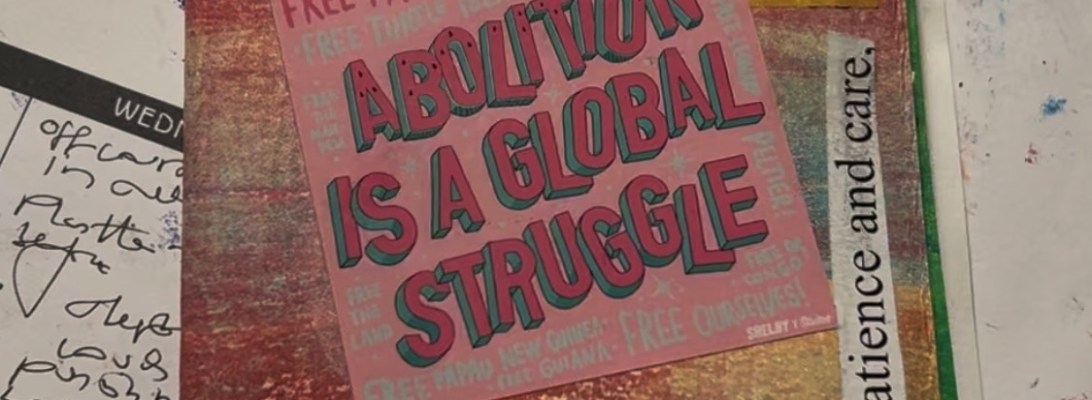
In the video what you are seeing is the front cover stating that ‘Abolition is a Global Struggle’ with FREE PALESTINE but also the caveat that this has to be completed ‘with patience and care’.
The next page with a wheel of a VW Campervan and the text ‘ like a bird flying into’, is a nod towards my love of nature and how she will always appear in my zine creating, some way or another.
The next double spread with an image of two little girls standing on the beach, myself and my estranged sister and the text reads, ‘me in all my fucked up glory’. This signifies the task of creating perzines, using the format to explore my life stories.
On the green page with a roughly drawn book in black pencil refers to my desire to dive deep into my black studies, studying blackness as fugitivity, fugitive spaces. ‘You will find comfort in blackness’ the text reads to accompany this intention.
The next page is a quote from Octavia E Butler, from Parable of the Sower which states, ‘All that you touch you change, all that you change, changes you. The only lasting truth is change.’ This was a small print I received from a printmaker friend called Theresa Easton.
The second double spread, because I hadn’t finished yet with my intentions (so who says you can’t add in another page?) is a recognition of my word of the year which is AFROSURREAL. I’ll be exploring what this means further throughout the year here and on my website.
This is partnered with a splash of purple/ mauve as the text reads, ‘ in mauve there is a quiet power.’ This is a reminder for myself to use my zines to share my poetry. My voice is my power. This was how I started making small zines, booklets before my first collection of poetry, Family Album was published. Because I was reading at all these gigs and people would come up afterwards and say where can I buy your work and I had no where to point them to. So I got creative and created these little zines , one dedicated to the poems I’d written about my daddy and one other dedicated to my mummy, and sold them for £1 each. I’d forgotten about them until I just wrote about them here now. Don’ you just love the creative process?
And then moving towards the end of this first zine of 2026, which apparently has been announced as the year of the zine – 2026, we’ll see what happens there as zines could become if not already commercialised and co-opted and become unrecognisable from their origins ( which I’ll be exploring and sharing further about here), there is a polaroid photo of myself smiling. This was taken last year at a Outdoor Citizen gathering, and these were taken to put on the wall with details about ourselves so we could be putting names to face,s be recognised within the crowds. This image is here with the title ‘fugitive sista’ as a reminder of who I {BE} but also who I {BE}coming through my continuing thoughts and praxis around fugitivity.
The final page with the outline of a goddess in black pencil and spiral within her gut/ womb and the text, ‘ Today I will praise. I will praise The Black Woman.’ Today ,tomorrow and always, I will praise the Black Woman. I support this praise with my continuing reading and practicing of Black Feminist thought and praxis. This is my foundation always.
The back cover ends with another sticker and this time it states, ‘ From the river to the sea, Palestine will be free.’ Again reminding myself that I do this work, explore my creativity and share whatever comes up within a constantly changing context of struggles, struggles for liberation, peace, justice, self-determination and love.
2026, the year of the zines. Let’s make it the year of the zines that give voice to the struggles near and far , struggles for liberation, peace, justice, self-determination and love.
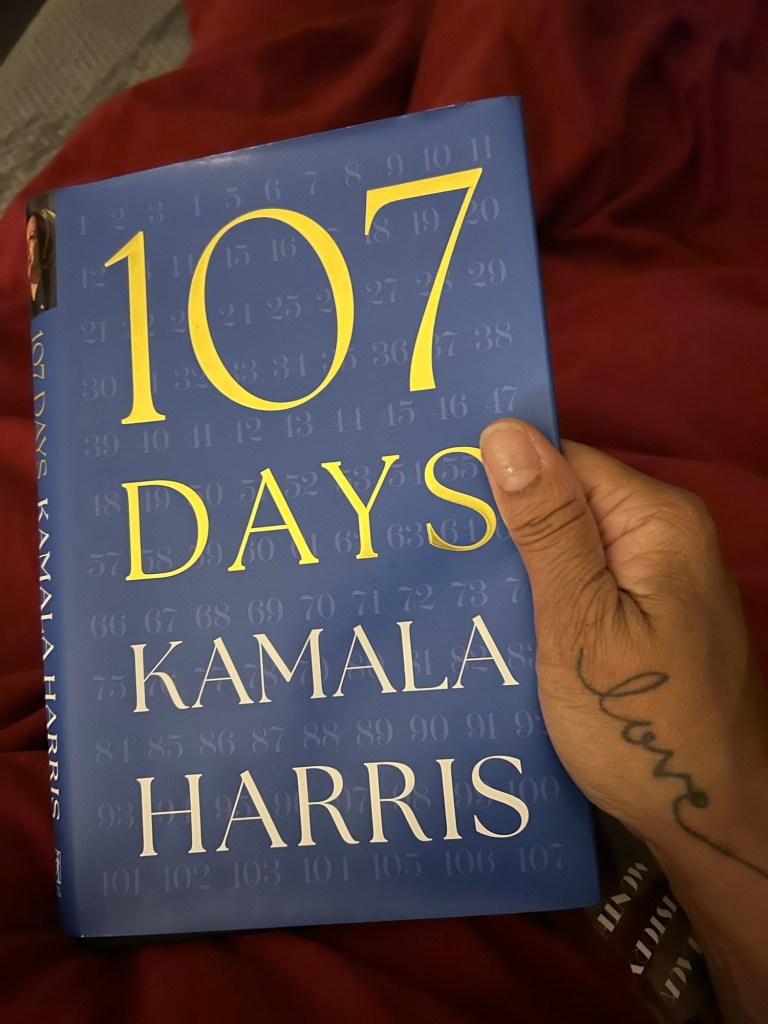
For my birthday, my beautiful and talented daughter gave me 107 Days by Kamala Harris. I might have dropped some hints beforehand but boy was I pleased to receive this gift.
As soon as I heard Harris had published a memoir all about her run for the President of the United Stated of America, I knew I had to read it.
During that remarkable time from 21 July 2024 to the election 5 November, when Harris was propelled into the run for office, given such a historically short time for campaigning, I was hooked.
Hooked into hope. Having a black/ brown woman as president of the United States wouldn’t just be radical and amazing it would change the world. Harris would change the world, not just through what she stood for in terms of policies, but more importantly what message her face in the White House would say about us to the world. Thanks once again to a black woman stepping up, caring and making changes not for egotistical, selfish gains but for the benefit of all
I’ve always been in conflict with Black Feminism, in that reality that black women receive the worst treatment from everyone within society and yet we go to bat, stand up and fight for everybody’s freedom. We lead from a foundation of love while at the same time surviving and thriving within a world that does not give that same love in return.
We are destroyed on the daily and yet we still love ourselves and each other. That is what we have to do, love ourselves in the face of being unloved by others.
So here I am reading 107 days, feeling as if Harris is talking directly to me because of her writing style and because I’ve watched far too many of her speeches and interviews to hear her voice while I’m reading, I’m taken back to that time of campaigning and I’m crying when I’m reading.
I’m crying for what Harris had to go through during this time and after. The behind the scenes undermining and neglect, to the public abuse and questioning of her credentials, intelligence and race, by her opponents as well as those who were supposed to be her supporters.
How there’s nothing more revealing of what is within a person’s heart as when a black/ brown woman walks into a room and what that individual says or does in response. Do they see the black/brown woman? Do they recognise them for who they are/ as a human being or do they operate through a stereotypical, misogynoir lens?
I’m crying because during those 107 days, I bought into the whole Harris campaign. I had to. No choice. I knew that to get a black/brown woman elected as President was a long shot, was believing in unicorns, was hopeful, blissful dreaming for groundbreaking change.
And I was all in. I had to be. I had to believe it was possible otherwise what’s the fucking point! what would that be saying about how I viewed myself and my place in this world?
I’m crying now not just because of all those hopes and possibilities being dashed when Harris didn’t win. But also because of what the world is like now because she didn’t win and the dick for an arse who is now in control of the White House and what a fucking mess he’s making of the job, the country, the world. how many people he’s hurting and killing because he didn’t give a fuck. Because he doesn’t and never will care. Harris cared and cares.
I’m crying because my heart was broken then when Harris didn’t win and it’s breaking now as I read how Harris was graceful and joyful in her appearances and actions during the campaign while dealing with racist, sexist shit behind the scenes.
Harris was used just like any other black/brown woman, brought in to repair and save the day, without given the proper support or time or resources to do so. But expectations were and still are there to excel beyond anyone/ everyone else while given less than in terms of resources, grace, the benefit of the doubt.
What Harris achieved in 107 days was remarkable and historical and downright amazing. But does she receive her rightful credit and accolades? Not a fucking chance.
I’m crying because I still have hope in the face of such shit. I’m hurting with hope.
Hope is a practicing and we have to keep practicing.
“Reading across our curiosities, the story and imagination are testimonies grounded in the material expression of black life”
Excerpt From Dear Science and Other Stories Katherine McKittrick
I’m a multi-passionate Creatrix ( I don’t use artist because it’s a term historically linked to imperialism and colonialism and we need to unlearn that shit!).
Reading feeds these passions. I can get myself lost up in a book or trip on many different subjects/ disciplines .
Today I was reading a crime novel, then a self-help book around self-sabotage, a healing and grief article, a Substack newsletter on erotic engineering, permaculture design, a Black feminist thought anthology, and instructions on a tube of Polyfilla!
I’ve always been curious. I got beats as a child for asking questions. For asking why?
For me fugitivity flourishes in and with having the time and space to lean into my multi-passions without anybody else telling me to stop, or move along or get back to ‘work’.
During my favourite season of the year, I’m leaning into my reading. I’m devising my own reading list of self-study around getting free.
I’m reading across disciplines and I’m reading into black studies and black livingness. I realised today, while, reading Katherine McKittrick, what I’m doing and have been doing is searching for and following the breadcrumbs that are shared through the writings and practices of black scholars, creatives and beings that have at their centre/ purpose/ inspiration black freedom.
I’m been talking here about finding my tribe. About my search for comrades in solidarity. I’ve remained pine in the process, for real. From one particular source I asked for further reading, as something was niggling me. Id expressed my concerns in terms of using the oppressors language as well as, well I felt as, the lack of warmth, kindness, care and love. And then through the further reading it all became clear. This was my response.
I believe that there needs to be unity to fight all oppressions. You can’t fight racism without fighting against capitalism.
But I realise through this further reading where my concerns lie. It’s not in the socialist/Marxist movement as a whole but it’s with the people who make up the movement.
I’m not sure if the people of the movement have/ or continue to take the time to work on their own racism. There seems to be a given that because the movement is against all oppressions that it means those who are part of the movement can’t be racist or sexist because they say they are against all forms of oppression. Saying it is one thing. Practising it is another.
In practice there is still the use of the oppressors language as I’ve mentioned before. Using ‘non-white’ or ‘minorities’ is offence as they still centre whiteness which is used for division and oppression.
The articles mention the BPP alienating white people because of their support for Black Nationalism and Separatism, and their language used around Black Power. You even mentioned yourself that we can’t fight capitalism through language and its use. Modifying language is not going to bring about material change you say.
And yet it is language the party is using to rally the masses, to bring people together. Language is the tool of persuasion no? Language is the tool of education.
But if that language continues to use the language of the oppressor and is offensive to certain groups of people, they are accused of being confused, ill informed and falling into the identity politics trap again.
However, from my experience, through reading the literature of the party, I feel that the language used reflects a party line where the people behind that line are not continuing to work on their own racism/ biases while focusing their efforts on society’s ills, outside of themselves.
I do not feed into white supremacy culture with the characteristics of either/or. I believe in and/both. That means for me, there has to be the work on the individual’s internalised racism and sexism at the same time as working against oppressions within society. Working on our own blind spots and prejudices can only benefit the movement as a whole. Where this fails to take place is where the oppressors divide and rule become fixed without our recognition of it.
To say that ‘non-white’ is every day language, quote, ‘commonly understood by ordinary people as respectful ways to refer to some people who are oppressed’, as a black person being referred to as ‘non-white’ is offensive to me and I’m not really bothered if other black people are okay with it. I might be falling into an identity police trap but one my identity is not built on my relation to whiteness that is racism. Two, if someone says they find it offensive and that is not recognised or is questioned and explained away as being the norm is denying that person’s experience which is racist. Three, to bring this up then to have it dismissed as being defensive and accusing someone of being a bigot/ racist and dismissed as a distraction from the cause is another example of an individual failing to check themselves and work on themselves to combat their racism/ discrimination tendencies.
I work on myself daily to check my prejudices or biases or judgments and blind spots. I only wish more people would also as I do believe the world would be a better place because of it. Movements and societies are groupings made up of individuals. Working on the individual at the same time as the collective can only strengthen that connection and keep moving it forward in an effective way, I believe.
If we think about what is happen in the USA today, and the ICE raids within every community. The Latino community is coming out and asking where are the black people why are they not out here on the streets with them protesting? Why are they sitting this fight out etc.? Black people are tired, esp. black women. Black people told everyone to vote for Kamala Harris and they didn’t listen. They voted for Trump. And now he is doing all that he said he would do.
Now people are asking for black people once again to put their bodies on the line. And yeah this is a prime example of the ruling class dividing and ruling. Pitting one group against another. But what is true there and what is true here, black people only make up a small percentage of the population. In the states 12% here 4% with other ethnicities. And yet it is expected for us to save the world. ( Aside here we might be termed ‘minorities’ within these countries but we are the global majority. I don’t use ‘minorities’ because it is used as language of control. Black Feminism or Third World Feminism has always been global in its remit).
It is expected for black people to put aside those differences which on a daily effect our life chances. Our lives in terms of life and death. And this is not feeding into a victim hierarchy and who’s suffering is more than someone else’s. It’s a reality. Black people, black women do not just suffer violence and brutality from the state but do so from person to person in their every day and yet black feminism still criticises and attempts to bring material change for all through fighting all oppressions including capitalism and yet if they ‘fail’ to bring about material change it is because of ill-fighting or confusion in their ideology but no mention of doing this within a racist/ sexist society that does not see Black women as anything except mules of the world. Not either/or but and/both.
As black women we continue to not be seen as human. Read Fugitive Feminism by Akuwgo Emejulu to understand this, which is anti-capitalist, anti-imperialist and anti-colonialist. It’s arguing for a rejection of the whole system. A refusal of what has already been refused to us. Other ways of being are possible.
Marx himself saw the future of capitalism as self-destruction and a social mode of production being the outcome. Fugitive Feminism is being/working now with the other possibilities. It’s about creating an outside while still on the inside. Creating spaces of liberation and joy on our own terms. It’s not waiting until then for it to be now. It’s collective and speculative and might be fostered by black women but can be utilised for all, all oppressions including capitalism and the class struggle. It is probably dismissed though because it comes from the mouths, minds and hearts of black women.
Thanks for all these readings. They have helped in clarifying where I stand. In solidarity but at the same time in my own fullness and power which I lend to any movement which recognises this and works with me to bring about dismantling all oppressions for all people.
The reply I got, was thanks, I’ll reflect on it, and wish you luck on finding your people.
I’m sharing it here as I don’t want my realisation to do to waste. The words I shared to go to waste, as I’m still open for the conversation, still open to standing together.
As they become known and accepted to ourselves, our feelings, and the honest exploration of them, become sanctuaries and fortresses and spawning grounds for the most radical and daring of ideas, the house of difference so necessary to change and the conceptualization of any meaningful action. Right now, I could name at least ten ideas I would have once found intolerable or incomprehensible and frightening, except as they came after dreams and poems. This is not idle fantasy, but the true meaning of “it feels right to me.” We can train ourselves to respect our feelings, and to discipline (transpose) them into a language that matches those feelings so they can be shared. And where that language does not yet exist, it is our poetry which helps to fashion it. Poetry is not only dream or vision, it is the skeleton architecture of our lives. It lays the foundations for a future if change, a bridge across our fears of what has never been before.
Audre Lorde, ‘Poetry is not a Luxury’, on Sister Outsider: Essays and Speeches (Trumansburg, NY: The Crossing Press, 1984), 37.
Okay where to begin.. That has been the issue – worried about where to begin has stopped me beginning. But now I’ve got to begin as I need to get it out of me onto the page, in order to create some kind of sense of it all. So maybe I’ll begin with the Combahee River Collective (CRC).
I’m diving into the realms of Black Feminism- thought and theory and practices.
I’ve already been in the thick of it for years, with me first coming to Black Feminism through my degree and then masters and then this forming the foundation really of my PhD when I traced the tradition of Black British Women’s Poetry. But retaining knowledge and theory is difficult when I keep putting new things in my brain.
I don’t want to be an expert on Black Feminism but I do want to revisit it and consider it’s premise again in light of recent readings and experiences.
So I begin with the Combahee River Collective Statement, 1977. And I’m not saying that this is the beginning of Black Feminism. But I’m using it as a marker along the way. I figure if I keep this statement in clear view, using it like a signpost then I can’t stray too far off the path.
This exploration of Black Feminist thought is going to be a new folder within this website’s portfolio as this is area of research is something I plan to keep returning back to and adding to as I continue to re-familiarise as well as extend my thinking and practices around Black Feminism.
So what is the Combahee River Collective Statement all about. Well first you can was the full statement here.
It has been argued that this statement issue by a collective of Black women in Boston in 1977 who came together after witnessing an recognising the racism within the women’s movement and the sexism within the race/ civil rights movement, was based on the reality that Black women’s experiences cannot be reduced to either race or gender but have to be understood on their own terms.
Combahee River Collective Statement introduced to the world terms such as “interlocking oppression” and “identity politics.” Formed in 1974, The Combahee River Collective (CRC) was a radical Black feminist organisation which took it’s name from Harriet Tubman’s 1853 raid on the Combahee River in South Carolina that freed 750 enslaved people.
It might have been The Kimberlé Crenshaw in 1989 who coined the phrase “intersectionality” but it was CRC who articulated the analysis that underpins the meaning of intersectionality. The idea that multiple oppressions reinforce each other to create new categories of suffering, these interlocking oppressions, happening simultaneously, renders the Black woman’s position in society unique and most direr.
As the statement begins:
“The most general statement of our politics at the present time would be that we are actively committed to struggling against racial, sexual, heterosexual, and class oppression, and see as our particular task the development of integrated analysis and practice based upon the fact that the major systems of oppression are interlocking. The synthesis of these oppressions creates the conditions of our lives. As Black women we see Black feminism as the logical political movement to combat the manifold and simultaneous oppressions that all women of color face.”
It goes on to state:
“Merely naming the pejorative stereotypes attributed to Black women (e.g., mammy, matriarch, Sapphire, whore, bulldagger), let alone cataloguing the cruel, often murderous, treatment we receive, indicates how little value has been placed upon our lives during four centuries of bondage in the Western Hemisphere. We realize that the only people who care enough about us to work consistently for our liberation are us. Our politics evolve from a healthy love for ourselves, our sisters and our community which allows us to continue our struggle and work”.
CRC comes to the conclusion that:
“We might use our position at the bottom, however, to make a clear leap into revolutionary action. If Black women were free, it would mean that everyone else would have to be free since our freedom would necessitate the destruction of all the systems of oppression”.
And this would come to pass through the practice of the revolutionary politics of Black Feminism.

 Living Wild Studios