I go to my local probably about once a week if not more. I was brought up next to a library, in Bradford and in Newburn. They were places I could go to for some sense of freedom and adventure.
The librarians knew me and would recommend books to me and events. They wouldn’t rush me, I was welcome to stay as long as I wanted.
Today, I love to pop in to see the book sales at my local libraries. As I have a few on my doorstep now. I flit between them, collecting worn and torn books that I repurpose.
I was brought up to know it was ‘wrong’ to write in books. They were sacred in our home. Probably because we were poor and if we bought books, usually from the indoor market in town, we knew it was money we couldn’t afford to spend on books. But my parents spent it anyway, as they valued books, learning and education. It was our way out of poverty.
I wonder what they would say now, if they saw what I did to books?
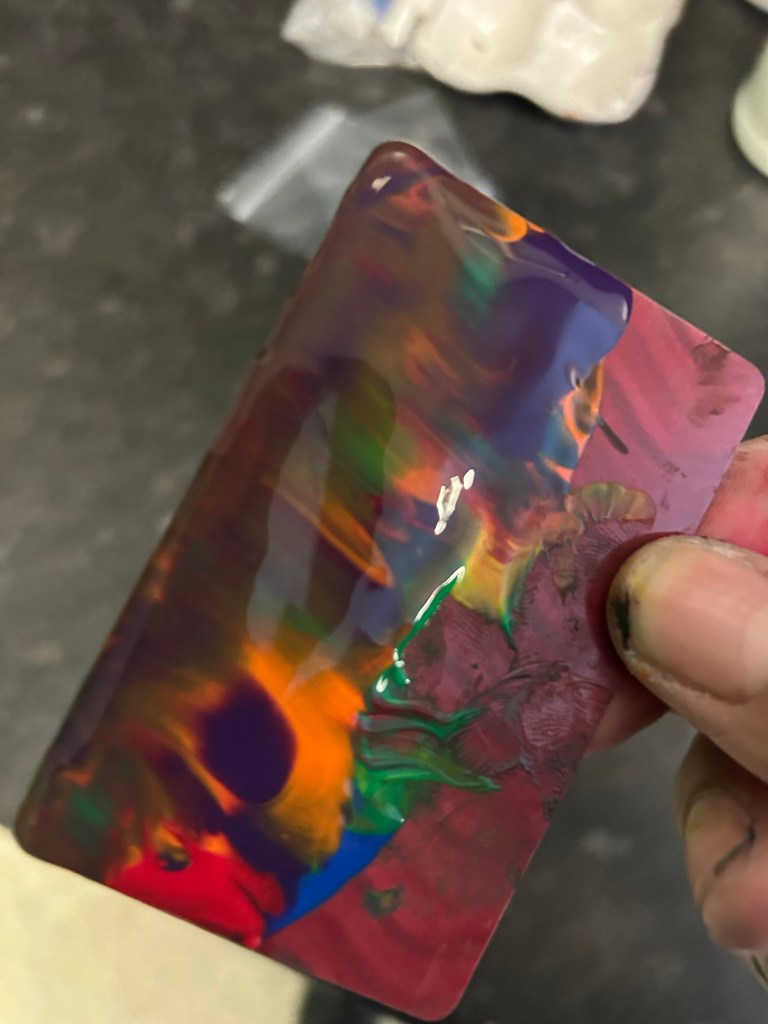
10p is all I pay for big, colourful children’s books, withdrawn from library stock. I have to feel the paper first though before I buy them. Even if only 10p, too shiny the page and the paint won’t grip it as well. The paint just swirls around and doesn’t stick.
I like my pages rough and matt finished. Ready to absorb whatever I put down on it.
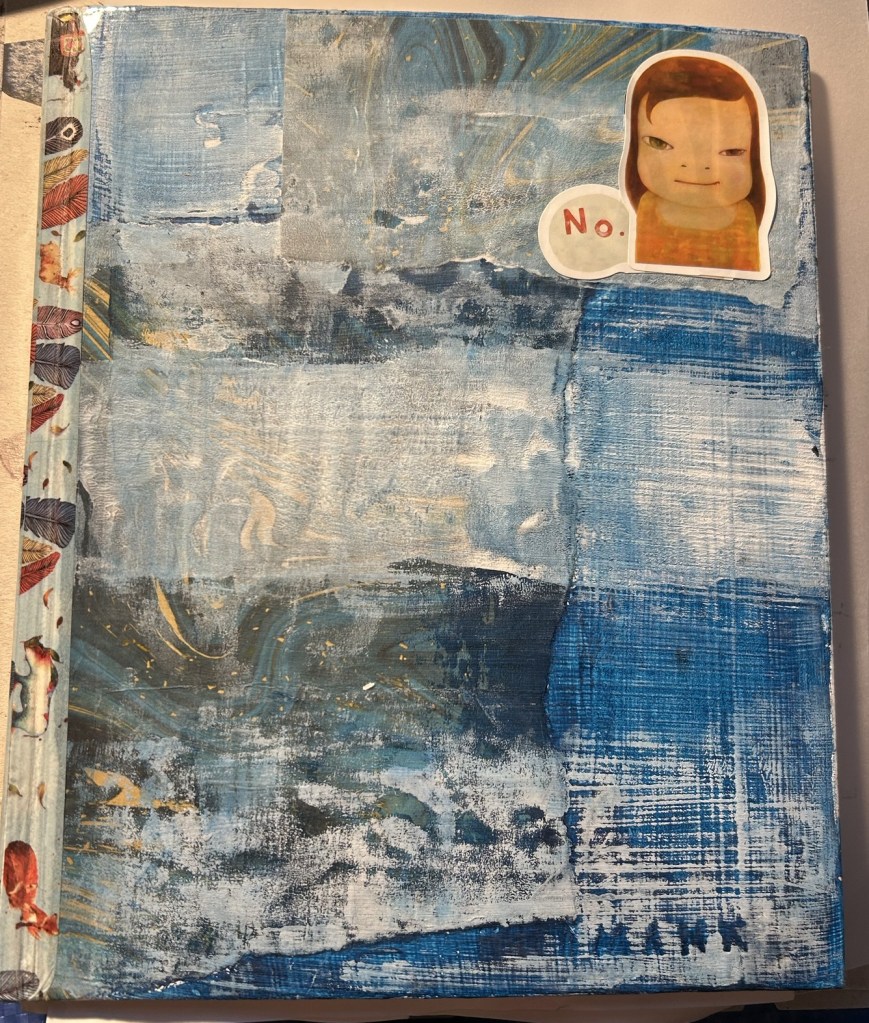
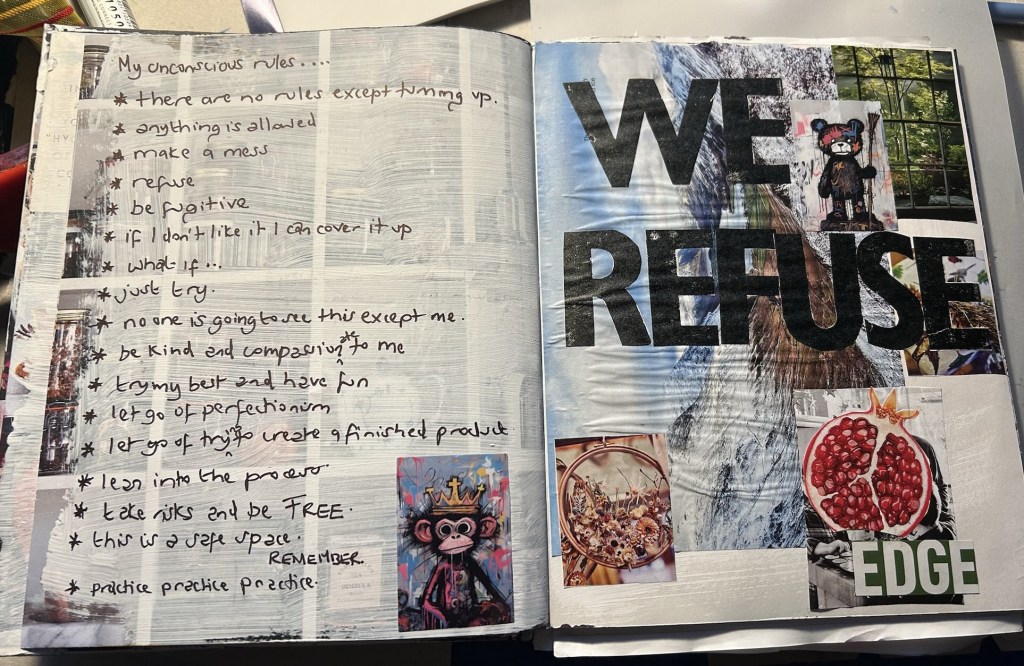
This sketchbook was my side hustle for the last month. Side hustle to my main creative sketchbook. Here I just lay down colour and see what happens.
I like when what’s underneath the paint bleeds through. I like when the different layers of paint and pencil and pen bleeds through to the surface too.
It’s like a palimpsest. The marks beneath is the feeling I’m after. The haunting, the trace, the evidence of time and the passage of time. The archive is present now.
Visual journaling in community is always time well spent.
Even if it’s their first rodeo, to witness the freedom, the mess, the expansion as paint meets paper meets card. Bliss. Magic. A gift.
Walking out with their own visual journals clutched close to their chests, promising to carry on the practice themselves, now they’ve got the power within their hands, hearts and soul.
A job well done any time the visual journaling practice is passed on.
I do believe it makes us better human beings. Better to each other and ourselves. Softer, caring and well-nourished.
This is one of my favourite images from my extensive collection.
I know exactly when and where it was taken. Westfjords Residency, Iceland, Feb/March 2017.
This was my go to breakfast. Coffee, cornflakes and Skyr, Icelandic protein enriched yogurt. I love the colours, the composition. The items included. But most of all, I love the memories and feelings just looking at this image evokes.
It takes me back to that time of wonder and discovery during my second time to Iceland. A residency I gifted to myself, writing the application while teaching temporally; frustrated, longing to get out and create.
I stayed for two weeks in the shadows of the mountains, knee deep in snow most days until the thaw came with some greening of the landscape.
I didn’t know what the fuck I was doing there back then. I just knew in my body that I needed to get away, gain inspiration from the landscape and {BE}.
I might not have completed much when I was out there, but I know when I returned the experience shifted my creativity and how I saw myself as a creative.
I saw glimmers of the Northern Lights during this retreat. Pale creamy wisps and trails in a dark navy sky. It was magical and a mystery.
This makes me think about my art-making practice and how most of the time I’m working in the dark, moving out of my comfort zone into the unknown, looking and listening hoping to catch a glimpses of magic and mystery in the process.
What’s created on the page, like this photography, is an archive, a record which when looked upon brings to the surface all the memories and feelings of the process, the experience once again experienced to the full with wonder and a smile.
This was quickly followed with the writings and (re)drafts of Darkling, my poetry/hybrid collection published in October 2024.
After this 2025 has been a period of extended rest and refusal.
But something has been niggling me. The desire to create with paint again. the desire to play without expectations and outcomes/ products.
I’ve just scratched the itch through scrolling through Pinterest. Adding another abstract or landscape painting to a board that I’ll probably not look at again.
But it satisfied this niggling feeling. Until it didn’t.
It was going back into the classroom. Completing a few days of supply that pushed me over the edge.
The time I gave away for money. The time I’d lost pursuing my own pursuits. And realising that I wasn’t pursuing all the pursuits I wanted to pursue in the time I had/have.
So out came a creative sketchbook, inspired by the 30 days sketchbook challenge created by Cheryl Taves over at Insight Creative.
This is as much as I’m willing to share for now about the challenge, my creative sketchbook, processes and insights.
One of my rules is that it’s just for my eyes only. I want to see how this rule changes my practice. I want to create without fear but with curiosity. I want to give myself all the freedom without worrying about what others will think or say or comment on.
It’s not like I’m hanging on other people’s responses and reactions but I have gotten into a habit of just sharing anything and everything on my blog and I’m curious to see what happens when I keep things to myself.
Just for my eyes, heart, and soul only.
So far I’m enjoying the process of the challenge and I’m reflecting and paying attention to what makes my heart sing, what’s my creative vocabulary, what pushes my energies.
Do doubt whatever I explore within my creative sketchbook will be showing up in everything that I create. In everything who I {BE}. For sure.
I’ve always felt nervous when meeting new people. Not because I’m worried about what they’ll think of me, but because at some point in the conversation I will no doubt be asked the question, “So, where do you come from?”
When a white person asks me, this question comes with the implicit assumption that I am not ‘from here’. They might think this is a simple question to ask but it is not a simple question for me to answer.
Should I say Bradford, West Yorkshire, where I was born and brought up until the age of ten? Or the North-East Coast where I live now with co- parenting my daughter? Or even London, where I went to University and got in touch with my ‘black’ side? Or Trinidad, Ghana, Barbados, Nigeria, and Sierra Leone where my ancestral roots lie?
When I was younger in the 1970s and living in Bradford, my dad didn’t talk about Trinidad, but we knew it was the land of his birth. One of the reasons we knew this was because of the black crushed velvet scroll that hung in our front room depicting the islands of Trinidad and Tobago. We didn’t even know he had siblings until, after 25 years of no contact, he received a letter from his sister, Tantie Gladys living in the United States, which started a new relationship with ‘family’.
After my dad’s death in 1981, all the silences changed. Our mum told us the stories our dad had told her but had decided not to tell us about his land, his family, his home. We moved to Newcastle then, to be closer to mum’s family.
It was being closer to my grandparents, listening to them talking and seeing photograph after photograph, that I began to understand my heritage. My maternal great granddad, my nana’s dad, was from the Gold Coast, now Ghana. Charles Mason was billed as the first black man in Newburn, our small village.
I knew that someday I would visit my ancestral lands, Trinidad, Ghana, Barbados, on my granddad’s side, and Sierra Leone and Nigeria, a new piece of information which places my Trinidadian family as descendants of slaves.
“Where will you be buried?” asks a friend. For her the answer is simple; born in England, lives and works in England, dies in England, buried in England. But for me, it’s a tricky question because frankly, I’m not sure where I’m from. I live in Nirth-East England, but I don’t call it home; it’s my base. I wouldn’t call Bradford home, even though I still carry the Yorkshire accent around with me.
‘Home’ as a concept is problematic as it makes visible such notions as gender, diaspora, identity, culture. ‘Home’ as a term includes the sense of ‘knowing home’, what and where home is. It also encompasses that feeling of ‘being at home’ or away from home. But most importantly, ‘home’ includes that matter of ‘belonging’. There are multiple and fluid meanings of home, from private to public, from physical to imagined. The idea of home is plural, a conflicting site of belonging and becoming.
‘Confused’ is one word that should be on my passport. In 2007, I took the plunge. I approached a visual artist friend and said, “I’m going to Trinidad and Tobago. Want to come?” At the time, I wasn’t sure what I was planning. I was excited, worried, nervous and scared. When I tried to visualize myself there all I could see was the touristy, travel brochure images of the Caribbean; blue sky, blazing heat, turquoise sea, crystal white sands and swaying palm trees. All my knowledge of my heritage was based upon Westernized sources, framing the islands in a certain way.
Having completed a visit to the Caribbean, I can not really imagine what it is/was like to live there, to be born there and grow up there, as my ancestors did. I am second and third generation of immigrants, depending of which side of my family is in focus. I do not have that first hand knowledge of ‘home’, be it the Caribbean or Ghana, but I do of England. As
Avtar Brah says, ‘home’, is a mythic place of desire in the diasporic imagination. Nostalgia is a sentiment of loss and displacement. My experience of my ancestral homelands is limited. In terms of nostalgia, I have a longing for places that are far removed from my everyday but are part of my identity. I may gain an impression of these places through my travels to them or through my family members, sadly all of which are now dead, except my sister. I have that sense of loss of place and of people. I use my writing to create those lost worlds.
There is a photograph of me, in holiday gear (green and white striped top and white cargos), grinning like an idiot, clinging tightly with two hands, onto the arm of a man I’ve just met ten minutes ago in Laventille, Port of Spain, Trinidad. My smile speaks of satisfaction, joy, relief and belonging. This man is a cousin I did not know I had. This embrace is one of ownership. He is family and he is mine. He is part of my past, my present in that photograph, and my future. The past is in our futures, in our nows. I carry with me the baggage of the past into my present and future. My Laventille visit was like going to collect baggage from the left luggage department,finding and claiming baggage that I didn’t know I had lost, but is now vital to me in my task of trying to know myself better.
This feeling of belonging, this split identity/mixedness of being/feeling British, Caribbean, African without exclusive claim to any of them is something difficult to live with, to function with.
This is an updated and redrafted extract taken from my 2010 PhD thesis, ‘A Drift of Many-Hued Poppies in the Pale Wheatfield of British Publishing’ Black British Women Poets 1978 – 2008
Growing up, and I still feel as if I’m growing up or at least progressing in this process of becoming, but yes growing up, I constantly rejected core parts of myself in order to fit in, in order to be accepted and loved. There was also an element of protection too. Growing up I knew or sensssd that being too wild and too unresostrcted and out there could bring trouble my way. Be looked up, be beaten up, be killed.
But I’m not prepared to repress, reject core parts of myself anymore. I don’t do it anymore because all it does it hurt me and stops me living my life on my own terms. Living y life to it’s fullest potential because I’m focused on the fear and rejection instead.
It has taken years and practice for me to take down the internal prejudices against myself. They might have been fortification constructed for protection and rejection but they did not serve me then and certainly don’t serve me now. Yeah I still protect myself from harm. I think I got complacent recently with the sea and also within the recent counselling skills session, but I’m practicing this from a place of love, self-love rather than self-hate and disgust. And the feelings are totally different.
“He knew exactly what she meant: to get to a place where you could love anything you chose — not to need permission for desire — well now, that was freedom.”


 Living Wild Studios