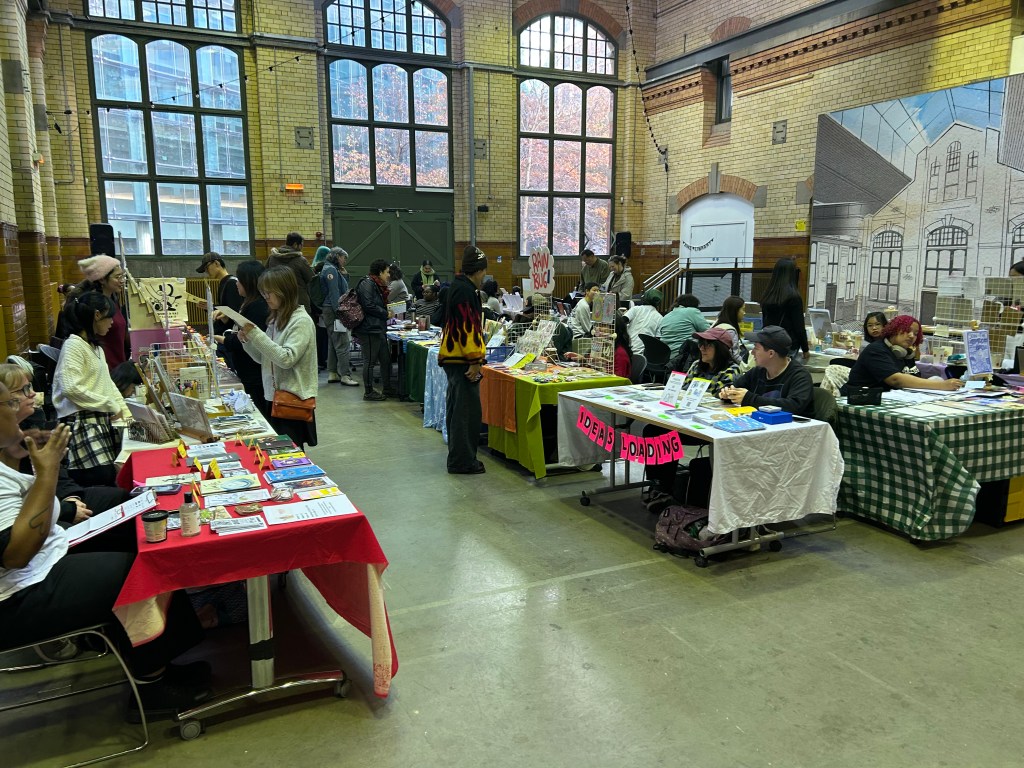
Today, Dal and I were in Manchester as the Over Here Zine Festival again. I think is out third year there together, sharing a table of our creations and laughing far too loud for such a small room in People’s Museum in Manchester.
It was good to be in a space that was created for people of the global majority to share their zines. It’s usually a safe and supportive space. And it still is in some respects. But what is worrying is that more and more white people are infiltrating our safe spaces. I know that white people come in to see and buy our creations. I can this is who we are selling to, while we swap with each other. But at the same time, I noticed white people behind the curtain, on the wrong side of the tables selling zines. But I could be wrong?
An article I read the other year, titled ‘Ontological Expansiveness’ by Chris Corces-Zimmerman, Devon Thomas, Elizabeth A. Collins and Nolan L. Cabrera, where I learnt the language I needed to call out this sense of expansionof white people into black and brown spaces where maybe the ethos and intention is exclusivity.
Ontological Expansiveness is a theoretical framework used under the umbrella of Critical Whiteness Studies (CWS) that was conceptualized by Sullivan (2006) to describe the complex and nuanced relationships that exist among race, Whiteness, and space. Sullivan (2006) argues, “As ontologically expansive, white people tend to act and think as if all spaces – whether geographical, psychical, linguistic, economic, or otherwise – are or should be available to them to move in and out as they wish” (p. 10).
I could be wrong, but how is feels to me, and how I’ve been experiencing things, is that white people think and act and move as if they have a right to be in any and all spaces. Sullivan suggests that White people tend to think of themselves as though they are the only people to exist or have worth in the world. Black and brown people just don’t come into the equation. Colonialism is the epitome of ontological expansiveness.
In this example as the zine festival, I’m talking about taking up physical space, but ontological expansiveness also applies to language and who white people claim ownership, through creating definition of what is proper English for example. What’s acceptable is the language and tone and style of whiteness, any other forms of communications are wrong. Yet that doesn’t stop white people wanting to use Ebonics or use the ‘N’ word. And then there’s the appropriate of our cultural practices .
As Sullivan (2006) states, White people frequently act as if, “The appropriate relationship is one of appropriation: taking land, people, and the fruit of others’ labor and creativity as one’s own” (p. 122). Frequently, instances of White people engaging in acts of cultural appropriation represent a fetishizing and exploitation of the language, customs, or practices of Communities of Color.
Of course white privilege is wrapped up in this but it’s not enough to say this privilege needs to be given up or shared. Before anything changes white people need to acknowledge what they are actually doing, but how are they going to do this if they are oblivious to what they are doing?
I invite white people to recognise that they will feel uncomfortable when they do enter spaces that are predominantly non-white and get used to it. As in that discomfort is the seed of change.
those questions that provoke and are testing you, to establish if you really want to have a conversation or if you just want to use and abuse me on your own terms, for your own agenda and gain.
I’m trying here. Really trying to look after myself. To rest when I need to. To eat well. To move my body. To protect my mind, body and soul. To make a way out of nothing. Protect my energy. From what I hear you say?
Vampires. Blood fucking sucking vampires. I’m not referring to the Count here. I’m referring to those people who treat others like a puppet or pawn ( insert whiteness/ white people here).
All paternalistic, thinking they’re doing me some kind of favour when they take my ideas and run with them and then come back to me ( that is if they do) and present some kind of gig/job/role for me to carry out sometimes for free( sometimes for a fee) and think/expect/assume that I’m okay with this. That I’d jump at the chance of doing this shit for them on their own terms with them assuming all the control and power when I’ve been doing this shit by myself for others for as long as time, without shit from them.
Exploitation. Extraction. White supremacy culture comes to mind. Comes to heart here.
No discussion. No seeking permission. No asking if this is okay. Nothing.
Except the conceited, privileged, racist assumptions/ take over that this is something I would do and not refuse to do because … that I need them? Or that I need the money or the exposure? That this is the only way to do it? Or what?
I don’t know because they didn’t see fit to talk to me about it.
So many things are wrong about this situation. The whole concept. The timeframes. The costings. The language used to describe my people. My community.
Not to even mention that they spelt my name wrong throughout the whole fucking ‘proposal’.
I don’t think they know who they are dealing with. I don’t think they really know who I am or have been listening to me all along. Really listening to me and understanding who I am and where I’m coming from.
There’s blood in the water.
The sun has broken through the dark.
Vampires are not feasting on my fucking soul anymore.
I sold my soul once before and it didn’t turn out well for me.
With soul and dignity and integrity intact I’m not about to surrender them again for jackshit. For someone who does not hear/ value/ see me.
i’m protecting my peace so i have the energy for me, to {BE} in service for we, the we that looks/{BE} like me
this is all becoming clearer now
i’m not expending or wasting any more time, energy, attention on those (white) people who do not see me. or when they do see me, they do not see me as human
as Akwugo Emejulu says, the black woman can never be a human being
for decades i’ve spent time, energy, attention, through my practice and day to day life, trying to convince others ( white people) of my humanity. i would bend over backwards trying to get accepted, recognised, cherished as a fellow human being
look, please, i’m human. look, please, i feel, i hurt, i bleed. i breathe
no more. i am no longer prepared to play that role. dance this stupid dance. as i will never be accepted, recognised, loved as a human being. the system won’t allow it. (white) people won’t allow it
i’m no longer wasting my energy on proving jackshit
i’m refusing what has already been refused of me ( fugitivity)
i knowing who i be. i am smart, i am kind, i am important ( The Help). and i don’t need/want/entertain any (white) person to tell/grant/recognise me as such
and i’m no longer apologising/ playing it down or safe/ tempering for how i feel/act/ {BE} about this situation
as that just expends/takes/sucks out of me a whole heap and of other energy
The lessons I try and pass on to my kids are not to allow anyone else to change you. You go about your business as yourself. Don’t change for nobody.
I’ve been in a battle with myself.
I know my nature. I smile a lot. I lean into the joy of life because I’ve always said life is too short after being touched by death so young ( I now think life is long but that’s another conversation).
I’ve been in a battle with myself.
I’ve noticed I’m walking out now and not smiling. To myself or others. My face is fixed in a neutral stare, going about my business. I don’t not need/ want to look, speak or touch anyone else.
I’ve been in a battle with myself.
Is it my nature to smile and make contact with other (white) people because that’s who I am? Or do I do it to make them feel comfortable and not to think I’m a threat to their safety? Do I smile because I’m happy? Or do I smile to keep others happy?
I’ve been in a battle with myself.
Through speaking with a ( black female) friend recently things have become clearer and more resolute.
i ain’t smiling.
Not smiling, gazing or connection with (white) people while out walking/ coffee drinking/ shopping/whatever, is me, protecting my peace.
People have said to me before – you have a beautiful smile.
Or – you’re beautiful when you smile.
Or – your smile is contagious. I see you smile and I just smile backatya.
Bullshit.
Where I live, black faces are few and far between. But I’ve lived here close to 16 years. It’s my home now. I wouldn’t want to live anywhere else because I’m close to the sea.
But still when I’m walking the streets. My streets. I’m still looked upon as a stranger. That is when they see me.
Because I’m a joyful person, I smile. I smile a lot. Especially after a dip in the sea. Then I can take on the world. I can face the world with a smile.
I have lost count of the number of times I’m walking out, look up to make eye contact with someone walking towards me. Even give a smile or a nod of recognition, a greeting. And there’s been nothing in return. No eye contact. No smile. No recognition of a fellow human being. No connection. Nothing.
And if there has been a gaze at me, it’s not welcoming or positive. It’s been hostile, or questioning or vacant.
Don’t gaslight me into thinking this isn’t the case. This is my experience. You weren’t there. And I’m sick and tired of giving the others the benefit of the doubt.
I’ve never been given the benefit of the doubt. That is never bestowed on me. I’ve accepted it. Allowed it. Made excuses and explanations for it. But no more.
i ain’t smiling.
I ain’t making eye contact. I’m not stepping off the pavement to make room for others. I’m taking up space. My space. Nobody else’s. Mine.
“On the afternoon of May 16, 2020, about a week before George Floyd was killed by the police, twenty-one-year-old Tye Anders was accused by the Midland, Texas, police of running a stop sign. He pulled over in front of his ninety-year-old grandmother’s house.”
Excerpt From We Refuse Kellie Carter Jackson
There’s Anders pleading for his life. There’s many policemen with guns drawn pointed at him and there’s bystanders filming it all. One woman who’s filming this is also pleading for the police to not shot Anders saying he’s scared. Hasn’t there been enough killing of unarmed black people, killed just because of the colour of their skin?
Still no guns are lowered and Anders is on the ground clearly empty handed but the situation is just escalating as the police continue to train their guns on his body.
Anders’ ninety-years-old grandmother steps out of her house praying. With cane in hand she walks towards her grandson even though guns are trained in her direction.
There was still panic still bystanders screaming for the police to put their guns up. Some do but still one cop is walking towards Anders with his gun raised. Trying to move and push her out of the way, his grandmother doesn’t believe that her grandson won’t still be shot so she falls onto her grandson, protecting his body with her own body. Not longer after this with the police and crowd pushing and pulsating around her , she loses consciousness.
Anders is arrested for fleeing the police. His grandmother is taken to hospital.
Reading this story this morning made me cry. Not because of the police brutality or the disregard for human life, black life. But because of what the grandmother in the story did. She’s ninety-years-old, frail and only has her prays and body, but used both in protection, in an act of love.
“Her collapse was not a coincidence. Protection is powerful, beautiful, and sacrificial because protection is love. But she should not have needed to put her body between the police and her grandson to protect him.”
Excerpt From We Refuse Kellie Carter Jackson.
Protection. She should not have needed to, but she did put her body between the police and grandson to protect him. This act of courage broke my heart this morning. Had me weeping. Maybe it was the last straw that pushed me over the edge into the breakdown. Maybe it was my imagination seeing this playing out.
Maybe I’m just sick and tired of living in a world where white violence is justified and black violence is really self-defence but is never judged that way.
I’ve always been a supporter of care work but even more so now. As care work, along with rest are forms of protection. Through the way I {BE} with myself and others, and the work that I do for self and others, I’m tending daily to the mental, emotional, and physical needs and health of black people, so we are better equipped to survive and thrive within a hostile, brutal, grinning world.
I’m been talking here about finding my tribe. About my search for comrades in solidarity. I’ve remained pine in the process, for real. From one particular source I asked for further reading, as something was niggling me. Id expressed my concerns in terms of using the oppressors language as well as, well I felt as, the lack of warmth, kindness, care and love. And then through the further reading it all became clear. This was my response.
I believe that there needs to be unity to fight all oppressions. You can’t fight racism without fighting against capitalism.
But I realise through this further reading where my concerns lie. It’s not in the socialist/Marxist movement as a whole but it’s with the people who make up the movement.
I’m not sure if the people of the movement have/ or continue to take the time to work on their own racism. There seems to be a given that because the movement is against all oppressions that it means those who are part of the movement can’t be racist or sexist because they say they are against all forms of oppression. Saying it is one thing. Practising it is another.
In practice there is still the use of the oppressors language as I’ve mentioned before. Using ‘non-white’ or ‘minorities’ is offence as they still centre whiteness which is used for division and oppression.
The articles mention the BPP alienating white people because of their support for Black Nationalism and Separatism, and their language used around Black Power. You even mentioned yourself that we can’t fight capitalism through language and its use. Modifying language is not going to bring about material change you say.
And yet it is language the party is using to rally the masses, to bring people together. Language is the tool of persuasion no? Language is the tool of education.
But if that language continues to use the language of the oppressor and is offensive to certain groups of people, they are accused of being confused, ill informed and falling into the identity politics trap again.
However, from my experience, through reading the literature of the party, I feel that the language used reflects a party line where the people behind that line are not continuing to work on their own racism/ biases while focusing their efforts on society’s ills, outside of themselves.
I do not feed into white supremacy culture with the characteristics of either/or. I believe in and/both. That means for me, there has to be the work on the individual’s internalised racism and sexism at the same time as working against oppressions within society. Working on our own blind spots and prejudices can only benefit the movement as a whole. Where this fails to take place is where the oppressors divide and rule become fixed without our recognition of it.
To say that ‘non-white’ is every day language, quote, ‘commonly understood by ordinary people as respectful ways to refer to some people who are oppressed’, as a black person being referred to as ‘non-white’ is offensive to me and I’m not really bothered if other black people are okay with it. I might be falling into an identity police trap but one my identity is not built on my relation to whiteness that is racism. Two, if someone says they find it offensive and that is not recognised or is questioned and explained away as being the norm is denying that person’s experience which is racist. Three, to bring this up then to have it dismissed as being defensive and accusing someone of being a bigot/ racist and dismissed as a distraction from the cause is another example of an individual failing to check themselves and work on themselves to combat their racism/ discrimination tendencies.
I work on myself daily to check my prejudices or biases or judgments and blind spots. I only wish more people would also as I do believe the world would be a better place because of it. Movements and societies are groupings made up of individuals. Working on the individual at the same time as the collective can only strengthen that connection and keep moving it forward in an effective way, I believe.
If we think about what is happen in the USA today, and the ICE raids within every community. The Latino community is coming out and asking where are the black people why are they not out here on the streets with them protesting? Why are they sitting this fight out etc.? Black people are tired, esp. black women. Black people told everyone to vote for Kamala Harris and they didn’t listen. They voted for Trump. And now he is doing all that he said he would do.
Now people are asking for black people once again to put their bodies on the line. And yeah this is a prime example of the ruling class dividing and ruling. Pitting one group against another. But what is true there and what is true here, black people only make up a small percentage of the population. In the states 12% here 4% with other ethnicities. And yet it is expected for us to save the world. ( Aside here we might be termed ‘minorities’ within these countries but we are the global majority. I don’t use ‘minorities’ because it is used as language of control. Black Feminism or Third World Feminism has always been global in its remit).
It is expected for black people to put aside those differences which on a daily effect our life chances. Our lives in terms of life and death. And this is not feeding into a victim hierarchy and who’s suffering is more than someone else’s. It’s a reality. Black people, black women do not just suffer violence and brutality from the state but do so from person to person in their every day and yet black feminism still criticises and attempts to bring material change for all through fighting all oppressions including capitalism and yet if they ‘fail’ to bring about material change it is because of ill-fighting or confusion in their ideology but no mention of doing this within a racist/ sexist society that does not see Black women as anything except mules of the world. Not either/or but and/both.
As black women we continue to not be seen as human. Read Fugitive Feminism by Akuwgo Emejulu to understand this, which is anti-capitalist, anti-imperialist and anti-colonialist. It’s arguing for a rejection of the whole system. A refusal of what has already been refused to us. Other ways of being are possible.
Marx himself saw the future of capitalism as self-destruction and a social mode of production being the outcome. Fugitive Feminism is being/working now with the other possibilities. It’s about creating an outside while still on the inside. Creating spaces of liberation and joy on our own terms. It’s not waiting until then for it to be now. It’s collective and speculative and might be fostered by black women but can be utilised for all, all oppressions including capitalism and the class struggle. It is probably dismissed though because it comes from the mouths, minds and hearts of black women.
Thanks for all these readings. They have helped in clarifying where I stand. In solidarity but at the same time in my own fullness and power which I lend to any movement which recognises this and works with me to bring about dismantling all oppressions for all people.
The reply I got, was thanks, I’ll reflect on it, and wish you luck on finding your people.
I’m sharing it here as I don’t want my realisation to do to waste. The words I shared to go to waste, as I’m still open for the conversation, still open to standing together.