Anti-racism is anti-capitalism

I really appreciate it when you’ve bought a book and are ready to dive into it, but you’re just not feeling it. You can’t get into it. So onto the book shelf it goes, collecting dust. Maybe even taunting you.

And then, over time, into a different time, you pick up said book again and you dive into this time, deeply. It’s singing it’s message through you mind, body and soul.

This practice happened for me with Women Who Run With Wolves by Clarissa Pinkola Estes and here it’s happened again with What is antiracism? by Arun Kundnani.

It’s that time of year again where I’m due to go back into Sunderland University and lecture within the Social Work Department around anti-racism. This started in 2020, in the pandemic and the Black Lives Matter uprisings around the world. Up until this point there had been no addressing of race and racism within social work training. And you could still say this is the case as one session, 2-3 hours long, is hardly making a dent into racism and its consequences. But I digress.

Anyway each year, my thinking and practices have changed as I’ve read more and developed more as an anti-racist, anti-capitalist agitator, organiser and activist.

I share my learnings and findings as I want to bring about change for everyone. And this transformation can’t be just limited to working on a personal level as the usual anti-racism training/ education would have us believe.

The problem is not just on an individual level, our unconscious biases etc, the problems are structural and are engrained into the bedrock of our societies, countries and communities.

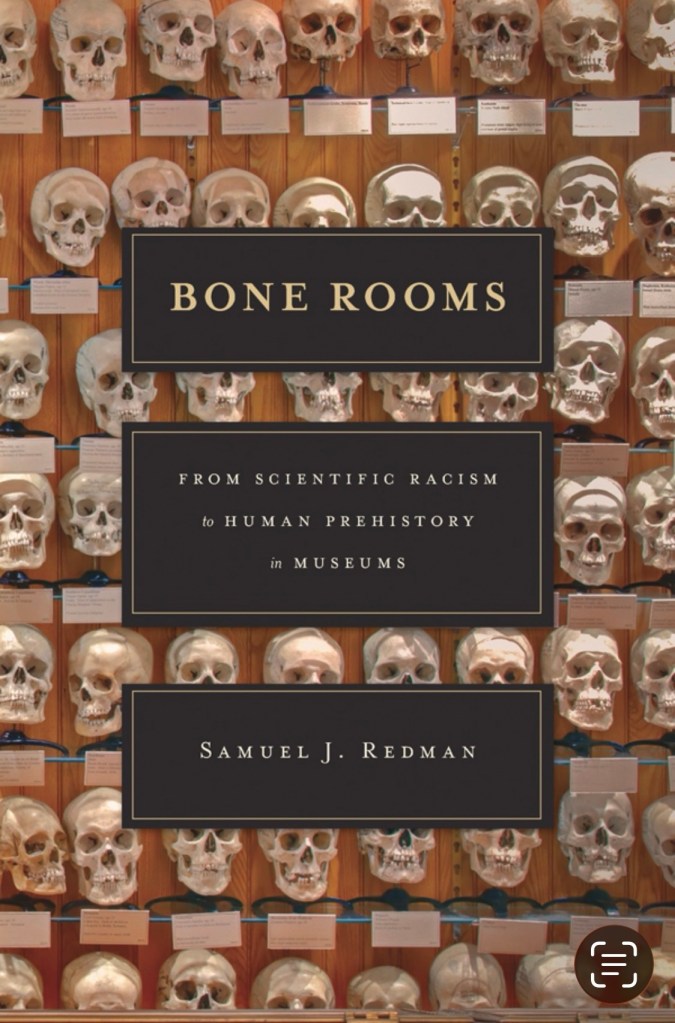
Anyhow, this book What is antiracism? is not only giving me the historical evidence of racism, the term and practices, but is also sharpening my argument around how racism and classism go hand in hand and that you cannot have a revolution without black workers leading the way. As black workers have always fought for freedom and the dismantling of capitalism for everyone, not just for (white) workers as the revolutions within Europe have done.

We have the French Revolution in the 1700s, lead by the urban masses. We have the Russian Revolution lead by the vanguard party for the proletariat. But we have the Saint-Domingue Revolution in the 1700s lead by the enslaved for abolition of all enslavement in the colonies and Europe, in tandem with the French Revolution happening in Paris. The first time that black and white workers were fighting a common cause together on this scale.

Which revolution succeeded?

The revolution lead by the enslaved, black forced labour, which created the sovereign state of Haiti, a black revolution which had at its heart radical action to transform all societies.

This is what we need now.

Over Here Zine Festival 2025

Today, Dal and I were in Manchester as the Over Here Zine Festival again. I think is out third year there together, sharing a table of our creations and laughing far too loud for such a small room in People’s Museum in Manchester.

It was good to be in a space that was created for people of the global majority to share their zines. It’s usually a safe and supportive space. And it still is in some respects. But what is worrying is that more and more white people are infiltrating our safe spaces. I know that white people come in to see and buy our creations. I can this is who we are selling to, while we swap with each other. But at the same time, I noticed white people behind the curtain, on the wrong side of the tables selling zines. But I could be wrong?

An article I read the other year, titled ‘Ontological Expansiveness’ by Chris Corces-Zimmerman, Devon Thomas, Elizabeth A. Collins and Nolan L. Cabrera, where I learnt the language I needed to call out this sense of expansionof white people into black and brown spaces where maybe the ethos and intention is exclusivity.

Ontological Expansiveness is a theoretical framework used under the umbrella of Critical Whiteness Studies (CWS) that was conceptualized by Sullivan (2006) to describe the complex and nuanced relationships that exist among race, Whiteness, and space. Sullivan (2006) argues, “As ontologically expansive, white people tend to act and think as if all spaces – whether geographical, psychical, linguistic, economic, or otherwise – are or should be available to them to move in and out as they wish” (p. 10).

Corces-Zimmerman, Chris & Thomas, Devon & Collins, Elizabeth. (2021). Ontological Expansiveness. 10.1163/9789004444836_058.

I could be wrong, but how is feels to me, and how I’ve been experiencing things, is that white people think and act and move as if they have a right to be in any and all spaces. Sullivan suggests that White people tend to think of themselves as though they are the only people to exist or have worth in the world. Black and brown people just don’t come into the equation. Colonialism is the epitome of ontological expansiveness.

In this example as the zine festival, I’m talking about taking up physical space, but ontological expansiveness also applies to language and who white people claim ownership, through creating definition of what is proper English for example. What’s acceptable is the language and tone and style of whiteness, any other forms of communications are wrong. Yet that doesn’t stop white people wanting to use Ebonics or use the ‘N’ word. And then there’s the appropriate of our cultural practices .

As Sullivan (2006) states, White people frequently act as if, “The appropriate relationship is one of appropriation: taking land, people, and the fruit of others’ labor and creativity as one’s own” (p. 122). Frequently, instances of White people engaging in acts of cultural appropriation represent a fetishizing and exploitation of the language, customs, or practices
of Communities of Color.

Corces-Zimmerman, Chris & Thomas, Devon & Collins, Elizabeth. (2021). Ontological Expansiveness. 10.1163/9789004444836_058.

Of course white privilege is wrapped up in this but it’s not enough to say this privilege needs to be given up or shared. Before anything changes white people need to acknowledge what they are actually doing, but how are they going to do this if they are oblivious to what they are doing?

I invite white people to recognise that they will feel uncomfortable when they do enter spaces that are predominantly non-white and get used to it. As in that discomfort is the seed of change.

I refuse to allow you to suck me dry and believe you’re doing me a favour

I’m trying here. Really trying to look after myself. To rest when I need to. To eat well. To move my body. To protect my mind, body and soul. To make a way out of nothing. Protect my energy. From what I hear you say?

Vampires. Blood fucking sucking vampires. I’m not referring to the Count here. I’m referring to those people who treat others like a puppet or pawn ( insert whiteness/ white people here).

All paternalistic, thinking they’re doing me some kind of favour when they take my ideas and run with them and then come back to me ( that is if they do) and present some kind of gig/job/role for me to carry out sometimes for free( sometimes for a fee) and think/expect/assume that I’m okay with this. That I’d jump at the chance of doing this shit for them on their own terms with them assuming all the control and power when I’ve been doing this shit by myself for others for as long as time, without shit from them.

Exploitation. Extraction. White supremacy culture comes to mind. Comes to heart here.

No discussion. No seeking permission. No asking if this is okay. Nothing.

Except the conceited, privileged, racist assumptions/ take over that this is something I would do and not refuse to do because … that I need them? Or that I need the money or the exposure? That this is the only way to do it? Or what?

I don’t know because they didn’t see fit to talk to me about it.

So many things are wrong about this situation. The whole concept. The timeframes. The costings. The language used to describe my people. My community.

Not to even mention that they spelt my name wrong throughout the whole fucking ‘proposal’.

I don’t think they know who they are dealing with. I don’t think they really know who I am or have been listening to me all along. Really listening to me and understanding who I am and where I’m coming from.

There’s blood in the water.

The sun has broken through the dark.

Vampires are not feasting on my fucking soul anymore.

I sold my soul once before and it didn’t turn out well for me.

With soul and dignity and integrity intact I’m not about to surrender them again for jackshit. For someone who does not hear/ value/ see me.

I refuse.

Jog on!

where does your energy go?

i ain’t smiling

i’m protecting my peace so i have the energy for me, to {BE} in service for we, the we that looks/{BE} like me

this is all becoming clearer now

i’m not expending or wasting any more time, energy, attention on those (white) people who do not see me. or when they do see me, they do not see me as human

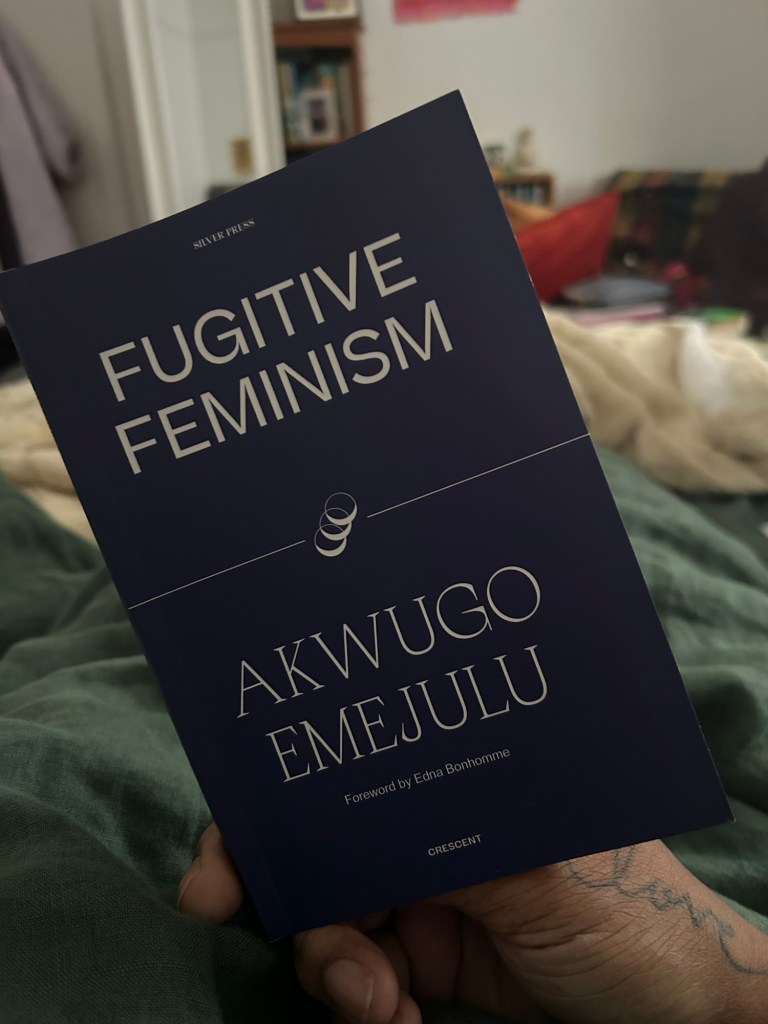
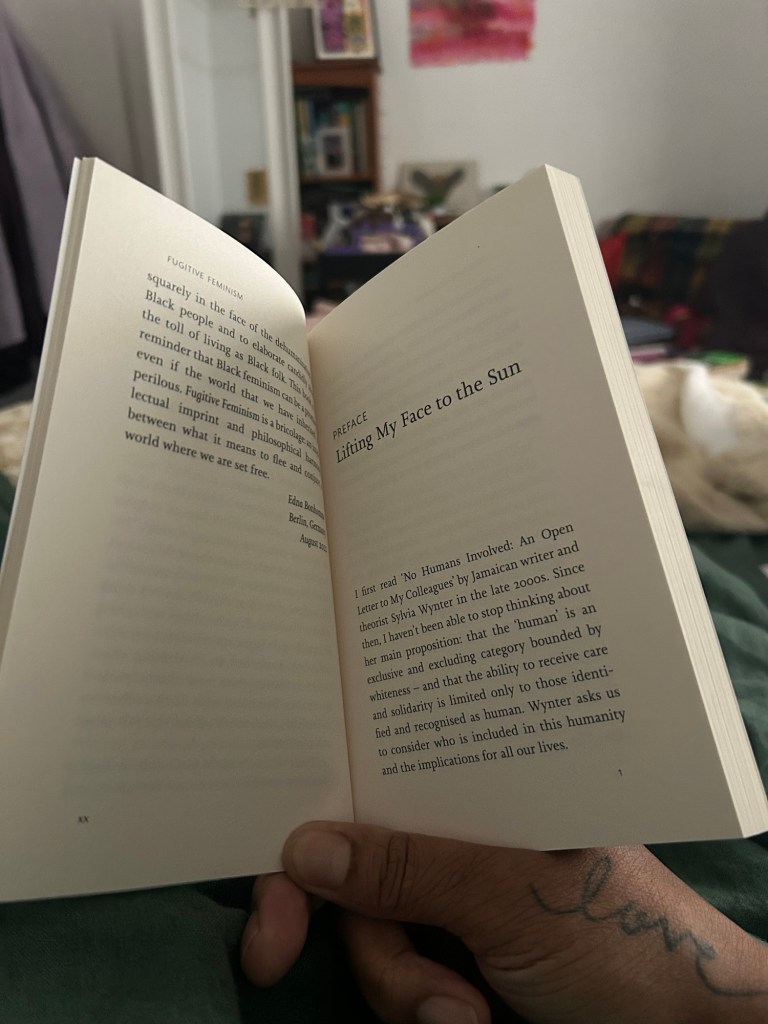
as Akwugo Emejulu says, the black woman can never be a human being

for decades i’ve spent time, energy, attention, through my practice and day to day life, trying to convince others ( white people) of my humanity. i would bend over backwards trying to get accepted, recognised, cherished as a fellow human being

look, please, i’m human. look, please, i feel, i hurt, i bleed. i breathe

no more. i am no longer prepared to play that role. dance this stupid dance. as i will never be accepted, recognised, loved as a human being. the system won’t allow it. (white) people won’t allow it

i’m no longer wasting my energy on proving jackshit

i’m refusing what has already been refused of me ( fugitivity)

i knowing who i be. i am smart, i am kind, i am important ( The Help). and i don’t need/want/entertain any (white) person to tell/grant/recognise me as such

and i’m no longer apologising/ playing it down or safe/ tempering for how i feel/act/ {BE} about this situation

as that just expends/takes/sucks out of me a whole heap and of other energy

i ain’t smiling.

Protecting my peace

i ain’t smiling

I’ve been in a battle with myself.

The lessons I try and pass on to my kids are not to allow anyone else to change you. You go about your business as yourself. Don’t change for nobody.

I’ve been in a battle with myself.

I know my nature. I smile a lot. I lean into the joy of life because I’ve always said life is too short after being touched by death so young ( I now think life is long but that’s another conversation).

I’ve been in a battle with myself.

I’ve noticed I’m walking out now and not smiling. To myself or others. My face is fixed in a neutral stare, going about my business. I don’t not need/ want to look, speak or touch anyone else.

I’ve been in a battle with myself.

Is it my nature to smile and make contact with other (white) people because that’s who I am? Or do I do it to make them feel comfortable and not to think I’m a threat to their safety? Do I smile because I’m happy? Or do I smile to keep others happy?

I’ve been in a battle with myself.

Through speaking with a ( black female) friend recently things have become clearer and more resolute.

i ain’t smiling.

Not smiling, gazing or connection with (white) people while out walking/ coffee drinking/ shopping/whatever, is me, protecting my peace.

i ain’t smiling

i ain’t smiling

People have said to me before – you have a beautiful smile.

Or – you’re beautiful when you smile.

Or – your smile is contagious. I see you smile and I just smile backatya.

Bullshit.

Where I live, black faces are few and far between. But I’ve lived here close to 16 years. It’s my home now. I wouldn’t want to live anywhere else because I’m close to the sea.

But still when I’m walking the streets. My streets. I’m still looked upon as a stranger. That is when they see me.

Because I’m a joyful person, I smile. I smile a lot. Especially after a dip in the sea. Then I can take on the world. I can face the world with a smile.

I have lost count of the number of times I’m walking out, look up to make eye contact with someone walking towards me. Even give a smile or a nod of recognition, a greeting. And there’s been nothing in return. No eye contact. No smile. No recognition of a fellow human being. No connection. Nothing.

And if there has been a gaze at me, it’s not welcoming or positive. It’s been hostile, or questioning or vacant.

Don’t gaslight me into thinking this isn’t the case. This is my experience. You weren’t there. And I’m sick and tired of giving the others the benefit of the doubt.

I’ve never been given the benefit of the doubt. That is never bestowed on me. I’ve accepted it. Allowed it. Made excuses and explanations for it. But no more.

i ain’t smiling.

I ain’t making eye contact. I’m not stepping off the pavement to make room for others. I’m taking up space. My space. Nobody else’s. Mine.

continuing to live and learn

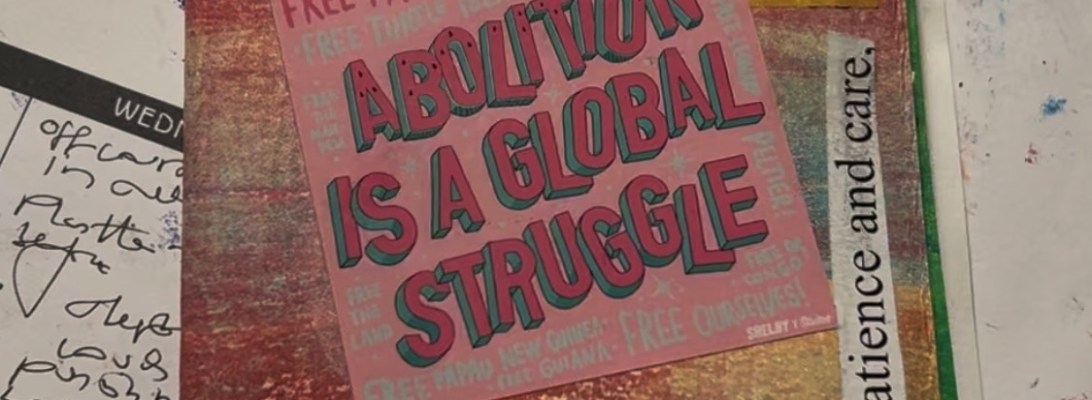
Studio Practice Journal, 2023-4

“On the afternoon of May 16, 2020, about a week before George Floyd was killed by the police, twenty-one-year-old Tye Anders was accused by the Midland, Texas, police of running a stop sign. He pulled over in front of his ninety-year-old grandmother’s house.”

Excerpt From
We Refuse
Kellie Carter Jackson

There’s Anders pleading for his life. There’s many policemen with guns drawn pointed at him and there’s bystanders filming it all. One woman who’s filming this is also pleading for the police to not shot Anders saying he’s scared. Hasn’t there been enough killing of unarmed black people, killed just because of the colour of their skin?

Still no guns are lowered and Anders is on the ground clearly empty handed but the situation is just escalating as the police continue to train their guns on his body.

Anders’ ninety-years-old grandmother steps out of her house praying. With cane in hand she walks towards her grandson even though guns are trained in her direction.

There was still panic still bystanders screaming for the police to put their guns up. Some do but still one cop is walking towards Anders with his gun raised. Trying to move and push her out of the way, his grandmother doesn’t believe that her grandson won’t still be shot so she falls onto her grandson, protecting his body with her own body. Not longer after this with the police and crowd pushing and pulsating around her , she loses consciousness.

Anders is arrested for fleeing the police. His grandmother is taken to hospital.

Reading this story this morning made me cry. Not because of the police brutality or the disregard for human life, black life. But because of what the grandmother in the story did. She’s ninety-years-old, frail and only has her prays and body, but used both in protection, in an act of love.

“Her collapse was not a coincidence. Protection is powerful, beautiful, and sacrificial because protection is love. But she should not have needed to put her body between the police and her grandson to protect him.”

Excerpt From
We Refuse
Kellie Carter Jackson.

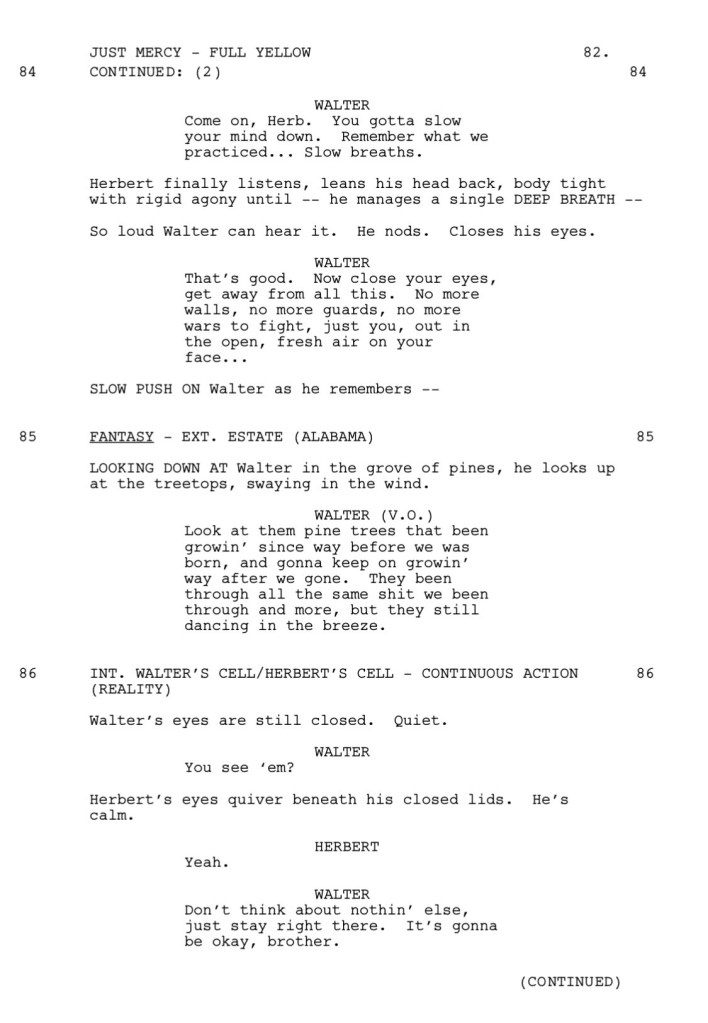
Protection. She should not have needed to, but she did put her body between the police and grandson to protect him. This act of courage broke my heart this morning. Had me weeping. Maybe it was the last straw that pushed me over the edge into the breakdown. Maybe it was my imagination seeing this playing out.

Maybe I’m just sick and tired of living in a world where white violence is justified and black violence is really self-defence but is never judged that way.

I’ve always been a supporter of care work but even more so now. As care work, along with rest are forms of protection. Through the way I {BE} with myself and others, and the work that I do for self and others, I’m tending daily to the mental, emotional, and physical needs and health of black people, so we are better equipped to survive and thrive within a hostile, brutal, grinning world.

Black People’s Day of Action, 2 march 1981

Graham Turner, in Resistance, Steve McQueen

“13 Dead, Nothing Said”, the rallying cry rings out.

walking with dignity, arm in arm, a protest, not a riot nor a mob.

a powerful display of unity and resistance. “13 Dead, Nothing Said”,

in the face of adversity. of racism, police conduct, and social justice,

the New Cross Massacre Action Committee respond.

treating black victims as criminals themselves, “13 Dead, Nothing Said”.

on 18 January 1981, Yvonne Ruddock celebrated her 16th birthday with friends,

when a fire tore through 439 New Cross Road in south-east London.

“13 Dead, Nothing Said”.

community solidarity, in the midst of racial tensions and police mishandling,

they marched, 20.000 strong, from the scene of the fire

to the Houses of Parliament to present a petition. “13 Dead, Nothing Said”.

the loss of young black lives barely noted by the media,

no words of condolence from maggie, and to this day, no one

has ever been charged with starting the fire. “13 Dead, Nothing Said”.