i’ve been searching for my tribe and i’m still searching

I’ve been seeking people, groups and organisations that I can become part of.

After a life changing anti-racism training session, which I no longer call it as such, where I realised that what I’ve been doing is really just continuing to centre whiteness and uphold white supremacy culture through this training, I feel the need to not be alone any longer in my views and activism.

I need comrades and solidarity in action.

This search for my tribe has seen me reaching out to the Revolutionary Communist Party( RCP) and the Revolutionary Communist Group – Fight Racism, Fight Imperialism, The Ella Baker School of Organising and their recent conference in London titled Defeating Narratives of Division and just yesterday, attending a meeting of the North East Anti-Racism Coalition. Let’s explore each of these experiences in turn as there has been much learning as well as clarification of where I stand in the mix.

First, my main concern around the anti-racism training I’d been doing for the last five years was that it wasn’t looking at the class system, oppression through class which is a result of capitalism. It really isn’t critical enough, or even analysing capitalism and how this is our common enemy. Through focusing on whiteness, white privilege and white supremacy culture is fails to acknowledge and really get to the roots of what and where racism came about. Race was the creation of the rich landowners afraid of the workers, both black and white, rising up and revolting. So they created the elevated status of whiteness, and the white class to bestow certain right and privileges on to the poor white workers who shipped over to the Americas for a better life form England as a means of separating them from this black workers they were so recently working side by side with. To continue to maximise profit through brutal working conditions the white working class was created, whiteness was now at the top of the hierarchy and could weld power over black workers who were once their comrades and fellow sufferers.

I realised that the common enemy is capitalism. We may have differences but we can find that common ground and come together to fight for better lives and conditions, or even destroy the whole capitalist system as then everyone, every worker would be better off. The means of production and money and gains within society would the shared out equally to all members of community. No one would be ruling over another, no bourgeois as Marxists would say.

I was looking for comrades and solidarity not allyship so I started to explore the Revolutionary Communist Party UK which split off from the Revolutionary Communist Group ( Fight Racism, Fight Imperialism) in 1978. I’ve been exploring them both really once I established the distinction between them. I’ve reached out to both, subscribed to the newspaper, Fight Racism, Fight Imperialism and bought some books. I must say it’s kind of like a labyrinth to try and get involved. The need for some connection or someone to just respond in an email what they are doing and how someone like me could get involved was needed. They want to talk to you on the phone and share what they are doing and almost interview me in terms of what I’m looking for or do or think. I’ve felt at times as if I was being tested for something.

Then I received a long essay to read. Marxism ‘v’ Identity Politics, which is what the RCP stands behind and I assume RCG ( FRFI) do also. It’s a long read but I persevered. From the beginning by back was up because they were talking about women, and women being slaves to men and being oppressed before capitalism was created. I got the feeling that when they were mentioning women they were referring to white women. But I read on. And in all honesty I cannot stand behind this document if this is what Marxist and Communists stand for.

I know within this document , it is repeated that Marxists stand against all oppressions and yet it still uses the language of the oppressor in terms of using ‘immigrants and non-whites’ and ‘oppressed minorities’ . I find its tone offensive, condescending and dismissive.

Failing to acknowledge that Third World/ Black Feminism has always been about fighting all oppressions for the betterment of all, being anti-capitalist, anti-imperialist etc. I feel where feminism is mentioned within the article it is just referring to white feminism.

I do take on board and agree to a certain degree that intersectionality and identity politics are divisive. I have tended to adopt an intersectional approach to issues now. But I have to take issue with the lack of respect and care demonstrated towards people’s difference within the piece. It almost feels as if the document is calling people who fight along identity lines against oppression as stupid or near sighted and just thinking of the individual.

There is a case for being forceful and adamant about what Marxism stands for, but I just didn’t feel the care and kindness and joy within the piece which I seek within any movement I am part of.

So I’ve left my Marxist/ Communist involvements there as they focus on the workers, as capitalism, imperialism, colonialism are the problems, we can come together and fight together on but not at the expense of love as the foundation. I felt the love and joy at the recent Defeating Narratives of Division conference in London with the Ella Baker School of Organising but I think this was coming directly from the creatives present as well as the gay and trans-people present. That’s how we want our movement to feel, joyful , respectful and loving and caring for each other. I am still waiting to hear back from the organisers of this conference in how I can get more involved.

Finally, yesterday I took a trip to Hartlepool to attend the North East Anti-Racism Coalition gathering so find out what they are all about and up to. Formed in 2024, they aim to make the North East a region that actively opposes racism and hatred based on religious identity. I was interested in finding out about their journey this far, what they stand for and what are their next steps. It was well attended, with the majority of people being white. After details about how the coalition has developed and where they see things going focusing on campaigns, membership, raising awareness and learning, we were tasked, our tables, to introduce ourselves and why we were there. I was the only black person on the table and while I said I was there to agitate, others were there to gain information to take back to their organisations, maybe not realising that they were also there to give not just take. But let’s go on.

Next was the keynote speaker, Matt Storey from Cleveland Office of the Police and Crimes Commission. He gave a powerful speech about how diversity within the region is a positive, a strength and how they are standing up against the racist riots of last summer, but he frequently referred to people of the global majority within the region as immigrants, or refugees and asylum seekers, people who had come here on boats so to speak, not once referring to the black and brown people who were born here in the UK, or the region who have been here for hundreds of years. For me this is just playing into the narrative that we do not belong here. There was talk of fighting and defending these diverse groups of people, again falling into the white savourism narrative. I am not your victim, I do not need saving, I need comrades and solidarity. We don’t need any more heroes thank you.

From here it was to get into working groups to focus on such things as membership, campaigns, learning hubs, and research. Let’s just say something about their research. It was billed as if the coalition was going to share some research. The person presenting their findings another white person came to the conclusion that more research was needed and was beyond the scope of the working group and should be taken on board by the wider/ whole coalition. The research proposed, you guess it, a survey of black and brown people in the region to share their experiences of racism. It can be done anonymously but if you give your contact details you will be put into a prize draw to win £100 in shopping vouchers. So please share with your networks as the deadline is 18 July.

Of course everything I’ve just said there about the survey is done in a sarcastic tone as I am not promoting people of the global majority in the region to complete this survey as from my point of view there is plenty of research completed which demonstrate racism exists. Maybe they want some up to date data after the riots of 2024, but still I’m sure there is research out there where they wouldn’t have to exploit or expect us to share our experiences once more or fall into this habit of having to prove it exists once again. There was no mention or indication as to what this research would be used for afterwards either.

I joined the campaign working group to see what was happening there. One question we talked about in smaller groups was how can we build better connections across difference. Things that came up was attempting to find that common ground, where there is mutuality over issues that we can come together on and work together on to bring about change for everyone. Yes I can get behind this.

But then, from the few other black and brown people who were part of this small group, I got the impression that is was a competition to share as many stories and instances of when and where they experienced racism. Of course the white people in the group were lapping this up but I felt it was again a way to prove that racism exists and is happening or has been happening within the region for generations. And this is true, but for me I am past trying to convince anyone that racism exists. For me it is a given, let’s move on. For me it’s just treading water.


And the last point, from another group’s feedback, a white woman speaking said that it would be really important for building connections to hear first hand from black and brown people about their lived experiences around racism. It helps others to understand it, she said. And I disagreed saying it just re-traumatises someone to retell their experiences of racism again and again to strangers, no doubt. A black man disagreed stating that we should be sharing, telling our stories. And I just said well from personal experience, I’d rather not be triggered and again it’s as if we are spending our energy on trying to prove it exists. That racism exists. I’d rather focus on our joy, black joy which white people do fin threatening but at least ti would demonstrate we’re not just cardboard cut outs created to experience race and racism.

After this I left. I left early because I’d had enough. I felt as if I was on different page to people who where at the event. I know it’s not an either/ or, it’s a both/and. But for me what was lacking was listening to each other. People were talking over each other, people were there to take at the same time as be heard, but there wasn’t much giving and listening.

I know I’m a lone wolf in terms of being fugitive. In terms of the way I think and operate. I listen and consolidate and try to meet a consensus but there was just not enough respect and comradeship within the room for me. It was very transactional and very little care and love and kindness.

So I’m still on the hunt for my tribe. I wanted to contribute to whatever was happening already. Contribute to the flow already happening. But as of yet I have not found this space. Maybe need to create my own that can hold all the contradictions and differences but is build on solidarity, respect, kindness, care and love.
Black Aliveness


“We are not the idea of us, not even the idea that we hold of us. We are us, multiple and varied, becoming. The heterogeneity of us. Blackness in a Black world is everything, which means that it gets to be freed from being any one thing. We are ordinary beauty, Black people, and beauty must be allowed to do its beautiful work.” Kevin Quashie describes in Black Aliveness, or, A Black Poetics of Being.

The Motherhood Essay

I think I heard back about my abstract being accepted for Demeter Press collection The Mother Wave: Matricentric Feminism as Theory, Activism, and Practice back in November 2022. And really haven’t engaged much with it since.

I submitted it on a whim off the back of the afterglow from BALTIC exhibition A Country Journal of a Blackwoman( Northumberland). 

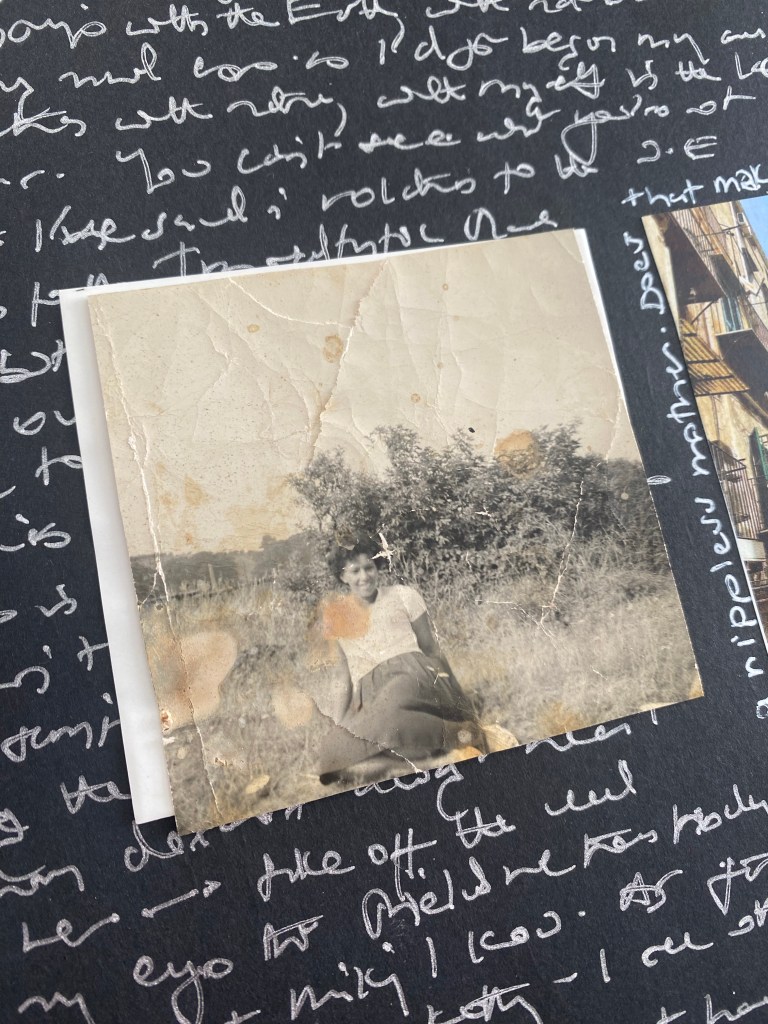
I wanted to continue this work as I felt as if I’d just got started mining this seam. But really I feel as if I’ve always been working with memory, family and archives throughout my whole creative journey. There’s always been a desire to fill in the gaps around my origins. Who be my people? Where did we come from? What makes us tick?

So I submitted the abstract changing Blackwoman to Black Mothers, as that’s what I’ve been exploring my matrilineage, our bodies with/in nature and healing.  I just wanted to continue this through a different medium; before ‘art’ now ‘word’. But really all hybrid.

I’ve surrendered more and more with each creation, that to fully express myself, my identity, ideas, passions and preoccupations, hybridity, multidisciplinary creations/ renditions are a truer take on things. More of a fuller picture/ form is rendered. 

My first draft of the essay has to be submitted by May 1st ( now changed to 10 June!). As it happens, I’ve been away house/ dog sitting for the first two weeks of April, alone in Buckinghamshire. Prime time I thought to dive deep and immerse myself in the writing process.

I’ve been using my Patreon supporters as accountability buddies, these past few weeks while working on this essay. I’ve been updating them on progress reports along the away. With my time coming to an end down here, I thought I’d use what time I have left to reflect on the process and progress so far. And I’m sharing the post with you here.

I’m using this reflection as a place marker for progress as well as evidence for when I go home and think I could have done more, or start to beat myself up about wasting time. At least I’ll have this reflection to fall back on.

Defining My Focus – Trace Mentorship

Portfolio Review Sample, October 2022

I’m merging myself, self-portraiture, with nature. Self assimilated with nature. I’m exploring my connection with nature through photography( for now!).

I’m exploring the environment and the visibility of Blackwomen within the landscape. Using the photographic image to tell a story. In the process reclaiming the narrative of Blackwomen and nature and photography.

I’m exploring the Blackwoman’s space and visibility in love and in relationship with nature. My audience is the Blackwoman. I want her to enter the space I create through my practice and recognise herself there. I want her feel that she belongs, feel the joy and all the lushness created in that space.

This will be a multidisciplinary experience. This will be a celebration of mixness, hybridity and our bodies in love with nature.

Archive: a Country Journal of a Blackwoman

A Visual Journal Spread from The Country Journal of a Blackwoman (Northumberland), archive

Right now my practice is on display within The BALTIC: Centre for Contemporary Art.

As I was out of the country when the group exhibition, Hinterlands, launched on Friday 22 October, 2022, I managed to get into seeing it after such event the following week.

I really didn’t know what to expect as you visualise the end result, the culmination of months of hard work, dreaming and winging it. But to actually see it all come together in a white cube space is another thing.

I visited my archive last week, with my daughter, excited and nervous and unsure. I got to see The Country Journal of a Blackwoman(Northumberland) exhibited on level 3 of The BALTIC. I was shocked and surprised to see my work out of context within this space. It was an emotional as well as nerve wracking experience.

Because of my absence, I had to leave instructions about the installation as well as extensive notes and labels for each art piece. There are about 50 items if not more within this creative archive. It’s to be expected that things got lost or mislaid in translation. So my focus for this trip was to make sure everything was how I wanted it to be.

After some discussion and sending of correct audio files, everything is now complete and as I want it to be presented to the world.

I’m not sure how I feel that during the launch of the whole exhibition, that things were wrong or missing. But I do know that after seeing everything in terms of my contribution and making things right after my visit, I felt great relief and was able to enjoy the achievement. It was also weird to be there at the same time as seeing peel interacting with my work. I’m not sure I want to have many experiences like that as their reactions did affect my state of mind, pride and achievement. And it would be very unsetting, I feel, to be there and witness someone laughing and disrespecting my work. I think this is something I need to gain a thicker skin for. But right now, my skin is thin for a number of reasons, tat I might explore here in time.

I know I have to return now, to take in the rest of the group show as well as the rest of The BALTIC’s exhibitions for this season, as this is a strong presentation.

I’m honoured to be showing at the same time with them.

Of course more reflection and images to come around this achievement.

HINTERLANDS
22 October 2022 – 30 April 2023, BALTIC: Centre for Contemporary

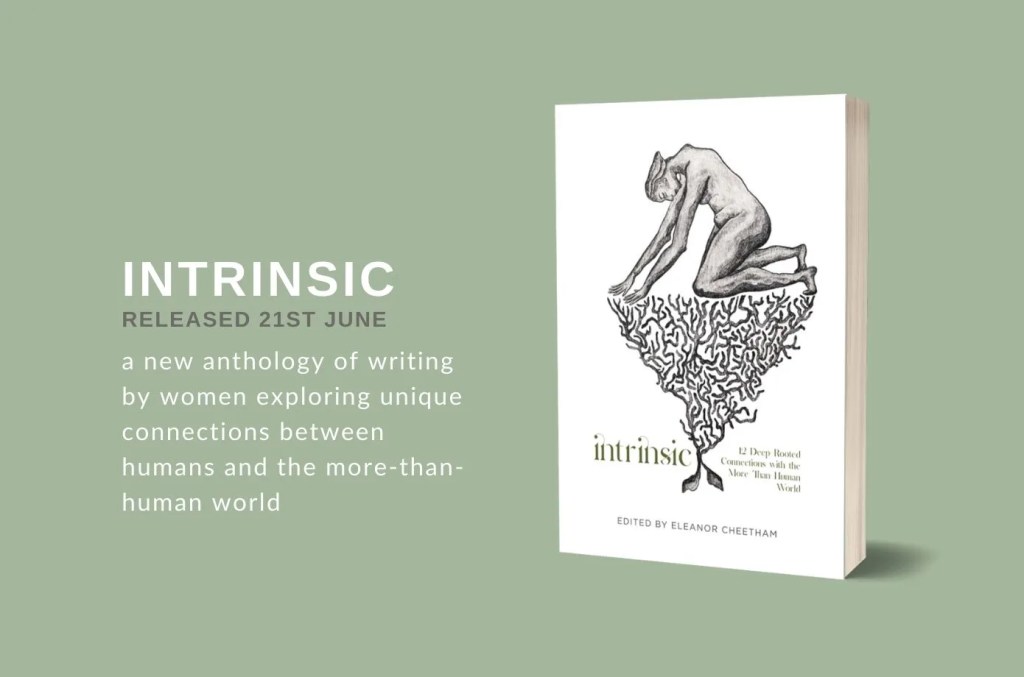
Intrinsic – a new anthology of writing

It is with great delight that I share with you this forthcoming publication.

Late last year, I submitted a completed mixmoir essay to Eleanor Cheetham, at Creative Countryside. This was the end result of an application submitted on invitation by Eleanor last August.

Now, coming next month, through a successful Indigogo fund raising campaign, Intrinsic will be out in the world. And I’m overjoyed to see this project succeed. It’s been a while in the making, which isn’t a complaint as I am an advocate of ::SLOW:: but it was touch and go if this project was going to come to fruition due to finances. and that would have been a great shame and disservice if this beauty was lost to the world.

An anthology of 12 deep-rooted connections with the more-than-human world, this book is not like any other nature writing text out there. This anthology supports and uplifts the diverse voices which exist within this writing genre at the same time as expanding and redefining what nature writing can be.

I’m one of the twelve writers featured in this anthology. I took the time, and the much needed space, to explore something that I’ve been carrying around within my body and soul for a while; the link to the sea for my ancestors and me.

Seascape- Grief and Grievance and Healings is the title. It’s a narrative mixmoir piece rich in memories and hauntings, voices and references. I’m really proud of this baby and it was such a delightful process of creation throughout it all.

Please consider checking the anthology out, published by Creative Countryside and available to buy next month, July 2022.

Let’s Start with a Poem

Extract from my recent presentation for the Women and Wetlands Panel Discussion

When Petrified Trees Stand Up and March Into the Sea

I carve out solitude to wander
wide open shores

sanddunes, pebbles and
wooden limbs

Submerged
a forest of trees
so tall they flowed
above the clouds

what we cannot control,
we destroy and call it progress.

We advance like the tide
to claim what
we have
no right to claim

concrete blocks,
seaweed and dead seals,
emerge from
frothy waves
and marram grass.

unseasonal storms
uproot ancient trees
while manmade
concrete lines
remain in tact
in place in defence

here a legion of
foreign bodies marched
to expand an empire,
build a wall
then leave it to moss.

Bizzing dragonflies,
shrubs of wax mirtle
and the coconut vanilla
scent of golden gorse

Some day soon
all this will be gone,

gorse, grass, concrete wall,

washed away like blood
as the sea returns to the source,

returns to where it belongs.

There’s a small hamlet, Low Hauxley nestled behind sand dunes along a long and quiet stretch of sandy beach on the Northumberland coast.
Here along the high tide line stumps of an ancient forest are visible.

It is believed the stumps were preserved by peat and sand and are believed to date back to more than 7000 years and are the remains of Doggerland- an area of bogs, marches and forest that connected the British Isles to mainland Europe.

Archaeologists have also uncovered animal footprints and it is believed red deer, wild boar and brown bears would have roamed ancient Doggerland forest.

These petrified trees. This really blew my mind.

My name is Dr. Sheree Mack. I’m Creatrix : she who makes.

My practice manifests through poetry, storytelling, image and the unfolding histories of black people. I engage audiences around black women’s voices and bodies, black feminism, grief and healing, nature, identity and memory.

I advocate for black women’s voices, facilitating national and international creative workshops and retreats in the landscape, encouraging and supporting women on their journey of remembrance back to their bodies and authentic selves. This journey is supported and recognised by Mother Nature.

I’m the founder of Earth Sea Love, which is a social enterprise, offering opportunities to People of the Global Majority living in the north east of England to develop a deeper connection with/in nature.

The Earth Sea Love Podcast has developed out of these experiences and aims to change the narrative around who has a right to have a relationship with nature. I’ve recently been writer in residence for Northumberland National Park Authority. A black-led nature project I will add. At the moment I’m Creatrix in Residence for Hadrian’s Wall part of the 1900 years festival.

My Practice is a Healing Practice.

The Practice of ::SLOW:: is how I engage with my work and the world. Living within White Supremacy Culture, we are indoctrinated into certain principles and practices which benefit the few rather than the many.

Leaving aside racism and the systematic destruction of Black, brown and indigenous peoples, White Supremacy Culture, perpetuates the pursuit of perfectionism, product over process, and quantity over quality, to name but a few.

This means that the majority of us live our lives at speed, with a greater sense of urgency, with feelings of never being or doing enough, resulting in reduced contact to ourselves, our intuition and inner wisdom.

Slowing down supports me on my journey back to self and ultimately self-love and healing. Being and walking with/in nature teaches me how to slowdown and pay attention and just be.

Nature shows me that there is an abundance rather than a scarcity. It is through these practices that I fell in love with nature.

Nature and I are connected. We are one, therefore falling in love with nature, I fell in love with myself. This in turn means I turn up in life, in connection with others not only as a better version of myself but in a better place to offer love to other people.

Women and Wetlands

Last night I was part of a panel discussion which tackled the subject of women and wetlands.

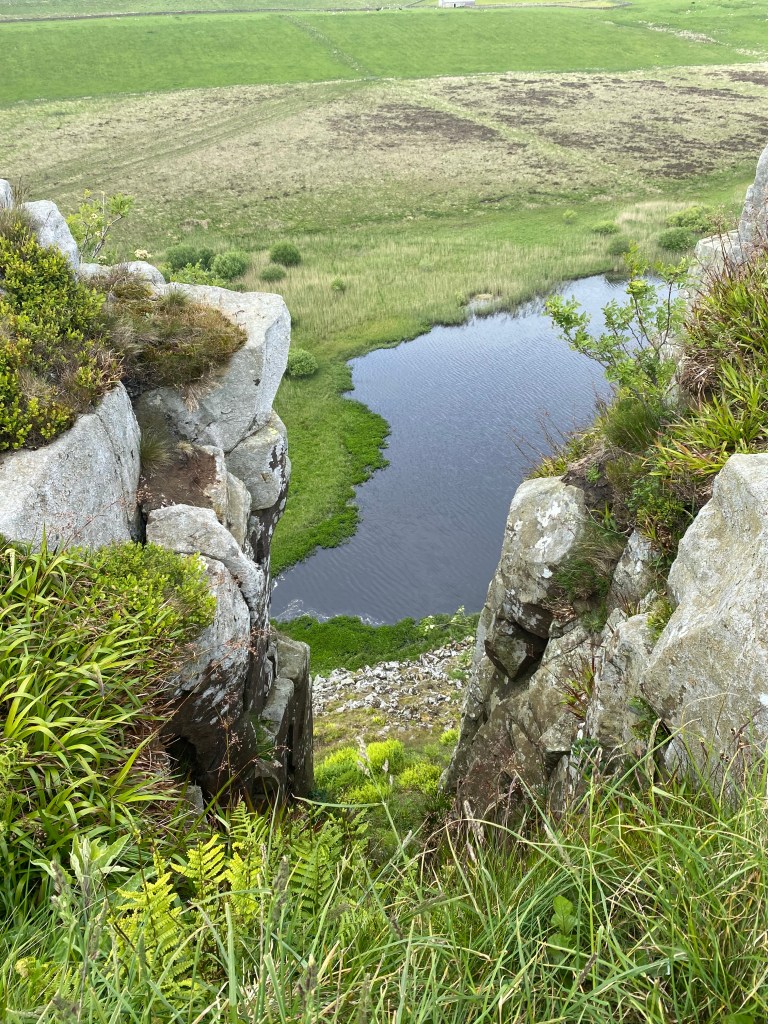
Crag Lough, seen from Peel Crags, Hadrian’s Wall

I was asked by Elizabeth-Jane Burnett at Northumbria University to be part of this event and share my work around my residence at Northumberland National Park and my explorations of peat bogs.

I wasn’t really sure what to expect about this event or what I was going to share. But on reflection now, I’m so glad that I was invited to take part because I learned so much about peatlands within the UK, around the world and the special place they hold within the global climate crisis.

So much of my language around nature and the environment has been formed through white supremacy culture which has been biased on colonialism and imperialism and capitalist consumption. And of which I am at great pains now to unlearn and find a new language or it is just a re-memory of the language of my ancestors where there is no separation between us and nature.

Something that was raised last night by Khairani Barokka, which was totally new to my knowledge and way of thinking was that within indigenous communities gender was much more fluid and diverse. The binary system of male and female/ he and she which we take as a given now, as the norm, is a construction and part of the colonist program.

That the idea of “the coloniality of gender,” which might have seen the binary gender system in Europe but was not the case for indigenous populations around the world who were brutalised, moved off the lands and eliminated through genocide. This is going to require more reading on my part but it will be completed eagerly as it’s more evidence of how this system to live and breathe is a construct of power for a few white people over the rest of us all.

I share an extract of my presentation here.