Endure

This wasn’t the way he promised it would be.

Bare floors, five to a room, babies’

faces lined with hunger, piercing

cries towards an empty oil lamp.

Love squeezes out of lives.

Boys shooting boys as regular as angel

dusting on banana leaves, long

and glistening. Violence standing

caged on corners with broken

standpipes, living next to dread.

The seething and faltering silence

as the dreamed for life

bobs on a distant horizon.

The moon is nowhere in sight.*

*Laventille, Smokestack Books, 2015

Show Up In Fullness

I’m practicing how to show up in spaces, alone and with others, in fullness.

I’ve used wholeness before. Striving to get back to that sense of being whole, as we enter as already into this world. And then for the rest of our lives society and culture pull us away from our wholeness. When we realise, usually when much older and not giving a fuck, we spend our time and energy attempting to get back to that wholeness. This is a practice too, but to be whole sounds final and also out of reach.

Fullness. While fullness seems something that can be embraced now. In the present, moment to moment. Fullness for me gives the middle finger to those who have criticised me by saying I’m too much. Too Black. Too fat. Too loud. Too enthusiastic. Too Alive. Too much.

Fullness is me embracing my too-muchness and giving off that ‘don’t care less’ energy.

I’m showing up in fullness. Come join me.

I was told I couldn’t be one!

Time to Dress Up

When you were five, what did you want to be when you grew up?

When I was five I said to my mum when I grow up I want to be a lollipop lady.

I saw a lot of lollipop ladies as I walked to and from school each day. Not only did I love the bright yellow uniform and the hat. But I also loved how they had the power to stop traffic.

Lollipop ladies just walk out into the road put down their lollipop stick and stick up a hand and the cars stop for them.

I thought that was cool.

But the main reason I wanted to be a lollipop lady was because they were always smiling. They always greeted me with a smile and a good morning or the question, ‘Good day at school?’

Lollipop ladies not only looked like they were enjoying their job but they were also sharing that joy with others, even if only for the little time it took for me to walk across the road in front of them with the cars at bay.

They were smiling.

So I wanted to be a lollipop lady when I was five and I told my mum. My mum said I couldn’t be a lollipop lady. No, she said. Maybe when you retire but not until then. You can be anything you want to be Sheree, she said. Save being a lollipop lady until you retire.

I better start filling out my application then as I’m getting old (er).

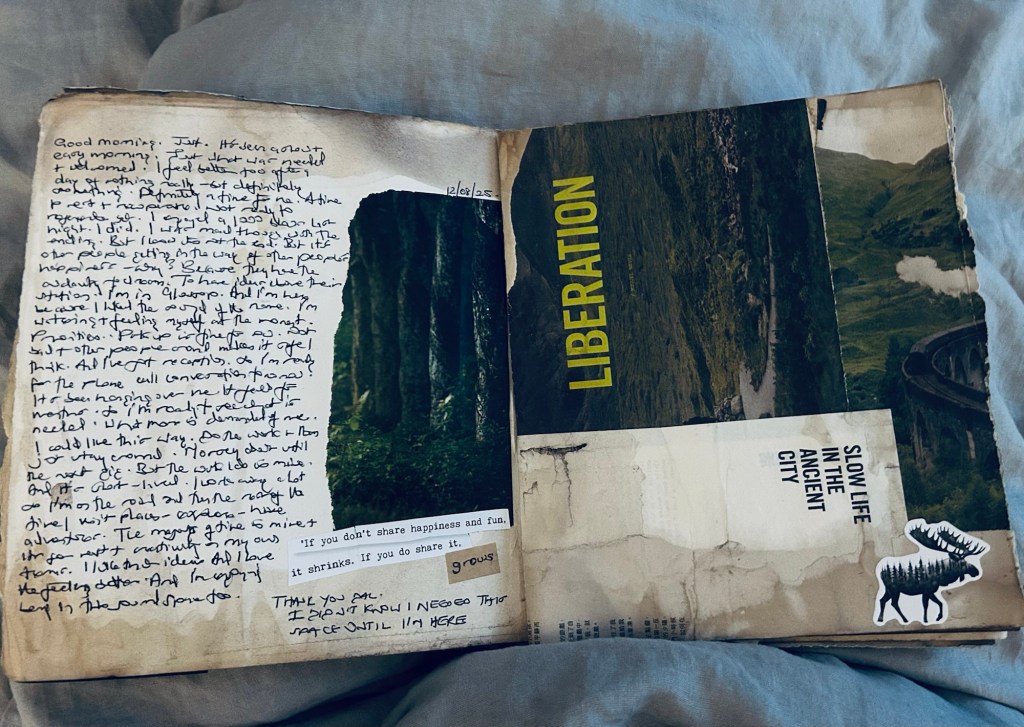
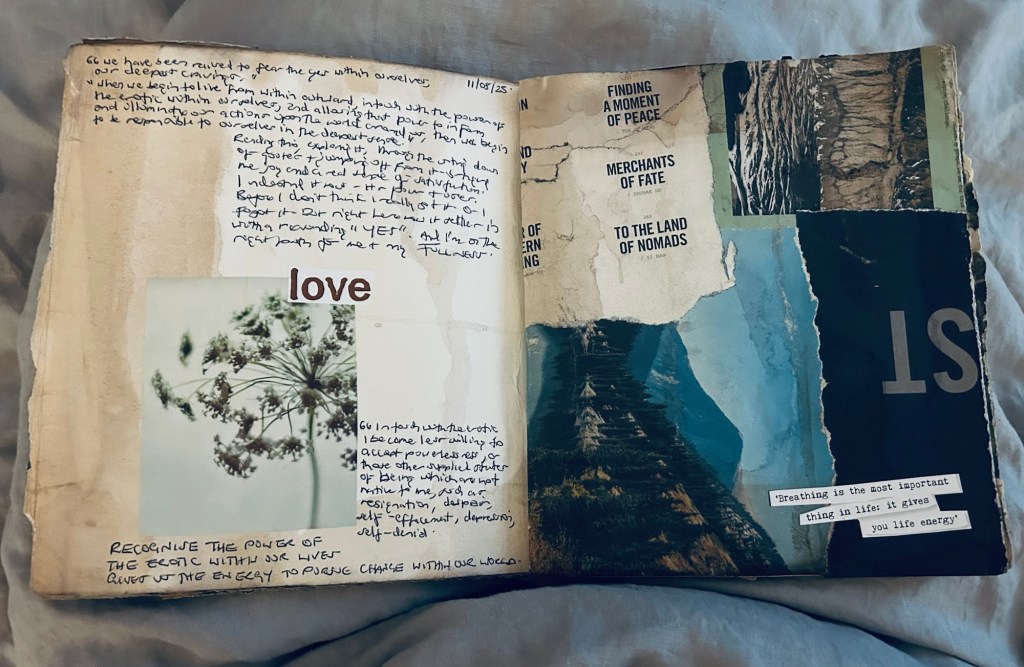
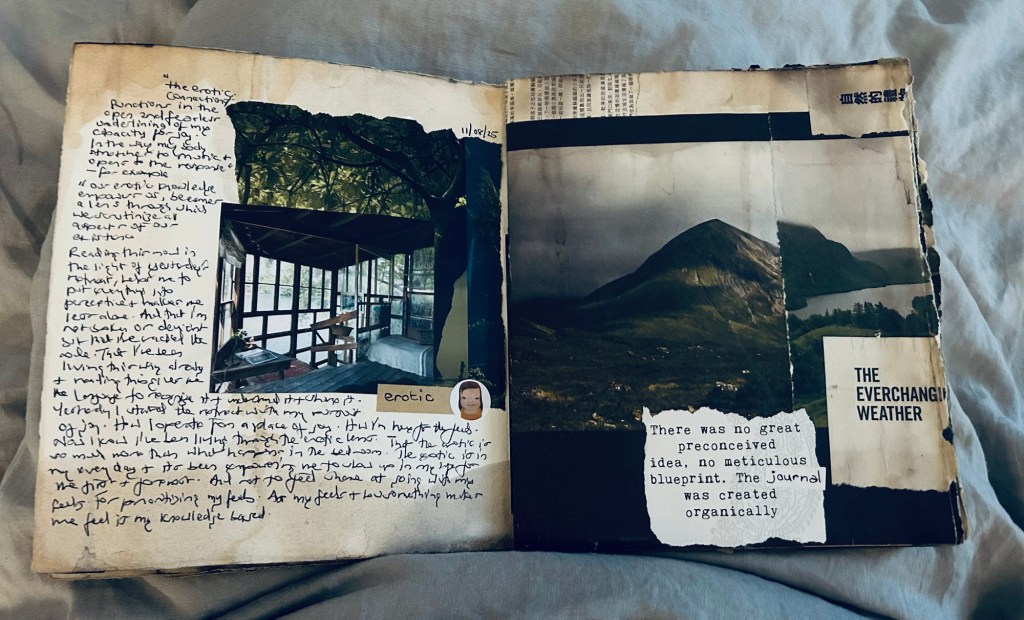
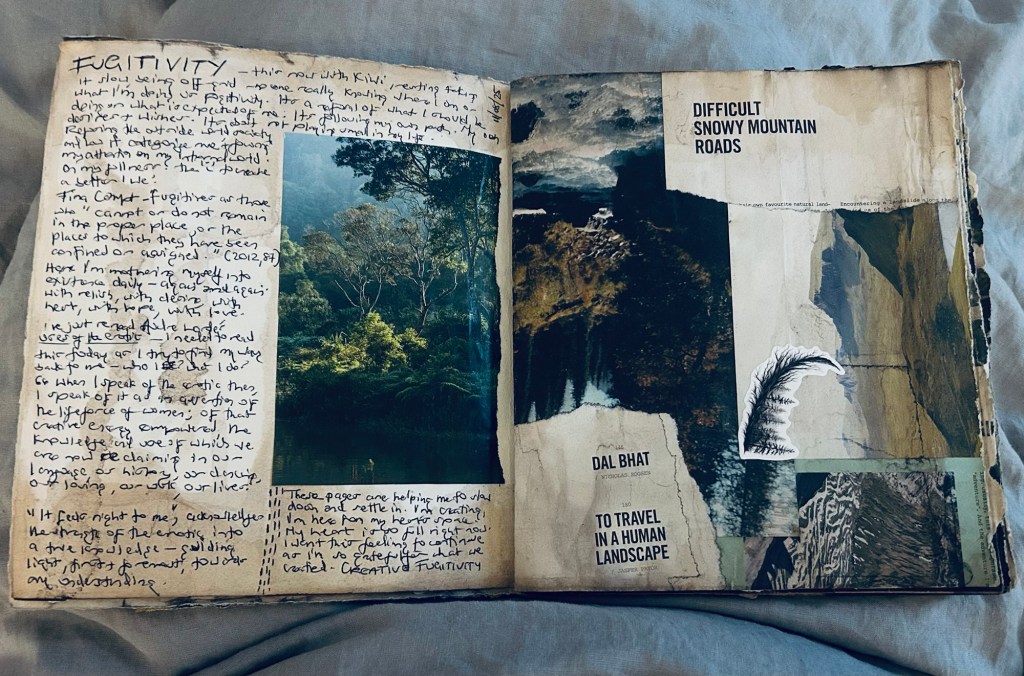
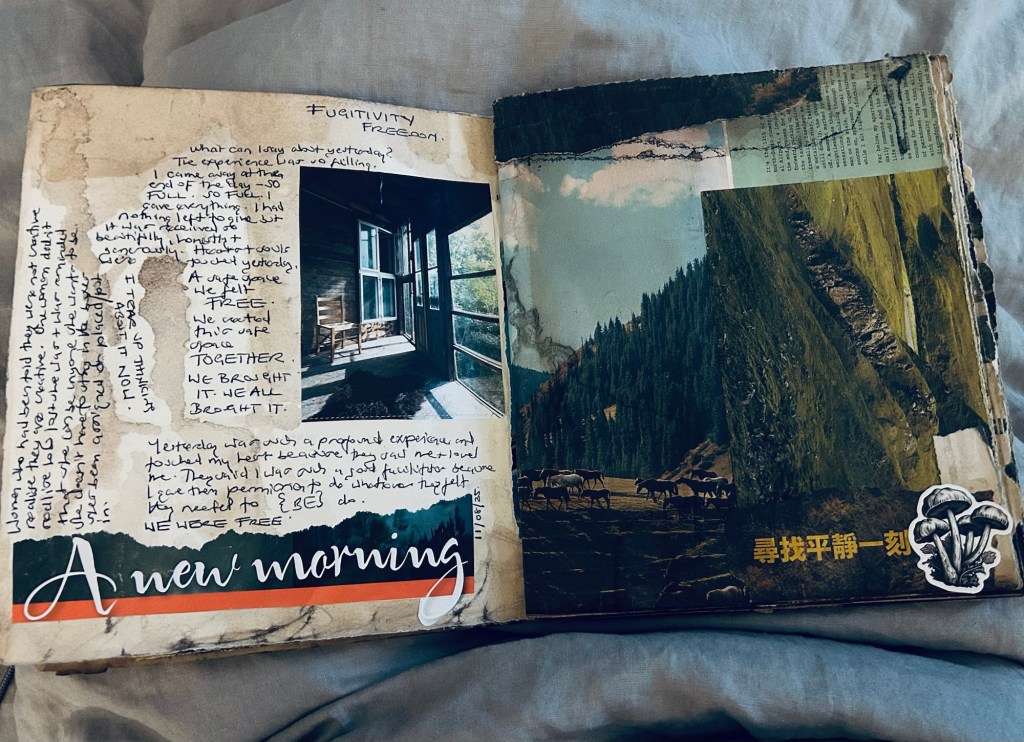
When my journal matches my moods

Current Squeeze

March is nearly over. I spent a lot of it getting ready for a trip that didn’t happen. I’m still sore around the wound but will share here at some point.

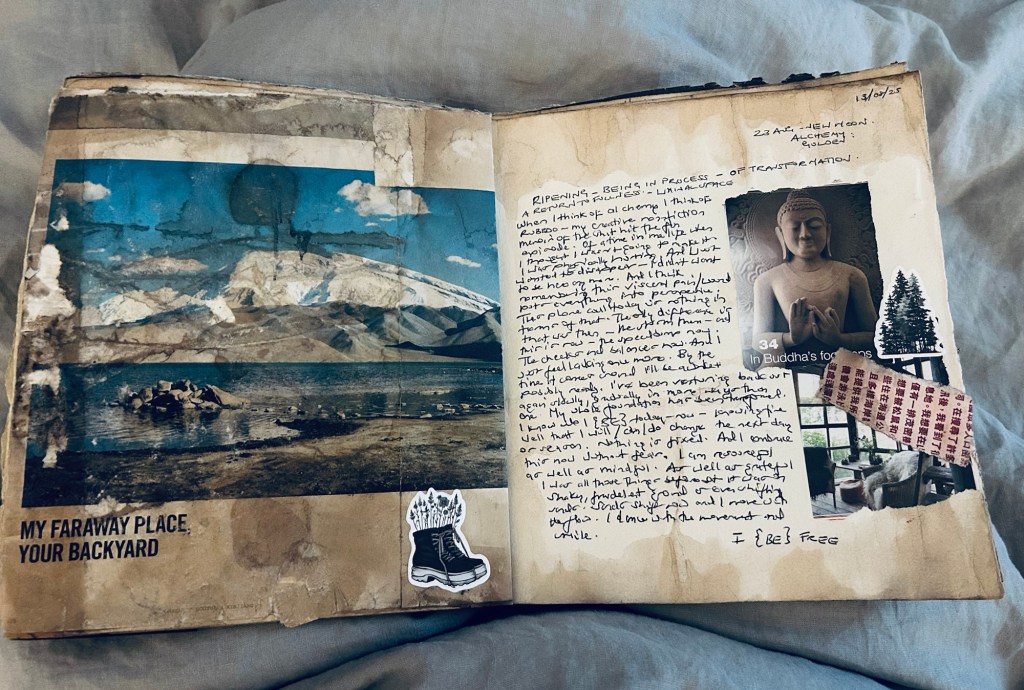
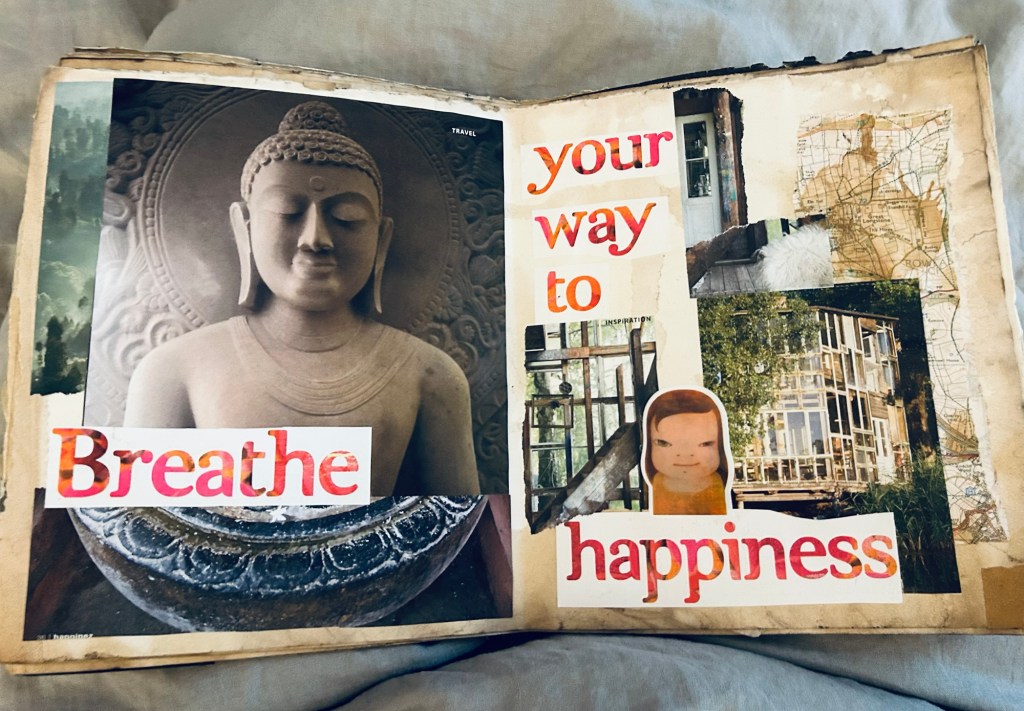
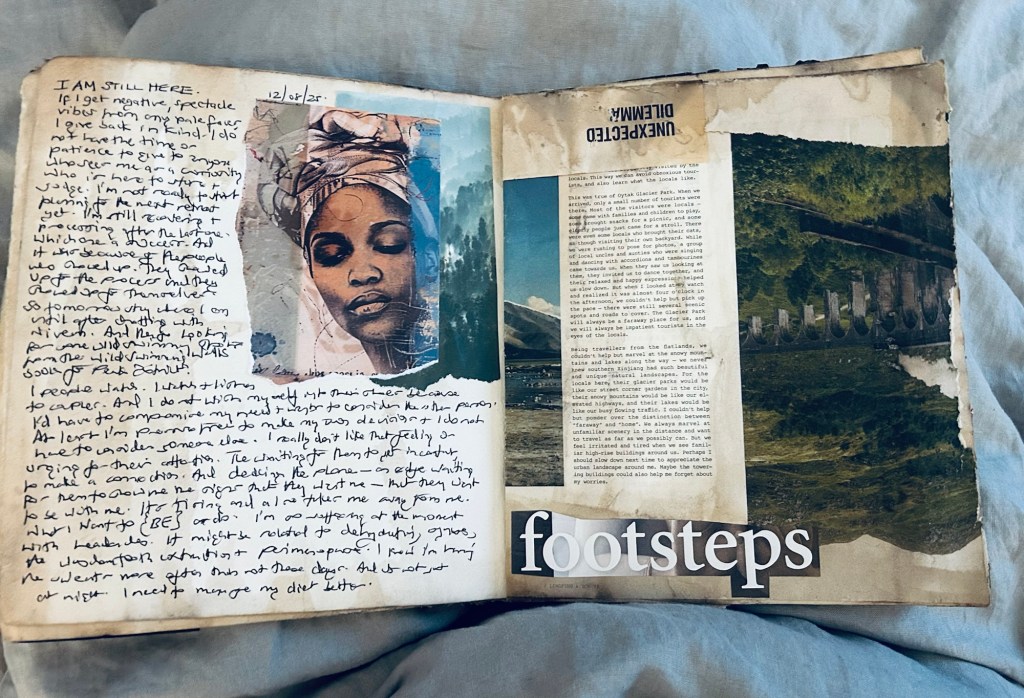
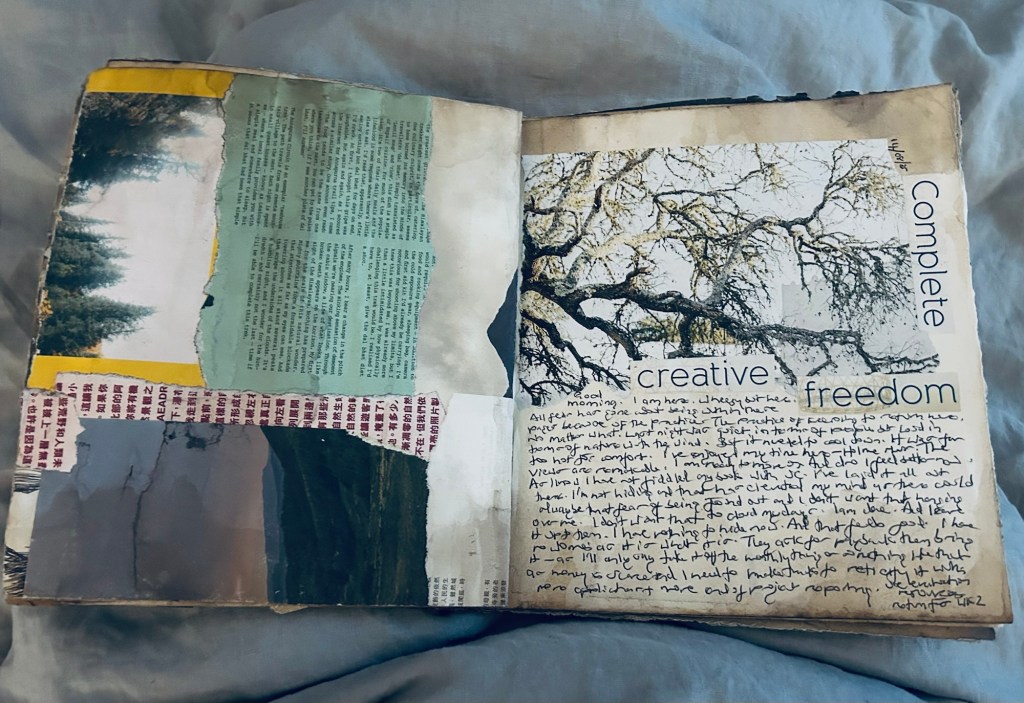
The journal above which I share is the journal I created for my travels. It’s an Elle Decorating Magazine which I’ve repurposed. I pulled out the images and text I wanted to use in my visual journaling and then painted over the remaining pages.

It’s rough and ready. Messy and grungy and in the process I didn’t realise how much it has reflected my mood.

It’s not perfect.

I’ve been all over the place in terms of my moods these past few weeks. Serene and blissed out to stressed and anxious and angry.

And this messy, at times ugly, journal has captured it all. And I am grateful for its space and non-judgmental welcome.

I’ll be back here over the coming days to share the spreads that have been created in this journal. Just so you can see a bit more of my process and practice.

One more thing. The back of this journal was converted into a mini guide book to take on my travels with me. Since I didn’t make that trip, I haven’t been back into the back of the journal. I was also contemplated chucking the whole thing and start a new journal as I felt it would be painful and annoying to continue to use the journal as its purpose was for my time away.

But instead of avoiding the pain and frustrations and disappointments, continuing to use the journal has meant I haven’t run away from the feels but have allowed myself to sit with the feels.

I’m not sure if that means I’m a glutton for punishment or if I’m just all in with this life, my life of attempting to thrive rather than just survive.

Still showing up in this journal, just created from a magazine man, has given me the time and space to work through my feelings and come through feeling grateful for my life and the people I have around me who care about me and love me.

Visual journaling, it kills me in how it’s such a powerful tool for staying present and connecting with the self. Amazeballs!

she tries for home

I’ve always felt nervous when meeting new people. Not because I’m worried about what they’ll think of me, but because at some point in the conversation I will no doubt be asked the question, “So, where do you come from?”

When a white person asks me, this question comes with the implicit assumption that I am not ‘from here’.  They might think this is a simple question to ask but it is not a simple question for me to answer.

Should I say Bradford, West Yorkshire, where I was born and brought up until the age of ten? Or the North-East Coast where I live now with co- parenting my daughter? Or even London, where I went to University and got in touch with my ‘black’ side? Or Trinidad, Ghana, Barbados, Nigeria, and Sierra Leone where my ancestral roots lie?

​When I was younger in the 1970s and living in Bradford, my dad didn’t talk about Trinidad, but we knew it was the land of his birth. One of the reasons we knew this was because of the black crushed velvet scroll that hung in our front room depicting the islands of Trinidad and Tobago. We didn’t even know he had siblings until, after 25 years of no contact, he received a letter from his sister, Tantie Gladys living in the United States, which started a new relationship with ‘family’.

After my dad’s death in 1981, all the silences changed. Our mum told us the stories our dad had told her but had decided not to tell us about his land, his family, his home. We moved to Newcastle then, to be closer to mum’s family.

It was being closer to my grandparents, listening to them talking and seeing photograph after photograph, that I began to understand my heritage. My maternal great granddad, my nana’s dad, was from the Gold Coast, now Ghana. Charles Mason was billed as the first black man in Newburn, our small village.  

I knew that someday I would visit my ancestral lands, Trinidad, Ghana, Barbados, on my granddad’s side, and Sierra Leone and Nigeria, a new piece of information which places my Trinidadian family as descendants of slaves.


“Where will you be buried?” asks a friend. For her the answer is simple; born in England, lives and works in England, dies in England, buried in England. But for me, it’s a tricky question because frankly, I’m not sure where I’m from. I live in Nirth-East England, but I don’t call it home; it’s my base. I wouldn’t call Bradford home, even though I still carry the Yorkshire accent around with me.  

‘Home’ as a concept is problematic as it makes visible such notions as gender, diaspora, identity, culture. ‘Home’ as a term includes the sense of ‘knowing home’, what and where home is. It also encompasses that feeling of ‘being at home’ or away from home. But most importantly, ‘home’ includes that matter of ‘belonging’. There are multiple and fluid meanings of home, from private to public, from physical to imagined. The idea of home is plural, a conflicting site of belonging and becoming.

‘Confused’ is one word that should be on my passport.
In 2007, I took the plunge. I approached a visual artist friend and said, “I’m going to Trinidad and Tobago. Want to come?” At the time, I wasn’t sure what I was planning. I was excited, worried, nervous and scared. When I tried to visualize myself there all I could see was the touristy, travel brochure images of the Caribbean; blue sky, blazing heat, turquoise sea, crystal white sands and swaying palm trees.  All my knowledge of my heritage was based upon Westernized sources, framing the islands in a certain way.  

Having completed a visit to the Caribbean, I can not really imagine what it is/was like to live there, to be born there and grow up there, as my ancestors did. I am second and third generation of immigrants, depending of which side of my family is in focus.  I do not have that first hand knowledge of ‘home’, be it the Caribbean or Ghana, but I do of England. As

Avtar Brah says, ‘home’, is a mythic place of desire in the diasporic imagination. Nostalgia is a sentiment of loss and displacement. My experience of my ancestral homelands is limited. In terms of nostalgia, I have a longing for places that are far removed from my everyday but are part of my identity. I may gain an impression of these places through my travels to them or through my family members, sadly all of which are now dead, except my sister. I have that sense of loss of place and of people. I use my writing to create those lost worlds.

There is a photograph of me, in holiday gear (green and white striped top and white cargos), grinning like an idiot, clinging tightly with two hands, onto the arm of a man I’ve just met ten minutes ago in Laventille, Port of Spain, Trinidad. My smile speaks of satisfaction, joy, relief and belonging. This man is a cousin I did not know I had. This embrace is one of ownership. He is family and he is mine. He is part of my past, my present in that photograph, and my future. The past is in our futures, in our nows. I carry with me the baggage of the past into my present and future. My Laventille visit was like going to collect baggage from the left luggage department,finding and claiming baggage that I didn’t know I had lost, but is now vital to me in my task of trying to know myself better.

This feeling of belonging, this split identity/mixedness of being/feeling British, Caribbean, African without exclusive claim to any of them is something difficult to live with, to function with. 

This is an updated and redrafted extract taken from my 2010 PhD thesis, ‘A Drift of Many-Hued Poppies in the Pale Wheatfield of British Publishing’ Black British Women Poets 1978 – 2008


My Wall of Fugitivity

I’ve got a chapter to write and it’s going nowhere fast.

I hate it when I think I have all the time in the world to complete a writing task and then I procrastinate.

I know I procrastinate because it’s important to me. Very important to me and I don’t want to get it wrong. So I do nothing instead.

Well not really nothing. This is my bedroom wall, where I’ve started to put up post-it notes to help me with the chapter on fugitivity.

This makes me feel as if I’m doing something. Seeing this everyday also, I hope, makes something go into my creative brain subconsciously. I’m hoping that living with it makes the wheels start turning and connections being made.

What I’m learning with fugitivity is that is’s not linear. Not a straight line from captivity to freedom, from unfreedom to freedom. It is argued that fugitivity performs freedom ‘as a constant struggle’ ( R. Slavitt cited in Davis, 2016).

This I hold close as I attempt ( struggle!) to write this chapter around fugitivity as this is not going to be a linear chapter from A to B to C etc. This chapter with its content and structure and form will be dancing with unfreedom and freedom, constantly struggling to convey meaning around fugitivity at the same time as remaining free from the academic frameworks and restricts and expectations.

In order to write about fugitivity I need to take on board fugitive methods and practices.

I’m spiralling and circling back and forth in a good way, in an honest way and hopefully the chapter will be the result.

Morning Routine: March

  1. I wake up ( that is if I got any sleep) and give thanks.
  2. Play Love Dimension by Beautiful Chorus a few times
  3. Water out/ water in
  4. Back to bed for Insight Timer medication or course
  5. Read in bed
  6. Make coffee and then journal in bed
  7. Get up.
  8. Strength training with free weights
  9. Move my body – yoga/ walk/run/ swim
  10. Greet the world with a smile.

What led you to this morning routine?*

Well I started on this find tuning of a morning routine at the beginning of January 2025, more or less. I was hibernating and I wanted to start a ritual that would anchor me into my life. Into the present moment at the same time as showing to myself that I am loved. I’ve done everything in my current morning routine at some point or other before but the putting them all together in some kind of coherent order is a first this year.

Did any ancient practices inspire you?

I’m not sure if a particular ancient practice inspired me. But maybe practices from my ancestral ancients might have subconsciously. If I remember living with my mum, back when I was in my 20s, she had a morning routine which I really didn’t notice then but can now. She’d get up early everyday, even though she wasn’t going to work, and go to the bathroom. Then make a cup of tea, open the windows and have a smoke. Maybe read at the same time but she’d claim the sitting room and the quiet. When she’d finish she’d make herself available for others.

For you, what is the importance of following a morning routine?

I hate routines usually. The predictability of them and the monotony gets on my nerves and I have to break out of them. But I think , in the past, this is because the routines and rituals have not been my own but have been imposed on me by external forces. I’ve mentioned when I was teaching before but also when I think of when I was studying creative writing. We were told if we wanted to be successful we should stick to one genre of writing and practice it in this way, using these techniques and following these rules. I found it all so restrictive. But here with this morning routine containing sacred rituals to myself, even if not carved in stone and open to change, I do not fight against the routine because I created. I feel that it is coming from a place of love for myself. This is my way of practicing self-love because I am giving myself the time and space each day so commune with myself and get my shit together ( or not!).

Questions taken from a similar interview found @ Academy Healing Nutrition