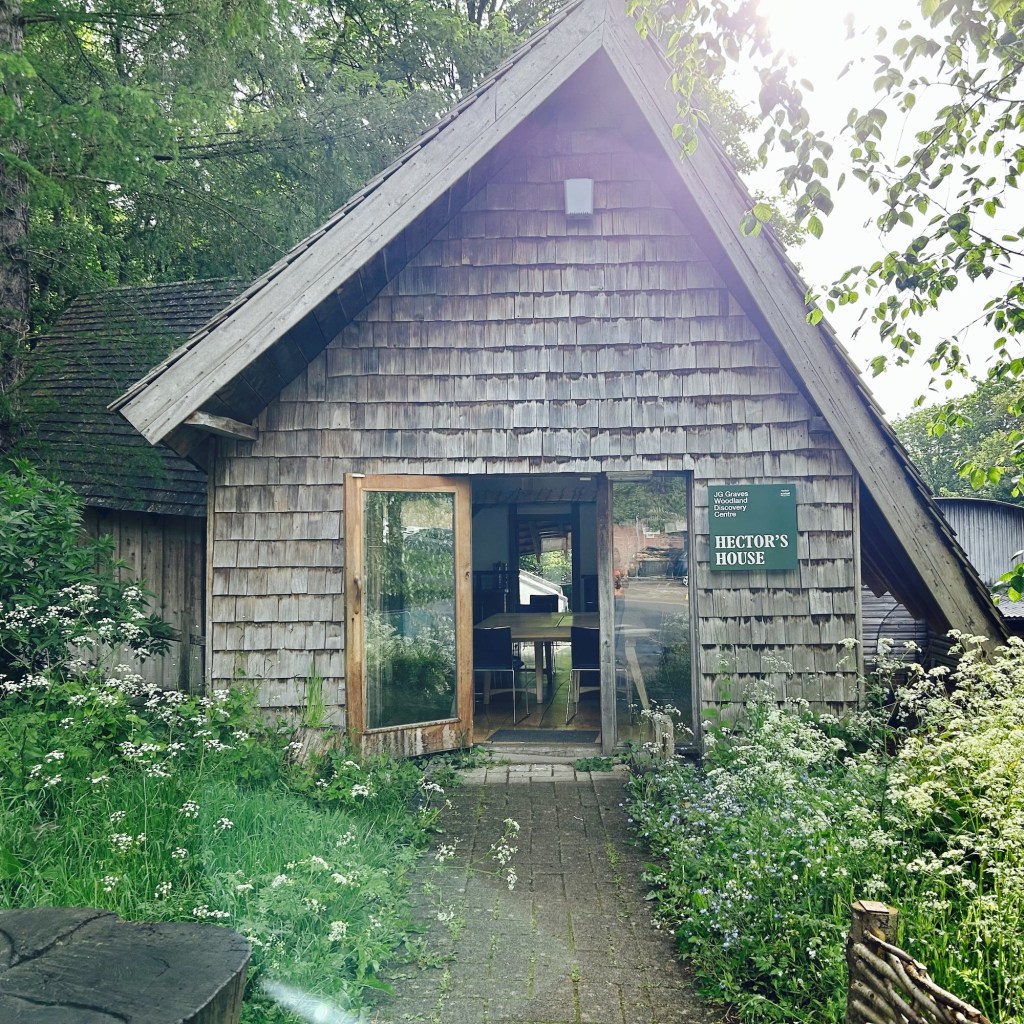
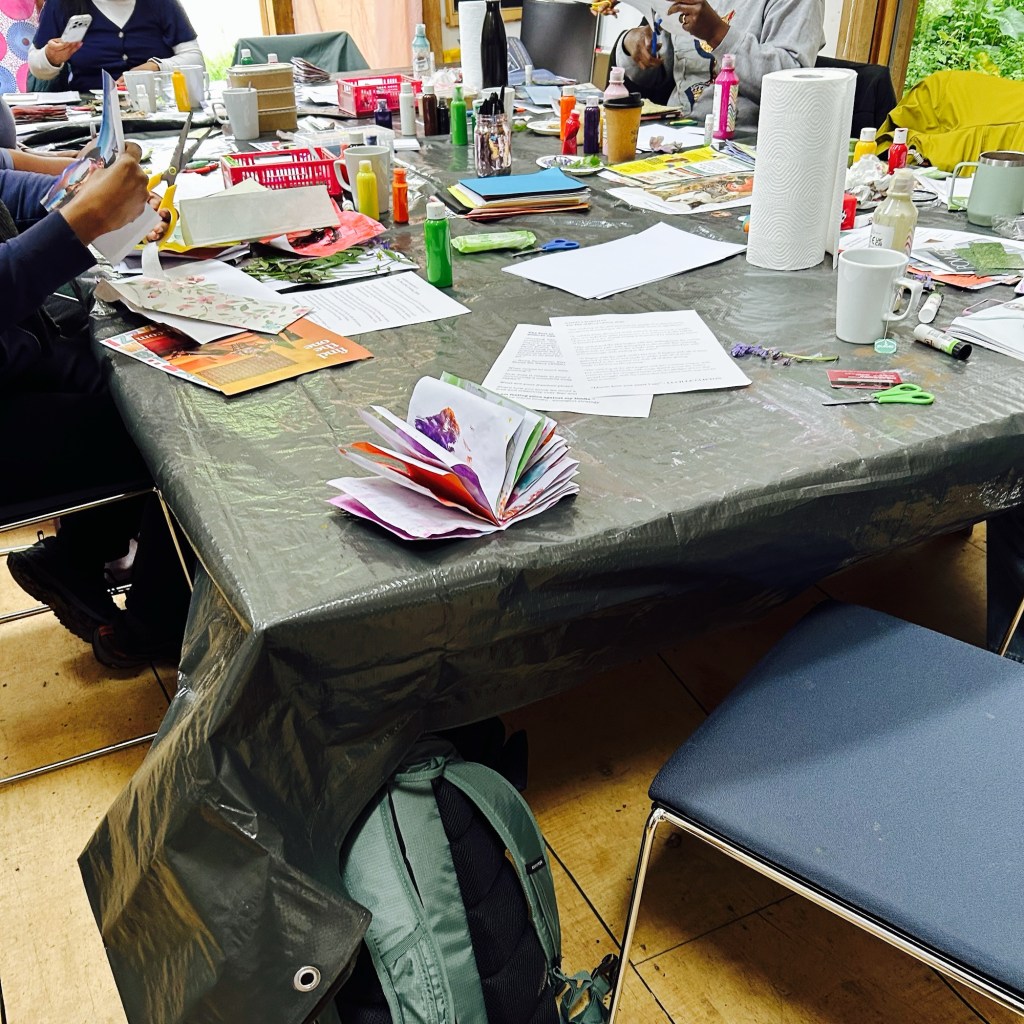
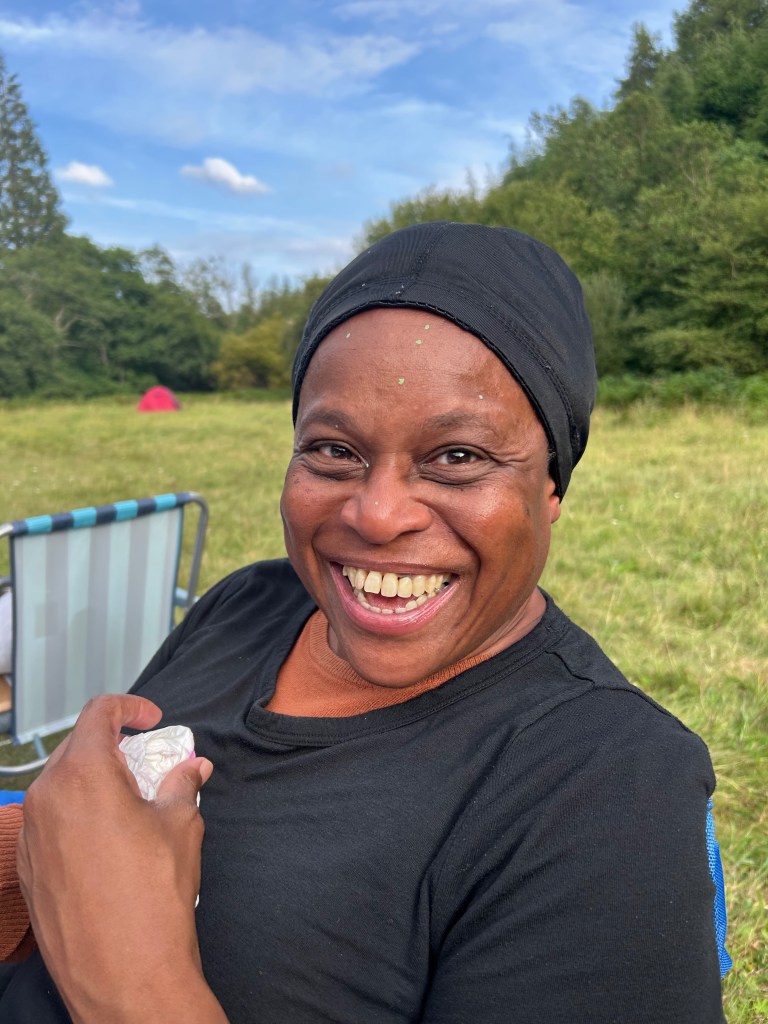
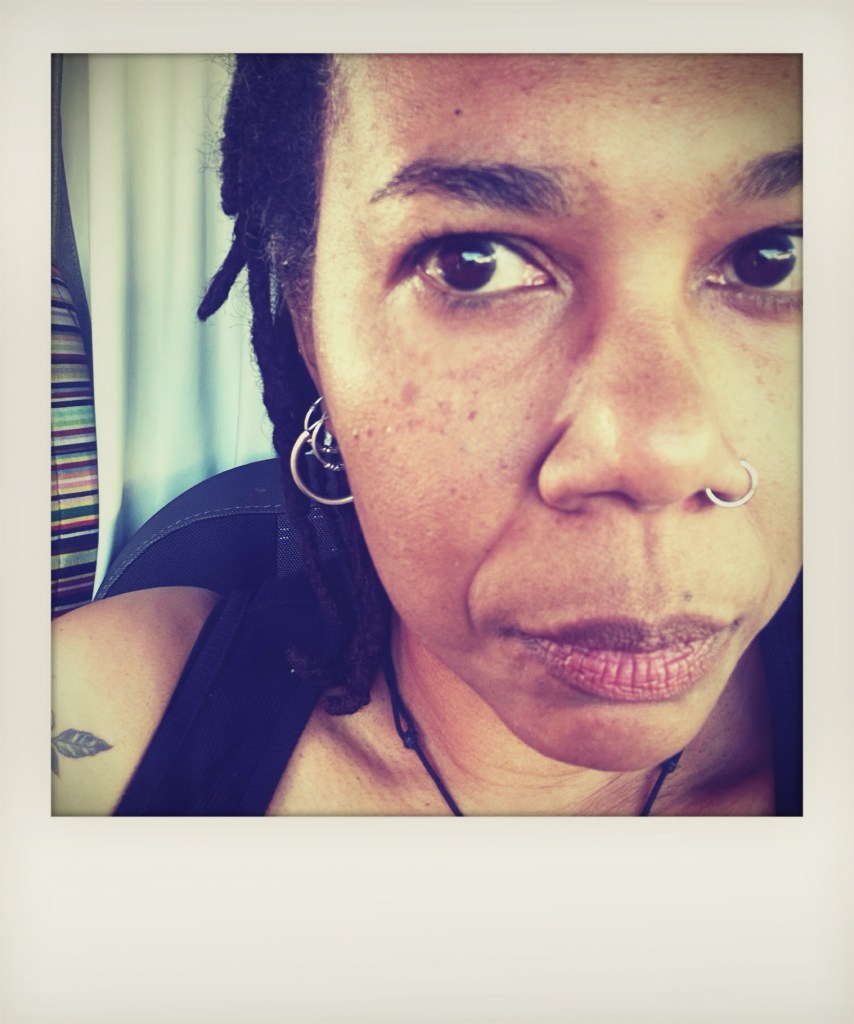
I had the pleasure of gathering with the WOC Azadi again in Sheffield today.
We gathered to share ideas around how to plot/plotting our healings, our liberation together.
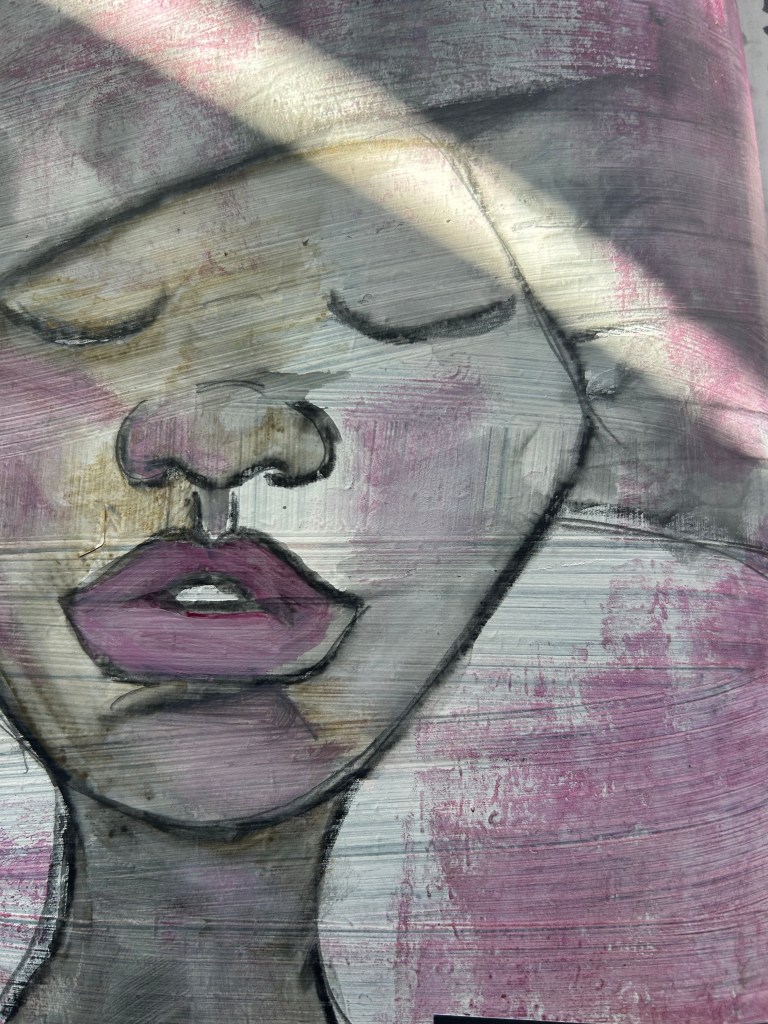
Visual journaling was on hand to capture our thoughts, feelings, plans and plots.
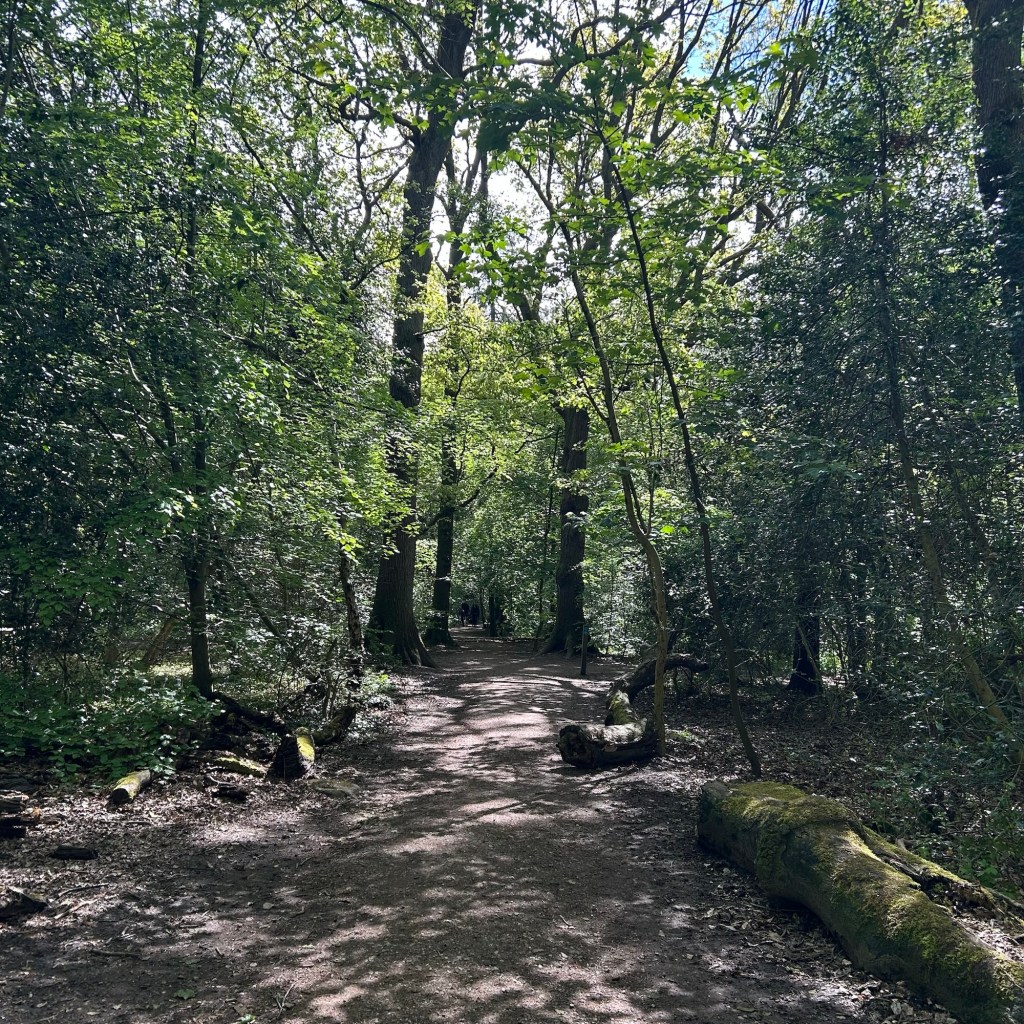
It was such a nurturing and nourishing space in nature. It was a gathering of hope and aspirations.
It was an honour to be part of the day retreat. Ideas for The Plot of Our Repair came about from a reading is Saidiya Hartman’s essay , The Plot of her Undoing (2020).
The plot of her undoing begins with his dominion. It begins in the fifteenth century with a papal bull, with a philosopher at his desk, pen in hand, as he sorts the world into categories of genus and species. It begins with a bill of sale, with a story in the newspaper that enumerates her crimes, with a note appended to the file: she answers questions easily, but appears stupid; it begins with a wanted poster that reduces the history of her life to a single word-condemned.
And then towards the end of this essay there is a switch. A turn to explore how we can undoing the plot of her undoing. How we can move against the forces aiming to ruin/ control/ oppress the black/brown woman.
The undoing of the plot proceeds by stealth. It is almost never recognized as anything at all and certainly never as significant.
…
It begins with the earth under her feet. It begins with all of them gathered at the river and ready to strike, with all of them assembled in the squatter city, with all of them getting ready to be free in the clearing.
The undoing of the plot begins with her runaway tongue, with her outstretched hands, with songs shared across the unfree territory and the occupied lands, with the pledges of love that propel struggle, with the vision that this bitter earth may not be what it seems.
The undoing of the plot, the plot developing towards our repair was started before us. We stand on the shoulders of our ancestors. We continue this journey, this plotting together. Today makes me feel that we have already won.
Sweeping violins. A Southern Belle, pretty and shallow, chatters on as young men flock around her feet, captive. *Fiddle de de.* Relishing in colour, technicolor; rich reds, blues and greens of the gallant Old South. Pan out see mansions surrounding by plantations. Bonnets and ribbons. Dances and horses. Cotton.
I first read Gone with the Wind by Margaret Mitchell while completing an extra year at college. Gaining extra ‘A’ levels while I waited on my then boyfriend to make the grades.
I identified with Scarlett O’Hara, the bitch of a heroine, not Mammy. I definitely was no mammy. Not here to fetch and clean and be loyal. I definitely was not obese and coarse and ugly, or ‘have a shiny, glossy face of contentment as she be the most happy slave alive.’
Of course as I’ve gotten older, I’ve learned where I’m placed in society. It’s okay to fantasise being the white heroine but I’ll never really be her. Better learn my place – to be there for the pleasure and enjoyment and whim of the white folk – and smile.
But what about my own pleasures and pains? Apparently they don’t exist. Apparently I’m incapable of such things, such finer characteristics. My reality states/shows otherwise.
It’s quitting time. I’m retreating into the woods in Aberdeenshire for the next week. I’m taking this opportunity as a reset. A chance to focus on my pleasures and pains. Drink on Mother Nature and give thanks for this life I have which isn’t being subservient/ submissive/ subjection to anybody.
I refuse the Mammy as well as the Scarlett, as they are both constructions and constrictions to control the female body.
I’m much more interested in the overspill, the excess, the unruly body. The blackwoman body that I live with/in daily and how nature supports me on this journey.
As a wind of flames sweeps through Georgia; menacing reds and oranges against a bleak dark sky swirl and crackle in time with fast ascending music. Real danger and Butterfly McQueen (real name not character name that would be Missy) flits around like a blue arsed fly worrying with no sense or plan.
the zine that documents the zines I want to create moving forward into 2026
I’ve just been over on my Patreon page sharing about the first zine of the year. Do you want to know what I shared about it?
Okay, I’ll tell yo here too!
A few years ago, I gave myself the challenge of creating a zine a month. Check back using the ‘zine’ tags and no doubt you’ll find them, still there ready to download and peruse.
This year, I vaguely set myself this challenge again, to create a zine a month and share it here. I think. As I’m still in the process of committing. But last night, at a Zinester Sanctuary that I’m creating witha fellow fugitive, I had the time to create my first zine of the year. See the video above.
I looked back at one of my zines from my first challenge, this was a zine about the zines I wanted to create. I looked back to see if this list of zines with illustrations were still zines I wanted to create.
After this reflection, I then set forth to create the zine that hopefully is the blueprint for 2026 creations.
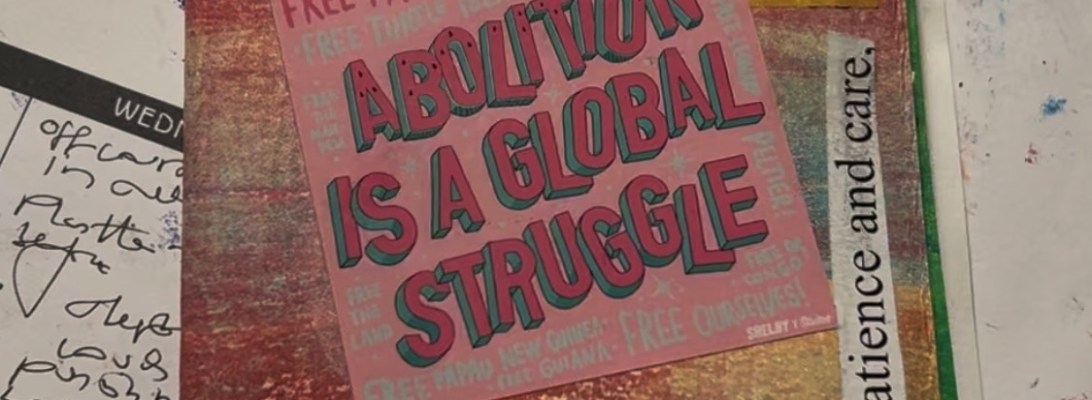
In the video what you are seeing is the front cover stating that ‘Abolition is a Global Struggle’ with FREE PALESTINE but also the caveat that this has to be completed ‘with patience and care’.
The next page with a wheel of a VW Campervan and the text ‘ like a bird flying into’, is a nod towards my love of nature and how she will always appear in my zine creating, some way or another.
The next double spread with an image of two little girls standing on the beach, myself and my estranged sister and the text reads, ‘me in all my fucked up glory’. This signifies the task of creating perzines, using the format to explore my life stories.
On the green page with a roughly drawn book in black pencil refers to my desire to dive deep into my black studies, studying blackness as fugitivity, fugitive spaces. ‘You will find comfort in blackness’ the text reads to accompany this intention.
The next page is a quote from Octavia E Butler, from Parable of the Sower which states, ‘All that you touch you change, all that you change, changes you. The only lasting truth is change.’ This was a small print I received from a printmaker friend called Theresa Easton.
The second double spread, because I hadn’t finished yet with my intentions (so who says you can’t add in another page?) is a recognition of my word of the year which is AFROSURREAL. I’ll be exploring what this means further throughout the year here and on my website.
This is partnered with a splash of purple/ mauve as the text reads, ‘ in mauve there is a quiet power.’ This is a reminder for myself to use my zines to share my poetry. My voice is my power. This was how I started making small zines, booklets before my first collection of poetry, Family Album was published. Because I was reading at all these gigs and people would come up afterwards and say where can I buy your work and I had no where to point them to. So I got creative and created these little zines , one dedicated to the poems I’d written about my daddy and one other dedicated to my mummy, and sold them for £1 each. I’d forgotten about them until I just wrote about them here now. Don’ you just love the creative process?
And then moving towards the end of this first zine of 2026, which apparently has been announced as the year of the zine – 2026, we’ll see what happens there as zines could become if not already commercialised and co-opted and become unrecognisable from their origins ( which I’ll be exploring and sharing further about here), there is a polaroid photo of myself smiling. This was taken last year at a Outdoor Citizen gathering, and these were taken to put on the wall with details about ourselves so we could be putting names to face,s be recognised within the crowds. This image is here with the title ‘fugitive sista’ as a reminder of who I {BE} but also who I {BE}coming through my continuing thoughts and praxis around fugitivity.
The final page with the outline of a goddess in black pencil and spiral within her gut/ womb and the text, ‘ Today I will praise. I will praise The Black Woman.’ Today ,tomorrow and always, I will praise the Black Woman. I support this praise with my continuing reading and practicing of Black Feminist thought and praxis. This is my foundation always.
The back cover ends with another sticker and this time it states, ‘ From the river to the sea, Palestine will be free.’ Again reminding myself that I do this work, explore my creativity and share whatever comes up within a constantly changing context of struggles, struggles for liberation, peace, justice, self-determination and love.
2026, the year of the zines. Let’s make it the year of the zines that give voice to the struggles near and far , struggles for liberation, peace, justice, self-determination and love.
I’ll tell you the truth, I heard about Keith Porter Jr. 1 day ago.
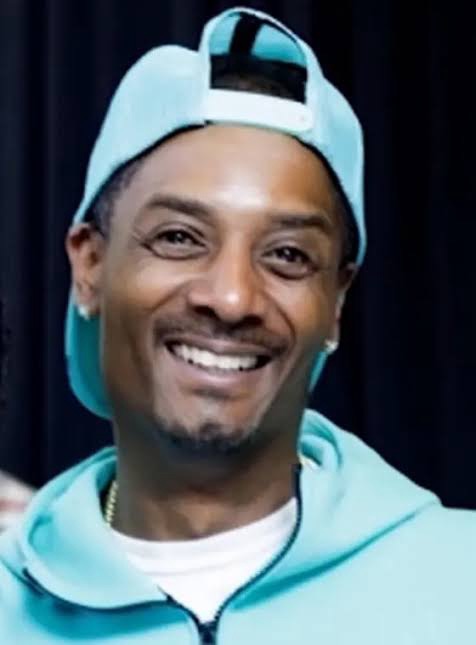
Keith Porter Jr., a 43 year old father of two girls. He loves fishing and spending time with his family. Laughing.
Keith fundraised for battered women’s shelters, supported street artists, advocated for health services. With real family and friends, real daughters and a real presence in his community, Keith Porter Jr. is no longer with us.
Rest in Power Keith.
On New Year’s Eve, in Northridge, Los Angeles, Keith was seeing in the new year with family and friends in his neighbourhood. Tradition was to fire a gun into the air in celebration.
An off duty ICE agent, heard the shots, and inserted himself into the situation. A situation he shouldn’t have been in as an ICE agent is supposedly trained in compliance, transportation, custody paperwork. Immigration.
ICE is not designed or trained in community engagement responses. community law enforcement.
It is argued that after a short verbal exchange, the ICE agent shot and killed Keith.
Official reports from federal agencies say the ICE agent was responding to an ‘active shooter situation’. The department of homeland security says Porter fired at the agent before he was killed (in cold blood).
Watch how they change the narrative. Remember Keith Porter Jr. the man laughing with his family, caring and empathetic will become the monster who deserves to be dead.
Family and community advocates dispute this claim, stating that there is no independent released video evidence showing Keith Porter Jr. posed an imminent threat or fired at the agent.
Rather than lethal force, this off duty ICE agent should have done his citizen’s duty and called local Police as this was not an immigration issue. This was not his jurisdiction, his authority.
Keith Porter Jr. became an imminent threat only when this ICE agent turned up.
ICE has no community engagement training. They might have authority but not in the community, they don’t have the judgement and empathy to be on the streets. But obviously this ICE agent, off duty, thought otherwise.
Nearly two weeks ago Keith Porter Jr. was shot and killed. And people, the average person, even those online are just starting to find out about this murder. Only after Renee Good’s cold bloodied murder.
There is selective outrage in America. As I wrote last week, I have no issue with the response to Renee Good – that’s how we should be respond in this situation.
But
#SayHisName
Keith Porter Jr.
His family had been struggling to get his story, his unlawful killing into the current media cycle. This just compounds what I’ve been saying about the lack of visibility in mainstream media of black people being unlawfully killed by law enforcement.
Be honest have you heard of Keith Porter Jr? But you’ve heard of Renee Good?
There are arguments we can put in place here . You might not have heard his name, Keith Porter Jr. because he was killed by an off duty ICE agent not on duty with a large crowd there. Might be because there’s little video evidence circulating around. But the main reason is because Keith Porter Jr. was a black man.
This is part of the reason for not using #SayHerName for Renee Good.
No one’s even heard of Keith Porter Jr. No national attention for his murder but within 24 hours everybody knew Renee Good’s name.
This is the very reason #SayHerName was created for the invisible black women and black men who are causalities of the state, of state terror.
And it’s only now that white people are waking up to this terror when black people have been enduring if for centuries. This is why I argue to consider the language used and to give credit and recognition for where it originated, why it was created in the first place.
And yet the same stories are being used to justify the unlawful killings of Renee Good and Keith Porter Jr. They were both pointing weapons at ICE agents, posed a threat and had to be eliminated.
I say
2 different people
2 different cities
but the same structural problem.
Later down the line this might get read as the one bad apple or one bad moment. But this is clearly a system which once hidden no longer neededs to remain hidden.
A system that is built without limits or accountability.
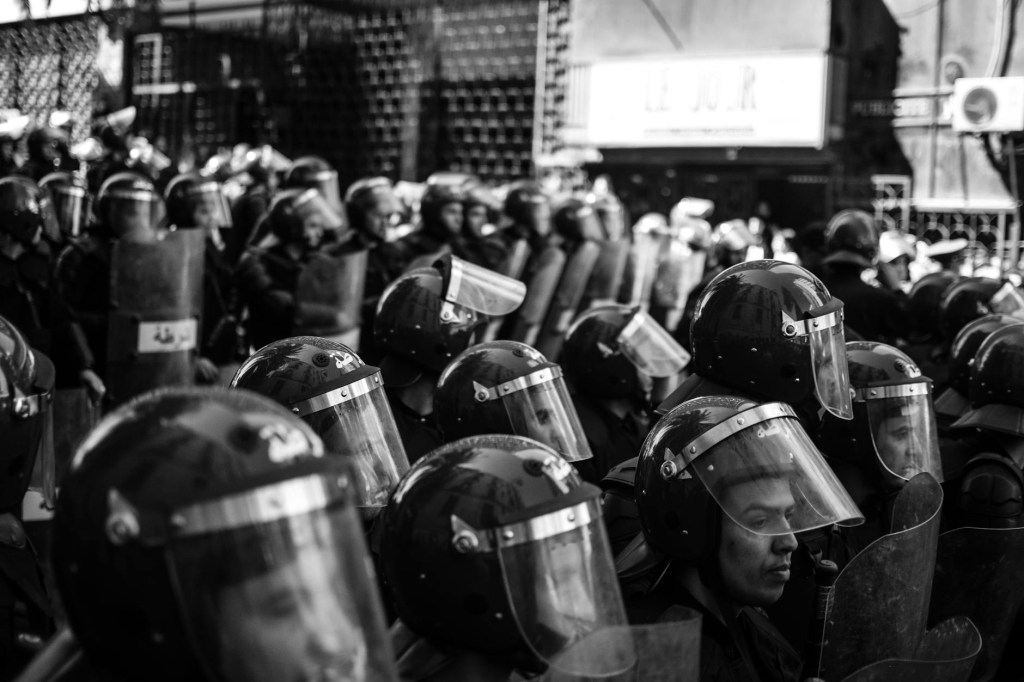
De facto special powers bestowed by the Trump administration on ICE that seem to supersede police powers. ICE is now inserting itself into everyday life and every day neighbourhoods. And as we are witnessing this very presence is killing people. Killing more and more people who weren’t even their targets.
But that no longer seems to matter.
As I’ve said before and I’ll say again, I don’t have an issue with the response to Renee Good – that’s how we should be responding in a situation like this. I just argue that the others, and there’s a long list that is growing of people who have been killed by ICE during this administration, deserve the same energy that is surrounding the murder of Renee Good.
As last time I checked, these are not animals, criminals or just talking points but human beings. Real human beings with grieving families. And this is something that gets forgotten in the media.
We need to continue to have these conversations and we need to keep fighting, on the small and large scale, against fascism near and far.
If you’ve been watching the news this week, you’ve seen that it’s been dominated by what is happening in America. Or the actions America has taken elsewhere in the world. Flexing their muscles, going in for the strike.
In my opinion, what is happening, right now, is that white people can see the power of the state being used against people who look just like them.
This is where AfroSurrealism takes on significance – because the reality of blackness is the power of the state is always and, repeated for centuries and generations, been used against black people. Being black is a surreal experience. THEN. RIGHT NOW. ALWAYS.
The abuse of power has been turned up to the max so that no one is safe. But some people can’t see this yet. Maybe even deny it, spin a false narrative around it.
There’s a quote somewhere that I remember which goes something along the lines as, they’ll come for me in the evening, but then they’ll come for you in the morning.
Fascism had raised its head once again. But did it ever go away for black and brown bodies? Did it not just change its mask, switched up its playbook?
There’s protests across American cities against the unlawful killing of a white woman/ mother by an ICE agent. These protesters scream out, “say her name.”
The thing is this – no disrespect or condoning of this violence or unlawful killing as it is an abuse of power and murder. I am outraged but …
I am also outraged because #SayHerName was an awareness campaign started by Kimberle Crenshaw to bring attention to the unlawful killings of black women by law enforcement that were going unreported/ not getting the same level of outrage and attention as when black men and boys are killed by law enforcement, in comparison. And this doesn’t even start into the ‘white woman syndrome.’
#SayHerName was needed to highlight and remember and get justice (?) for black women who have been killed in custody, or when calling 911 for help, or when sleeping in their beds, or for just breathing while black.
#SayHerName is needed for these unlawful killings of black women not for the white woman killed in Minneapolis on Wednesday because everybody knows her name and everybody is saying her name.
What happened in Minneapolis was wrong and the Trump administration is lying about it and blaming the victim. This is an abuse of power and is being played out, as the images of the bloodied seat and the bullet hole in the windshield, as a threat.
You get in the way of us, protest our regime then this is what happens to you, is the message. They rule with fear, threats and intimidation. The ICE agent is immune from prosecution because he was just doing his job. His job for the state. Above the law. Lawlessness is the state. This is the only way to get the mass of population behind a fascist society. Fear, threats and intimidation.
Check the historical playbook.
The reality though, the truth that has to be stated otherwise I’d be silenced through fear and intimidation, is that #SayHerNane centred black women, centred blackness. But using it here in this instance for the murder of a white woman, this is just another thing that is whitewashed and co-opted by white people.
I’m thinking this and berating myself for thinking this. Condemning myself for seeing this play out in reality. I had to go online and check myself. Check that I’m not being unreasonable, or hateful or wrong. But I’m not alone in seeing this reality.
This truth.
( And do you also notice how much and often I’m couching my opinion in diplomatic ways, highlighting my intentions not to cause harm. Obviously needed as far too often people choose to see only part of the argument. Take issue with what isn’t the real issue as a means of not listening and not addressing the real issue! Kill the messenger and all that!)
I also have to ask ( myself, anybody else) if the woman who was killed by ICE was black or brown would there be such media attention, protests, calls for justice? Would her unlawful killing/ murder be used as a touchstone, as a moment that changes American history moving forward? Or would that be another case of #SayHerName?
I say this not to distract from the horrendous crime that has been committed by the state against a white woman. I say this because it’s all part of the same system that has been operating for centuries and it is just now, in this moment, that more people, white people are seeing that this shit is killing them too. It has been all along but just slower than black people (Fred Moten).
These are strange times (white) people are arguing. Democracy is being eroded. Violence is no longer buried and concealed. Violence is (now) at their (white) doors.
AfroSurreal. This has always been the reality of blackness. The violence. The absurdity of it all. No rhyme or reason except profits and power.
Now white people are waking up to seeing on their feeds people who look like them being murdered by the state. Unlawfully murdered by the state for demanding justice and fairness.
It’s awful that some (white) people are just starting to experience the dangers of oppression right now.
This is nothing new for / to black people. And saying this isn’t to wish ill will on anyone else or to take glee or satisfaction in violence inflicted on anybody.
I’m remembering the summer as well as archiving the events that went down @Earth Sea Love.
In August we managed to pull off a black women’s creative retreat. A weekend of creative camping in the middle of a forest. We cooked, and created, shared stories and slept under the stars. It was a magical time as we stepped out of time, to steal our lives back on our own terms. We laughed and cried and sang and walked and reconnected with ourselves, each other and nature.
I’ve just spent some time, updating the Earth Sea Love website with some events that took place over the summer, this retreat included because it’s important to have a record, an archives of these happenings. My heart and body remembers these days, these events because they have a profound effect on my {BEING}. Events like these reinforces everything that I {BE} and do for myself and others. And it is finding those ways of getting free, more often and for longer stretches of time.
This image above is of Pauline Mayers, one of the women to come on the retreat. And as you can see from her facial expression, and the sheer glow coming off her being, we had fun out there in nature together.
I’m now fixing to create more opportunities like this one. It was a dream come true, a dream started in a visual journal spread one day a few years ago. And who says dreams don’t come true. All you have to do is believe. Believe in yourself and the community around you and all will come to fruition.
i’m protecting my peace so i have the energy for me, to {BE} in service for we, the we that looks/{BE} like me
this is all becoming clearer now
i’m not expending or wasting any more time, energy, attention on those (white) people who do not see me. or when they do see me, they do not see me as human
as Akwugo Emejulu says, the black woman can never be a human being
for decades i’ve spent time, energy, attention, through my practice and day to day life, trying to convince others ( white people) of my humanity. i would bend over backwards trying to get accepted, recognised, cherished as a fellow human being
look, please, i’m human. look, please, i feel, i hurt, i bleed. i breathe
no more. i am no longer prepared to play that role. dance this stupid dance. as i will never be accepted, recognised, loved as a human being. the system won’t allow it. (white) people won’t allow it
i’m no longer wasting my energy on proving jackshit
i’m refusing what has already been refused of me ( fugitivity)
i knowing who i be. i am smart, i am kind, i am important ( The Help). and i don’t need/want/entertain any (white) person to tell/grant/recognise me as such
and i’m no longer apologising/ playing it down or safe/ tempering for how i feel/act/ {BE} about this situation
as that just expends/takes/sucks out of me a whole heap and of other energy
I’m been talking here about finding my tribe. About my search for comrades in solidarity. I’ve remained pine in the process, for real. From one particular source I asked for further reading, as something was niggling me. Id expressed my concerns in terms of using the oppressors language as well as, well I felt as, the lack of warmth, kindness, care and love. And then through the further reading it all became clear. This was my response.
I believe that there needs to be unity to fight all oppressions. You can’t fight racism without fighting against capitalism.
But I realise through this further reading where my concerns lie. It’s not in the socialist/Marxist movement as a whole but it’s with the people who make up the movement.
I’m not sure if the people of the movement have/ or continue to take the time to work on their own racism. There seems to be a given that because the movement is against all oppressions that it means those who are part of the movement can’t be racist or sexist because they say they are against all forms of oppression. Saying it is one thing. Practising it is another.
In practice there is still the use of the oppressors language as I’ve mentioned before. Using ‘non-white’ or ‘minorities’ is offence as they still centre whiteness which is used for division and oppression.
The articles mention the BPP alienating white people because of their support for Black Nationalism and Separatism, and their language used around Black Power. You even mentioned yourself that we can’t fight capitalism through language and its use. Modifying language is not going to bring about material change you say.
And yet it is language the party is using to rally the masses, to bring people together. Language is the tool of persuasion no? Language is the tool of education.
But if that language continues to use the language of the oppressor and is offensive to certain groups of people, they are accused of being confused, ill informed and falling into the identity politics trap again.
However, from my experience, through reading the literature of the party, I feel that the language used reflects a party line where the people behind that line are not continuing to work on their own racism/ biases while focusing their efforts on society’s ills, outside of themselves.
I do not feed into white supremacy culture with the characteristics of either/or. I believe in and/both. That means for me, there has to be the work on the individual’s internalised racism and sexism at the same time as working against oppressions within society. Working on our own blind spots and prejudices can only benefit the movement as a whole. Where this fails to take place is where the oppressors divide and rule become fixed without our recognition of it.
To say that ‘non-white’ is every day language, quote, ‘commonly understood by ordinary people as respectful ways to refer to some people who are oppressed’, as a black person being referred to as ‘non-white’ is offensive to me and I’m not really bothered if other black people are okay with it. I might be falling into an identity police trap but one my identity is not built on my relation to whiteness that is racism. Two, if someone says they find it offensive and that is not recognised or is questioned and explained away as being the norm is denying that person’s experience which is racist. Three, to bring this up then to have it dismissed as being defensive and accusing someone of being a bigot/ racist and dismissed as a distraction from the cause is another example of an individual failing to check themselves and work on themselves to combat their racism/ discrimination tendencies.
I work on myself daily to check my prejudices or biases or judgments and blind spots. I only wish more people would also as I do believe the world would be a better place because of it. Movements and societies are groupings made up of individuals. Working on the individual at the same time as the collective can only strengthen that connection and keep moving it forward in an effective way, I believe.
If we think about what is happen in the USA today, and the ICE raids within every community. The Latino community is coming out and asking where are the black people why are they not out here on the streets with them protesting? Why are they sitting this fight out etc.? Black people are tired, esp. black women. Black people told everyone to vote for Kamala Harris and they didn’t listen. They voted for Trump. And now he is doing all that he said he would do.
Now people are asking for black people once again to put their bodies on the line. And yeah this is a prime example of the ruling class dividing and ruling. Pitting one group against another. But what is true there and what is true here, black people only make up a small percentage of the population. In the states 12% here 4% with other ethnicities. And yet it is expected for us to save the world. ( Aside here we might be termed ‘minorities’ within these countries but we are the global majority. I don’t use ‘minorities’ because it is used as language of control. Black Feminism or Third World Feminism has always been global in its remit).
It is expected for black people to put aside those differences which on a daily effect our life chances. Our lives in terms of life and death. And this is not feeding into a victim hierarchy and who’s suffering is more than someone else’s. It’s a reality. Black people, black women do not just suffer violence and brutality from the state but do so from person to person in their every day and yet black feminism still criticises and attempts to bring material change for all through fighting all oppressions including capitalism and yet if they ‘fail’ to bring about material change it is because of ill-fighting or confusion in their ideology but no mention of doing this within a racist/ sexist society that does not see Black women as anything except mules of the world. Not either/or but and/both.
As black women we continue to not be seen as human. Read Fugitive Feminism by Akuwgo Emejulu to understand this, which is anti-capitalist, anti-imperialist and anti-colonialist. It’s arguing for a rejection of the whole system. A refusal of what has already been refused to us. Other ways of being are possible.
Marx himself saw the future of capitalism as self-destruction and a social mode of production being the outcome. Fugitive Feminism is being/working now with the other possibilities. It’s about creating an outside while still on the inside. Creating spaces of liberation and joy on our own terms. It’s not waiting until then for it to be now. It’s collective and speculative and might be fostered by black women but can be utilised for all, all oppressions including capitalism and the class struggle. It is probably dismissed though because it comes from the mouths, minds and hearts of black women.
Thanks for all these readings. They have helped in clarifying where I stand. In solidarity but at the same time in my own fullness and power which I lend to any movement which recognises this and works with me to bring about dismantling all oppressions for all people.
The reply I got, was thanks, I’ll reflect on it, and wish you luck on finding your people.
I’m sharing it here as I don’t want my realisation to do to waste. The words I shared to go to waste, as I’m still open for the conversation, still open to standing together.